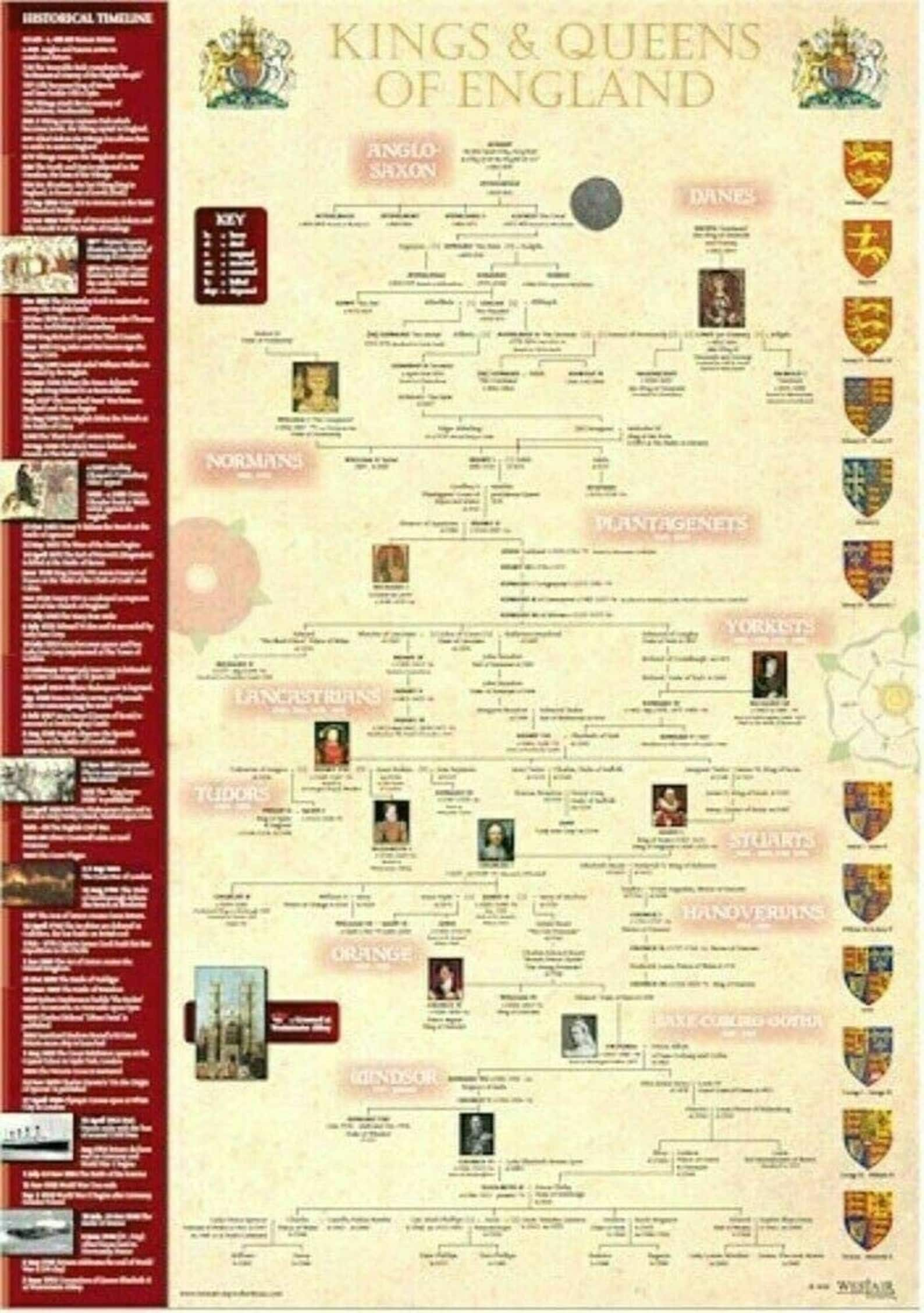
The English monarchy spans over 1,100 years, beginning with the unification of Anglo-Saxon kingdoms and evolving into the modern constitutional monarchy of today. As of 2026, the lineage consists of 62 distinct monarchs across various royal houses, starting with the House of Wessex in the 9th century and continuing through to the current reign of King Charles III of the House of Windsor.
The Foundation of the English Monarchy (827–1066)
The concept of a single "King of England" did not emerge overnight. Before the 9th century, the land was divided into several Anglo-Saxon kingdoms, including Wessex, Mercia, Northumbria, and East Anglia. Egbert of Wessex is often cited as the first to establish a form of dominance over the others in 827, but it was his grandson, Alfred the Great, who styled himself "King of the Anglo-Saxons" after defending the realm against Viking invasions.
The true unification is technically credited to Alfred’s grandson, Athelstan, who in 927 became the first to rule over the entirety of England. This period, known as the House of Wessex, was marked by constant struggle against Norse and Danish invaders. The lineage was briefly interrupted by Danish kings—most notably Canute the Great—who ruled a "North Sea Empire" that included England, Denmark, and Norway. The restoration of the House of Wessex under Edward the Confessor set the stage for the most famous turning point in English history: the succession crisis of 1066.
The Norman Conquest and the Medieval Shift (1066–1154)
The death of Edward the Confessor without an heir led to the Battle of Hastings in 1066. William the Conqueror, Duke of Normandy, claimed the throne by right of conquest, ending Anglo-Saxon rule and introducing the House of Normandy. This era fundamentally reshaped English society, replacing the old nobility with Norman elites and introducing the feudal system.
The Norman line was characterized by strong, often ruthless leadership. William’s sons, William II and Henry I, maintained tight control, but the dynasty ended in a period of civil war known as "The Anarchy." This conflict arose when Henry I’s only legitimate son died, leaving his daughter Matilda to fight for the throne against her cousin Stephen. While Stephen technically ruled, the compromise that ended the war allowed Matilda’s son, Henry II, to take the throne, initiating the longest-running dynasty in English history.
The Plantagenet Dynasty: Power and Parliament (1154–1399)
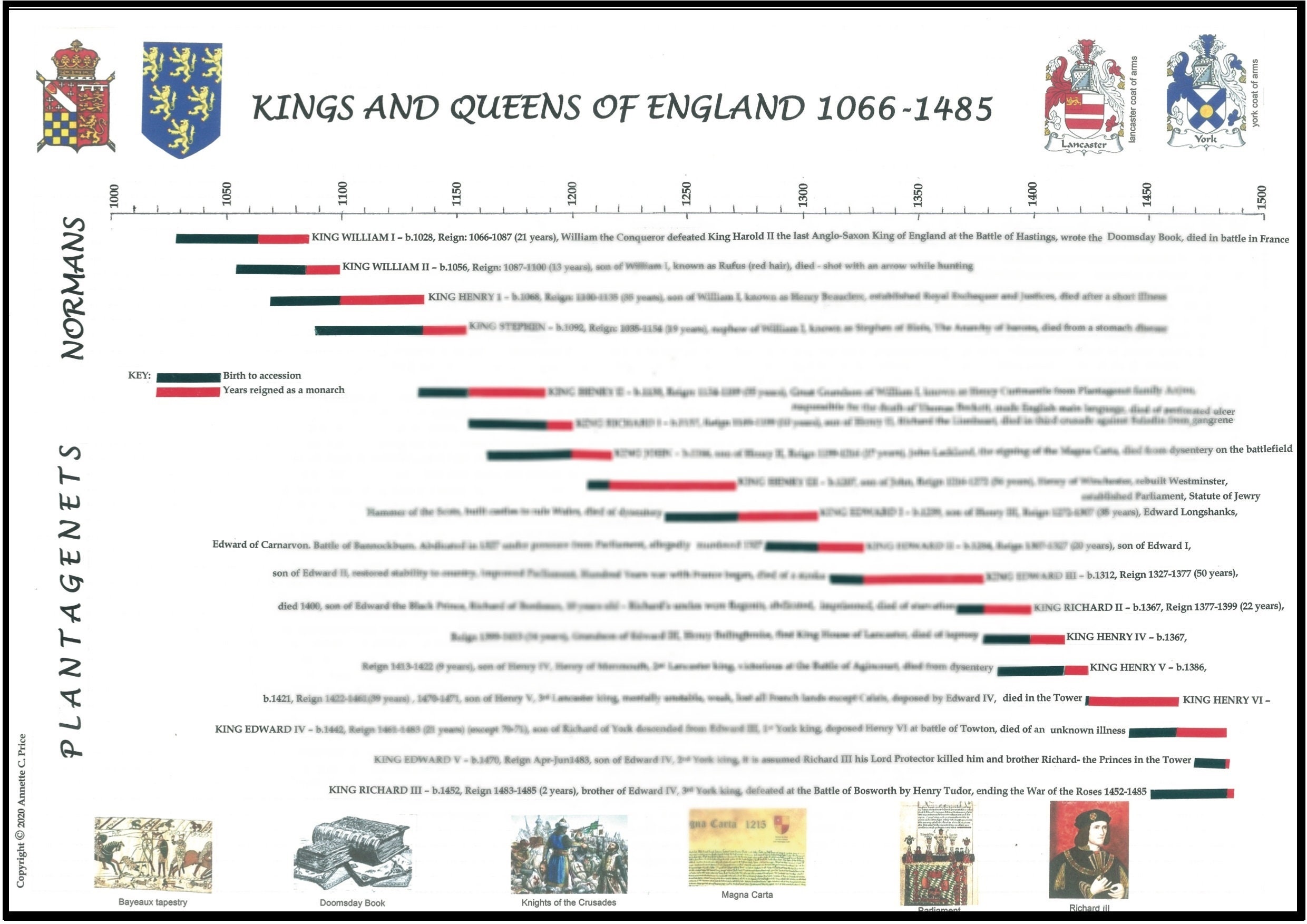
The Plantagenets ruled for over 240 years, a period defined by the expansion of English territories in France, the signing of the Magna Carta in 1215, and the beginning of the Hundred Years' War. Henry II established the basis for English Common Law, while his son Richard the Lionheart became a legendary figure of the Crusades.
Under the Plantagenets, the relationship between the Crown and the nobility was often volatile. King John’s failures led to the first constitutional checks on royal power, while Edward I (Longshanks) formalised the role of Parliament. The dynasty reached its cultural and military zenith under Edward III but fractured during the reign of Richard II. Richard’s deposition by his cousin, Henry Bolingbroke, split the dynasty into two rival branches: the House of Lancaster and the House of York.
The Wars of the Roses (1399–1485)
The 15th century was dominated by the dynastic struggle known as the Wars of the Roses. The House of Lancaster (symbolized by a red rose) and the House of York (symbolized by a white rose) fought a series of bloody battles for the right to rule.
- Lancaster: Henry IV, Henry V (the victor of Agincourt), and the mentally unstable Henry VI.
- York: Edward IV, the brief reign of Edward V (one of the "Princes in the Tower"), and Richard III.
The conflict concluded at the Battle of Bosworth Field in 1485, where Richard III was killed. The victor, Henry Tudor, claimed the throne by both conquest and a tenuous Lancastrian link. By marrying Elizabeth of York, he united the two houses and began the Tudor era.
The Tudors and the English Reformation (1485–1603)
The Tudor period is perhaps the most famous in English history, characterized by the transition from the Middle Ages to the Renaissance. Henry VIII is the central figure of this era, known for his six marriages and his break with the Roman Catholic Church, which established the monarch as the Supreme Head of the Church of England.
The religious turmoil continued through the brief reigns of his son Edward VI and his daughter Mary I (Bloody Mary). However, it was the 44-year reign of Elizabeth I that defined the age. The "Golden Age" saw the defeat of the Spanish Armada, the plays of William Shakespeare, and the beginning of English colonial expansion. Because Elizabeth died without an heir (the "Virgin Queen"), the crown passed to her cousin, James VI of Scotland.
The Stuarts, the Civil War, and the Union (1603–1714)
The accession of James I (and VI of Scotland) marked the Union of the Crowns, though the two countries remained separate political entities. The Stuart era was fraught with conflict between the King and Parliament over "the Divine Right of Kings." This tension exploded into the English Civil War during the reign of Charles I, resulting in the King's execution in 1649 and a brief period of republican rule under Oliver Cromwell (the Interregnum).
The monarchy was restored in 1660 under Charles II, but religious tensions remained. The "Glorious Revolution" of 1688 saw the Catholic James II deposed in favor of his Protestant daughter Mary II and her husband William III. This period culminated in the Act of Union 1707 under Queen Anne, which formally united England and Scotland into the Kingdom of Great Britain.
The House of Hanover and the Victorian Era (1714–1901)
When Queen Anne died without surviving children, the crown passed to the German House of Hanover to ensure a Protestant succession. The early Hanoverian kings (George I and George II) relied heavily on their ministers, leading to the development of the role of Prime Minister.
The reign of George III was the longest of the house, marked by the American Revolution and the Napoleonic Wars. However, the 19th century was defined by Queen Victoria, who reigned for 63 years. During her time, the British Empire reached its territorial peak, and the Industrial Revolution transformed the world. The monarchy transitioned into its modern form: a symbolic, ceremonial institution that remained above the fray of party politics.
The House of Windsor: 1917 to 2026
The current royal house was originally the House of Saxe-Coburg and Gotha (following Victoria’s marriage to Prince Albert). However, during World War I, King George V changed the name to Windsor to distance the family from its German roots.
The 20th century saw the monarchy adapt to the loss of the Empire and the rise of mass media. Elizabeth II’s reign (1952–2022) became the longest in British history, providing a sense of stability through decades of social change. Following her death, King Charles III ascended the throne. In 2026, the monarchy continues to serve as a symbol of national continuity while addressing modern discussions regarding the Commonwealth and the institution's historical legacy.
Chronological Royal Lineup Table
| House | Monarch | Reign Dates | Key Event |
|---|---|---|---|
| Wessex | Athelstan | 924–939 | First King of all England |
| Wessex | Ethelred the Unready | 978–1016 | Viking invasions |
| Denmark | Canute (Cnut) | 1016–1035 | Part of North Sea Empire |
| Wessex | Edward the Confessor | 1042–1066 | Built Westminster Abbey |
| Normandy | William I (The Conqueror) | 1066–1087 | Norman Conquest |
| Plantagenet | Henry II | 1154–1189 | Established Common Law |
| Plantagenet | John | 1199–1216 | Signed Magna Carta |
| Lancaster | Henry V | 1413–1422 | Battle of Agincourt |
| York | Richard III | 1483–1485 | Last King killed in battle |
| Tudor | Henry VIII | 1509–1547 | English Reformation |
| Tudor | Elizabeth I | 1558–1603 | Defeat of Spanish Armada |
| Stuart | Charles I | 1625–1649 | Executed after Civil War |
| Hanover | Victoria | 1837–1901 | Height of British Empire |
| Windsor | Elizabeth II | 1952–2022 | Longest-reigning monarch |
| Windsor | Charles III | 2022–Present | Current reigning King |
Frequently Asked Questions
Who was the very first King of England?
While Egbert of Wessex is often called the first, Athelstan (924–939) is recognized by most modern historians as the first true King of all England. He was the first to be styled "King of the English" and exercised authority over the various regional sub-kingdoms that had previously been independent.
Why did the Royal House name change to Windsor?
The name change occurred in 1917 during World War I. King George V belonged to the House of Saxe-Coburg and Gotha, but because Britain was at war with Germany, the German name was considered a liability. He chose Windsor after the royal castle to emphasize the family's British identity.
How many female monarchs have ruled England?
There have been eight female monarchs: Mary I, Elizabeth I, Mary II (jointly with William III), Anne, Victoria, Elizabeth II, and the disputed reigns of Empress Matilda and Lady Jane Grey. While Matilda and Jane Grey are often excluded from official lists, their impact on succession laws was significant.
What is the difference between the King of England and the King of the UK?
Technically, there has not been a "King of England" since 1707. With the Act of Union, the titles of King of England and King of Scotland were merged into the King of Great Britain. In 1801, this became the King of the United Kingdom of Great Britain and Ireland.
Who is the longest-reigning monarch in history?
Queen Elizabeth II holds the record for the longest reign in British history, serving for over 70 years from 1952 until 2022. She surpassed the previous record held by her great-great-grandmother, Queen Victoria, in 2015.
Verifying Royal Lineage and Succession
For those researching the genealogy of the British Royal Family or the technicalities of the line of succession, it is essential to consult official records. The Royal Family's official website royal.uk provides the most accurate and up-to-date information regarding current members of the monarchy and the laws of succession.
To understand the historical context of earlier dynasties, the National Archives at Kew hold original documents, including the Domesday Book and various Charters. For a visual representation of the lineup, the National Portrait Gallery in London houses the primary collection of royal portraits, which serves as a chronological record of the monarchy’s physical evolution from the Tudors to the present day. If you are planning to visit historical sites associated with these monarchs, the Historic Royal Palaces website offers guides for the Tower of London, Hampton Court, and Kensington Palace.