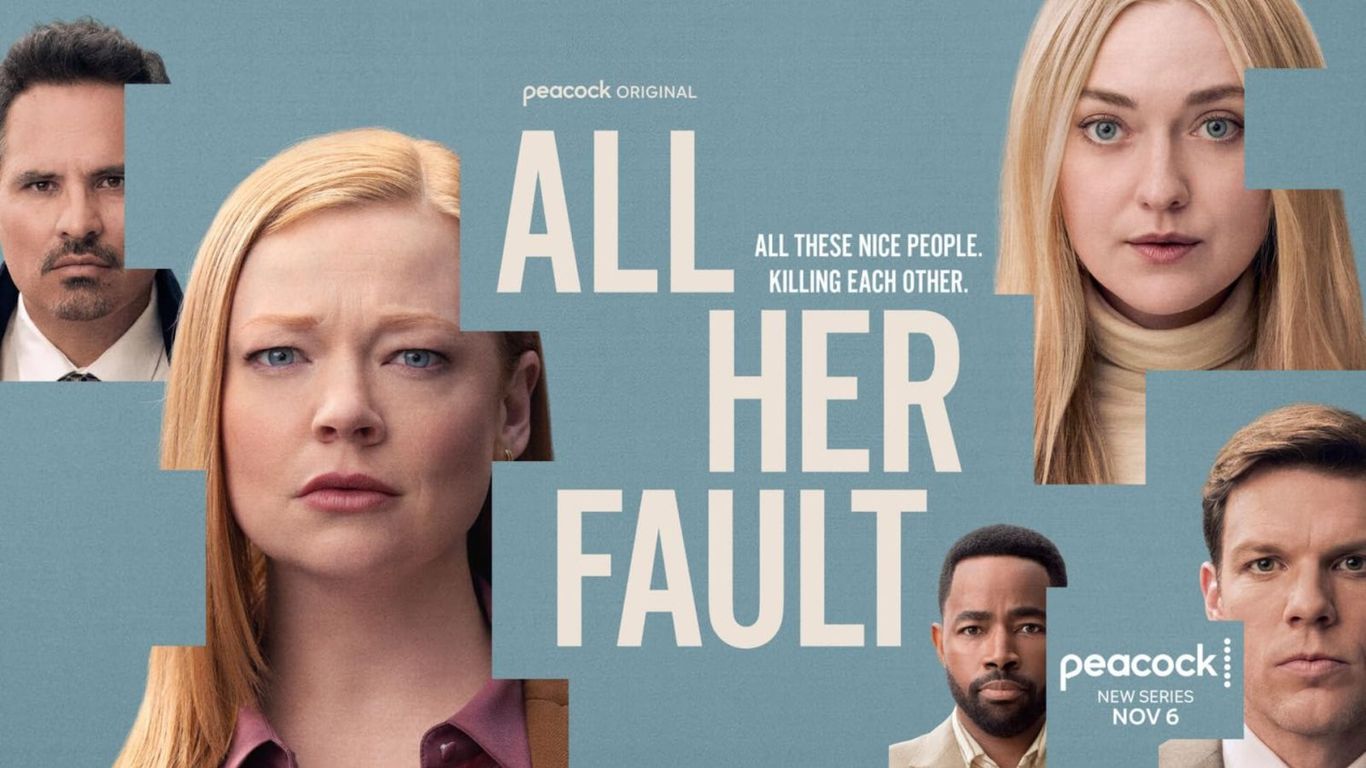
In the 2026 television landscape, the "truth" behind the headlines in the thriller All Her Fault centers on a harrowing case of mistaken identity and a meticulously planned abduction. While media headlines initially blamed the mother, Marissa Irvine, for negligence, the reality involved a sophisticated deception where a kidnapper posed as a trusted neighbor to snatch her son, Kyle, during what was supposed to be a routine playdate.
The Premise of "All Her Fault" (2026 Perspective)
As of 2026, the Peacock adaptation of Andrea Mara’s psychological thriller All Her Fault has become a benchmark for the "domestic noir" genre. The story begins with a universal parental nightmare: Marissa Irvine arrives at 14 Tudor Grove to pick up her young son, Kyle, from a playdate. However, the woman who answers the door—Jenny—has no idea who Marissa is, and more importantly, Kyle is not in the house.
The series, starring Sarah Snook, masterfully explores the immediate aftermath of this disappearance. The "headlines" mentioned in the series (and the subsequent public discourse) reflect a society quick to judge maternal lapses. The "truth" is far more localized and sinister than the sensationalist media suggests. The narrative doesn't just focus on the search for Kyle; it deconstructs the lives of the women in this affluent suburb, revealing that everyone has a secret they are desperate to keep hidden behind their manicured lawns.
Who is Kyle? Dissecting the Central Mystery
The disappearance of Kyle is the catalyst for the entire series. In the headlines, Kyle is often portrayed as a pawn in a larger story of parental negligence. Within the plot, Kyle represents the "perfect" child of a "perfect" family, making his abduction all the more shocking to the community.
The "truth" about Kyle’s disappearance is rooted in the concept of the "wrong door" playdate. Marissa had arranged the playdate via a series of text messages with someone she believed was another mother from Kyle’s new school. When she dropped him off, she was in a rush and didn't wait to see him safely inside with the woman she recognized. This small, relatable moment of haste becomes the fulcrum upon which the media pivots to blame her.
The investigation eventually reveals that the abduction was not a random act of opportunity. Instead, it was a targeted hit designed to exploit the social anxieties and "busy-ness" of modern parenting. The headlines focused on the how—the missed cues and the "fault" of the mother—while the truth lay in the who and the why, involving a deep-seated grudge that predated Kyle’s birth.
The "Mother-Blame" Phenomenon: Why the Headlines Pointed at Marissa
A major theme of All Her Fault is the velocity at which the public and the media turn against the victim's mother. The title itself serves as a meta-commentary on this phenomenon. In the world of the show, the "truth behind the headlines" is often obscured by the narrative that a mother who "allows" her child to be taken must be fundamentally flawed.
The Social Media Trial
In the 2026 context, the series highlights how digital headlines are amplified by social media commentary. Within the story, Marissa is subjected to:
- Judgment of her career: Suggesting she was too focused on her professional life to vet the playdate properly.
- Critique of her marriage: Tabloids hinting at domestic instability as a "reason" for the kidnapping.
- Perception of wealth: The idea that her privilege blinded her to the dangers in her own neighborhood.
The truth, however, is that Marissa was a victim of a "social engineering" attack. The kidnapper used the very tools Marissa used to organize her life—messaging apps and school rosters—to create a facade of safety.
The Investigation: How the Truth Was Uncovered
The police investigation, led by detectives who are themselves caught between the pressure of the headlines and the slow grind of evidence, eventually moves away from the "negligent mother" theory. The truth behind the headlines was uncovered through a combination of digital forensics and old-fashioned neighborhood canvassing.
The breakthrough occurs when the investigation shifts focus to the Tudor Grove community. It is revealed that the kidnapper didn't just take Kyle; they had been "living" in the digital periphery of the parents' group for months. By tracking the IP addresses of the messages sent to Marissa, the authorities were able to pinpoint a location that contradicted the "stranger danger" narrative the headlines were pushing. The perpetrator was someone within their social circle, proving that the greatest threats are often those closest to home.
Comparison of the Media Narrative vs. The Reality
The following table outlines the discrepancy between what was reported in the fictional headlines and what the actual investigation revealed to be the truth.
| Feature | The Media "Headline" Version | The Investigation Reality |
|---|---|---|
| The Cause | Parental negligence and lack of supervision. | Premeditated social engineering and identity theft. |
| The Suspect | A mysterious "stranger" or a disgruntled ex-employee. | A known associate with a long-standing personal vendetta. |
| The Playdate | Marissa dropped Kyle at a random house. | Marissa was lured to a specific address by a spoofed identity. |
| The Motive | Ransom or random malice. | Psychological warfare intended to destroy Marissa’s reputation. |
| Community Role | Innocent bystanders in shock. | Complicit in silence, with several neighbors hiding related secrets. |
Book vs. Series: Key Differences in the "Kyle" Narrative
While the 2026 Peacock series remains largely faithful to Andrea Mara’s original novel, there are notable shifts in the "truth" presented on screen. In the book, the internal monologue of Marissa provides a more nuanced look at her guilt. On screen, the focus shifts more toward the visual "headlines" and the external pressure of the media.
One major difference is the role of Jenny, the woman at whose house Kyle was supposed to be. In the series, Jenny’s background is expanded to make the "truth" more complex, involving her own history of loss which the headlines initially misinterpreted as suspicious behavior. The series also updates the technology involved, making the "digital trail" a more prominent part of the 2026 resolution than it was in the original 2021 publication.
Production and Reception of the Peacock Adaptation
The production of All Her Fault in Melbourne, standing in for the story's setting, utilized high-contrast cinematography to emphasize the gap between the "sunny" suburban exterior and the dark truth of the kidnapping. Directed by Minkie Spiro, the show was praised in 2025 and 2026 for its claustrophobic tension.
The "truth behind the headlines" also extends to the production's success. Critics noted that Sarah Snook’s performance was pivotal in shifting the audience's perspective from judging Marissa to empathizing with her. The series became a viral sensation not just for its twists, but for its honest depiction of how easily a person's life can be dismantled by a single, public mistake.
Frequently Asked Questions
Is "All Her Fault" based on a true story?
No, All Her Fault is a work of fiction based on the novel by Andrea Mara. However, the themes of "mother-blame" and the dangers of social media-organized playdates are inspired by real-world concerns and the pervasive nature of true-crime media coverage.
What actually happened to Kyle in the end?
The truth revealed in the finale is that Kyle was being held in a nearby location by a character seeking retribution for a past trauma they blamed on Marissa’s family. Without spoiling the final moments, the resolution involves a tense confrontation that exposes the kidnapper's true identity, which was hidden in plain sight throughout the series.
Who is the "Jenny" character in relation to the headlines?
Jenny is the resident of the house where the playdate was supposed to occur. The headlines initially painted her as a possible accomplice or a victim of home invasion. The reality was that she was a completely uninvolved neighbor whose identity and address were weaponized by the kidnapper to provide a sense of legitimacy to the fake playdate.
Why does the media blame the mother in the story?
The story uses the media's reaction to highlight a societal double standard. When a child goes missing under a mother's watch, the headlines often focus on her perceived failures (the "all her fault" narrative) rather than the criminal actions of the perpetrator. This serves as a primary source of conflict and social commentary in the series.
Where was the "All Her Fault" series filmed?
Despite the story being set in a generic suburban environment (originally Dublin in the book), the 2025/2026 Peacock series was primarily filmed in Melbourne, Australia. The production used various suburban locales to create the sense of an insular, high-stakes community.
Recommendation for Viewers and Readers
If you are following the "All Her Fault" phenomenon in 2026, the best way to understand the full scope of the truth is to consume both the Andrea Mara novel and the Peacock limited series. The novel provides the psychological depth and internal "truth" of the characters, while the series offers a visceral look at the "headlines" and the external societal pressure.
For those interested in the themes of media manipulation and domestic suspense, paying close attention to the background news reports and social media tickers within the show provides a deeper layer of "truth" regarding how the public perception of the case was intentionally steered by the characters involved.