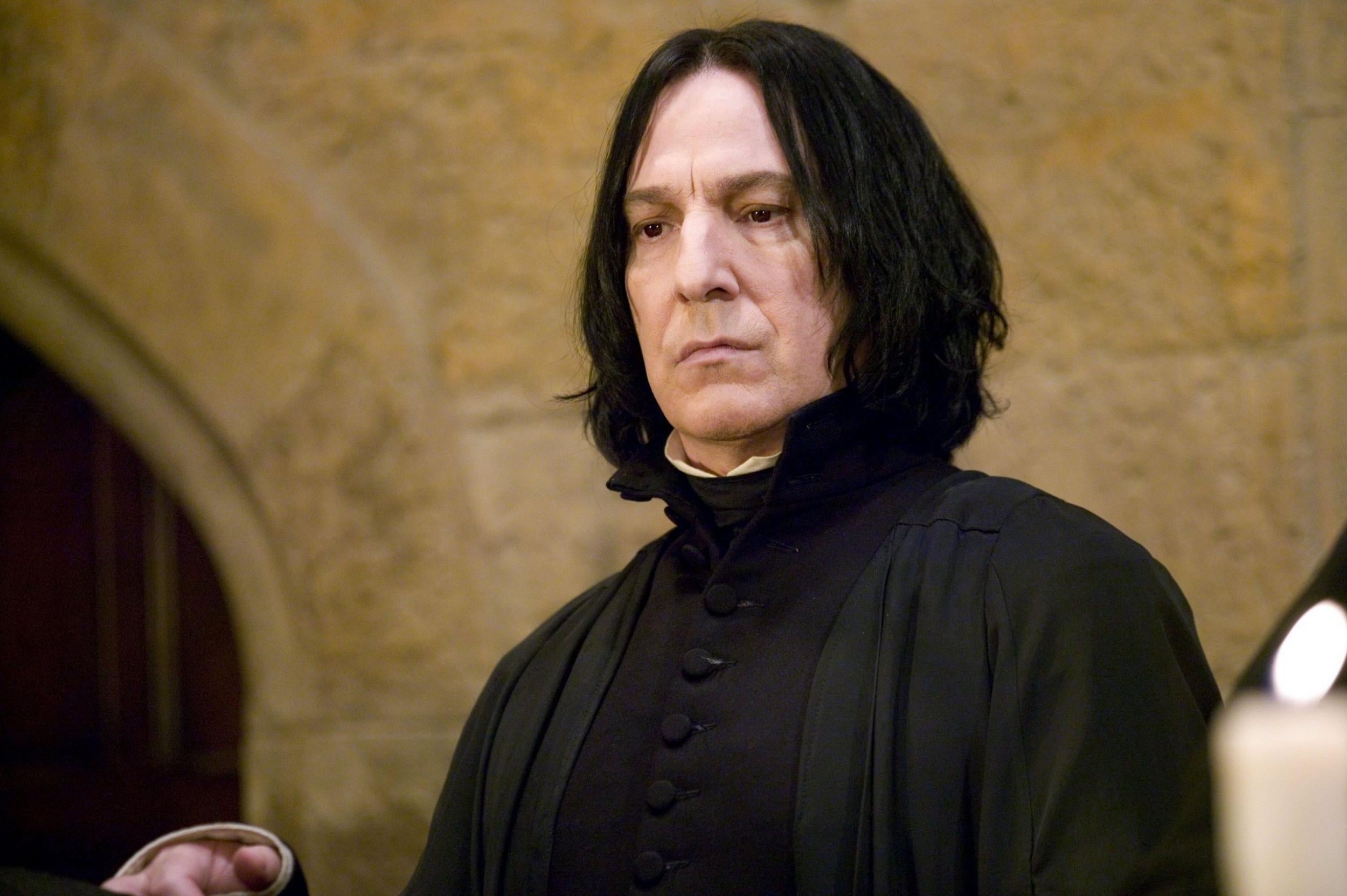
Alan Rickman remains the definitive Severus Snape due to his unique ability to balance menace with profound vulnerability, a performance informed by a secret plot twist shared only with him by J.K. Rowling. While globally recognized for film, Rickman’s "star" status was forged in British television and the Royal Shakespeare Company long before his Hollywood breakthrough.
The Definitive Portrayal of Severus Snape
Alan Rickman’s casting as Severus Snape in the Harry Potter film franchise is often cited as one of the most perfect alignments of actor and character in cinematic history. When the first film, Harry Potter and the Sorcerer's Stone, was released in 2001, Rickman brought a gravitational pull to the screen that few other actors could replicate. His portrayal was characterized by a deliberate, rhythmic speech pattern—often described as a "contrabass" voice—and a physical stillness that commanded every scene.
The "ultimate" nature of his performance stems from a foundational piece of information provided by J.K. Rowling. Long before the final book, Harry Potter and the Deathly Hallows, was written, Rowling whispered a single word to Rickman: "Always." This cryptic insight into Snape’s unrequited love for Lily Potter allowed Rickman to play the character with a specific internal logic. While the audience saw a cruel antagonist, Rickman was playing a man burdened by a tragic secret and a double-agent’s life. This depth ensured that upon re-watching the series, viewers could see the subtle flickers of pain and protection in his eyes, making his Snape far more complex than a standard literary villain.
From the Stage to the Small Screen: Rickman as a TV Star
While contemporary audiences primarily associate Alan Rickman with the silver screen, his rise to prominence was deeply rooted in television. In the late 1970s and early 1980s, Rickman was a fixture of British television dramas, which at the time were the primary medium for reaching the national consciousness. His performance as the manipulative and oily Obadiah Slope in the 1982 BBC adaptation of The Barchester Chronicles is widely considered his breakout role.
In The Barchester Chronicles, Rickman demonstrated the magnetic villainy that would later define his career. His portrayal of Slope was so effectively repulsive that it made him a household name in the United Kingdom. This "TV star" era was crucial because it allowed him to hone the precise vocal control and facial micro-expressions that would eventually captivate global audiences in Die Hard and Harry Potter. Unlike many film stars who struggle with the intimacy of the camera, Rickman’s background in high-quality television drama taught him how to convey massive amounts of information with minimal movement.
The Technical Artistry of the Rickman Performance
Rickman’s acting technique was a masterclass in economy. He understood that in both television and film, the camera rewards thought over action. His use of the "pregnant pause" became a trademark. By delaying his lines by just a fraction of a second, he forced the audience—and the other characters—to hang on his every word. This wasn't merely a stylistic choice; it was a psychological tool used to establish dominance in a scene.
His training at the Royal Academy of Dramatic Art (RADA) and his years with the Royal Shakespeare Company (RSC) provided him with a technical foundation in breath control and projection. Even when whispering, Rickman’s voice had a resonant quality that cut through background noise. This was particularly evident in his television work, such as the 1996 television movie Rasputin: Dark Servant of Destiny. Playing the titular "Mad Monk," Rickman used his physical stature and intense gaze to create a character that was simultaneously divine and demonic, earning him an Emmy and a Golden Globe.
Comparing Key Roles Across Mediums
To understand why Rickman was the ultimate actor for complex figures like Snape, one must look at the breadth of his work across television and film. He rarely played "simple" characters. Whether he was a romantic lead, a cold-blooded terrorist, or a heartbroken ghost, there was always an underlying layer of intellectualism.
| Feature | Severus Snape (Film) | Obadiah Slope (TV) | Rasputin (TV Movie) | Hans Gruber (Film) |
|---|---|---|---|---|
| Medium | Cinema | Television Series | Television Movie | Cinema |
| Primary Trait | Stoic/Tragic | Manipulative/Ambitious | Volatile/Mystical | Intellectual/Ruthless |
| Vocal Style | Slow, deliberate drawl | Sibilant and oily | Deep, commanding growl | Precise, accented urbanity |
| Key Award | Multiple Critics' Awards | BAFTA Nomination | Emmy & Golden Globe | AFI Top Villains List |
| Legacy Impact | Redefined "anti-hero" | Defined BBC period drama | Gold standard for biopics | Redefined the action villain |
The "Snape Effect" on Rickman’s Later Career
The success of the Harry Potter series from 2001 to 2011 created a phenomenon often referred to as the "Snape Effect." For a decade, Rickman was synonymous with the Wizarding World, yet he managed to avoid the "typecasting trap" that claims many actors in major franchises. Between filming Potter installments, he continued to seek out challenging work in smaller films like Snow Cake and Bottle Shock, as well as returning to the stage.
However, Snape remained his most influential role because it bridged the gap between a "character actor" and a "movie star." Rickman brought a level of Shakespearean gravity to a children's fantasy series, elevating the entire production. His presence forced the younger actors—Daniel Radcliffe, Emma Watson, and Rupert Grint—to raise their performances. Radcliffe has frequently noted in interviews that Rickman was one of the first "adult" actors on set to treat the children as peers and professionals, further cementing his status as a legendary figure behind the scenes.
Navigating the Transition from UK TV to Global Cinema
Rickman’s journey to becoming a global icon was atypical. He did not achieve worldwide fame until his early 40s, when he was cast as Hans Gruber in Die Hard (1988). Before this, he was respected within the industry as a "star of the stage and the small screen." This late-blooming career path meant that he arrived in Hollywood with his craft fully formed. He didn't need to "find himself" as an actor; he already knew exactly who he was and what he could do.
This maturity is what allowed him to navigate the demands of a massive franchise like Harry Potter. While younger stars might have been overwhelmed by the fame, Rickman viewed Snape as just another complex character to be dissected and understood. His perspective was always that of a craftsman. This professional distance allowed him to maintain the mystery of the character, refusing to give many interviews about Snape's motivations until the series had concluded.
Common Misconceptions About Alan Rickman's Career
One frequent misconception is that Rickman disliked his association with Severus Snape. While his personal journals, published posthumously, revealed his occasional frustrations with the grueling filming schedules and the direction of certain scenes, he remained deeply protective of the character. He understood the impact Snape had on a generation of readers and viewers.
Another misconception is that he was primarily a villain actor. While Hans Gruber, the Sheriff of Nottingham, and Snape are his most famous roles, his work in Truly, Madly, Deeply and Sense and Sensibility showcased a capacity for warmth and romantic longing that was equally profound. His television work often showcased this range more than his blockbuster films did, proving that his "TV star" roots were essential to his versatility.
Why was Alan Rickman chosen for the role of Snape?
J.K. Rowling personally envisioned Rickman as Snape while writing the novels. She felt his unique ability to portray a character who is outwardly cold but internally complex was essential for the eventual revelation of Snape's true loyalties. His performance in The Barchester Chronicles had already proven he could play a "hated" character with charisma.
Did Alan Rickman win any awards for his TV work?
Yes, Rickman was highly decorated for his television performances. Most notably, he won an Emmy Award, a Golden Globe, and a Screen Actors Guild Award for his portrayal of Grigori Rasputin in the 1996 HBO film Rasputin: Dark Servant of Destiny. He was also nominated for a BAFTA for his television work in the early 1980s.
What secret did J.K. Rowling tell Alan Rickman about Snape?
Rowling told Rickman about Snape's enduring love for Lily Potter and the significance of the word "Always." This information was shared with him before it was revealed in the books, ensuring that his performance in the early films contained the necessary depth and hidden motivation to make the final twist believable.
How did Rickman's theater background influence his TV and film acting?
His theater background gave him impeccable vocal clarity and a physical presence that allowed him to dominate the frame. In television, where the screen is smaller, his ability to use his voice to create atmosphere was vital. In film, his training allowed him to maintain a character's intensity over long production periods.
What was Alan Rickman's last television or film role?
Alan Rickman's final film role was providing the voice for Absolem the Caterpillar in Alice Through the Looking Glass, released in 2016. His final live-action appearance was in the thriller Eye in the Sky, where he played Lieutenant General Frank Benson, a role that highlighted his career-long ability to play authoritative yet morally complex figures.
Honoring the Legacy of a Master Craftsman
As we look back from 2026, ten years after his passing, Alan Rickman’s influence on the acting profession remains undiminished. For those looking to truly appreciate his range beyond the Harry Potter series, the best next step is to revisit his foundational work in British television. Watching The Barchester Chronicles provides a fascinating look at the "proto-Snape" energy he brought to Obadiah Slope, while Rasputin showcases the raw, transformative power he could bring to a lead role.
Rickman’s career serves as a reminder that "stardom" is not just about celebrity, but about the relentless pursuit of truth within a character. Whether he was on a small television set in the 80s or a massive soundstage in the 2000s, his commitment to the internal life of his characters made him the ultimate actor for any role he inhabited.