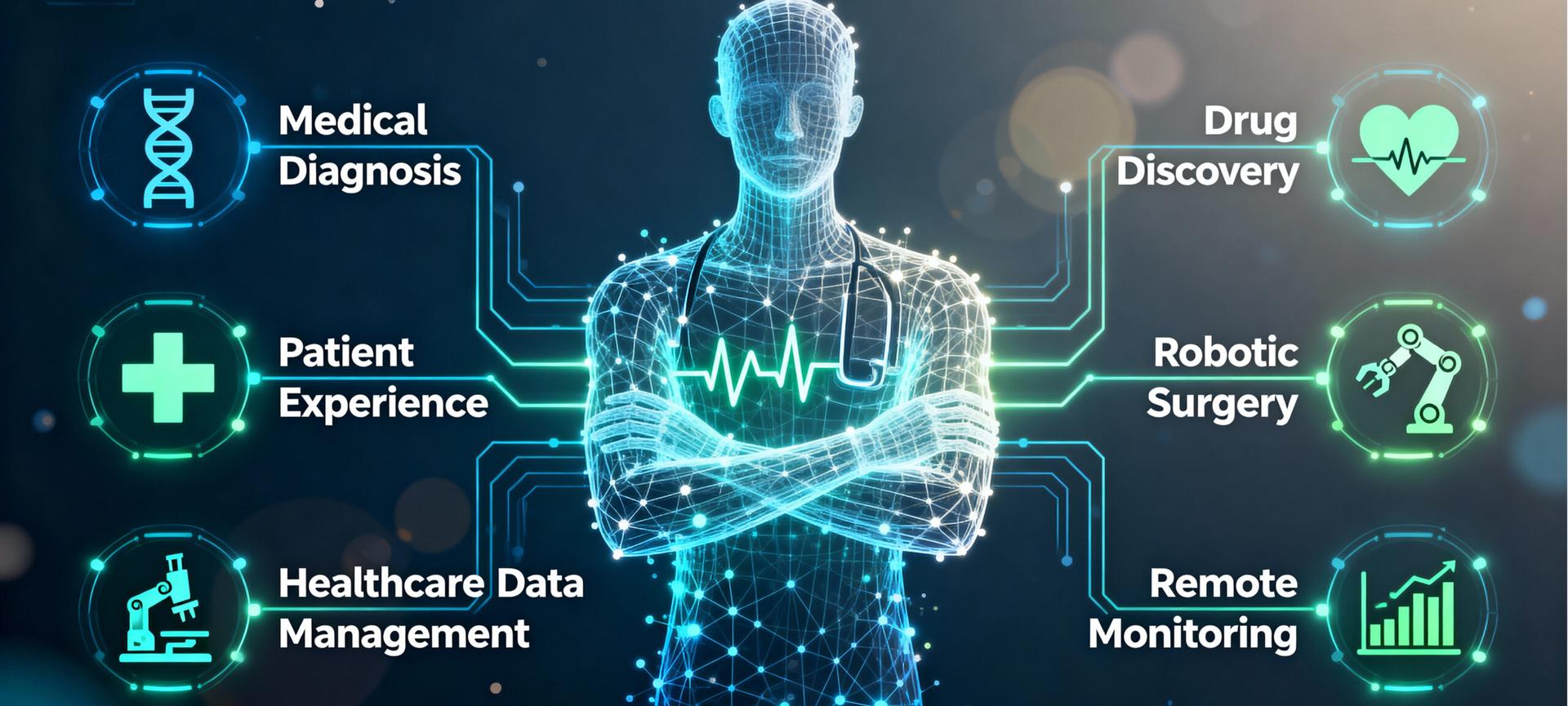
Artificial intelligence in medicine refers to the use of machine learning algorithms, deep learning neural networks, and natural language processing to analyze complex medical data, assist in clinical decision-making, and streamline healthcare delivery. By augmenting human expertise across diagnostics, pharmacology, and operational workflows, AI systems process vast datasets to improve patient outcomes and optimize resource allocation.
Understanding the Core Technologies Driving Clinical AI
The integration of artificial intelligence into healthcare relies on several foundational computational branches. Machine learning (ML), a subset of AI, enables software systems to identify patterns in clinical data without explicit programming. In medical contexts, supervised ML models train on labeled datasets—such as histopathology slides marked for malignancy or electronic health records (EHRs) tagged with readmission outcomes—to classify future unseen cases.
Deep learning, which utilizes multi-layered artificial neural networks, powers more complex perceptual tasks. Convolutional Neural Networks (CNNs) excel at processing grid-like data such as medical imaging, including X-rays, magnetic resonance imaging (MRI) scans, and computed tomography (CT) outputs. Meanwhile, natural language processing (NLP) parses unstructured clinical notes, biomedical literature, and patient communications to extract actionable health insights. Large language models (LLMs) and transformer architectures further expand NLP capabilities, summarizing patient histories, assisting with differential diagnoses, and drafting clinical documentation.
Clinical Applications in Diagnostics and Imaging
Diagnostics represents one of the most mature and impactful deployment areas for artificial intelligence in medicine. Radiologists and pathologists face mounting caseloads, making algorithmic triage and second-opinion software invaluable. In radiology, CNNs can detect early-stage abnormalities—such as microcalcifications in mammograms, pulmonary nodules in chest CT scans, or ischemic strokes in brain MRI sequences—often with sensitivity levels comparable to or exceeding human specialists under high-fatigue conditions.
Beyond static imaging, AI systems analyze continuous physiological signals in critical care environments. Intensive care units (ICUs) employ predictive algorithms to monitor telemetry data, alerting clinicians to impending sepsis, septic shock, or cardiac arrest hours before clinical deterioration becomes outwardly visible. In ophthalmology, FDA-cleared autonomous diagnostic systems analyze retinal photographs to detect diabetic retinopathy without requiring a physician's immediate interpretation of the primary image.
Revolutionizing Pharmacology and Drug Discovery
Traditional drug discovery is a notoriously protracted, capital-intensive endeavor, often taking over a decade and billions of dollars to bring a single therapeutic compound to market. Artificial intelligence fundamentally compresses this timeline by transforming how molecules are identified, designed, and tested.
- Target Identification & Validation
- Uses NLP to mine biomedical literature and genomic databases for disease targets.
- Molecular Generation & Optimization
- Employs generative neural networks to design novel chemical structures.
- Preclinical & Clinical Trial Optimization
- Predicts patient response, optimizes dosing regimens, and stratifies cohorts.
Generative AI models, including variational autoencoders and generative adversarial networks (GANs), synthesize entirely new molecular structures optimized for specific binding affinities against disease targets. Furthermore, AlphaFold and similar protein-folding architectures have solved decades-old biological challenges by accurately predicting three-dimensional protein structures from amino acid sequences, accelerating structure-based drug design for neglected tropical diseases and oncology targets alike.
Operational Efficiency and Administrative Automation
While clinical diagnostics and drug discovery capture public attention, healthcare systems face acute administrative burdens that directly impact care delivery. Artificial intelligence streamlines non-clinical workflows, reducing clinician burnout and operational overhead.
Natural language processing tools transcribe patient-provider interactions in real time, automatically populating electronic health records (EHRs) and drafting discharge summaries. Robotic process automation (RPA) combined with machine learning accelerates medical billing and insurance claim adjudication, minimizing denials and reducing administrative lag times. Additionally, predictive scheduling algorithms analyze historical admission rates, weather patterns, and local public health data to forecast emergency department staffing needs, ensuring optimal nurse-to-patient ratios and minimizing wait times.
Ethical Considerations, Bias, and Regulatory Compliance
The deployment of artificial intelligence in high-stakes medical settings introduces significant ethical and legal challenges. Algorithmic bias remains a critical concern; if training datasets disproportionately represent specific demographic groups, the resulting models may underperform or misdiagnose minority populations, exacerbating existing health disparities.
Data privacy and security are governed by stringent regulatory frameworks, such as the Health Insurance Portability and Accountability Act (HIPAA) in the United States and the General Data Protection Regulation (GDPR) in the European Union. Algorithms processing protected health information (PHI) must employ advanced anonymization, secure federated learning, or homomorphic encryption to prevent data breaches. Furthermore, the Food and Drug Administration (FDA) regulates AI and machine learning-based Software as a Medical Device (SaMD), requiring rigorous validation for software that adapts continuously after deployment versus locked-algorithm systems that remain static until cleared for updates.
Comparing Traditional Clinical Workflows and AI-Augmented Care
| Feature / Domain | Traditional Clinical Workflow | AI-Augmented Care Workflow | Primary Benefit |
|---|---|---|---|
| Radiology Triage | First-come, first-served queueing based on manual check-in order. | Algorithmic prioritization flagging critical findings instantly. | Reduced time-to-treatment for acute conditions like stroke. |
| Drug Discovery | High-throughput screening of physical chemical libraries over years. | In silico molecular generation and binding simulation in weeks. | Dramatically lowered research costs and accelerated pipelines. |
| Documentation | Manual typing or audio dictation transcribed post-visit. | Ambient conversational AI auto-populating structured EHR fields. | Mitigation of physician burnout and increased patient face-time. |
| Sepsis Detection | Reactive identification upon manifestation of overt clinical symptoms. | Continuous multivariate telemetry monitoring for early pre-symptomatic shifts. | Prevention of organ failure through proactive intervention. |
Frequently Asked Questions
Can artificial intelligence replace human physicians in clinical practice?
No, artificial intelligence is designed to augment, not replace, human clinical judgment. While algorithms process high-dimensional data at unprecedented speeds, they lack empathy, contextual understanding, and legal accountability. Clinicians remain responsible for synthesizing AI recommendations with patient histories, personal preferences, and holistic evaluations.
How do regulatory bodies ensure medical AI safety?
Regulatory bodies like the FDA evaluate AI medical devices through premarket clearance pathways, requiring manufacturers to demonstrate analytical and clinical validity. Developers must submit evidence showing that their algorithms maintain safety, efficacy, and generalizability across diverse patient populations, with post-market surveillance required to monitor real-world performance drift.
What is algorithm bias in healthcare AI, and how is it addressed?
Algorithmic bias occurs when AI models produce systematically less accurate or fair outputs for certain demographic groups due to skewed or unrepresentative training data. To mitigate this risk, researchers enforce rigorous data auditing, mandate diverse clinical trial cohorts, and apply algorithmic fairness constraints during model training and validation phases.
Who is legally liable if an AI diagnostic tool makes an error?
Legal liability generally rests with the licensed healthcare provider or healthcare institution that utilized the tool, rather than the software developer, under current medical malpractice frameworks. Physicians are expected to exercise independent professional judgment and verify AI-generated outputs rather than following them blindly.
How is patient data protected when training machine learning models?
Patient data protection relies on strict de-identification protocols, encryption standards, and privacy-preserving computational techniques such as federated learning. Federated learning trains algorithms across decentralized edge devices holding local data samples without exchanging the raw medical records themselves, preserving patient confidentiality.
Implementing AI Tools in Clinical Practice
Healthcare administrators and clinicians seeking to integrate artificial intelligence solutions must adopt a structured, phased implementation strategy. Begin by identifying a specific operational or clinical bottleneck—such as emergency department triage delays or high administrative transcription burdens—rather than pursuing AI deployment as a general initiative. Evaluate vendor solutions against stringent criteria, demanding transparency regarding training data demographics, validation metrics, and integration compatibility with existing electronic health record infrastructures. Establish multidisciplinary oversight committees comprising clinicians, IT specialists, legal counsel, and ethicists to monitor algorithm performance, track potential drift or bias, and ensure continuous compliance with evolving regulatory mandates.