The Age of Aquarius is one of twelve astrological ages defined by the precession of the equinoxes, representing a roughly 2,150-year period characterized by humanitarianism, technological advancement, and decentralized networks. While its exact start date is debated among astronomers and astrologers, it signifies a collective transition from the hierarchical, faith-based structures of the Age of Pisces toward a paradigm centered on individual sovereignty and scientific innovation.
The Astronomical Foundation: The Precession of the Equinoxes
To understand the Age of Aquarius, one must first grasp the astronomical phenomenon known as the precession of the equinoxes. The Earth does not rotate on a perfectly stable axis; rather, it has a slight "wobble" similar to a spinning top. This cycle, often called a "Great Year" or a Platonic Year, takes approximately 25,800 years to complete one full rotation.
As the Earth wobbles, the position of the sun on the vernal equinox (the first day of spring) slowly moves backward through the twelve signs of the zodiac. It takes roughly 2,150 years for the equinox point to cross through one entire zodiacal constellation. The "Age" is named after the constellation in which the sun resides during the vernal equinox. For the last two millennia, we have been in the Age of Pisces. We are currently in the transition zone, moving into the constellation of Aquarius.
This movement is purely observational from our perspective on Earth, but in astrology, these shifts are believed to correlate with massive changes in human consciousness, culture, and social organization. The transition between ages is rarely an overnight event; instead, it is a gradual "twilight" period where the themes of the outgoing age overlap with the emerging themes of the new one.
The Great Debate: When Does the Age of Aquarius Actually Begin?
One of the most frequent questions regarding the Age of Aquarius is the exact date of its commencement. Because the boundaries of the constellations are not strictly defined in a mathematical sense—and because different astrological traditions use different "starting points" for the zodiac—there is no single consensus.
As of 2026, we are in a period many experts describe as the "cusp." However, several prominent theories exist regarding the official start:
- The 20th Century Perspective: Some cultural historians point to the 1960s, popularized by the musical Hair, as the beginning of the Aquarian influence. This was characterized by a radical break from tradition and the rise of civil rights and environmental movements.
- The Astronomical Boundary: Based on the International Astronomical Union (IAU) constellation boundaries established in 1930, the vernal equinox will not officially enter the constellation of Aquarius until approximately the year 2597.
- The 2020 Great Conjunction: Many modern astrologers argue that the "Great Conjunction" of Jupiter and Saturn at 0 degrees of Aquarius on December 21, 2020, served as the formal energetic inauguration of the age. This event marked a shift from 200 years of conjunctions in "Earth" signs to a 200-year cycle in "Air" signs.
- The Pluto Factor: In 2024, the planet Pluto entered Aquarius for a nearly 20-year stay. In our current year of 2026, Pluto is firmly established in this sign, which many believe is the final catalyst for dismantling old Piscean power structures and replacing them with Aquarian systems.
Characteristics of the Aquarian Age vs. the Piscean Age
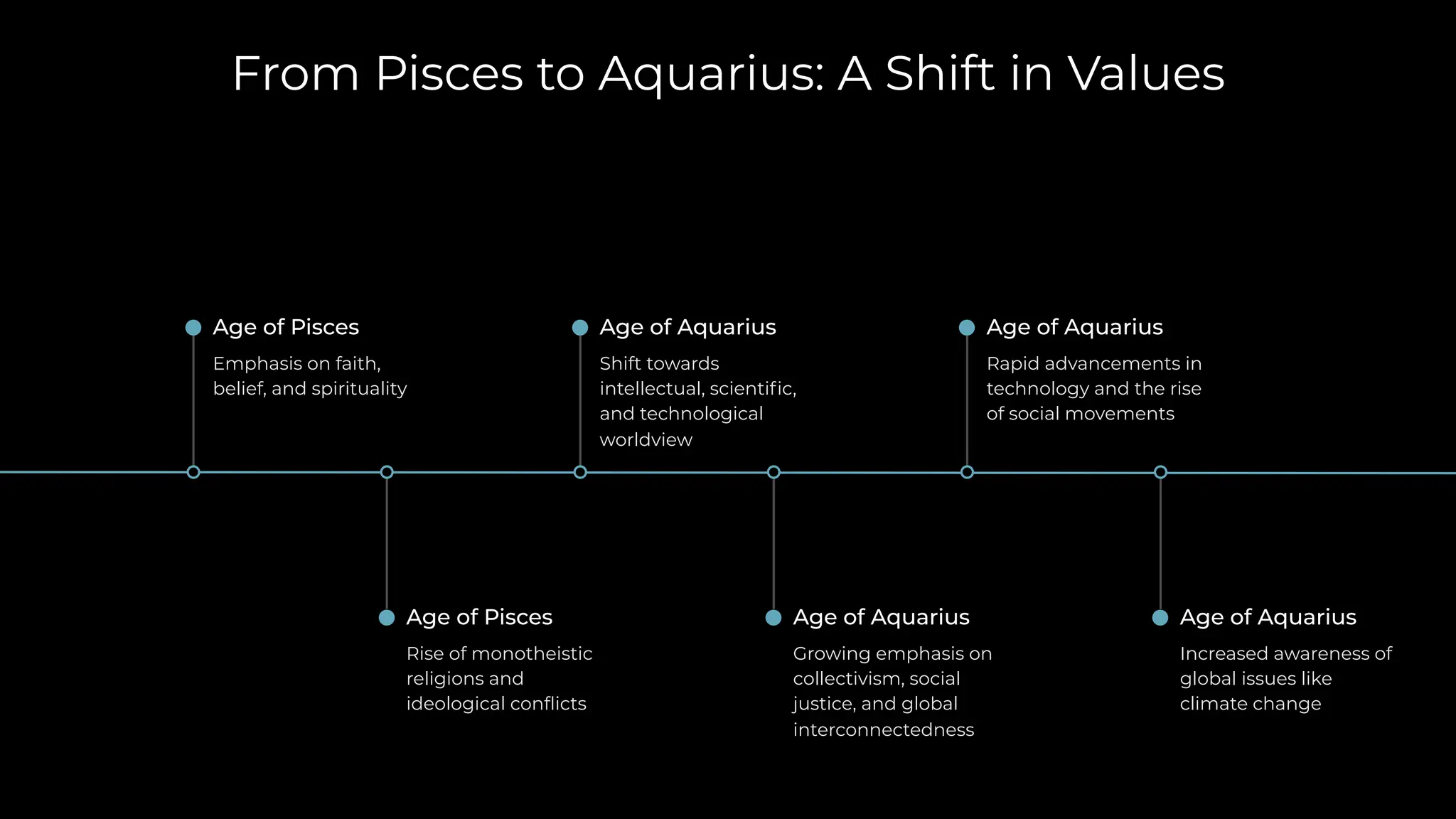
The shift from Pisces to Aquarius is often described as a move from "I Believe" to "I Know." To understand what lies ahead, we must look at the archetypal differences between these two signs.
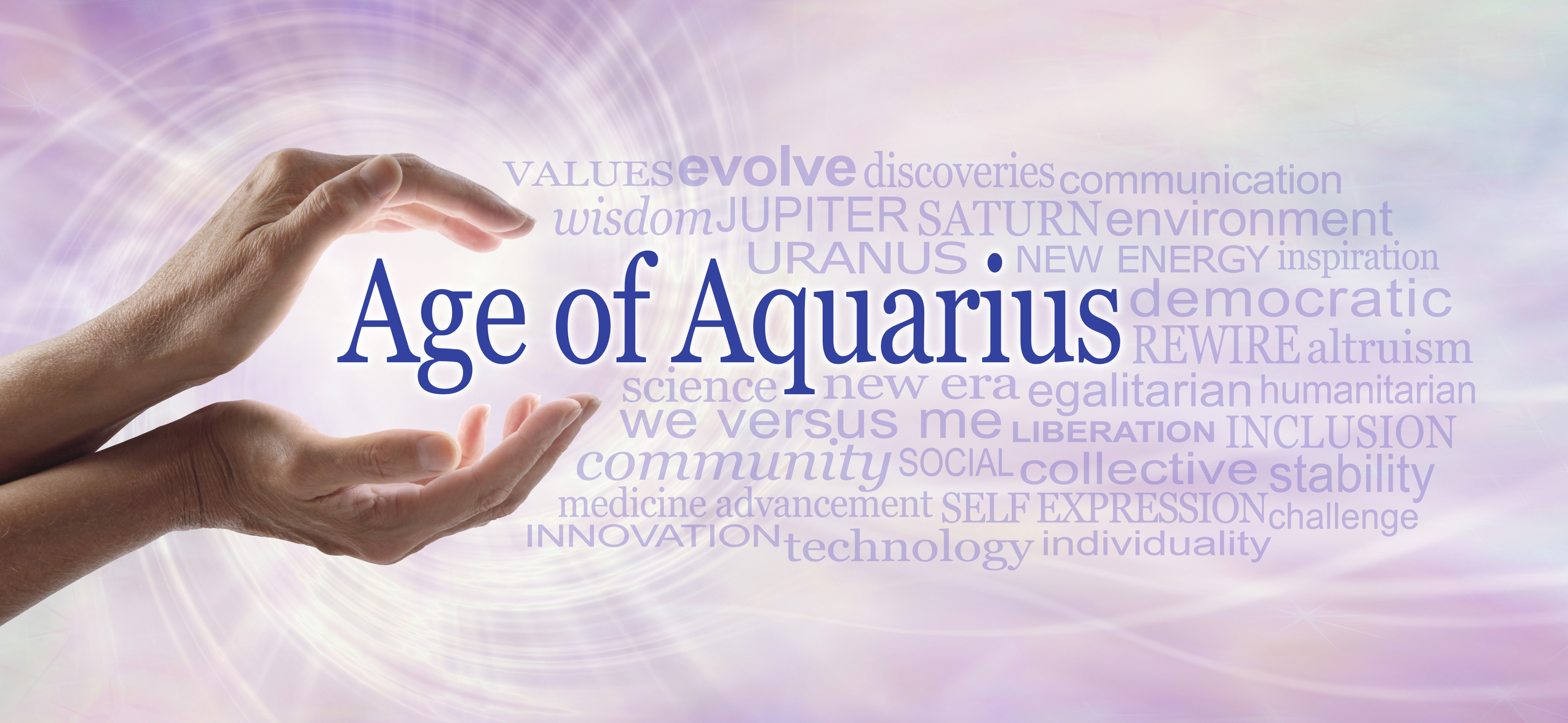
The Age of Pisces was dominated by religion, mysticism, and a hierarchical "top-down" approach to power. It was an era of sacrifice, hidden truths, and the search for a savior. In contrast, Aquarius is an Air sign ruled by Uranus (the planet of revolution and innovation) and Saturn (the planet of structure and discipline). This combination suggests a future defined by collective action, technological integration, and the democratization of information.
| Feature | Age of Pisces (Outgoing) | Age of Aquarius (Emerging) |
|---|---|---|
| Core Mantra | "I Believe" | "I Know" |
| Social Structure | Hierarchy and Monarchy | Networks and Decentralization |
| Primary Driver | Religion and Devotion | Science and Technology |
| Focus | Spiritual Salvation | Humanitarian Progress |
| Power Dynamic | Centralized Authority | Peer-to-Peer Collaboration |
| Communication | Prophetic/Symbolic | Digital/Data-Driven |
| Conflict Type | Ideological/Holy Wars | Systems-Based/Information Wars |
In 2026, we see these shifts manifesting in the rise of decentralized finance (DeFi), the expansion of artificial intelligence, and a growing skepticism toward traditional gatekeeping institutions. The Aquarian influence encourages individuals to find their own "inner authority" rather than relying on external icons or leaders.
The Cultural and Spiritual Impact of the New Age
The term "New Age" became synonymous with the Age of Aquarius during the late 20th century, but the implications go far beyond crystals or meditation. The spiritual hallmark of the Aquarian Age is the "global village"—a concept where technology bridges the gap between disparate cultures, leading to a unified human consciousness.
One of the primary themes is the breakdown of secrecy. Pisces is a sign of shadows and hidden depths; Aquarius is a sign of transparency and "the light of the mind." This is reflected in the modern obsession with data transparency, whistleblowing, and the instant availability of global news. As we navigate 2026, the challenge of this age is becoming apparent: how to maintain individual privacy in a world defined by total connectivity.
Furthermore, the Aquarian Age shifts the focus from the "great man" theory of history to the power of the collective. Movements are no longer led by a single charismatic figure but are organized through digital networks. This "horizontal" power structure is a hallmark of Aquarian energy, emphasizing that the "savior" we have been waiting for is actually the collective effort of humanity itself.
Technological Integration and the "Air" Element
As an Air sign, Aquarius governs the atmosphere, electricity, and the invisible waves that carry information. The rapid advancement of aerospace technology, satellite internet, and quantum computing are all direct expressions of Aquarian themes.
In the current year of 2026, we are seeing the maturation of technologies that were only theoretical a decade ago. The integration of AI into daily life mirrors the Aquarian goal of optimizing systems for the benefit of the many. However, the shadow side of Aquarius involves coldness, detachment, and a tendency to prioritize "the system" over individual human emotions.
The task for society in this age is to balance the radical innovation of Uranus with the grounded responsibility of Saturn. Without structure, Aquarian energy becomes chaotic and destructive; without innovation, it becomes a rigid, technocratic dystopia.
Navigating the Transition: What to Expect in the Coming Decades
As we continue through this transition, the friction between old and new systems will likely intensify. The "Piscean" structures—large-scale centralized governments, traditional banking, and organized religion—are currently undergoing a process of radical transformation or obsolescence.
- Redefinition of Identity: Aquarius values the "misfit" and the unique individual. Expect a continued move away from rigid societal labels toward more fluid, self-defined identities.
- Decentralized Systems: From energy grids to social media, the trend will move toward "nodes" rather than "hubs." This reduces the risk of single-point failures but requires more individual responsibility.
- Scientific Breakthroughs: We are likely on the verge of major discoveries regarding the nature of energy, space travel, and the human genome. The "mysteries" of the past are becoming the "data points" of the future.
- Environmental Stewardship: Aquarius is the "Water Bearer," often depicted pouring water (knowledge/life) onto the earth. This symbolizes a renewed focus on global ecology and sustainable technology.
Frequently Asked Questions
Has the Age of Aquarius officially started?
There is no single "official" date recognized by all bodies. Most astrologers agree we are currently in the transition period, with the year 2020 (the Great Conjunction) and 2024 (Pluto's entry into Aquarius) serving as major milestones. By 2026, the Aquarian influence is undeniable in our global systems, even if the astronomical vernal equinox has not yet reached the constellation.
Why is it called the "Water Bearer" if it is an Air sign?
Aquarius is symbolized by a figure pouring water from a jug. In ancient symbolism, this "water" represents the flow of information, knowledge, and collective consciousness, rather than literal H2O. It is an Air sign because it deals with the mental and social realms, using "water" as a metaphor for the distribution of truth to the masses.
How long does each astrological age last?
Each age lasts approximately 2,150 years. This is calculated by dividing the 25,800-year cycle of the precession of the equinoxes by the twelve signs of the zodiac. Together, these ages form a "Great Year."
Does the Age of Aquarius mean world peace?
While the Age of Aquarius is associated with humanitarianism and cooperation, it is not a guarantee of utopia. Every sign has a "shadow" side. For Aquarius, the risks include emotional detachment, technocracy, and the "tyranny of the majority." The outcome depends on how humanity utilizes the tools of the age.
What is the significance of Pluto in Aquarius in 2026?
Pluto represents transformation and power. Its presence in Aquarius during 2026 suggests a profound restructuring of how power is distributed. It often correlates with the dismantling of corrupt hierarchies and the birth of radical new technologies that change the course of civilization.
Practical Recommendations for the Aquarian Era
To thrive in the burgeoning Age of Aquarius, individuals should focus on adaptability and community-building. The era of the "lone wolf" or the "unquestioning follower" is ending. Instead, success will be found by those who can collaborate within decentralized networks while maintaining their unique perspective.
Prioritize "intellectual sovereignty"—the ability to verify information and think critically—as the influx of data will only increase. Embrace technology as a tool for connection, but remain mindful of the need for grounded, human interaction. As we move further into 2026 and beyond, the most valuable currency will not be gold or paper, but the ability to innovate and contribute to the collective well-being of a globally connected society.