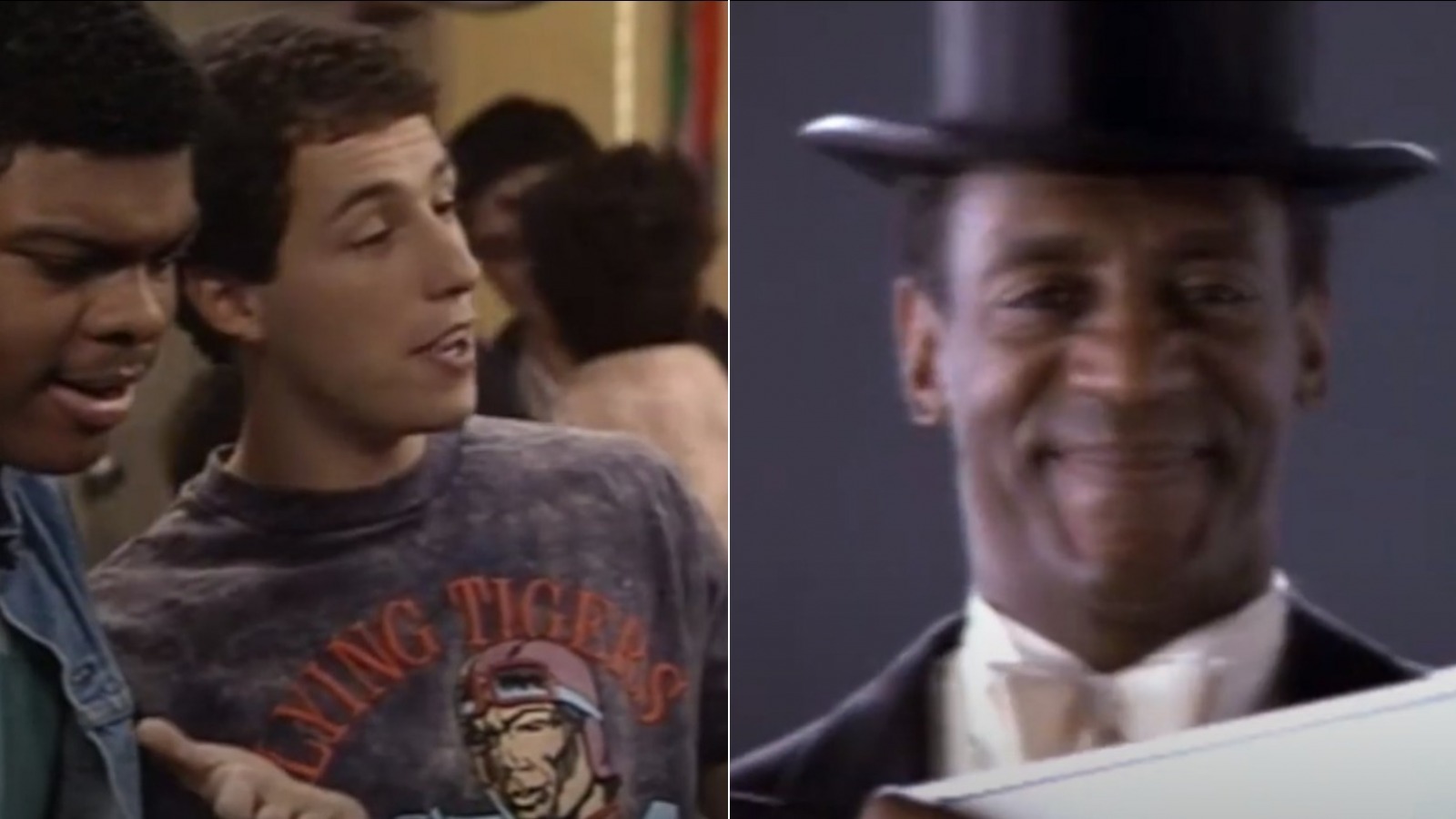
Adam Sandler’s professional acting debut occurred on The Cosby Show between 1987 and 1988, where he played the recurring character "Smitty," a friend of Theo Huxtable. This early role represents a fascinating "comedic collision course" between the disciplined, wholesome multi-camera sitcom era and the irreverent, "man-child" humor Sandler would later pioneer.
The Origin Story: How a Young Adam Sandler Landed "Smitty"
In the late 1980s, the landscape of American television was dominated by a single titan: The Cosby Show. It was the gold standard of the family sitcom, celebrated for its high production values, moral underpinnings, and disciplined comedic timing. Into this environment stepped a twenty-year-old NYU student named Adam Sandler. At the time, Sandler was balancing his studies at the Tisch School of the Arts with late-night stand-up sets at New York City clubs like The Comic Strip Live.
Landing the role of Smitty was a pivotal moment for Sandler. It wasn’t just a guest spot; it was an entry into the most-watched program in the United States. The casting directors were looking for actors who could play "authentic" teenagers—characters who felt like real-world extensions of Theo Huxtable’s social circle. Sandler’s natural ease and slightly goofy, relatable charm made him an ideal candidate for the role of Smitty, one of Theo’s core group of friends.
From a technical perspective, this was Sandler's first encounter with the rigors of a professional set. The Cosby Show was known for a specific type of precision. Bill Cosby, as the show's creator and star, demanded a high level of professionalism and often used the set as a teaching ground for young actors. For Sandler, this was a baptism by fire, forcing him to adapt his burgeoning, chaotic comedic energy into the structured, rhythmic requirements of network television.
Analyzing Smitty: The Role and Its Dynamics
Adam Sandler appeared in four episodes during the show's fourth season. His character, Smitty, was part of the teenage ensemble that frequently gathered in Theo’s room or at the community center. While Smitty was not a lead character, his presence provided a necessary "everyman" foil to the more established Huxtable family dynamics.
The episodes featuring Sandler include:
- "The Locker Room" (November 19, 1987): Sandler makes his debut, helping establish the social ecosystem of Theo’s high school life.
- "Dance Mania" (February 4, 1988): Smitty and the gang attempt to get on a popular dance show, highlighting the physical comedy Sandler would eventually master.
- "The Visit" (April 7, 1988): A more grounded episode where the friends navigate the complexities of teenage social hierarchies.
- "The Prom" (May 12, 1988): A quintessential sitcom trope that allowed Sandler to showcase his ability to play the nervous, awkward adolescent.
In these appearances, we see a "raw" version of the Sandler persona. He lacks the signature high-pitched voices and aggressive outbursts that would define his 1990s films like Billy Madison or Happy Gilmore. Instead, he offers a subdued, naturalistic performance. However, keen observers can spot the "collision course" in his timing. There are moments of hesitation and subtle facial expressions that hint at the absurdist performer waiting to break out. He was learning how to be funny within the lines, a skill that served as the foundation for his later, more expansive work.
The Cultural Impact of the "Collision Course"
The term "comedic collision course" aptly describes the meeting of two very different eras of American humor. On one side, you had the legacy of Bill Cosby—humor rooted in observational storytelling, family values, and a carefully curated public image. On the other side, you had the impending wave of Gen X "slacker" comedy, which Adam Sandler would eventually lead.
In 1987, the industry had no idea that the quiet kid playing Smitty would eventually become a mogul who redefined the comedy genre. Looking back from 2026, the contrast is stark. The Cosby Show represented the peak of the "Consensus Era" of television, where a massive audience watched the same show at the same time. Sandler’s eventual rise coincided with the fragmentation of media and the birth of "niche" comedy that prioritized absurdity and subversion over universal relatability.
This collision also highlights the evolution of the "straight man." On The Cosby Show, Bill Cosby was the ultimate authority figure, the one who reacted to the antics of the children. When Sandler moved to Saturday Night Live and later to his own production company, Happy Madison, he inverted this dynamic. He became the catalyst for chaos, forcing the world around him to react to his erratic behavior. Seeing him as Smitty—a character who had to respect the Huxtable house rules—is a fascinating look at the "before" image of a comedic revolutionary.
Behind the Scenes: The Working Environment of the 1980s
Working on The Cosby Show in the late 80s was unlike working on any other sitcom. The set was famously professional, often described as having an academic atmosphere. Bill Cosby was known for mentoring the younger cast members, including Malcolm-Jamal Warner (Theo) and the various guest stars. Sandler has noted in retrospective interviews that the experience taught him the importance of discipline.
The "collision" here was also logistical. Sandler was a Brooklyn-born comedian used to the grit of New York’s comedy cellars. Moving onto the polished, multi-million dollar sets at NBC’s Kaufman Astoria Studios required a different kind of "muscle." He had to learn how to hit marks, work with three different camera angles simultaneously, and play to a live studio audience without breaking character.
Furthermore, the late 80s were a time when "The Huxtable Effect" was in full swing, portraying an affluent African-American family in a way that challenged existing stereotypes. For a young actor like Sandler, being part of a show with such significant social weight provided a masterclass in how television could influence public perception. This understanding of "brand" and "audience" would later help him build his own massive, loyal fan base that followed him from SNL to Netflix.
Comparison: The Huxtable World vs. The Sandler Universe
To understand the magnitude of this collision, it is helpful to compare the creative requirements of Sandler's role as Smitty with the characteristics of his peak 1990s output.
| Attribute | The Cosby Show (Smitty) | Classic Sandler (90s Films) |
|---|---|---|
| Humor Style | Observational, Gentle, Situational | Absurdist, Slapstick, Aggressive |
| Character Archetype | The Supporting Friend / "The Normie" | The Underdog / "The Man-Child" |
| Setting | Disciplined, Upper-Middle Class Home | Chaos-prone, Surreal Environments |
| Performance Key | Subtle facial reactions, timing | Physicality, Vocal distortion, Shouting |
| Dialogue | Script-heavy, Narrative-driven | Catchphrase-heavy, Improvisational feel |
| Theme | Lessons in responsibility and family | Rebellion against authority and growth |
Career Trajectory: From Brooklyn to SNL and Beyond
The bridge from The Cosby Show to Saturday Night Live (SNL) was shorter than it appeared. While playing Smitty gave Sandler his SAG card and a taste of the industry, it was his continued persistence in the stand-up circuit that eventually led to his big break. It is reported that Dennis Miller saw Sandler performing and recommended him to Lorne Michaels.
By the time Sandler joined SNL in 1990 (initially as a writer), he had shed the "Smitty" persona entirely. He began developing characters like Opera Man and Canteen Boy, which were far removed from the grounded reality of the Huxtable household. However, the technical proficiency he gained—the ability to perform live and work within a production team—was undeniably rooted in those four episodes on NBC.
By 2026, Sandler's career has come full circle. He has moved from the juvenile humor of his youth into more serious, critically acclaimed roles in films like Uncut Gems and Hustle, while still maintaining his massive comedy empire. The "collision" that started in 1987 didn't result in a crash; instead, it provided the initial momentum for one of the most enduring careers in Hollywood history.
Where to Watch These Episodes in 2026
For those interested in witnessing this comedic collision firsthand, the availability of The Cosby Show has fluctuated significantly over the last decade due to the legal and ethical controversies surrounding its star. However, as of 2026, several avenues remain for television historians and fans.
- Digital Purchase: Episodes featuring Adam Sandler (Season 4) are generally available for individual purchase on platforms like Amazon Prime Video and Apple TV.
- Streaming Services: Depending on current licensing agreements, the show occasionally appears on specialized networks such as Philo or through the "Live TV" features of platforms like Hulu or Roku.
- Physical Media: For the most reliable access, the Season 4 DVD box sets remain the primary source for unedited versions of these episodes.
- Museum of Broadcasting/Paley Center: For academic or research purposes, archives in New York and Los Angeles maintain master copies of the series for study.
FAQ
Who did Adam Sandler play on The Cosby Show?
Adam Sandler played "Smitty," a high school friend of Theo Huxtable. He was portrayed as a standard, relatable teenager who hung out with the main cast in various social settings.
How many episodes of The Cosby Show was Adam Sandler in?
Sandler appeared in exactly four episodes, all during the fourth season of the show (1987-1988). The episodes are "The Locker Room," "Dance Mania," "The Visit," and "The Prom."
Was Adam Sandler already famous when he appeared on the show?
No, Sandler was a relatively unknown stand-up comedian and a student at New York University at the time. This was his first professional acting credit on television.
How did his role as Smitty differ from his later movie roles?
The role of Smitty was very "straight." He didn't use the funny voices, outbursts, or physical comedy that became his trademark. It was a grounded, naturalistic performance required by the sitcom format of the time.
Did Bill Cosby and Adam Sandler get along?
Sandler has spoken respectfully about the experience, noting that he learned a great deal about professionalism and the craft of television from the environment Bill Cosby ran on set.
Final Practical Recommendation for Viewers
If you are a fan of Adam Sandler’s later work, watching his episodes on The Cosby Show is a rewarding exercise in "forensic comedy." To get the most out of the experience, pay close attention to the episode "Dance Mania." In this episode, you can see the early sparks of Sandler’s physical comedy as he interacts with the group. It serves as a perfect historical marker for where he started versus where he ended up. For those interested in the history of television, these episodes provide a rare glimpse into the transition period between the classic sitcom era and the modern, talent-driven comedy boom of the 1990s.