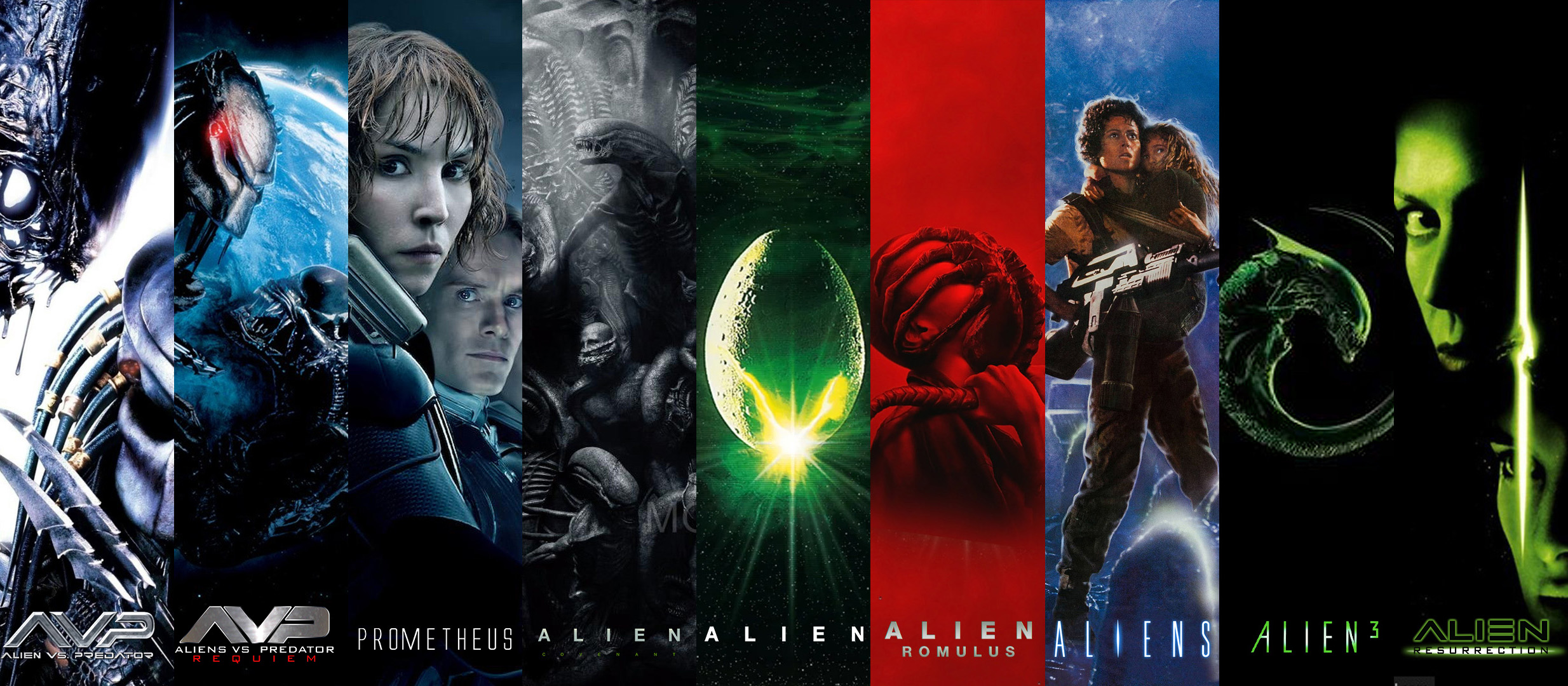
Navigating the intertwined mythologies of the Alien and Predator universes requires sorting through a complex web of cinematic releases, comic books, video games, and expanded universe lore to establish a single, coherent narrative sequence.
The shared science-fiction universe of the Xenomorphs and the Yautja spans millions of years of galactic history, stretching from ancient earth civilizations and primordial extraterrestrial origins down to distant, dystopian futures. Understanding this immense narrative requires separating release orders from internal chronology, tracking technological evolution across centuries, and aligning corporate greed with tribal hunting rituals.
Foundations of the Shared Continuity
The relationship between the Xenomorph (Alien) and the Yautja (Predator) began long before the 1979 release of Ridley Scott’s Alien or the 1987 release of John McTiernan’s Predator. While both franchises started as entirely independent intellectual properties owned by 20th Century Fox, crossovers in Dark Horse comics during the late 1980s and subsequent video games eventually codified a shared continuity. This crossover status was cemented on the silver screen with Alien vs. Predator (2004) and Aliens vs. Predator: Requiem (2007).
In this unified timeline, the Yautja have utilized the Xenomorphs for centuries as the ultimate game for their sacred hunts, known as the Blooding Ritual. Conversely, human mega-corporations like Weyland-Yutani continuously hunt both species to harness their biological and technological secrets for corporate dominance and bioweapon development. To trace this epic properly, enthusiasts must look past release dates and follow the internal calendar of events, beginning with deep prehistory and advancing into the far future.
Ancient History and Primordial Origins (Millions of Years Ago – 3000 BCE)
The earliest epochs of the timeline belong to precursor species and the ancient interactions between the Yautja and primitive terrestrial civilizations. Long before humanity built cities, the Engineers—introduced in Prometheus (2012)—experimented with mutagenic black liquid substances, giving rise to early strains of the Xenomorph organism. Simultaneously, the Yautja achieved spaceflight and visited primitive Earth, mentoring ancient human civilizations in exchange for worship and providing a reliable breeding ground for Xenomorph hunts.
During this era, humans served primarily as architects for massive subterranean pyramids and sacrificial hosts. The Yautja constructed sacred training grounds across various continents, embedding their advanced metallurgy and architectural styles into ancient cultures. These temples functioned as testing grounds where young Yautja blooded themselves by hunting Xenomorphs under the watchful eyes of their elders.
The Industrial and Contact Era (1715 – 1997)
As human history progressed into the modern age, encounters with both extraterrestrial species shifted from mythological occurrences to isolated, violent contacts. Historical encounters, such as the pirate skirmishes in the early 18th century depicted in comic narratives (Predator: 1718), demonstrated that the Yautja monitored human maritime and terrestrial conflicts for worthy adversaries. However, widespread human awareness remained virtually nonexistent.
| Era / Year | Primary Event | Key Media Representation | Species Involved |
|---|---|---|---|
| 1718 | A Yautja gifts an antique flintlock pistol to a human pirate. | Predator: 1718 (Comic) | Yautja, Humans |
| 2004 | Corporate expedition discovers an underground pyramid beneath Antarctica. | Alien vs. Predator (2004) | Yautja, Xenomorphs, Humans |
| 2007 | A hybrid Predalien outbreak occurs in a small Colorado town. | Aliens vs. Predator: Requiem (2007) | Yautja, Xenomorphs, Humans |
| 2122 | The commercial towing vessel Nostromo encounters a derelict engineer ship. | Alien (1979) | Xenomorph, Humans |
| 2179 | Colonial Marines investigate silence on LV-426; Weyland-Yutani seeks specimens. | Aliens (1986) | Xenomorphs, Humans |
The late 20th century marked the transition into active corporate surveillance and localized skirmishes. The events of Alien vs. Predator (2004) revealed that billionaire industrialist Charles Bishop Weyland funded an expedition to a submerged pyramid under ice sheets, confirming corporate knowledge of extraterrestrial life. Three years later, Aliens vs. Predator: Requiem (2007) brought the conflict directly onto American soil in Colorado, proving that government entities and small-town populations could become collateral damage in the interstellar feud.
The Weyland-Yutani Century and Corporate Exploitation (2122 – 2381)
The middle portion of the chronological timeline belongs primarily to the Alien saga, where the shadow of the Weyland-Yutani Corporation looms large over interstellar travel and colonization. Beginning with the ill-fated voyage of the commercial towing vehicle Nostromo in 2122, humanity learned of the terrifying reproductive cycle of the Xenomorph.
Subsequent decades saw humanity attempt to weaponize the creature, leading to the military-industrial disasters depicted in Aliens (1986), Alien 3 (1992), and Alien: Resurrection (1997). Throughout this period, the Yautja largely remained off-screen in the primary cinematic releases, though expanded universe materials confirm their ongoing surveillance of human space travel, waiting for human colonies to inadvertently breed enough Xenomorphs to justify a new hunt.
The Far Future and Extended Universe Intersections (2499 and Beyond)
Beyond the 24th century, the timeline extends into speculative territory through expanded media, including later comic book runs, novels, and standalone games like Aliens: Colonial Marines and Predator: Hunting Grounds. In these eras, humanity has spread across multiple star systems, frequently encountering remnants of Engineer technology, derelict Yautja starships, and mutated strains of Xenomorphs engineered by rogue synth factions or splintered corporate factions.
Chronological consistency in this deep future relies heavily on maintaining a clear distinction between canon film lore and supplementary expanded universe properties. While books and comics occasionally introduce time-travel elements or alternate futures, the core timeline remains anchored by the inevitability of human expansion colliding with ancient, apex predators who treat the galaxy as their personal hunting reserve.
How to Navigate and Watch the Franchise in Chronological Order
Viewers attempting a complete chronological run of both universes must balance structural continuity with shifting directorial visions across decades of filmmaking. Starting with the primordial creation myths and ancient terrestrial encounters provides the historical bedrock necessary to understand why Yautja and Xenomorphs are inextricably linked.
Recommended Chronological Viewing Sequence
- Prometheus (2012) – Explores the origin of the Engineers and the black liquid precursor.
- Alien: Covenant (2017) – Details the direct creation and evolution of early Xenomorph strains.
- Alien vs. Predator (2004) – Establishes the modern historical crossover and ancient pyramid traditions.
- Aliens vs. Predator: Requiem (2007) – Showcases an urban outbreak and immediate government cover-up.
- Predator (1987) – Introduces the Yautja hunting culture in the Central American jungles.
- Predator 2 (1990) – Explores urban Yautja hunting in 1997 Los Angeles and introduces the Xenomorph skull trophy.
- Prey (2022) – Depicts early 18th-century Yautja encounters on the Great Plains.
- The Predator (2018) – Examines advanced Yautja hybridization programs.
- Predators (2010) – Features human game transported to a Yautja game reserve planet.
- Alien (1979) – The classic first contact between a human crew and a lone Xenomorph.
- Alien Romulus (2024) – Explores corporate scavengers between the events of Alien and Aliens.
- Aliens (1986) – The transition from survival horror to military sci-fi action.
- Alien 3 (1992) – The grim aftermath of the Hadley’s Hope colony disaster.
- Alien: Resurrection (2nd Century Post-Nostromo) – Cloned Ripley and military-corporate bioweapon experiments.
Frequently Asked Questions About the Timeline
Are the Alien vs. Predator films considered canon to the main Alien and Predator series?
The official stance among creators and studios is that the Alien vs. Predator films exist in their own distinct sub-continuity or branch of the multiverse. Major entries in the solo franchises, such as Ridley Scott's Prometheus and Covenant, generally ignore the events of the crossover films, though a subtle Easter egg in Predator 2 (the Xenomorph skull) originally sparked the entire shared universe movement.
Where does the film Prey fit into the Predator chronological order?
Prey (2022) is set in the year 1719 on the Northern Great Plains, making it the earliest chronologically set live-action film in the Predator franchise. It depicts an earlier model of Yautja technology and armor, showcasing how the species has hunted on Earth for centuries before modern firearms became prevalent.
Which came first in the internal chronology, the Engineers or the Yautja?
In the established lore, the Engineers are ancient cosmic architects who predated human civilization by millions of years and experimented with primordial life forms. The Yautja are also an ancient spacefaring civilization with millions of years of technological evolution, but direct interactions between the two species remain rare and largely confined to expanded universe novels and comic books.
How does Alien Romulus fit into the timeline?
Alien Romulus (2024) is strategically placed chronologically between the events of Ridley Scott’s original Alien (1979) and James Cameron’s Aliens (1986). It follows a group of young space colonists who scavenge a derelict Weyland-Yutani space station, encountering facehuggers and Xenomorphs roughly twenty years after the destruction of the Nostromo.
Why do some timelines exclude the expanded universe comics and games?
Expanded universe materials often introduce contradictory dates, alternate survival outcomes for major characters, and experimental technologies that clash with cinematic releases. Film purists and official studio continuity managers typically prioritize the live-action theatrical releases as the primary pillars of the official canon.
Optimizing Your Chronological Watch Party
Planning a multi-film marathon through this interconnected lore requires careful attention to shifting tones, ranging from atmospheric survival horror to high-octane action and historical adventure. To maximize enjoyment, ensure your viewing setup accounts for the distinct visual shifts between 1970s practical effects and modern digital cinematography. Reviewing production release histories alongside internal chronological markers helps contextualize how practical monster suits evolved into sophisticated CGI creations. Take notes on corporate logos, weapon designs, and ship models to spot recurring motifs that tie these legendary cinematic universes together.