Building a professional actor career in 2026 requires a sophisticated blend of classical performance craft, digital self-marketing, and an understanding of evolving labor protections. Success involves securing high-quality training, assembling professional marketing materials, navigating union requirements like SAG-AFTRA, and mastering the virtual audition landscape to sustain long-term growth in a competitive global market.
Establishing the Foundation: Training and Craft Development
A sustainable actor career is rarely built on luck; it is built on a foundation of rigorous, ongoing training. In 2026, the industry distinguishes between "performers" and "actors" based on their ability to replicate high-level emotional truth across multiple takes or performances. While a degree from a prestigious conservatory like Juilliard or the Royal Academy of Dramatic Art (RADA) remains a powerful calling card, it is no longer the only viable path.
Many successful professionals utilize specialized studios that focus on specific techniques such as Meisner, Chekhov, or Stanislavski. These studios allow actors to hone their "instrument"—their voice, body, and emotional accessibility—without the four-year commitment of a university. Furthermore, the 2026 market demands versatility. An actor should ideally be proficient in:
- On-Camera Technique: Understanding the technical nuances of eye lines, hitting marks, and adjusting the "size" of a performance for a close-up versus a wide shot.
- Script Analysis: The ability to quickly identify beats, objectives, and stakes within a scene, which is critical for the rapid turnaround of modern auditions.
- Voice and Speech: Developing a neutral dialect or mastering specific accents to increase "castability" in international co-productions.
- Movement: Improving physical awareness to handle the demands of motion-capture (mocap) or high-action sequences common in contemporary streaming series.
Training should never truly end. Even established actors return to "gym" classes to stay sharp between projects. This commitment to the craft ensures that when an opportunity arises, the actor has the technical skill to deliver under pressure.
Building Your Professional Toolkit
Before an actor can secure an audition, they must have a professional "package" that agents and casting directors use to evaluate their potential. In 2026, this toolkit has become almost entirely digital, but the standards for quality have never been higher.
Professional Headshots
Your headshot is your primary calling card. It must be a high-resolution, professionally lit photograph that looks exactly like you do on a "good hair day." In the current market, actors often need 3–4 distinct "looks" that suggest different character types, such as the "young professional," the "approachable neighbor," or the "edgy antagonist." Avoid heavy retouching; casting directors need to know that the person who walks through the door—or appears on the Zoom screen—is the person in the photo.
The Performance Reel
A reel is a short video (usually 60–90 seconds) showcasing your best on-camera work. For those just starting an actor career, "demo clips" filmed in a professional studio setting can substitute for actual film or TV credits. These clips should feature high-quality audio and focused acting, rather than high-concept production values. The goal is to show the industry how you look and sound on screen within the first ten seconds.
Digital Profiles and Resumes
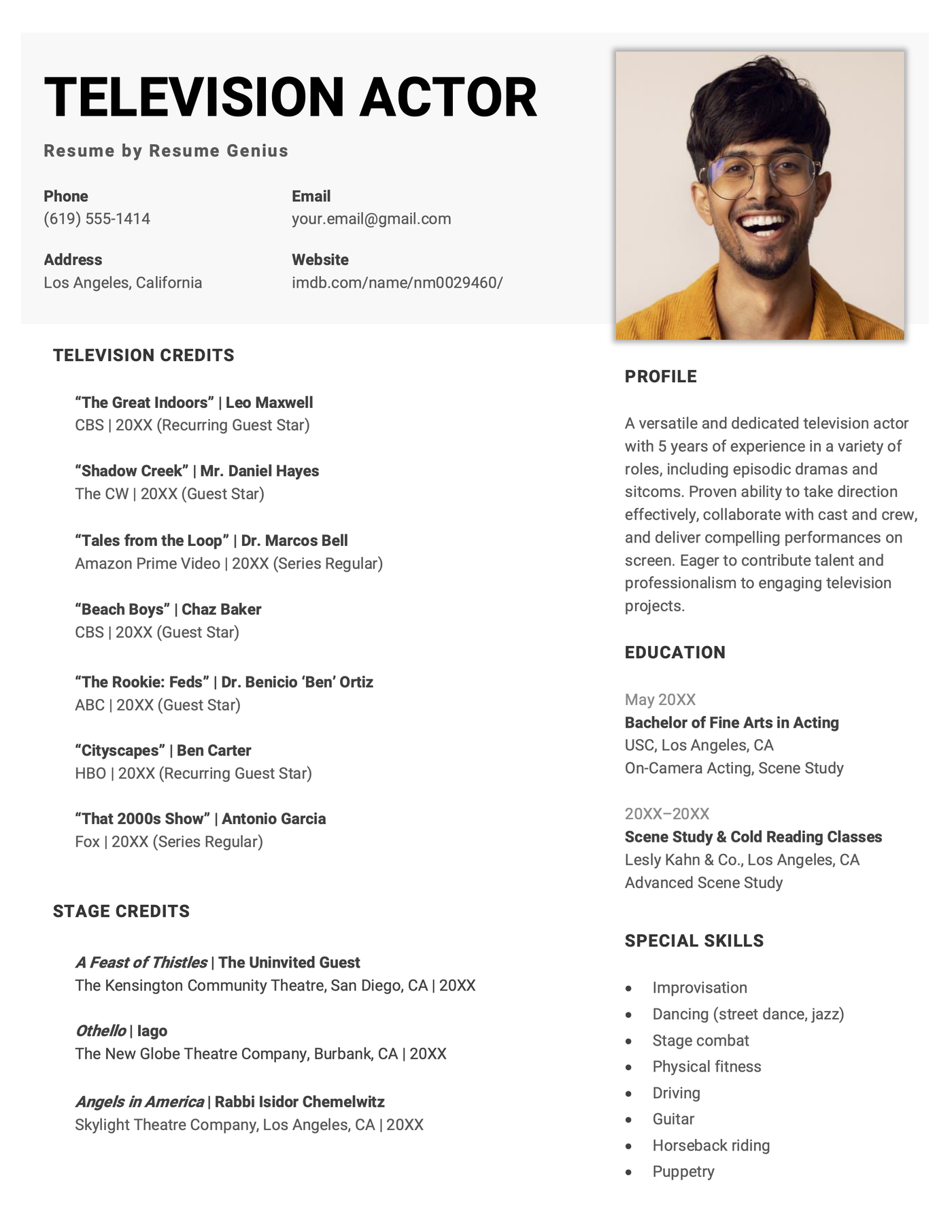
Platforms like IMDbPro and Casting Networks act as the industry's digital ecosystem. An actor’s resume should be formatted traditionally but hosted on these searchable databases. It should clearly list credits by category (Film, Television, Theatre, Commercials), training, and "special skills" like stage combat, fluency in other languages, or musical instruments.
The Digital Shift: Mastering the Virtual Audition
By 2026, the "self-tape" has become the definitive standard for first-round auditions. The days of traveling across town for a two-minute meeting are largely over for initial screenings. Mastering the technical side of self-taping is now a non-negotiable requirement for an actor career.
To compete, actors must invest in a "home studio" setup, which typically includes:
- A Neutral Backdrop: A solid grey or blue "pop-up" background or a dedicated wall.
- Three-Point Lighting: Utilizing ring lights or softboxes to eliminate shadows and make the eyes pop.
- High-Quality Audio: An external directional microphone to ensure dialogue is crisp and clear.
- A Reliable Reader: A partner to read the other lines off-camera, ensuring they do not overshadow the actor’s performance.
The shift to virtual auditions also includes "Live Zoom" sessions, where casting directors give redirects in real-time. This requires a stable, high-speed internet connection and the ability to maintain the same level of focus and energy as one would in a physical casting office.
Understanding Industry Representation: Agents and Managers
While an actor can find work independently through "open call" sites like Backstage, scaling an actor career to major film and television projects usually requires representation. There is a distinct difference between an agent and a manager that every professional must understand.
| Feature | Talent Agent | Talent Manager |
|---|---|---|
| Primary Focus | Securing auditions and negotiating contracts. | Long-term career planning and brand building. |
| Legal Standing | Regulated and licensed by the state; can legally book work. | Unlicensed in many states; focuses on guidance rather than "booking." |
| Commission | Strictly capped at 10% (for union work). | Typically 10% to 15%. |
| Client Volume | Often handles 100+ clients. | Handles a smaller, more selective roster. |
| Union Status | Must be "franchised" by unions like SAG-AFTRA. | Not governed by union commission caps. |
Securing representation involves "submitting" your toolkit (headshot, reel, resume) to agencies during their designated window. However, most actors find representation through referrals from acting teachers, casting directors, or fellow actors. It is a partnership; the agent opens the door, but the actor must perform well enough to keep it open.
Navigating Unions and Labor Regulations
In the United States, SAG-AFTRA (Screen Actors Guild-American Federation of Television and Radio Artists) is the dominant union for screen actors. In the UK, it is Equity. Joining a union is a major milestone in an actor career, offering protections such as minimum daily rates (scale), health insurance, and pension contributions.
As of 2026, unions have established critical protections regarding the use of Artificial Intelligence and digital likenesses. Actors are now protected against unauthorized "digital cloning," ensuring that they must be compensated and give consent if their image or voice is used to generate synthetic content.
However, joining a union too early can be a mistake. Once you are "Must Join" or a full member, you can no longer work on non-union projects. Many actors spend the first few years of their career in the "non-union" sector to build their reel and resume on indie films and smaller commercials before making the leap to union status.
Financial Management for the Modern Actor
The financial reality of an actor career is one of "feast or famine." Income is often irregular, arriving in large chunks followed by months of silence. This requires a high level of fiscal discipline and an understanding of the tax implications for 1099 independent contractors.
The "Survival Job"
Most actors maintain a secondary income stream. In 2026, many prefer remote "gig economy" roles—such as copywriting, digital marketing, or virtual assistance—that allow them to drop everything for a last-minute audition or a month-long shoot. The ideal survival job provides enough income to cover "the basics" while remaining flexible.
Professional Expenses
Actors can often deduct industry-related expenses from their taxes. These include:
- Classes and coaching sessions.
- Headshot photography and printing.
- Streaming service subscriptions (viewed as research).
- Union dues and commissions to agents/managers.
- Home studio equipment and internet costs.
Maintaining a dedicated bank account for acting income and expenses is highly recommended to simplify the filing process and ensure that you are reinvesting in your career growth.
Frequently Asked Questions
How long does it typically take to start booking professional work?
Most actors spend 2 to 5 years building a foundation before seeing consistent professional bookings. This "development phase" involves taking classes, filming student projects, and building a network. The timeline varies significantly based on your location, your "type," and your existing skill level.
Do I need to live in Los Angeles or New York to have an actor career?
While LA and NYC remain the primary hubs, 2026 sees significant production volume in "secondary" markets like Atlanta, Vancouver, London, and Toronto. Remote self-taping allows you to live elsewhere initially, but you generally must be willing to work as a "local hire" in a major production hub to be considered for most roles.
How do I find a legitimate acting agent?
Legitimate agents never ask for money upfront. They only earn a commission (usually 10%) when you get paid for a job. To find one, consult the SAG-AFTRA franchised agent list or use reputable databases like IMDbPro to see who represents actors working in your "category."
What is the most important skill for an actor in 2026?
Beyond acting talent, resilience and adaptability are the most critical skills. The industry is characterized by frequent rejection and rapid technological changes. Actors who can treat their career like a business while maintaining their creative passion are those who survive long-term.
Is an acting degree worth it in 2026?
A degree provides intensive training and a network of peers, but it is not a legal requirement for work. Many casting directors value "on-set experience" and specific studio training as much as, or more than, a college degree. The "worth" depends on whether you learn better in an academic environment or through specialized, craft-focused workshops.
Strategic Next Steps: Building Momentum
To advance your actor career in 2026, you must transition from a passive participant to an active CEO of your own brand. The first step is a cold assessment of your current materials: if your headshots are more than two years old or your reel doesn't reflect your current skill level, prioritize updating them immediately.
Next, focus on networking without "asking for favors." Attend industry screenings, participate in play readings, and engage with the filmmaking community on professional platforms. The goal is to be "top of mind" when a casting director or director is looking for your specific type. Finally, ensure you are consistently training. Whether it is an improv class or a scene study intensive, staying in a creative environment keeps your skills sharp and your morale high during the inevitable slow periods of the industry.