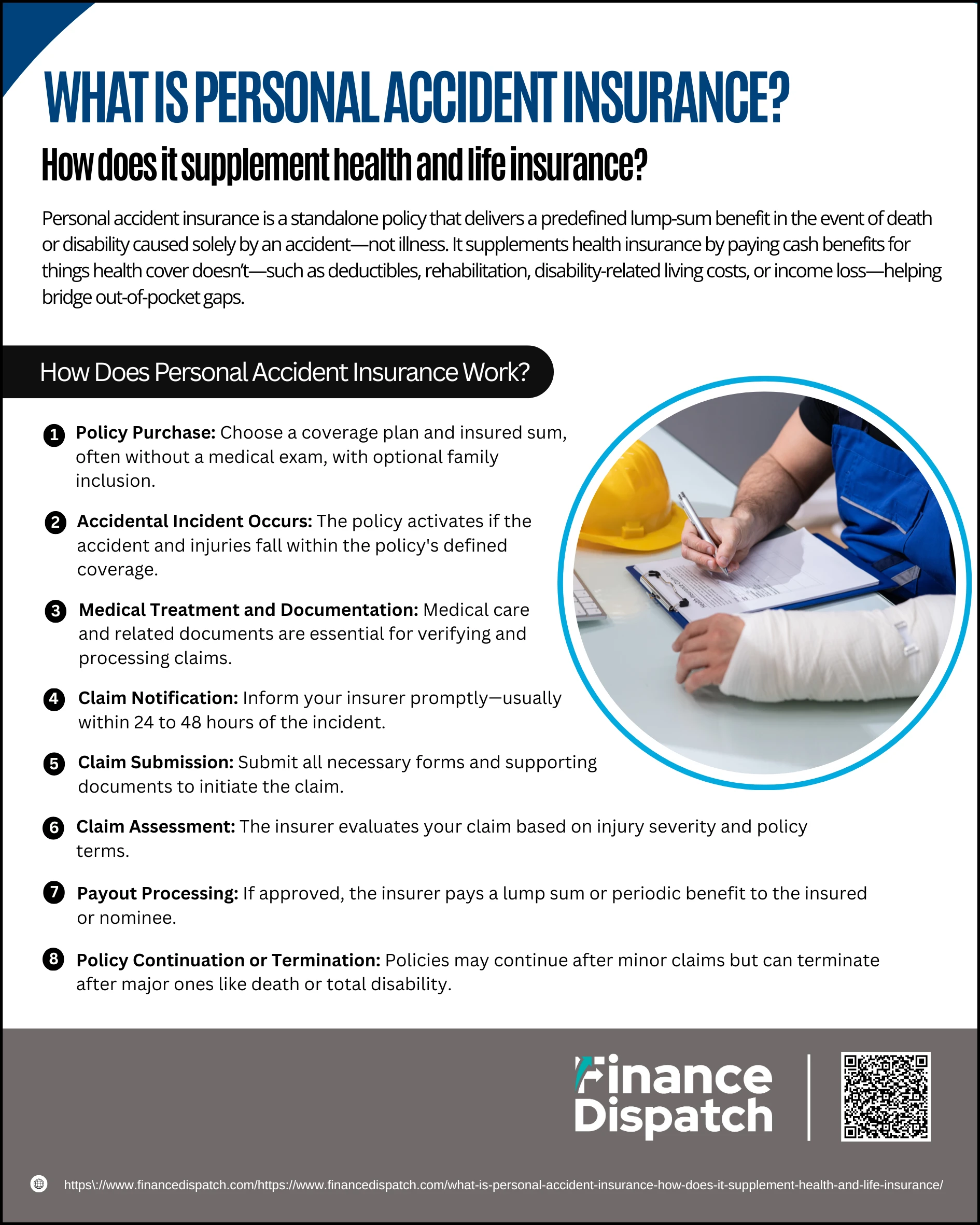
Accident insurance is a supplemental financial product designed to provide cash benefits in the event of specific injuries, accidental death, or dismemberment. Unlike comprehensive health insurance, which covers general medical treatment and diagnostic costs, accident insurance pays out a lump sum directly to the policyholder to help offset out-of-pocket expenses, deductibles, or daily living costs during a recovery period.
Understanding the Role of Accident Insurance
Accident insurance functions as a gap-filling mechanism within a broader financial portfolio. While standard health insurance policies cover the medical procedures performed by doctors, hospitals, and surgical centers, they often leave the patient responsible for significant co-pays, high deductibles, and non-medical expenses like transportation to appointments or lost wages during convalescence.
The primary intent of an accident insurance policy is to provide liquidity. Because payments are typically made as a fixed lump sum based on a pre-defined schedule of benefits, the policyholder has full autonomy over how those funds are utilized. This is distinct from indemnity-based plans, which require proof of specific costs incurred; accident insurance simply requires proof that the covered event occurred.
Differentiating Accident Insurance from Other Coverage Types
It is critical to distinguish between various insurance products to ensure you are managing risk appropriately. Accident insurance is often confused with Disability Insurance or Long-Term Care, yet they serve different purposes.
- Accident Insurance: Triggered by a specific injury (e.g., a broken bone, a concussion, or a third-degree burn) resulting from an accident. It is usually a short-term financial recovery tool.
- Disability Insurance: Replaces a portion of your income if you are physically unable to perform your job duties for an extended period, regardless of whether the cause was an accident or an illness.
- Health Insurance: The foundational coverage that pays for clinical medical care. Accident insurance is designed to sit on top of this, not replace it.
Eligibility and Prerequisites for Coverage
Most accident insurance policies are offered as voluntary benefits through an employer, though individual plans are available through private insurers. Eligibility requirements vary, but common prerequisites often include:
- Employment Status: In employer-sponsored group plans, you typically must be a full-time or part-time employee meeting the company's minimum hours requirement.
- Age Restrictions: Most insurers require applicants to be between 18 and 65 years of age at the time of enrollment.
- Active-at-Work Requirement: For group plans, you are often required to be actively performing your job duties on the effective date of the policy.
- Health Status: Unlike individual life insurance, many supplemental accident policies are "guaranteed issue," meaning you can enroll without undergoing a medical underwriting process.
Assessing the Cost-to-Benefit Ratio
When considering whether to purchase a policy in 2026, you must evaluate the premiums against the potential payout schedules. Premiums are generally low because the scope of the policy is narrow. However, before enrolling, review the "Schedule of Benefits" provided by the insurer. This document details exactly how much the insurance pays for specific injuries.
| Benefit Event | Typical Payout Structure |
|---|---|
| Emergency Room Visit | Flat payout ($50–$250) |
| Ambulance Transport | Flat payout ($100–$500) |
| Fracture (Simple) | Tiered amount based on severity |
| Concussion | Flat payout |
| Accidental Death | Full face value (Principal Sum) |
| Dismemberment | Percentage of Principal Sum |
When evaluating these numbers, look for the "Per Accident" limit. Most policies allow you to file multiple claims per year, but some have annual maximums. If you participate in high-risk hobbies or have an active family, a policy with a higher per-accident limit is usually more cost-effective over time.
Navigating the Claims Process
The efficiency of an accident insurance policy is largely defined by the claims process. In the event of a covered accident, the policyholder must typically submit a claim form alongside medical documentation.
- Documentation: Ensure you obtain a clear medical record from the hospital or urgent care center. This record must state the specific injury sustained and confirm it was the result of an accident.
- Timelines: Most insurers require notice of claim within 30 days of the injury, with formal proof of loss submitted shortly thereafter. Failing to meet these deadlines can result in a denial of benefits.
- Payment Disbursement: Once the claim is approved, the insurance company will issue a check or electronic deposit. Because this payment is made directly to you, there is no need to coordinate with your primary health insurance provider or hospital billing department.
Common Limitations and Exclusions
It is a common error to assume all accidents are covered by these policies. Before signing, you must read the "Exclusions" section of the policy document. Common exclusions in 2026 include:
- Pre-existing Conditions: While not always applicable to the accident itself, some policies may refuse payment if the injury was exacerbated by a pre-existing medical issue.
- Self-Inflicted Injury: Injuries resulting from suicide or intentional self-harm are universally excluded.
- Professional Athletics: Injuries sustained while participating in professional sports or hazardous activities like skydiving or rock climbing may require an additional rider or be excluded entirely.
- Illegal Activity: Accidents occurring while the policyholder is committing a felony or is under the influence of non-prescribed substances are typically excluded.
Professional Advice and Financial Planning
Accident insurance should be viewed as a component of your broader financial protection strategy rather than a standalone solution. It is highly recommended to consult with a certified financial planner or an insurance advisor who can review your current health insurance deductible and emergency fund size.
If your primary health plan features a very high deductible, an accident insurance policy can act as a bridge, preventing you from having to tap into your savings accounts when a sudden medical expense arises. Conversely, if you have robust savings and a low-deductible health plan, the premiums paid for accident insurance might be better utilized elsewhere.
Frequently Asked Questions
Does accident insurance cover illness-related hospitalizations?
No. Accident insurance is strictly for injuries caused by external, unforeseen events. Illnesses, chronic conditions, and general surgeries that are not the result of an injury are not covered.
Can I have both an HSA and an accident insurance policy?
Yes. Accident insurance is generally considered "excepted benefit" coverage, which means it is compatible with a Health Savings Account (HSA). It does not disqualify you from making contributions to your HSA.
Is the payout from an accident policy taxable?
Generally, if you pay the premiums for the accident insurance policy with after-tax dollars, the benefit payouts are not considered taxable income. If your employer pays the premiums as a tax-free benefit, the payouts might be subject to tax. Consult a tax professional regarding your specific situation.
What is the difference between accidental death and dismemberment (AD&D) and accident insurance?
AD&D is a subset of accident insurance that pays out specifically in the event of loss of life, limb, or sight. A comprehensive accident policy usually includes AD&D coverage but adds specific benefits for non-fatal injuries like burns, lacerations, or broken bones.
Can I purchase accident insurance if I already have a full-coverage health plan?
Yes. Many people maintain both. The health plan covers the medical bills, and the accident insurance provides a cash payment to help with indirect costs, such as time off work or childcare expenses resulting from the injury.
Next Steps for Implementation
If you determine that accident insurance aligns with your risk management goals, your first step is to check your employer's open enrollment portal. Most group policies are most affordable when purchased as an add-on during the annual enrollment period. If you are self-employed or your employer does not offer this, search for "supplemental accident plans" through licensed independent insurance brokers.
Before finalizing your selection, always request the "Summary of Benefits and Coverage" (SBC). Compare the "Fixed Payout" amounts for injuries you are statistically most likely to face based on your lifestyle. Once you have selected a plan, keep a copy of your policy and the claims department's contact information in a secure location where a family member can access it in an emergency.