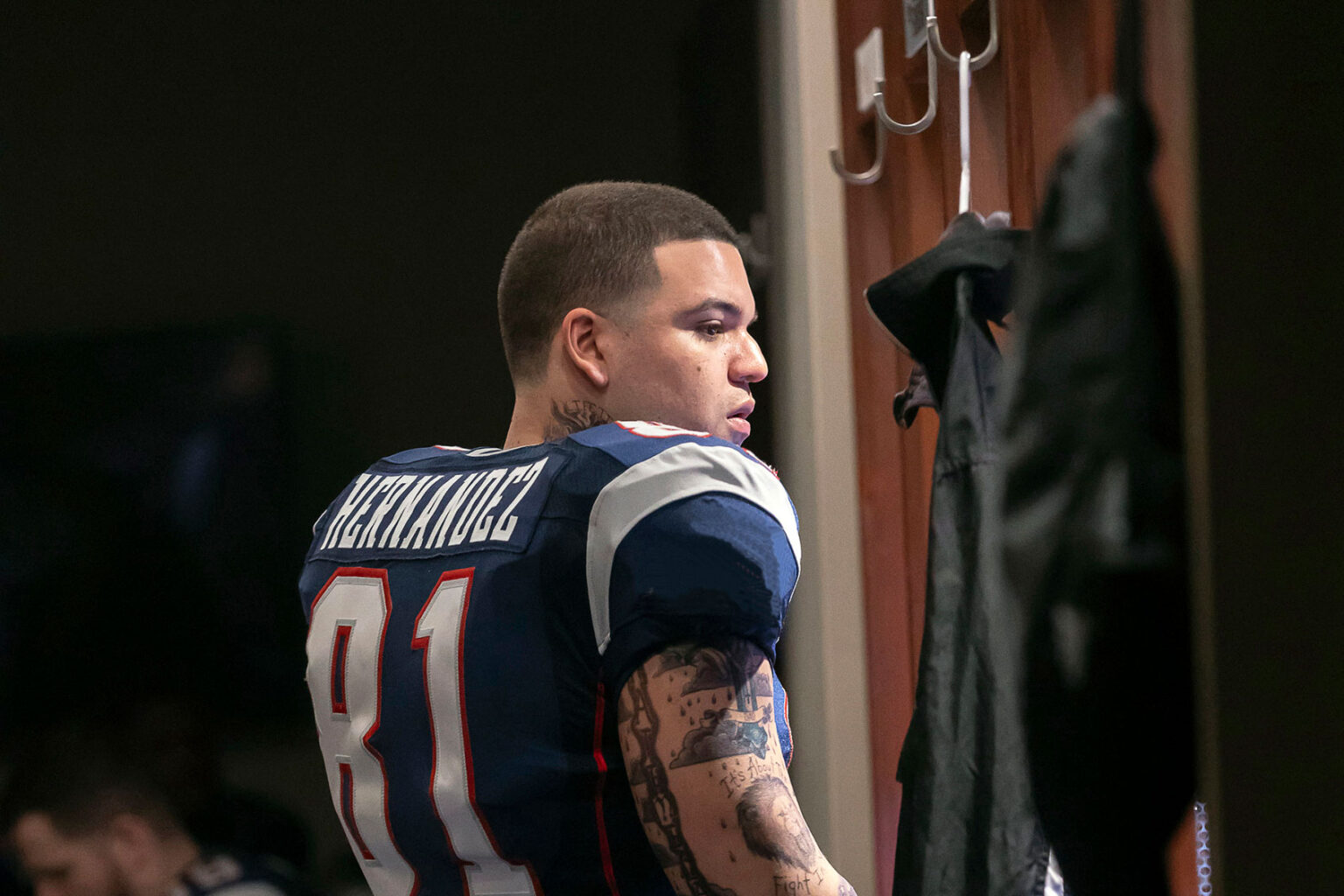
Aaron Hernandez’s transition from a standout NFL tight end for the New England Patriots to a central figure in a high-profile criminal case brought intense scrutiny to both his personal history and his financial standing. While his collection of tattoos often became a subject of public and media speculation regarding their meanings, the reality of his financial state was defined by the rapid dissolution of his professional contracts and the subsequent legal entanglements that ultimately left his estate with little to no positive net worth.
The Symbolic Language of Hernandez’s Tattoos
Aaron Hernandez was known for an extensive collection of ink that covered much of his upper body. During his career and the ensuing legal proceedings, these tattoos were frequently scrutinized by the media and criminal investigators as potential windows into his personal life and mindset. His body art included a mix of religious iconography, scripted phrases, and imagery that fans and analysts often attempted to interpret as reflections of his upbringing in Bristol, Connecticut, and his life in professional sports.
Among his most prominent tattoos were those reflecting his "blood" or family heritage, as well as star patterns and phrases that underscored his personal identity. In the context of his legal issues, investigators examined whether specific tattoos held ties to gang affiliations, an assertion that Hernandez’s legal team consistently denied. Because tattoos are inherently subjective forms of self-expression, they remain a source of fascination for observers, though they hold no verifiable connection to his financial history or the specifics of his professional net worth.
Professional Career and Earnings
To understand the financial trajectory of Aaron Hernandez, one must look at the standard structure of NFL compensation during his tenure. Hernandez signed a notable contract extension with the New England Patriots in 2012, valued at approximately $40 million over five years, which included a substantial $12.5 million signing bonus. At the time, this contract positioned him as one of the most promising and financially secure tight ends in the league.
However, the nature of NFL contracts is such that earnings are heavily tied to performance and availability. Upon his arrest in June 2013, the New England Patriots immediately released him, and the team moved to void the remaining guaranteed money on his contract. The NFL’s collective bargaining agreement allows teams to void future salary guarantees if a player is unable to perform due to legal incidents or conduct detrimental to the team. Consequently, the vast majority of the projected $40 million remained unpaid, significantly altering his long-term financial outlook.
Legal Costs and Asset Liquidation
The decline of Hernandez’s net worth was accelerated by the immense costs of legal defense. Retaining high-profile defense attorneys for multiple murder trials requires substantial capital, and these costs are typically paid from liquid assets and personal wealth. By the time the trials concluded, the financial burden had exhausted most of the liquid wealth he had accumulated during his years in the NFL.
Beyond legal fees, the wrongful death lawsuits filed against his estate further complicated his financial picture. Following his death in 2017, the legal proceedings shifted toward probate law. The estate was left in a state of insolvency, with debts and potential liabilities far exceeding the value of his remaining assets, such as his former residence in North Attleborough, Massachusetts.
Comparative Financial Context of NFL Players
It is common for public perception of professional athletes' net worth to be skewed by the initial value of their contracts. However, the reality involves significant deductions including agent fees, taxes, and the impact of contract termination. The following table illustrates the difference between gross contract potential and the typical net reality for players facing legal termination.
| Financial Factor | Impact on Asset Accumulation |
|---|---|
| Signing Bonus | Often the only "guaranteed" portion paid upfront before termination. |
| Performance Incentives | Typically forfeited upon release or inactivity. |
| Legal Defense Fees | Can reach millions, consuming liquid assets rapidly. |
| Tax Liabilities | Calculated based on gross income, regardless of legal outcomes. |
| Estate Debts | Liabilities and settlements often exceed residual asset value. |
The Reality of the Hernandez Estate
At the time of his passing in 2017, the financial reality for the estate of Aaron Hernandez was that there was no significant net worth to distribute. The property in North Attleborough was eventually sold, but the proceeds were largely entangled in legal settlements and claims from the families involved in the civil litigation.
In terms of financial planning, the Hernandez case serves as a stark example of how rapidly individual wealth can evaporate when career stability is lost and high-stakes litigation commences. Without the ability to earn further income through professional sports or endorsements, and with significant legal debts, the "net worth" of the former star effectively transitioned from an estimated multi-million dollar valuation to a negative balance sheet during his final years.
Frequently Asked Questions
Did Aaron Hernandez’s tattoos hold any value to his estate?
No. While his tattoos were a significant aspect of his personal identity and were extensively documented by the media, they hold no monetary or liquid value within an estate. They are personal markings and do not constitute assets that can be liquidated to pay off debts or legal obligations.
How much was Aaron Hernandez’s net worth at his peak?
At the peak of his career following the signing of his $40 million extension in 2012, Hernandez’s net worth was projected to be in the millions based on the potential value of his contract and endorsements. However, because most of that money was structured to be paid over future seasons, he never realized the full value of the contract before it was voided.
What happened to the money from his NFL signing bonus?
A significant portion of his signing bonus was utilized during his active years for lifestyle expenditures, investments, and, crucially, the initial funding of his legal defense. By the time his legal battles concluded, these liquid funds had been substantially depleted.
Why was his estate considered insolvent?
The estate was considered insolvent because the total value of his remaining assets—primarily real estate and personal property—was insufficient to cover the mounting legal fees and the damages awarded in civil wrongful death lawsuits. In legal terms, when liabilities exceed assets, an estate cannot pay out to potential heirs.
Can an NFL team legally claw back money paid to a player?
Yes. Under the NFL’s collective bargaining agreement, teams have specific clauses that allow them to recover portions of signing bonuses or void future guarantees if a player violates the terms of their contract, which includes involvement in illegal activities that result in criminal charges.
Next Steps for Financial Research
For those interested in the financial mechanics of professional sports, it is recommended to review the NFL Collective Bargaining Agreement (CBA) as published by the NFL Management Council. This document outlines the precise conditions under which teams may withhold or recoup compensation. For information regarding legal outcomes and probate, public court records from the Bristol County Superior Court offer the most accurate documentation of the civil claims brought against the estate.