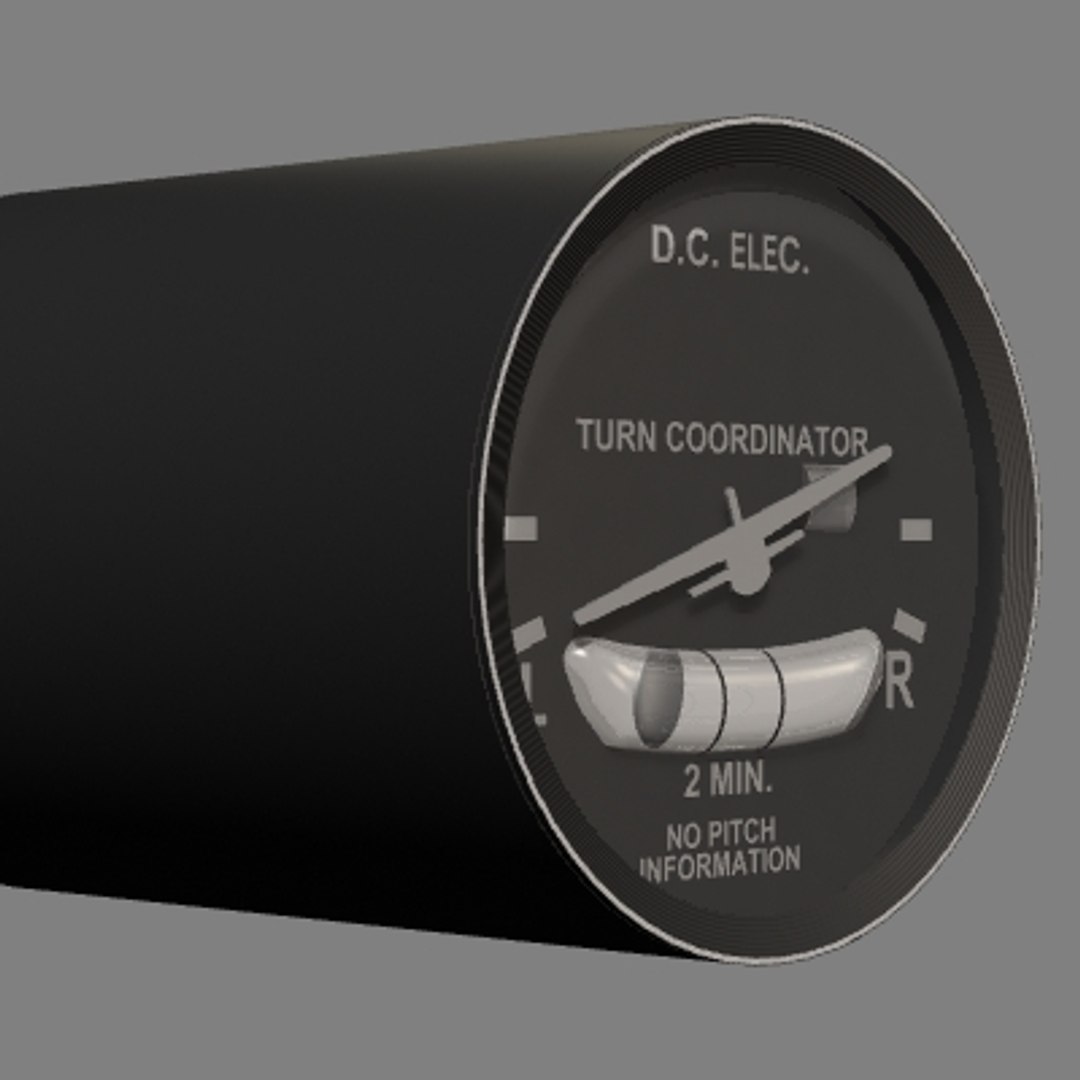
The 2909 P turn coordinator is a precision gyroscopic flight instrument designed to display both the rate of roll and the rate of turn. Unlike a traditional turn and slip indicator, the 2909 P utilizes a canted gimbal—typically set at a 30-degree angle—allowing it to sense movement around both the longitudinal (roll) and vertical (yaw) axes. This makes it an essential tool for maintaining coordinated flight and executing standard rate turns under both Visual Flight Rules (VFR) and Instrument Flight Rules (IFR).
Understanding the 2909 P Turn Coordinator Mechanics
The 2909 P stands as a cornerstone of the "partial panel" technique in aviation. To understand its value, one must first distinguish it from its predecessor, the turn and slip indicator. While both instruments provide information regarding the direction and rate of a turn, the 2909 P provides an immediate indication of roll rate the moment a pilot initiates a bank. This is achieved through the specific orientation of its internal gyroscope.
In a 2909 P model, the gyro is mounted on a gimbal that is tilted upward at the front. Because of this tilt, the gyro reacts to centrifugal force during a turn and the initial force of the roll. When you enter a turn, the miniature airplane on the instrument face banks in the direction of the turn. Once the bank is established and the roll rate drops to zero, the instrument purely reflects the rate of turn. This dual-sensing capability is why the 2909 P is preferred in modern cockpits; it gives the pilot a more proactive "heads up" during the entry and exit phases of a maneuver.
As of 2026, the 2909 P remains a standard in legacy aircraft upgrades and high-fidelity flight simulation training devices (FSTDs). Its transition from mechanical reliability to modern electronic precision ensures that the gyro reaches its operational RPM (revolutions per minute) quickly, usually within one to two minutes of receiving power.
Technical Specifications and Power Requirements
The 2909 P is primarily an electrically driven instrument. This is a deliberate design choice in the aviation industry to provide redundancy. In most general aviation aircraft, the primary attitude indicator and directional gyro are vacuum-driven. By making the turn coordinator electric, manufacturers ensure that if the engine-driven vacuum pump fails, the pilot still has a reliable gyroscopic reference for bank and turn rate to keep the "blue side up."
Standard specifications for the 2909 P series generally include:
- Input Voltage: Most models are dual-voltage (14V or 28V DC), automatically sensing the aircraft's electrical bus voltage.
- Current Draw: Extremely low, typically starting at 0.8 amps and settling into a 0.4 amp cruise draw, ensuring it does not overstress the alternator.
- Mounting: Standard 3-1/8 inch (ATI) round cutout, making it a drop-in replacement for older equipment.
- Certification: Usually carries TSO-C3b (Technical Standard Order) approval, meeting the FAA’s stringent requirements for accuracy and environmental durability.
The "P" designation in the 2909 P often refers to its "Precision" or "Panel-mount" configuration, featuring high-quality bearings and a balanced rotor that minimizes vibration. These precision components are vital for reducing "precession," the inherent tendency of a gyro to drift over time due to friction or Earth’s rotation.
The Role of the Inclinometer (The Ball)
While the gyroscopic miniature airplane handles the rate of turn, the bottom half of the 2909 P contains the inclinometer. This is a curved glass tube filled with damping fluid (often a specialized kerosene or silicone blend) containing a black steel ball.
The inclinometer measures the relationship between the force of gravity and centrifugal force. In a "coordinated" turn, these forces are balanced, and the ball stays centered between the two vertical reference lines.
- Slip: If the ball is on the inside of the turn, the aircraft is slipping (not enough rudder for the amount of bank).
- Skid: If the ball is swung to the outside of the turn, the aircraft is skidding (too much rudder for the amount of bank).
Pilots are taught the mantra "step on the ball." If the ball is to the left, the pilot applies left rudder pressure to center it. The 2909 P's inclinometer is designed with specific damping characteristics to ensure the ball doesn't oscillate wildly during turbulence, providing a smooth, readable average of the aircraft’s coordination state.
Installation and Integration Guidelines
Installing or replacing a 2909 P turn coordinator requires attention to the aircraft's electrical system and the physical alignment of the instrument panel. Because the instrument relies on a gyro that must remain level relative to the aircraft's lateral axis, the unit must be mounted securely and squarely within the panel.
Electrical Connections
The 2909 P typically features a circular MS-style connector (Military Standard). Proper shielding of the power wires is recommended to prevent electromagnetic interference (EMI) with sensitive avionics like GPS or COM radios. In 2026, it is standard practice to utilize a dedicated circuit breaker for the turn coordinator, allowing the pilot to isolate the instrument if an electrical fire or internal short is suspected.
Tilt and Calibration
Some advanced versions of the 2909 P allow for minor adjustments to the gimbal tilt to match specific airframe performance profiles, though for most General Aviation (GA) aircraft, the factory standard 30-degree tilt is ideal. During installation, the technician must verify that the "OFF" flag—a small red indicator—properly retracts once the gyro reaches sufficient speed. If the flag remains visible after the engine has been running for two minutes, the unit is likely drawing insufficient power or suffering from a mechanical seizure.
Operational Procedures and Standard Rate Turns
The primary operational goal of using the 2909 P is to achieve a "Standard Rate Turn." A standard rate turn is defined as 3 degrees per second, which allows an aircraft to complete a full 360-degree circle in exactly two minutes.
On the face of the 2909 P, you will see two marks (often white lines or "dog houses") on either side of the level flight position. When the wingtip of the miniature airplane is aligned with one of these marks, the aircraft is performing a standard rate turn.
Why Standard Rate Matters
For IFR pilots, the standard rate turn is the "speed limit" for maneuvering in the clouds. Air Traffic Control (ATC) calculates separation based on the assumption that aircraft are turning at this rate. If a pilot turns too sharply or too slowly, it can disrupt the flow of traffic or lead to a "loss of separation" event. The 2909 P provides the precision required to fly these procedures accurately without the need for complex mental math.
| Feature | 2909 P Turn Coordinator | Standard Turn & Slip Indicator |
|---|---|---|
| Gimbal Orientation | Canted (usually 30°) | Vertical |
| Senses Roll Rate? | Yes | No |
| Primary Power Source | DC Electric (14/28V) | Often Vacuum or DC |
| Display Type | Miniature Airplane | Needle/Pointer |
| Primary Benefit | Faster response to bank entry | Simplicity and reliability |
| Certification | TSO-C3b | TSO-C3c |
Maintenance, Troubleshooting, and Reliability
By 2026, the 2909 P has evolved to include more robust internal components, yet it still requires regular inspection. Like all gyroscopic instruments, friction is the primary enemy. Over time, the high-speed bearings inside the gyro can wear down, leading to increased noise or sluggish response.
Common Issues and Solutions
- Excessive Noise: If the instrument produces a high-pitched whine or a grinding sound upon startup, the bearings are failing. This requires an immediate overhaul or replacement.
- Sluggish Movement: If the miniature airplane takes an unusually long time to respond to a roll or stays stuck in one position, the gimbal may be bound.
- Erratic Inclinometer: If bubbles appear in the glass tube of the ball, the seal has failed. While the gyro may still work, the lack of damping in the ball makes coordinated flight difficult to judge.
- The "OFF" Flag: If the red flag appears during flight, it indicates a loss of electrical power or a drop in gyro RPM below a safe threshold. The pilot should immediately cross-check with the attitude indicator and treat the turn coordinator as unreliable.
The typical Time Between Overhaul (TBO) for a 2909 P in high-use environments is approximately 2,000 to 3,000 flight hours. In aircraft that sit idle for long periods, the lubrication in the bearings can "set," making the instrument more prone to failure upon the next use. Regular "exercise" of the electrical system and the gyro is recommended.
FAQ
Does the 2909 P turn coordinator show the actual bank angle?
No, the 2909 P does not show degrees of bank. It shows the rate of turn. While a steeper bank generally results in a faster rate of turn, the bank angle required to achieve a standard rate turn changes with the aircraft's airspeed. To see the specific bank angle (e.g., 20 or 30 degrees), a pilot must refer to the Attitude Indicator (AI).
Why is the 2909 P usually electric instead of vacuum-driven?
The primary reason is redundancy. Most light aircraft use a vacuum system for the Attitude Indicator and Directional Gyro. If the vacuum pump fails, those two instruments become useless. Having an electric 2909 P ensures the pilot still has at least one gyroscopic instrument to maintain level flight and make controlled turns.
Can I use the 2909 P for aerobatics?
Most standard 2909 P models are not designed for aerobatic maneuvers. High G-loads or extreme pitch/roll angles can "tumble" the gyro or damage the delicate gimbal bearings. If you plan to fly aerobatics, you should look for "caged" or specifically rated aerobatic instruments.
How long does it take for the 2909 P to stabilize after power-up?
Under normal conditions at room temperature, the gyro should reach operational speed and the "OFF" flag should disappear within 60 to 90 seconds. In extremely cold environments, this may take up to 3 minutes as the internal lubricants warm up.
Is the 2909 P required for VFR flight?
Under FAA FAR 91.205, a turn coordinator is not strictly required for VFR day flight. However, it is required for IFR flight. Most pilots consider it a "must-have" safety item for any cross-country flight, as it provides a vital backup in case of unintended entry into clouds or visibility-reducing haze.
Selecting and Implementing Your Precision Instrument
When integrating a 2909 P into your cockpit, the most critical step is ensuring compatibility with your existing electrical bus. Modern 2026-standard units are remarkably resilient, but they require clean, stable power. If your aircraft has an older voltage regulator that allows for significant "spikes," consider installing a transient voltage suppressor to protect the instrument's internal motor and circuitry.
For pilots performing an upgrade, the 2909 P offers a significant leap in "situational awareness" over older needle-and-ball units. The intuitive nature of the miniature airplane allows for a faster mental "scan," reducing the cognitive load during high-stress phases of flight such as instrument approaches in turbulent weather. Always consult with a certified A&P (Airframe and Powerplant) mechanic or an authorized avionics shop to ensure that the installation is documented correctly in the aircraft's logbooks and that the weight and balance data is updated accordingly.