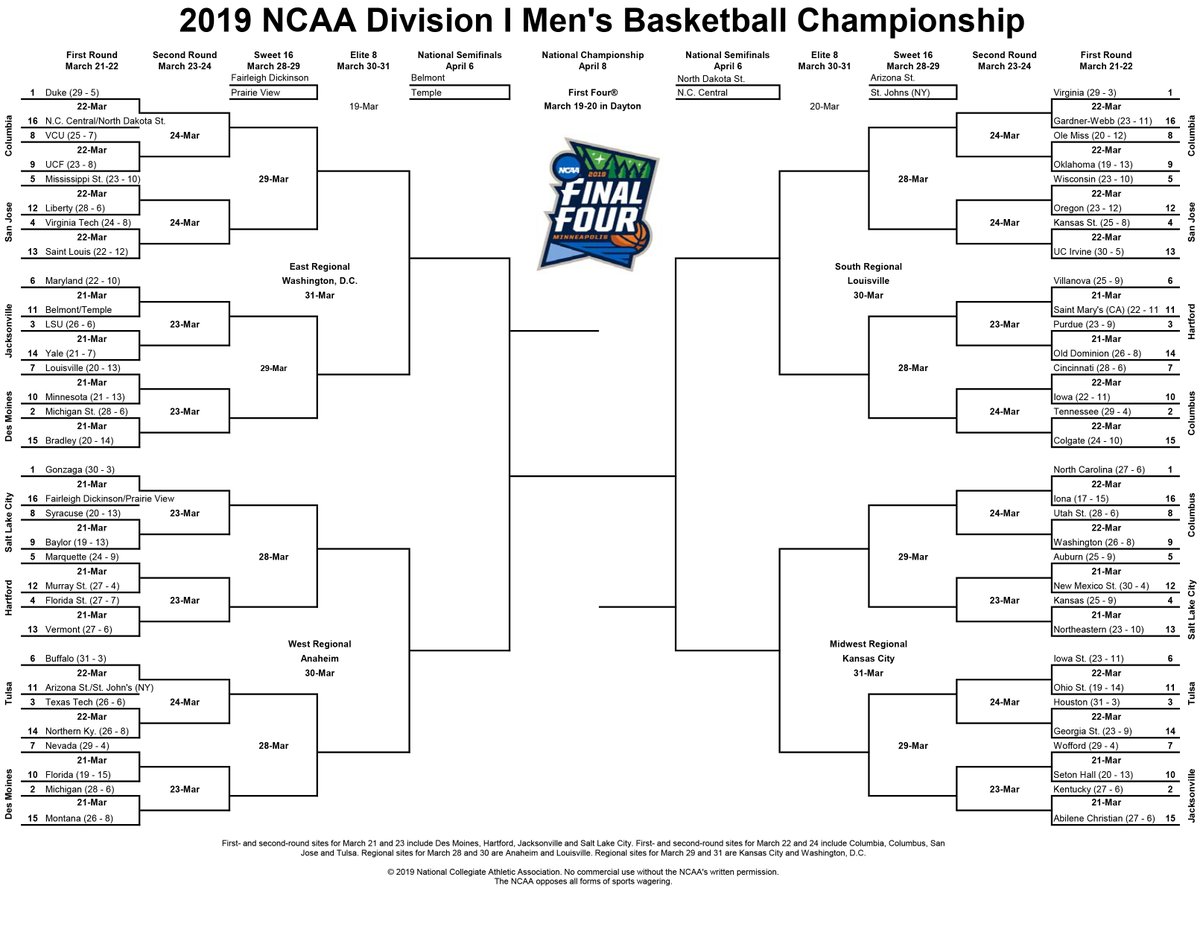
The 2019 March Madness tournament—officially the 2019 NCAA Division I Men's Basketball Tournament—concluded on April 8, 2019, with the Virginia Cavaliers securing their first national championship in program history. Virginia defeated the Texas Tech Red Raiders 85–77 in an overtime thriller at U.S. Bank Stadium in Minneapolis, completing one of college basketball’s greatest redemption stories.
The Road to Minneapolis: Setting the Stage for the 2019 Tournament
The 2019 NCAA Division I Men's Basketball Tournament began on March 19, 2019, with the First Four in Dayton, Ohio, and culminated in the National Championship game in Minneapolis. A field of 68 teams competed across four regionals—East, West, South, and Midwest—to determine the national champion.
Entering the tournament, the national spotlight was largely focused on the Duke Blue Devils, led by freshman phenom Zion Williamson alongside star teammates R.J. Barrett and Cam Reddish. Duke earned the top overall seed in the tournament, while the remaining No. 1 seeds were awarded to the Virginia Cavaliers (South), North Carolina Tar Heels (Midwest), and Gonzaga Bulldogs (West).
The 2019 tournament was characterized by an intriguing mix of high-powered offenses and elite defensive teams. While top-seeded programs controlled much of the regular-season narrative, the tournament field proved exceptionally balanced, leading to several overtime classic games, clutch buzzer-beaters, and unexpected runs by mid-tier seeds.
- 2019 NCAA FINAL FOUR BRACKET SUMMARY
- Semifinal 1: (1) Virginia defeated (5) Auburn (63-62)
- Semifinal 2: (3) Texas Tech defeated (2) Mich St (61-51)
- NATIONAL CHAMPION: (1) VIRGINIA (85-77 OT)
Virginia’s Path to Redemption: From Historic Defeat to National Champions
The central storyline of the 2019 tournament was Virginia’s path to redemption. Just one year earlier, in the 2018 NCAA Tournament, Virginia entered as the top overall seed but made unfortunate history by becoming the first No. 1 seed to lose to a No. 16 seed, falling to the UMBC Retrievers 74–54. Head coach Tony Bennett and his team faced immense scrutiny over the following twelve months.
Virginia returned in 2019 with a refined core built around guard Kyle Guy, point guard Ty Jerome, and forward De'Andre Hunter. Rather than shying away from their previous defeat, Bennett embraced the setback as part of their story, instilling a level of emotional resilience that defined their tournament run.
The Escape Against Gardner-Webb
The redemption journey hit an immediate test in the First Round against No. 16 seed Gardner-Webb. Virginia found themselves trailing by 14 points in the first half, stoking fears of another historical upset. However, Virginia responded with a disciplined second-half defensive display, outscoring Gardner-Webb 45–20 after halftime to secure a 71–56 victory.
The South Regional Final Miracle vs. Purdue
In the Elite Eight, Virginia matched up against the Purdue Boilermakers in one of the highest-quality games in tournament history. Purdue guard Carsen Edwards put on a legendary scoring display, putting up 42 points. Trailing 70–68 with less than six seconds remaining in regulation, Virginia’s Mamadi Diakite missed a free throw, but freshman guard Kihei Clark chased down the backcourt rebound and threw a 60-foot pass back to Diakite, who sank a floating jumper at the buzzer to force overtime. Virginia eventually won 80–75.
Final Four Drama Against Auburn
In the National Semifinal at U.S. Bank Stadium, Virginia faced the Auburn Tigers. Down by two points with 0.6 seconds left in regulation, Kyle Guy was fouled on a corner three-point attempt. Showing remarkable composure, Guy sank all three consecutive free throws under extreme pressure to lift Virginia to a 63–62 victory and secure their spot in the title game.
The Championship Game vs. Texas Tech
The National Championship game on April 8, 2019, pitted Virginia’s methodical Pack-Line defense against Chris Beard’s stifling Texas Tech defense. Texas Tech took a late lead in regulation, but De'Andre Hunter hit a game-tying three-pointer with 12.9 seconds left to force overtime tied at 68. In the extra period, Virginia’s offensive efficiency surged, outscoring Texas Tech 17–9 to seal an 85–77 victory. Kyle Guy was named the tournament's Most Outstanding Player (MOP), scoring 24 points in the final game, while Hunter added 27 points.
Regional Breakdown: Upsets, Elite Eight Thrillers, and Final Four Qualifiers
While Virginia dominated the narrative arc, each of the four regionals delivered significant tactical battles and high-stakes drama.
| Region | Winner | Seed |
|---|---|---|
| East (Wash. D.C.) | Michigan State | No. 2 Seed |
| West (Anaheim) | Texas Tech | No. 3 Seed |
| South (Louisville) | Virginia | No. 1 Seed |
| Midwest (Kan. C.) | Auburn | No. 5 Seed |
East Regional: Michigan State Halts Duke's Title Hopes
The East Region in Washington, D.C., was dominated by attention surrounding Duke. After escaping near-upsets against No. 9 UCF (77–76) and No. 4 Virginia Tech (75–73), Duke met Tom Izzo’s No. 2 seed Michigan State Spartans in the Elite Eight. Led by senior point guard Cassius Winston, who managed the tempo and scored 20 points, Michigan State executed precise secondary break actions and contested Duke's rim attempts. The Spartans earned a 68–67 victory, knocking off the tournament favorities to advance to the Final Four.
West Regional: Texas Tech’s Defensive Masterclass
In Anaheim, California, the West Region saw No. 3 seed Texas Tech break through to its first Final Four in school history. Guided by head coach Chris Beard, the Red Raiders deployed a high-pressure "no-middle" defense designed to force opponents toward the sidelines and baselines into secondary rim protection. Texas Tech defeated No. 2 seed Michigan 63–44 in the Sweet Sixteen before knocking off No. 1 seed Gonzaga 75–69 in the Regional Final, anchored by sophomore guard Jarrett Culver and forward Tariq Owens.
Midwest Regional: Auburn’s Historic Upset Run
The Midwest Region in Kansas City delivered the tournament's most volatile bracket run, courtesy of Bruce Pearl’s No. 5 seed Auburn Tigers. Auburn unleashed a high-tempo, three-point-heavy offense that knocked off traditional powerhouse programs in succession:
- Round of 32: Defeated No. 4 seed Kansas (89–75).
- Sweet Sixteen: Defeated No. 1 seed North Carolina (97–80).
- Elite Eight: Defeated No. 2 seed Kentucky (77–71 in overtime).
Auburn achieved this historic run despite losing key forward Chuma Okeke to an ACL tear during their Sweet Sixteen victory over North Carolina, highlighting the squad's remarkable rotation depth.
Standout Individual Performances and Star Players
The 2019 NCAA Tournament showcased several individual college basketball performances that left a lasting mark on tournament history.
Carsen Edwards (Purdue)
Purdue guard Carsen Edwards delivered one of the most remarkable shooting displays in March Madness history. Over four tournament games, Edwards scored 139 total points, including two separate 42-point outings against Villanova and Virginia. He set an NCAA Tournament record by making 28 three-pointers across four games, earning Regional Most Outstanding Player honors despite Purdue falling short of the Final Four.
Zion Williamson (Duke)
The 2019 Consensus National Player of the Year lived up to expectations on the tournament stage. Williamson averaged 22.6 points, 8.9 rebounds, 2.1 steals, and 1.8 blocks per game while shooting over 68% from the field across Duke’s four games. His athletic rim protection and transition dunking dominated national coverage throughout the first two weekends.
De'Andre Hunter (Virginia)
After missing the 2018 tournament due to a wrist injury, De'Andre Hunter proved to be Virginia’s tactical difference-maker in 2019. Hunter provided elite perimeter defense while matching opposing guards and forwards. His performance in the Championship Game—scoring a career-high 27 points while holding Texas Tech star Jarrett Culver to 5-of-22 shooting—solidified his status as a top NBA draft selection.
2019 NCAA Tournament Results Summary
The table below outlines the matchup results from the Regional Finals through the National Championship Game of the 2019 tournament.
| Game Stage | Winning Team | Opponent | Final Score | Key Game Factor / Highlight |
|---|---|---|---|---|
| East Regional Final | (2) Michigan State | (1) Duke | 68–67 | Cassius Winston scores 20 PTS; Spartans limit Duke's second-chance scoring. |
| West Regional Final | (3) Texas Tech | (1) Gonzaga | 75–69 | Texas Tech's "no-middle" defense forces 16 Gonzaga turnovers. |
| South Regional Final | (1) Virginia | (3) Purdue | 80–75 (OT) | Diakite hits buzzer-beater off Clark pass; Carsen Edwards scores 42 PTS for Purdue. |
| Midwest Regional Final | (5) Auburn | (2) Kentucky | 77–71 (OT) | Jared Harper and Bryce Brown combine for 50 PTS in overtime victory. |
| National Semifinal 1 | (1) Virginia | (5) Auburn | 63–62 | Kyle Guy sinks three consecutive free throws with 0.6 seconds remaining. |
| National Semifinal 2 | (3) Texas Tech | (2) Michigan State | 61–51 | Matt Mooney scores 22 PTS; Red Raiders hold Spartans to 31.9% shooting. |
| National Championship | (1) Virginia | (3) Texas Tech | 85–77 (OT) | De'Andre Hunter scores 27 PTS; Virginia outscores Texas Tech 17–9 in overtime. |
Tactical Insights: Defensive Systems That Dominated the 2019 Tournament
The 2019 March Madness tournament served as a tactical masterclass in elite defensive design. The championship game between Virginia and Texas Tech featured two distinct defensive philosophies that reshaped how coaches approach half-court defense.
Virginia's Pack-Line Defense
Designed by Dick Bennett and perfected by Tony Bennett, the Pack-Line defense is a sagged-man-to-man system. Only one player pressures the ballhandler, while the remaining four defenders position themselves inside an imaginary "pack line" located two feet inside the three-point arc.
- Primary Objective: Deny dribble penetration, eliminate easy paint scores, and force contested perimeter shots late in the shot clock.
- Execution in 2019: Virginia led the nation in defensive efficiency, limiting opponents to low shooting percentages by closing out cleanly without fouling.
Texas Tech's No-Middle Defense
Coach Chris Beard and assistant Mark Adams popularized the side/baseline positioning known as the "no-middle" scheme.
- Primary Objective: Completely deny the middle of the floor. On-ball defenders force ballhandlers toward the sidelines and corners.
- Execution in 2019: When an offensive player drives along the baseline, designated help-side defenders rotate over aggressively, trapping the driver against the boundary line. This tactic paralyzed high-scoring offenses like Gonzaga and Michigan State throughout their tournament run.
Frequently Asked Questions About 2019 March Madness
Who won the 2019 March Madness national championship?
The Virginia Cavaliers won the 2019 NCAA Division I Men's Basketball National Championship, defeating the Texas Tech Red Raiders 85–77 in overtime on April 8, 2019.
Where was the 2019 Final Four held?
The 2019 Final Four was hosted at U.S. Bank Stadium in Minneapolis, Minnesota, with the National Semifinals played on April 6 and the Championship Game played on April 8.
Who was awarded the Most Outstanding Player (MOP) in 2019?
Virginia guard Kyle Guy was named the Most Outstanding Player of the 2019 Final Four. Guy scored 15 points in the semifinal win over Auburn—including three pressure free throws with 0.6 seconds left—and added 24 points in the championship game against Texas Tech.
How many No. 1 seeds reached the 2019 Final Four?
Only one No. 1 seed reached the Final Four in 2019: the Virginia Cavaliers (South Region). Top seeds Duke, North Carolina, and Gonzaga were eliminated in the Elite Eight and Sweet Sixteen rounds.
What record did Carsen Edwards set during the 2019 tournament?
Purdue guard Carsen Edwards set the NCAA Tournament record for the most single-tournament three-pointers made, sinking 28 three-pointers across just four games.
Legacy and Archival Resources for College Basketball Fans
The 2019 March Madness tournament remains a landmark event in college basketball history, demonstrating how structural resilience, defensive scheme discipline, and late-game execution define championship programs. Virginia’s transition from a historic first-round loss in 2018 to national champions in 2019 stands as one of the most extraordinary turnarounds in modern sports.
For fans, analysts, and sports historians seeking official stats, game tape, or complete historical box scores, verified tournament archives are preserved directly by the NCAA and official collegiate athletic databases:
- Official NCAA Tournament Statistics & Records: Access historical bracket results, team box scores, and all-time tournament records directly on the NCAA Official Website.
- Detailed Player & Team Game Logs: Detailed historical metrics, play-by-play analytics, and advanced rating stats for every 2019 tournament matchup can be verified through Sports Reference College Basketball.