The 2002 World Series was a historic all-California matchup between the Anaheim Angels and the San Francisco Giants. As the first Fall Classic to feature two Wild Card teams, it concluded with the Angels winning their first championship in seven games, fueled by a legendary Game 6 comeback and the iconic "Rally Monkey" phenomenon.
The Path of the Two Wild Cards
The 2002 Major League Baseball season culminated in a way that forever changed the perception of the postseason structure. Before 2002, the Wild Card was often seen as a secondary path to the title, but this series proved that momentum entering October was more valuable than a division title. The San Francisco Giants finished the regular season with 95 wins, trailing the Arizona Diamondbacks in the NL West. Meanwhile, the Anaheim Angels amassed 99 wins—the most in franchise history at the time—yet finished four games behind the juggernaut Oakland Athletics in the AL West.
Both teams had to navigate a rigorous playoff bracket. The Angels dismantled the defending champion New York Yankees in the ALDS and then handled the Minnesota Twins in five games in the ALCS. The Giants took a more dramatic route, upsetting the Atlanta Braves in a five-game NLDS before defeating the St. Louis Cardinals in the NLCS. By the time both teams met in October, the "All-California" narrative took center stage, marking the first time two teams from the Golden State faced off in the World Series since the 1989 "Earthquake Series."
Key Players and Roster Analysis
The 2002 World Series featured a clash of philosophies. The Giants were built around the sheer offensive gravity of Barry Bonds, who was in the midst of the most dominant statistical stretch in baseball history. Conversely, the Angels utilized a "relentless" style of play, emphasizing high-contact hitting, aggressive baserunning, and a deep, specialized bullpen.
The San Francisco Giants' Power Core
Barry Bonds was the focal point of every scouting report. During the 2002 postseason, Bonds was virtually pitched around, setting a record for walks in a seven-game series (13). When he did see a pitch, he capitalized, hitting .471 with four home runs during the Fall Classic. Supporting Bonds were veterans like Jeff Kent, who provided elite production from second base, and J.T. Snow, a defensive wizard at first base. The rotation was led by Jason Schmidt and Russ Ortiz, with Robb Nen serving as a high-velocity closer, though he was battling significant arm injuries during the stretch.
The Anaheim Angels' Balanced Attack
Managed by Mike Scioscia, the Angels relied on a lineup with no easy outs. Troy Glaus, the eventual World Series MVP, provided the power, while Garret Anderson and Tim Salmon offered veteran stability and run production. A defining characteristic of the 2002 Angels was the emergence of 20-year-old rookie Francisco Rodriguez (nicknamed "K-Rod"). Rodriguez had only made a handful of regular-season appearances but became a postseason weapon, tying a record with five wins in a single postseason. Behind him sat Troy Percival, one of the league's premier closers, supported by bridge relievers Brendan Donnelly and Ben Weber.
2002 World Series Game-by-Game Results
The following table outlines the results of the seven-game series, highlighting the back-and-forth nature of the contest.
| Game | Date | Venue | Winner | Final Score | Winning/Losing Pitcher |
|---|---|---|---|---|---|
| 1 | Oct 19 | Edison Field | Giants | 4–3 | Schmidt / Washburn |
| 2 | Oct 20 | Edison Field | Angels | 11–10 | Rodriguez / Rodriguez (F) |
| 3 | Oct 22 | Pacific Bell Park | Angels | 10–4 | Ortiz (R) / Hernandez |
| 4 | Oct 23 | Pacific Bell Park | Giants | 4–3 | Worrell / Rodriguez |
| 5 | Oct 24 | Pacific Bell Park | Giants | 16–4 | Zerbe / Washburn |
| 6 | Oct 26 | Edison Field | Angels | 6–5 | Donnelly / Worrell |
| 7 | Oct 27 | Edison Field | Angels | 4–1 | Lackey / Hernandez |
The Anatomy of the Game 6 Comeback
The 2002 World Series is perhaps best remembered for Game 6, which many historians rank among the greatest single games in MLB history. Entering the bottom of the 7th inning, the Giants held a commanding 5-0 lead. They were just eight outs away from their first championship since moving to San Francisco. Giants manager Dusty Baker even pulled starter Russ Ortiz after he allowed two baserunners, famously handing him the "game ball" as he walked off the mound—a gesture that would later be viewed as premature.
The momentum shifted when Scott Spiezio hit a three-run home run off Felix Rodriguez, cutting the lead to 5-3. The Anaheim crowd, fueled by the "Rally Monkey" video on the scoreboard and "Thundersticks" noise-makers, reached a fever pitch. In the 8th inning, Darin Erstad led off with a solo home run to make it 5-4. Following hits by Tim Salmon and Garret Anderson, Troy Glaus delivered a clutch two-run double that vaulted the Angels into a 6-5 lead. Troy Percival closed the door in the 9th, forcing a Game 7 and devastating the Giants' morale.
Game 7: The Rookie and the Clincher
While Game 6 was the emotional peak, Game 7 was a masterclass in poise. The Angels turned to rookie John Lackey, making him the first rookie to start and win a World Series Game 7 since 1909. Lackey pitched five strong innings, allowing only one run.
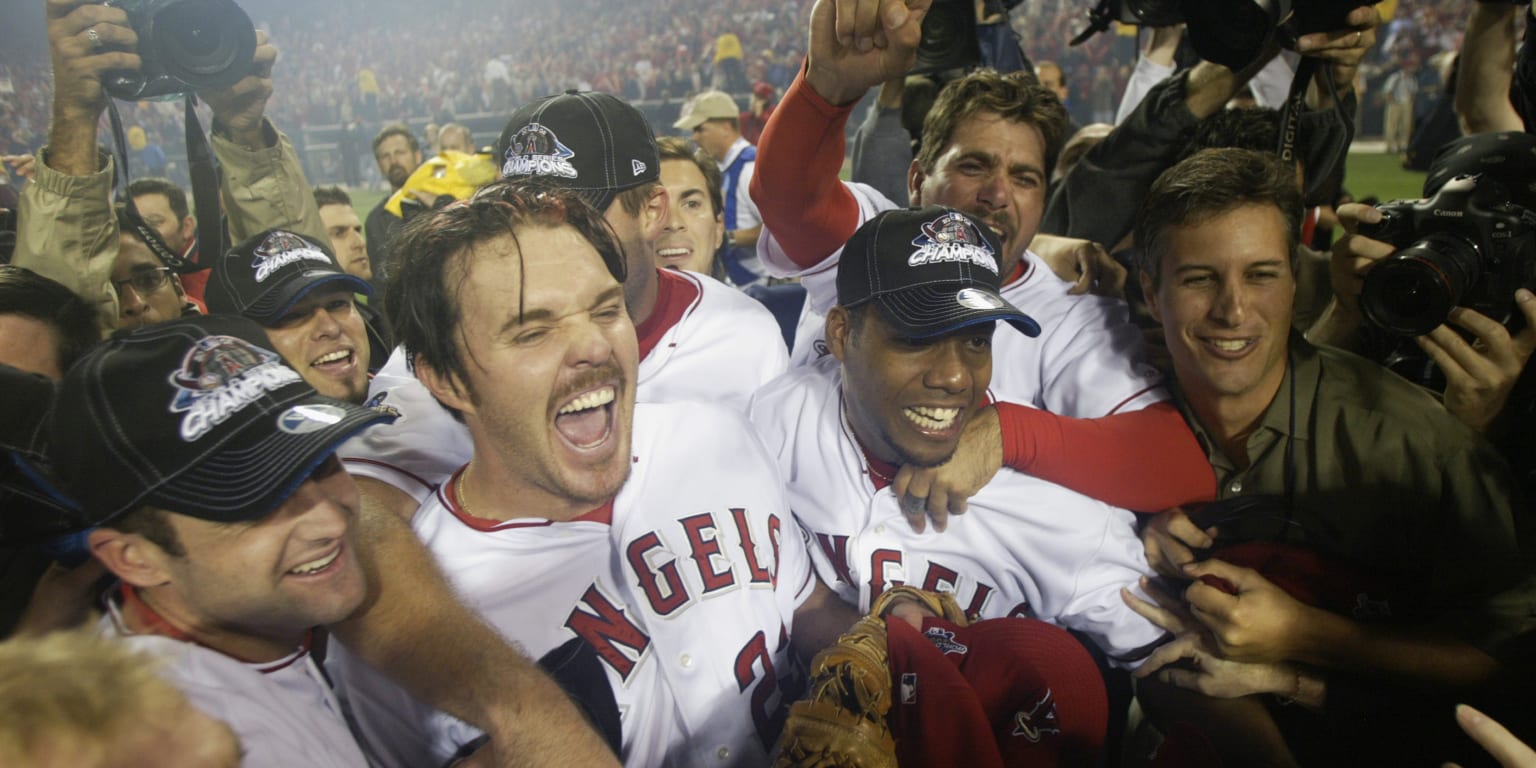
The Angels' offense provided early support, specifically through a three-run double by Garret Anderson in the 3rd inning. The bullpen—the backbone of the team throughout the season—took over from there. Donnelly, Rodriguez, and Percival combined for four scoreless innings of relief. When Darin Erstad squeezed the final fly ball out in center field, the Angels secured their first World Series title in their 42-year history. Troy Glaus was named MVP, finishing the series with a .385 average, three home runs, and eight RBIs.
Historical Significance and the "Rally Monkey" Legacy
As of 2026, the 2002 World Series remains the only championship in the Los Angeles Angels' franchise history. It validated the "small ball" and "bullpen-first" approach that Mike Scioscia championed, which influenced MLB managerial strategies for years to come.
The series was also a cultural phenomenon due to the Rally Monkey. Originally a 1999 clip from the movie Ace Ventura: Pet Detective used to entertain fans during a lopsided game, the monkey became a symbol of the Angels' comeback spirit in 2002. It remains one of the most successful marketing and psychological tools in sports history, illustrating how home-field atmosphere can impact high-stakes performance.
For the San Francisco Giants, 2002 served as a painful "nearly" moment. It would take another eight years before the Giants finally secured a championship in San Francisco (2010), beginning a "dynasty" period of three titles in five years. However, the 2002 loss remains a focal point for fans when discussing the career of Barry Bonds, as it was his only World Series appearance.
Frequently Asked Questions
Who won the 2002 World Series MVP?
Troy Glaus was named the 2002 World Series MVP. The Angels' third baseman hit .385 with three home runs and eight RBIs over the seven-game stretch. His most critical contribution was the go-ahead two-run double in the bottom of the 8th inning of Game 6, which completed one of the greatest comebacks in baseball history.
What was unique about the matchup in the 2002 World Series?
The 2002 World Series was the first time in MLB history that two Wild Card teams met in the Fall Classic. It was also an all-California series, featuring the Anaheim Angels (American League) and the San Francisco Giants (National League). This setup highlighted the competitive depth of the California teams and the effectiveness of the Wild Card system introduced in 1994.
What is the "Rally Monkey" and how did it start?
The Rally Monkey is a white-haired capuchin monkey that appeared on the Edison Field scoreboard to encourage fans to cheer during Angels' home games. It debuted in 2000 but became a national sensation during the 2002 World Series. The monkey would appear when the Angels were trailing or tied in the late innings, accompanied by the "Jump Around" song and the words "Rally Monkey!"
How many home runs did Barry Bonds hit in the 2002 World Series?
Barry Bonds hit four home runs during the 2002 World Series. Despite the Angels' pitching staff frequently walking him—intentionally or otherwise—Bonds remained highly productive, finishing the series with a .471 batting average, 13 walks, and an incredible 1.294 slugging percentage.
Who was the winning pitcher of Game 7 in 2002?
John Lackey was the winning pitcher in Game 7. He became the first rookie in 93 years to start and win the deciding seventh game of a World Series. Lackey's performance was pivotal, as he provided the stability the Angels needed to bridge the gap to their elite bullpen after the emotional exhaustion of the Game 6 comeback.
Recommended Viewing and Archival Resources
To fully appreciate the tactical depth of the 2002 World Series, enthusiasts should review the Official 2002 World Series Film produced by Major League Baseball. This documentary provides behind-the-scenes footage and mic'd-up segments that clarify the decision-making of Mike Scioscia and Dusty Baker. Additionally, statistical archives at Baseball-Reference offer a pitch-by-pitch breakdown of Barry Bonds’ historic plate appearances and the performance of the Angels’ relief corps. Exploring these resources provides a clearer picture of why this series is considered a watershed moment for modern baseball strategy.