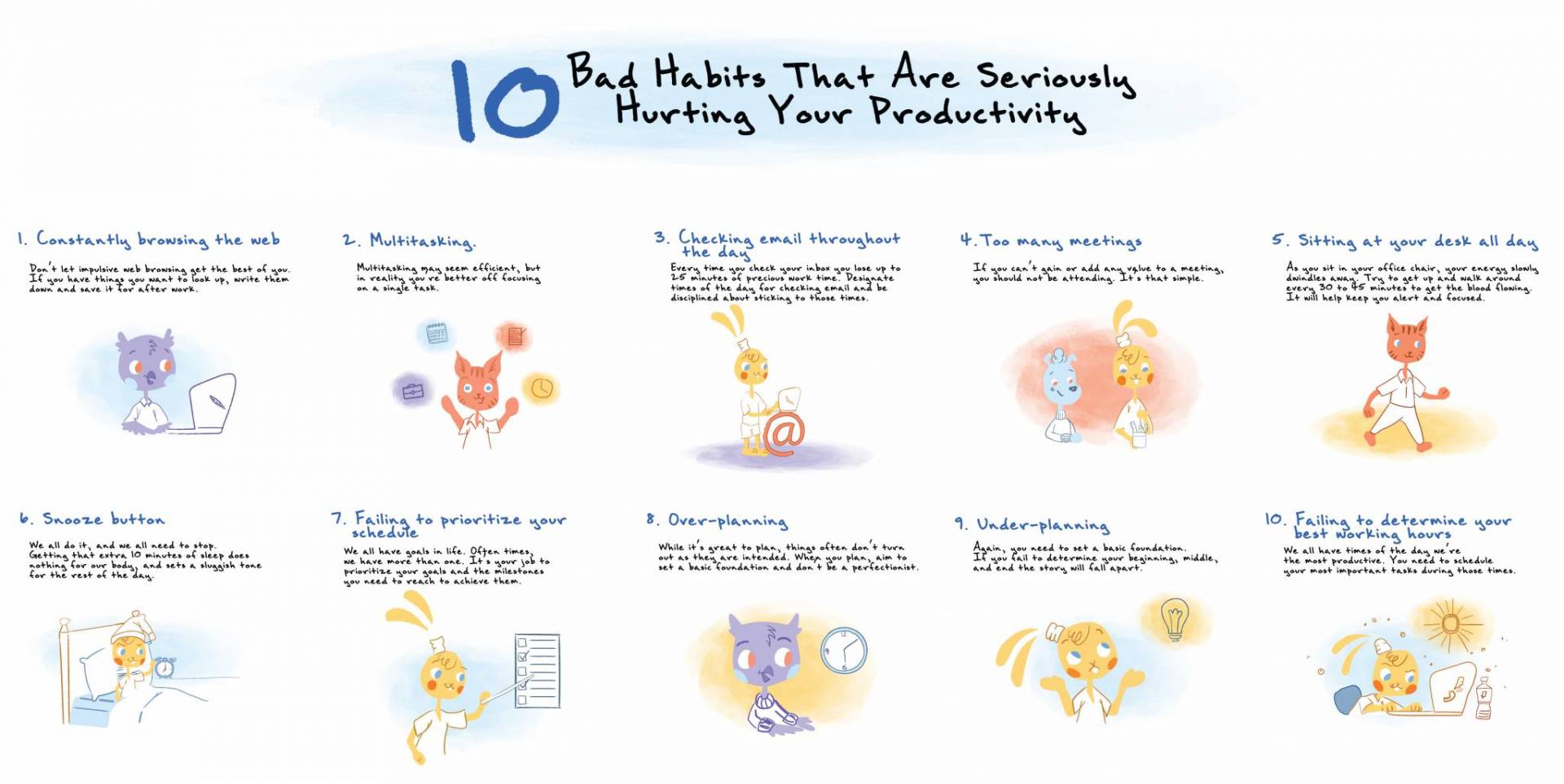
To skyrocket your productivity, you must transition from relying on fleeting motivation to implementing automated systems. By adopting core habits such as time blocking, deep work protocols, and the Eisenhower Matrix, you reduce decision fatigue and optimize cognitive energy. Success in 2026 requires mastery over your digital environment and a biological commitment to recovery.
The Foundation of Peak Performance: Why Habits Outperform Willpower
In the competitive landscape of 2026, the primary differentiator between high achievers and the average professional is not innate talent, but the strength of their behavioral architecture. Willpower is a finite cognitive resource, governed by the prefrontal cortex. When we rely on willpower to complete tasks, we gradually deplete our energy, leading to "decision fatigue" by mid-afternoon. Habits, conversely, are processed in the basal ganglia—a region of the brain responsible for automatic behaviors. By converting complex workflows into habits, you bypass the need for constant motivation, allowing your brain to execute high-value tasks with minimal resistance.
Understanding the "Habit Loop"—consisting of a cue, a routine, and a reward—is essential for any productivity overhaul. To skyrocket your output, you must identify the triggers that lead to procrastination and consciously replace them with productive routines. This scientific approach to behavior ensures that your peak performance becomes a default state rather than a sporadic occurrence.
1. Master Strategic Time Blocking and Energy Management
Time blocking is the practice of partitioning your day into distinct segments dedicated to specific tasks or categories. Unlike a standard to-do list, which often leads to "cherry-picking" easy tasks, time blocking forces you to confront the reality of your limited hours. In 2026, the most effective practitioners use "Energy-Based Time Blocking," which aligns task difficulty with their natural circadian rhythms.
Most individuals experience a peak in cognitive function roughly two to three hours after waking. This is the optimal window for complex problem-solving or creative work. Conversely, the post-lunch "circadian dip" is better suited for administrative duties or low-stakes communication. By defending your "Golden Hours" through strict calendar management, you ensure that your highest-value work receives your highest-quality energy.
2. Implement Deep Work Protocols
Coined by Cal Newport, the concept of Deep Work refers to professional activities performed in a state of distraction-free concentration that push your cognitive capabilities to their limit. These efforts create new value, improve your skill, and are hard to replicate. To make deep work a habit, you must establish a "monastic" environment—silencing all notifications, closing irrelevant tabs, and communicating your unavailability to colleagues.
The neurological benefit of deep work lies in the insulation of neural pathways. When you focus intensely on a single task, your brain triggers the production of myelin, a fatty substance that wraps around neurons, allowing signals to fire more efficiently. In an era dominated by rapid-fire digital interruptions, the ability to concentrate for 90-to-120-minute intervals is a "superpower" that significantly increases both the quality and quantity of your output.
3. Prioritization via the Eisenhower Matrix
Not all tasks are created equal. The Eisenhower Matrix is a productivity framework that categorizes tasks into four quadrants based on urgency and importance. To skyrocket productivity, you must habituate the practice of operating primarily in Quadrant II: Important but Not Urgent.
- Quadrant I (Urgent and Important): Crises and deadlines. These must be handled immediately but often lead to burnout.
- Quadrant II (Not Urgent but Important): Strategy, relationship building, and skill development. This is where long-term growth happens.
- Quadrant III (Urgent but Not Important): Interruptions and most emails. These should be delegated or minimized.
- Quadrant IV (Neither Urgent nor Important): Time-wasters. These should be eliminated.
By spending more time in Quadrant II, you prevent future crises in Quadrant I, creating a proactive rather than reactive professional life.
4. Strategic Recovery and Ultradian Rhythms
Productivity is not about working more hours; it is about managing the intensity of the hours you work. The human body operates on "ultradian rhythms," which are cycles of approximately 90 minutes of high-frequency brain activity followed by 20 minutes of lower-frequency activity. Ignoring these natural cycles leads to the "law of diminishing returns," where every additional hour worked produces less value.
Integrating strategic recovery breaks into your daily habit stack is non-negotiable. A 20-minute break that involves movement, hydration, or a change of scenery allows the brain to flush out metabolic waste and consolidate information. Research from the American Psychological Association suggests that brief diversions from a task can dramatically improve focus over long periods.
5. Digital Minimalism and Notification Control
The "Attention Economy" of 2026 is designed to fragment your focus. Each notification triggers a micro-release of dopamine, conditioning your brain to seek out distractions. To regain control, you must adopt a habit of digital minimalism. This involves "batching" communication—checking emails and messages only at specific times (e.g., 11:00 AM and 4:00 PM) rather than reacting to every ping in real-time.
Furthermore, utilize "Focus Modes" on your devices to whitelist only essential applications during deep work sessions. By reducing the "cost of switching"—the cognitive drain that occurs when you move from one task to another—you preserve your mental bandwidth for the work that actually moves the needle.
6. Utilizing the Two-Minute Rule for Micro-Tasks
A significant portion of mental stress comes from "open loops"—small, unfinished tasks that linger in our subconscious. The "Two-Minute Rule," popularized by David Allen in his Getting Things Done methodology, states that if a task takes less than two minutes to complete, you should do it immediately rather than adding it to a list or filing it for later.
This habit prevents the accumulation of "administrative debt." Whether it is replying to a simple confirmation email, filing a receipt, or tidying a desk, executing these tasks instantly keeps your mental workspace clear. It leverages the "Zeigarnik Effect," a psychological phenomenon where people remember uncompleted tasks better than completed ones, which can cause persistent underlying anxiety.
Comparison of Common Productivity Methodologies
The following table compares established frameworks to help you determine which habit stack fits your specific professional needs in 2026.
| Framework | Primary Focus | Best For | Key Metric |
|---|---|---|---|
| Pomodoro Technique | Sustaining Focus | Repetitive or tedious tasks | Intervals Completed |
| Getting Things Done (GTD) | Mental Clarity | Complex, multi-project roles | Inbox Zero/Open Loops |
| Eat the Frog | Procrastination | Overcoming task avoidance | Daily "Big Win" |
| Time Blocking | Schedule Control | High-level strategy & Deep work | Calendar Integrity |
| Agile Personal Mgmt | Iterative Growth | Software & Creative projects | Velocity/Sprint Goals |
7. Data-Driven Review: Weekly and Monthly Audits
You cannot optimize what you do not measure. A powerful habit of high-performing individuals is the "Weekly Review." Every Sunday or Friday afternoon, spend 30 minutes auditing your progress. Ask yourself: What were the biggest wins? Where did I lose time? Did my actions align with my 2026 quarterly goals?
This habit serves as a course correction mechanism. It allows you to identify patterns—such as a specific type of meeting that always runs long or a recurring distraction—and implement solutions before the next week begins. It transforms your career from a series of random events into a calculated progression toward specific outcomes.
8. The Habit of "Just-in-Time" Learning
In the rapidly evolving economy of 2026, information becomes obsolete quickly. Traditional "Just-in-Case" learning—consuming information you might need someday—often leads to information overload and low retention. Instead, adopt the habit of "Just-in-Time" learning.
This means focusing your educational efforts strictly on the skills required for your current or upcoming projects. By immediately applying what you learn, you move knowledge from short-term memory to long-term mastery. This targeted approach ensures that your learning habits directly contribute to your productivity rather than serving as a sophisticated form of procrastination.
9. Morning and Evening Rituals for Cognitive Clarity
How you start and end your day dictates the quality of the hours in between. A morning ritual should be designed to prime your brain for focus, avoiding the "reactive mode" of checking social media or news immediately upon waking. This might include light movement, meditation, or reviewing your "Rule of Three" (the three most important tasks for the day).
The evening ritual is equally critical for "shutdown" procedures. By formally ending your workday—closing your laptop and writing down a plan for the next morning—you allow your brain to enter a state of true rest. This prevents the "carry-over" stress that often leads to insomnia and decreased morning productivity.
10. Optimizing Biological Foundations
Productivity is an emergent property of a healthy body. No amount of time management can compensate for chronic sleep deprivation or poor nutrition. In 2026, peak performers treat their bodies like professional athletes. This includes prioritizing 7–9 hours of sleep to facilitate glympathic system clearance (the brain's waste removal process) and maintaining consistent hydration.
According to the Centers for Disease Control and Prevention (CDC), insufficient sleep is linked to lapses in attention and delayed reactions. By habituating consistent sleep hygiene and regular physical activity, you increase your baseline "power output," making every hour you work more effective.
How long does it take to form a new productivity habit?
While the popular myth suggests 21 days, a 2026 perspective based on longitudinal studies indicates that habit formation takes, on average, 66 days. The complexity of the task and your existing environment play significant roles. Consistency is more important than intensity; missing one day does not derail the process, but missing two consecutive days significantly reduces the likelihood of the habit "sticking."
Can multitasking actually improve productivity if the tasks are simple?
Neurologically, the human brain is not capable of multitasking; it is only capable of "task-switching." Even with simple tasks, there is a "switch cost" that reduces overall efficiency by up to 40%. Habitually focusing on one task at a time (monotasking) is always more productive than attempting to divide your attention, as it preserves cognitive energy and reduces errors.
What should I do if my job environment doesn't allow for deep work?
If you work in an open office or a high-interruption environment, you must negotiate "Focus Windows" with your team or utilize physical cues like noise-canceling headphones. Many organizations in 2026 have adopted "No-Meeting Wednesdays" or specific hours for synchronous communication to accommodate the deep work requirements of their employees.
How does the "Rule of Three" differ from a standard to-do list?
A standard to-do list is often an exhaustive inventory of everything you could do, which leads to overwhelm. The "Rule of Three" is a habit of selecting only the three most impactful outcomes you commit to achieving by the end of the day. This creates a clear definition of success and ensures that your energy is directed toward your most significant goals first.
Is digital minimalism still relevant with AI-assisted productivity tools?
Yes, digital minimalism is more relevant than ever. While AI tools can speed up execution, they also increase the volume of information you must process. Without a minimalist habit, you risk being overwhelmed by "AI-generated noise." The goal is to use AI as a tool for leverage while maintaining a distraction-free environment for the critical thinking that machines cannot replicate.
Implementing Your Performance Audit
To begin skyrocketing your productivity immediately, do not attempt to implement all ten habits at once. Habit stacking—the process of adding a new habit to an existing one—is the most effective strategy. Start by conducting a "Time Audit" for the next three days to identify where your energy is currently leaking. Once you have identified your primary "productivity killers," select one habit (such as the Two-Minute Rule or Time Blocking) and commit to it for 30 days before adding the next. This incremental approach ensures long-term behavioral change and sustainable high performance throughout 2026 and beyond.