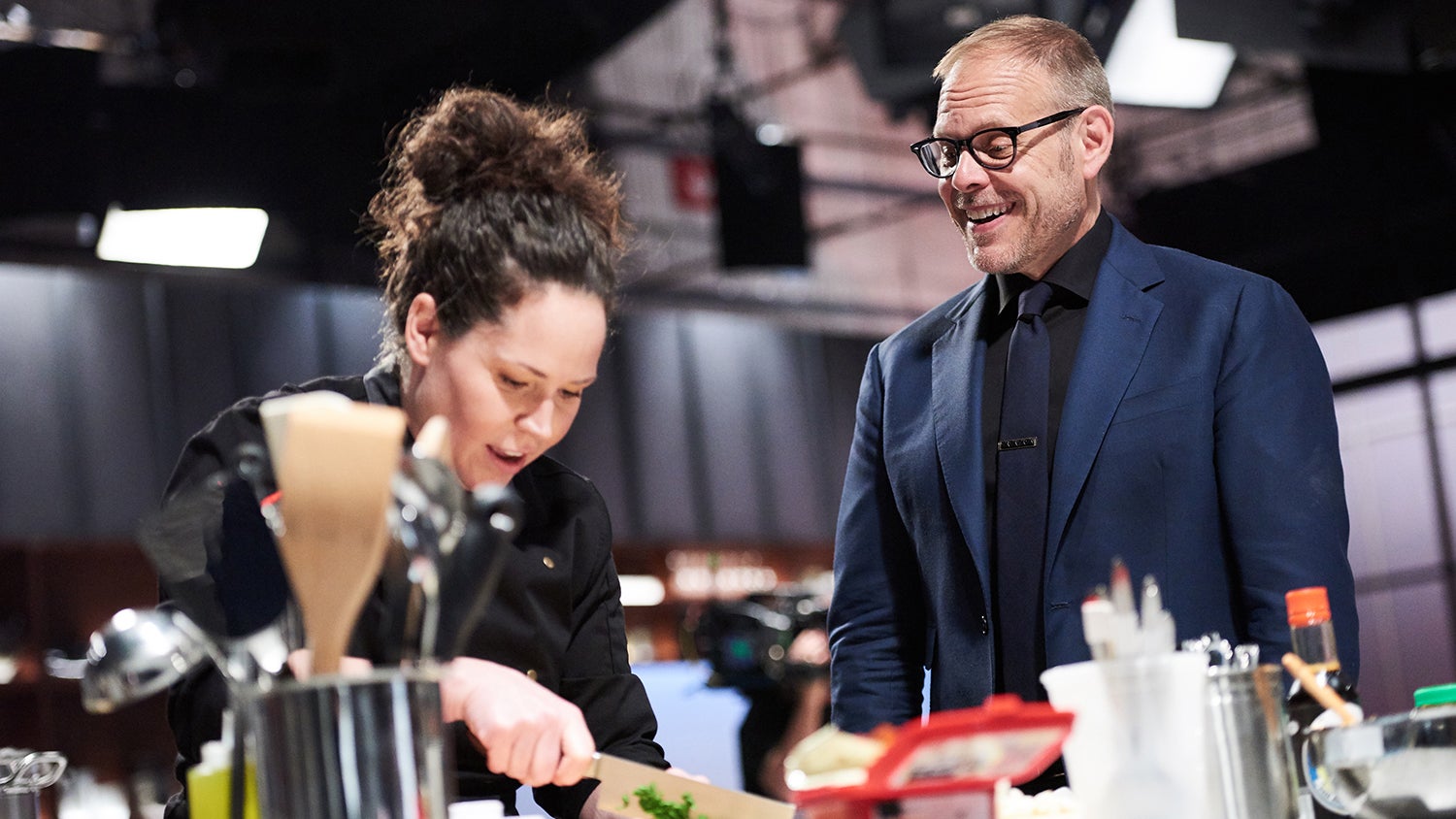
Alton Brown’s decision to become a chef was primarily driven by his dissatisfaction with the state of television cooking shows in the early 1990s. As a professional cinematographer, he believed that food programming was dull and lacked scientific depth. He chose to attend culinary school specifically to gain the professional legitimacy required to create Good Eats, a show that blended science, history, and humor.
The Cinematography Roots: Life Before the Kitchen
Before he was a household name on the Food Network, Alton Brown spent the 1980s and early 1990s behind the camera. His background was not in hospitality, but in film and video production. He studied film at the University of Georgia and eventually established a successful career as a cinematographer and director of television commercials.
Perhaps his most notable pre-culinary claim to fame was serving as the Director of Photography for the music video of R.E.M.'s "The One I Love." This technical background is crucial to understanding his later success. Unlike other chefs who learned to cook and then tried to figure out how to be on TV, Brown was a media professional who decided to learn how to cook to fill a specific void in the media landscape. His understanding of lighting, camera angles, and visual storytelling became the bedrock of his unique presentation style, which often featured "POV" shots from inside ovens or refrigerators.
The Catalyst of Boredom: Dissatisfaction with 1990s Food Media
The true inspiration for Brown’s career shift occurred during his off-hours as a director. He found himself watching a great deal of food television—largely because he enjoyed cooking as a hobby—but he was consistently frustrated by what he saw. In the early 90s, the "stand and stir" model dominated the airwaves. Shows typically featured a chef standing behind a counter, reciting a recipe, and performing tasks without explaining the underlying mechanics of why those tasks were necessary.
Brown realized that there were two major elements missing from the culinary media of the time:
- The Science of Food: Most shows told you to set the oven to 350 degrees, but none explained what happened to the proteins and sugars at that specific temperature.
- Entertainment Value: The shows were often dry and academic, lacking the narrative drive or humor that characterized other genres of television.
He famously noted that he wanted to create a program that was a cross between Julia Child, Mr. Wizard, and Monty Python. This realization was the "lightning bolt" moment. He didn't just want to be a chef; he wanted to reinvent how cooking was taught to the public.
The Strategy: Gaining "Street Cred" at the New England Culinary Institute
Unlike many who decide to switch careers on a whim, Brown approached his transition with the precision of a producer. He knew that if he walked into a network office and said, "I'm a camera guy with a good idea for a cooking show," he would be laughed out of the room. He needed "street cred"—a professional credential that proved he knew his way around a French knife as well as a Panavision camera.
In 1994, Brown moved to Montpelier, Vermont, to enroll in the New England Culinary Institute (NECI). This was a grueling period of his life. He was older than many of his classmates and was essentially starting from zero in a highly disciplined environment. However, his time at NECI was not just about learning mother sauces. He used his time in the kitchen to "field test" the concepts that would eventually become the episodes of Good Eats. He looked at every technique through the lens of a skeptic, asking his instructors "Why?" until he found the scientific root of the instruction.
The Theoretical Framework of Good Eats
While still in culinary school, Brown began drafting the blueprints for what would become his magnum opus. He didn't just write recipes; he wrote treatments. He viewed every ingredient as a character and every culinary process as a plot point. This intellectual approach to food is what eventually separated him from the "Emeril" era of high-energy, catchphrase-heavy cooking.
Brown’s inspiration was rooted in the idea of "culinary literacy." He believed that if a viewer understood the physics of heat transfer or the chemistry of leavening agents, they wouldn't need to follow a recipe line-by-line—they would understand the "how" and "why," allowing them to become better, more confident cooks. This philosophy of empowerment through education remains his most significant contribution to the industry.
Comparison of Traditional 90s Cooking Shows vs. Alton Brown’s Approach
| Feature | Traditional 90s "Stand and Stir" | Alton Brown’s Good Eats |
|---|---|---|
| Primary Goal | To demonstrate a specific recipe. | To explain a culinary technique or science. |
| Visual Style | Static, medium-wide shots. | Dynamic, POV shots, and creative lighting. |
| Tone | Formal, instructional, or overly chipper. | Informative, quirky, and self-deprecating. |
| Focus | Result-oriented (The Finished Dish). | Process-oriented (The Molecular Change). |
| Tools | Standard kitchen appliances. | Hardware store gadgets and modified tools. |
| Content Sources | Traditions and regional recipes. | Science, history, and pop culture. |
The Enduring Influence of Julia Child and Mr. Wizard
To understand what inspired Brown, one must look at his influences. He frequently cites Julia Child not just for her recipes, but for her fearlessness. Child wasn't afraid to make mistakes on camera, and she treated the audience as intelligent partners. Brown took this a step further by incorporating the educational style of Mr. Wizard’s World, a popular science show for children.
By utilizing props, cardboard cutouts, and visual metaphors (like using firecrackers to represent the expansion of steam in popovers), Brown demystified the kitchen. He drew inspiration from the humor of Monty Python to ensure the show never felt like a lecture. This trifecta of influences—technique, science, and absurdity—created a new sub-genre of television: the "edutainment" cooking show.
From Pilot to Powerhouse: The Food Network Era
In 1997, Brown produced two pilot episodes of Good Eats using his own money and resources. These pilots were shopped around until they eventually found a home on the Food Network in 1999. The network was initially skeptical; the show looked nothing like anything else on their lineup. It was fast-paced, oddly lit, and involved a lot of talking to puppets and imaginary neighbors.
However, the audience response was immediate. Viewers who were previously intimidated by the kitchen found Brown’s logic-based approach refreshing. He became the "geek" of the food world, a title he embraced. Over the next two decades, his career expanded into hosting Iron Chef America, Cutthroat Kitchen, and various live tours, but the core inspiration—the desire to fix broken food media—remained constant.
Why 2026 Still Values the "Alton Brown Method"
As of 2026, the culinary world has seen a massive shift toward short-form, high-speed social media content. Yet, Alton Brown’s methodical, science-first approach remains the gold standard for long-form instruction. In an era of "food hacks" that often fail, Brown’s verified, physics-based methods provide a level of reliability that audiences still crave.
His inspiration to become a chef wasn't about a love for the "glamour" of the restaurant industry; in fact, Brown has often been vocal about his lack of desire to run a commercial kitchen. He became a chef to be a better communicator. By merging the world of the director with the world of the saucier, he changed the DNA of food television forever.
Frequently Asked Questions
Did Alton Brown ever work as a professional chef in a restaurant?
While Alton Brown graduated from the New England Culinary Institute and completed an internship (externship) at a restaurant in the Green Mountains of Vermont, he did not pursue a long-term career as a line chef or executive chef in a traditional restaurant setting. His goal was always to use his culinary training for media production rather than restaurant management.
What degree does Alton Brown have?
Alton Brown holds a degree from the New England Culinary Institute (NECI), which he earned in the mid-1990s. Prior to that, he studied film at the University of Georgia, though he famously completed his remaining credits to officially receive his drama degree years after he had already become famous.
Why did Alton Brown focus so much on "unitaskers"?
One of Brown's most famous philosophies is his hatred for "unitaskers"—kitchen tools that only perform one job (with the exception of the fire extinguisher). This was inspired by his desire for efficiency and his background in film production, where every piece of equipment must be versatile and justify its space in the kit.
Is Good Eats still relevant in 2026?
Yes, Good Eats remains relevant because it focuses on the fundamental laws of physics and chemistry, which do not change. While kitchen trends and specific ingredients may go in and out of style, the way heat interacts with moisture or how acids break down connective tissue remains constant, making his "science-first" episodes timeless.
Who were the main people who inspired Alton Brown's style?
The three primary influences on Alton Brown’s style were Julia Child (for her technique and approachable personality), Don Herbert, also known as Mr. Wizard (for his ability to explain complex science through simple experiments), and the comedy troupe Monty Python (for their surrealist humor and non-linear storytelling).
What should aspiring culinary creators learn from Alton Brown's journey?
The most important lesson is the value of "interdisciplinary expertise." Brown didn't just learn to cook; he combined cooking with cinematography and science. For anyone looking to enter the culinary media space today, the lesson is to find a unique "angle" or "niche" that combines professional kitchen skills with another field of knowledge, such as data science, history, or engineering.
Pursuing a Multi-Disciplinary Culinary Path
If you are inspired by Alton Brown’s journey, the best next step is to identify a "knowledge gap" in your current field of interest. Brown saw that food TV lacked science; you might find that modern food media lacks sustainability metrics, historical context, or accessibility for specific dietary needs. Pursue formal education to gain the necessary "street cred," but never lose the "outsider's perspective" that allows you to see what the industry is currently missing.