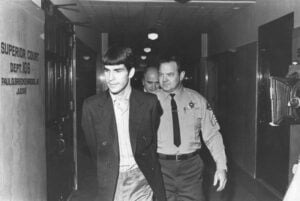
Charles "Tex" Watson, currently incarcerated for his role in the 1969 Manson Family murders, has four children fathered during his decades-long imprisonment. While he oversees a religious non-profit, he possesses no traditional financial legacy or estate; legal statutes and civil judgments ensure that any potential profits from his notoriety are redirected to the families of his victims.
The Foundation of the Watson Family: Marriage and Incarceration
The family history of Charles Watson is one of the more unusual chapters in American penal history. After his 1971 conviction for the murders of Sharon Tate, her friends, and the LaBiancas, Watson underwent a widely publicized religious conversion in prison. This transformation played a central role in his meeting Kristin Joan Svege, whom he married in 1979.
The marriage was not merely a symbolic union. During the late 1970s and through the mid-1990s, the California Department of Corrections permitted conjugal visits for many inmates, including those serving life sentences. These visits allowed Watson and Svege to maintain a semblance of a traditional family structure despite his permanent incarceration. For Watson, the family served as a core component of his "rehabilitated" image, which he frequently cited during his numerous, and consistently denied, parole hearings.
However, the foundation of this family was always precarious. Living under the shadow of one of the 20th century's most notorious crime sprees, the Watson family had to navigate a social landscape where their father's name was synonymous with violence. Despite this, the marriage lasted 24 years, during which time they raised four children primarily in the San Luis Obispo area, near the facility where Watson was then held.
The Four Children: Context, Birth, and Privacy
Between 1979 and 1996, Charles Watson and Kristin Svege had four children—three sons and one daughter. The birth of these children sparked significant public and political controversy. Critics argued that a man convicted of such heinous crimes should not be afforded the privilege of fatherhood, particularly when his victims were denied the chance to have families of their own.
The children have spent their entire lives away from the public eye. As of 2026, they are all adults and have consciously chosen to maintain anonymity. There are no public records of them participating in their father’s ministry or appearing at his parole hearings. This privacy is a deliberate effort to separate their own lives and identities from the legacy of the Manson Family.
From a technical standpoint, the birth of these children was made possible by the specific administrative rules of the California penal system of that era. When those rules changed in the 1990s, the possibility of Watson expanding his family ended. The children represent a "legacy" in a biological sense, but one that is entirely divorced from the ideological or criminal history of their father.
Abounding Love Ministries: Financial Structure and Non-Profit Status
The primary vehicle for Charles Watson’s public presence is "Abounding Love Ministries," a Christian organization he founded in 1980. This ministry often leads to questions regarding Watson’s personal wealth and financial legacy. To understand the "estate" of Tex Watson, one must understand the legal structure of this entity.
Abounding Love Ministries is a registered 501(c)(3) non-profit organization. Under U.S. tax law, the assets of a 501(c)(3) belong to the organization itself, not to the individual who founded it. Watson serves as the chaplain and primary voice of the ministry, but he does not "own" the assets in a way that would allow them to be passed down as a personal inheritance.
Furthermore, California’s "Son of Sam" laws (California Civil Code Section 2225) are designed to prevent criminals from profiting from the commercial exploitation of their crimes. While Watson has authored books and maintains a website, the financial intake from these ventures is strictly monitored. Any personal income he might generate is subject to seizure to satisfy the massive civil judgments won by the families of his victims.
| Aspect | Description | Legal Status (as of 2026) |
|---|---|---|
| Marital Status | Divorced from Kristin Svege (2003) | Single |
| Children | Four children (3 sons, 1 daughter) | Adult private citizens |
| Primary Asset | Abounding Love Ministries | 501(c)(3) Non-Profit |
| Personal Estate | Minimal personal property and prison accounts | Subject to civil liens |
| Son of Sam Laws | Restrictions on profiting from crime memoirs/media | Active and enforceable |
| Civil Judgments | Unpaid settlements to Tate/LaBianca families | Permanent liability |
Legal Barriers to a Financial Legacy: Son of Sam Laws and Civil Liability
The concept of a "financial legacy" for Charles Watson is effectively a legal impossibility. In the United States, and specifically in California, the legal system has created robust barriers to ensure that perpetrators of high-profile crimes do not accumulate wealth.
First, the Son of Sam Law ensures that any proceeds from books, movies, or interviews about the crimes are placed in an escrow account for the benefit of the victims' families. Although various versions of these laws have been challenged on First Amendment grounds, California's current statutes are tailored to survive judicial scrutiny by focusing on the "unjust enrichment" of the convict.
Second, the Civil Judgments awarded to the families of Sharon Tate, Leno LaBianca, and Rosemary LaBianca remain active. These judgments, which total millions of dollars when adjusted for decades of interest, act as a permanent lien against any assets Watson might acquire. If Watson were to inherit money or win a lawsuit, that capital would immediately be eligible for seizure by the victims' estates. Therefore, there is no "estate" to pass on to his children; his debts to his victims' families far exceed any possible income.
The Impact of California’s 1996 Conjugal Visit Policy Change
A pivotal moment in the Watson family history occurred in 1996. Following intense lobbying by victim advocacy groups, including Doris Tate (mother of Sharon Tate) and later Patti Tate, the California Department of Corrections changed its policy regarding "family visits."
The new regulations specifically barred inmates convicted of certain violent crimes, including those serving life sentences for murder, from receiving overnight conjugal visits. This change effectively ended the marital intimacy between Watson and Svege and halted any possibility of further children.
This policy shift was not just a personal blow to the Watson family but also a signal of the changing legal climate in California. It reflected a move toward "truth in sentencing" and a reduction in the privileges afforded to those convicted of capital offenses. For the Watson children, this meant that the latter half of their childhood was spent with a father who was even more physically and legally isolated than before.
The 2003 Divorce and Current Family Status
In 2003, Kristin Svege filed for divorce from Charles Watson. The divorce was granted, and Svege has since moved on to a private life, reportedly remaining committed to her faith but distancing herself from the "Tex" Watson persona.
As of 2026, Watson remains at the Richard J. Donovan Correctional Facility. His relationship with his adult children is not a matter of public record, but it is known that they do not participate in his legal defense or his parole efforts. The divorce marked the formal end of the "Watson family unit," leaving Charles Watson as a solitary figure within the prison system.
The "legacy" of Charles Watson, therefore, is split into two distinct paths:
- The Biological Path: Four adult children who have successfully integrated into society as private citizens, far removed from the crimes of 1969.
- The Legal/Financial Path: A bankrupt estate characterized by permanent debt and legal restrictions that prevent any accumulation of wealth.
Estate Planning for the Incarcerated: Theoretical vs. Practical Realities
While most individuals engage in estate planning to distribute assets like real estate, stocks, or heirlooms, an inmate like Watson has a very different set of "estate" concerns. For a life-term inmate with no chance of significant wealth accumulation, "estate planning" usually refers to the management of a prison trust account and the disposition of personal effects (books, legal papers, and religious materials).
Watson’s "financial legacy" is also complicated by the tax status of his ministry. Because Abounding Love Ministries is a public charity, it is governed by a board of directors. Upon Watson’s death, the ministry would not pass to his children; instead, the board would either appoint a new leader or dissolve the organization, in which case the assets must be transferred to another 501(c)(3) organization.
Consequently, the Watson children are not "heirs" to a ministry or a fortune. They are individuals who happen to share DNA with a historical figure, but they possess no legal claim to any "legacy" derived from his notoriety or his religious work.
FAQ
How many children does Tex Watson have?
Charles "Tex" Watson has four children: three sons and one daughter. They were born between 1979 and 1996 during his marriage to Kristin Joan Svege.
Where are Tex Watson’s children now?
As of 2026, the Watson children are adults living private lives. They have never sought public attention and their names and locations are not disclosed to the public to protect their privacy and safety.
Does Tex Watson make money from his books or website?
Watson's ministry, Abounding Love Ministries, is a non-profit. While his books and website may generate donations or sales, these funds go toward the ministry's operations. Under California's "Son of Sam" laws, any personal profit Watson might attempt to make from his crimes is subject to seizure by the victims' families.
Is Tex Watson still married?
No. Tex Watson and Kristin Svege divorced in 2003. Svege was granted the divorce after 24 years of marriage.
What will happen to Tex Watson’s "estate" when he dies?
Watson has no significant personal estate. His personal belongings and any small balance in his prison trust account would likely be handled according to CDCR regulations. The assets of his ministry are legally separate from him and would remain with the non-profit organization.
Navigating the Legacy of Charles Watson
When examining the "family estate and financial legacy" of a figure like Charles Watson, it is essential to distinguish between the person and the non-profit entity he represents. For researchers and the public, the primary "legacy" Watson leaves behind is not one of wealth or family succession, but one of legal precedent and victim advocacy.
The laws enacted or strengthened because of his crimes and his subsequent family life—such as the tightening of conjugal visit rules and the refinement of Son of Sam laws—form the actual lasting impact of his time in the California justice system. For the children of Charles Watson, their legacy is found in their ability to live independent, law-abiding lives despite the historical shadow of their father’s actions.