Sports valuation is the quantitative and qualitative process of determining the economic fair market value or enterprise value of sports franchises, leagues, media rights, and related athletic assets. It integrates traditional corporate finance frameworks—such as discounted cash flow analysis and transaction precedent multiples—with specialized drivers including broadcast rights contracts, venue real estate, collective bargaining agreements, and global brand equity.
The market for professional sports assets has evolved from trophy-asset acquisitions driven primarily by high-net-worth individuals into a institutionalized asset class attracting private equity funds, sovereign wealth capital, and multinational media conglomerates. Valuing a sports team requires looking beyond traditional operating income or accounting earnings. Because many sports franchises operate with minimal short-term net margins or deliberately reinvest cash flow into on-field talent, standard corporate valuation models must be adjusted to account for capital appreciation, structural league scarcity, and long-term contractual revenue streams.
Core Pillars of Sports Franchise Valuation
Valuing a sports entity differs fundamentally from evaluating a standard corporate enterprise. While traditional corporate finance relies heavily on short-term net earnings and EBITDA margins, sports franchise valuation centers on long-term capital preservation, scarcity power, and guaranteed revenue sharing.
- Total Sports Enterprise Value
- Core Team Assets
- League Membership
- Roster Value
- Local Fan Base
- Venue & Real Estate
- Stadium Ownership
- Real Estate Dev.
- Live Hospitality
- Media & IP Rights
- Broadcast Rights
- Sponsorships
- Direct-To-Consumer
- Core Team Assets
League Governance and Scarcity Value
North American sports leagues (such as the NFL, NBA, MLB, NHL, and MLS) function as closed-member cartels with strict territorial rights and limited expansion opportunities. Scarcity generates a natural valuation floor: because the supply of franchises is capped by league constitutions, prospective owners must purchase an existing team or pay high expansion fees. Closed leagues eliminate the financial risk of relegation, ensuring permanent participation in top-tier media contracts and national revenue-sharing pools.
Conversely, European sports models operate on open promotion and relegation systems. While top-flight clubs benefit from massive global audiences, their valuations carry a structural volatility risk. Relegation from the English Premier League or top European domestic leagues to lower divisions results in immediate revenue drops of 50% or more due to lost broadcasting distribution and reduced sponsorship rates.
Contractual vs. Variable Revenue Streams
A key metric in sports financial analysis is the ratio of guaranteed contractual revenue to variable performance-dependent revenue:
- Contractual revenues include multi-year national media distribution contracts, long-term stadium naming rights, luxury suite leases, and multi-year shirt/jersey sponsorships. Higher proportions of contractual revenue reduce cash flow volatility and command higher Enterprise Value-to-Revenue (EV/Rev) multiples.
- Variable revenues include single-game ticket sales, concession spend, playoff ticket surcharges, and performance-based tournament bonuses (such as UEFA Champions League distribution). These streams depend on team performance, weather, and local economic conditions.
Primary Financial Methodologies Used in Sports Valuation
Financial analysts and investment bankers rely on four primary valuation methodologies when pricing sports franchises and athletic properties.
| Methodology | Primary Application |
|---|---|
| Revenue Multiples | Standard franchise benchmarks & M&A |
| Discounted Cash Flow | Long-term infrastructure projects |
| Sum-of-the-Parts | Teams with attached real estate/RSNs |
| Market Precedents | Final deal negotiations & minority |
1. Enterprise Value-to-Revenue Multiples (EV/Rev)
In traditional corporate finance, the EV/EBITDA multiple is the default metric for M&A activity. In sports finance, however, revenue multiples dominate. Player wage competition frequently consumes net operating profits, leaving many profitable franchises with low or fluctuating EBITDA.
Revenue is less prone to aggressive roster accounting choices, localized squad capital expenditures, or short-term performance shifts. $$\text{Enterprise Value} = \text{Total Revenue} \times \text{Sector Revenue Multiple}$$
The applied multiple varies significantly across leagues:
- NFL: EV/Rev multiples typically range from 6.0x to 9.0x, driven by long-term media contracts, hard salary caps, and labor stability.
- NBA: EV/Rev multiples often reach 8.0x to 11.0x, reflecting high international growth potential, digital engagement, and cost control through soft salary caps and luxury tax distributions.
- European Football (Soccer): Multiples vary wider, between 2.0x and 5.5x, reflecting relegation risks, player wage inflation, and varying cost control strictness under regulations such as UEFA's Financial Sustainability Rules.
2. Sum-of-the-Parts (SOTP) Valuation
Modern sports teams are often multi-asset holding companies. Using a unified valuation multiple can underestimate or overestimate specific business divisions. A Sum-of-the-Parts model values each constituent asset class independently before combining them:
- Core Franchise Operations: Valued via league revenue multiples (roster talent, brand IP, membership rights).
- Real Estate and Stadium Assets: Valued through real estate cap rates or discounted net operating income (NOI) from non-gameday events, concerts, and surrounding mixed-use real estate developments.
- Media and Streaming Network Stakes: Valued independently using media subscriber valuation metrics or earnings multiples assigned to Regional Sports Networks (RSNs) and proprietary Direct-to-Consumer (DTC) platforms.
- Non-Consolidated Investments: Minority positions in esports organizations, tech platforms, or joint ventures measured at net asset value (NAV) or mark-to-market adjustments.
3. Discounted Cash Flow (DCF) Analysis
While cash flow volatility makes DCF models challenging for early-stage sports assets, DCF remains essential for infrastructure planning, venue financing, and projecting long-term broadcast deal renewals. Analysts construct 10-to-15-year unlevered free cash flow (UFCF) projections that incorporate:
- Contractual escalators built into national TV and streaming packages.
- Expected stadium debt amortizations and municipal bond service costs.
- Cost-of-capital estimates (WACC) adjusted for league-level credit support and low default history.
4. Market Comparison and Transaction Precedents
When evaluating franchise sales, analysts reference benchmark transactions. Adjustments are made for:
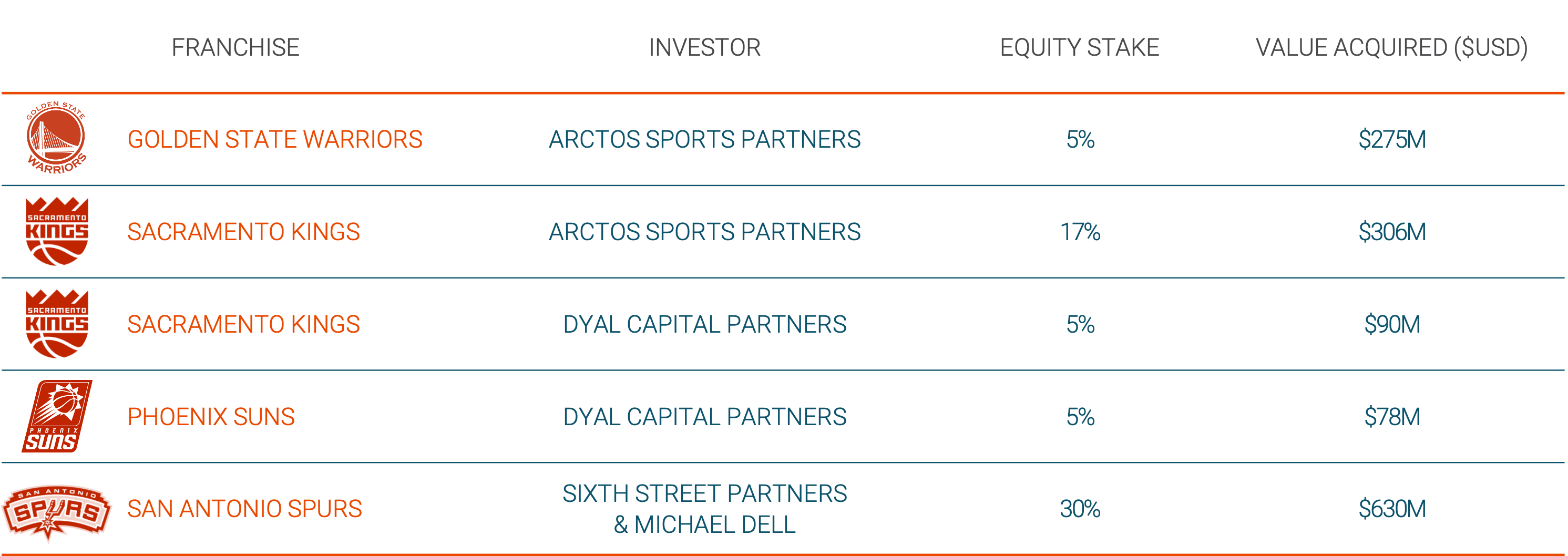
- Equity stake size (controlling interest vs. illiquid minority stakes).
- Debt absorption and net leverage ratios.
- Market size, metropolitan media market population, and local demographic trends.
Key Valuation Drivers and Growth Catalysts
The underlying drivers of sports franchise valuations have shifted from simple ticket sales to complex international commercial operations.
Media Rights and Streaming Transitions
National media rights are the primary source of guaranteed cash flows for major leagues. As traditional linear television subscriptions decline, major technology firms and streaming platforms compete directly with legacy broadcasters for live sports content. Live sports remain one of the few content categories capable of delivering consistent, high-volume real-time viewership.
Valuation models assess the remaining duration and counterparty risk of active rights packages, as well as digital rights retention that allows leagues to launch localized subscription networks.
- Traditional Broadcast Model
- Linear Cable Subscriptions
- Local TV Contracts
- Regional Sports Networks
- Modern Multi-Platform Revenue Model
- Direct-To-Consumer (DTC)
- Tech Platform Bidding Competition
- Global Streaming Syndication
Real Estate & Mixed-Use Entertainment Districts
Franchise owners increasingly act as real estate developers. Instead of relying solely on gameday stadium operations, organizations build surrounding sports and entertainment districts (including hotels, retail space, residential units, and office parks).
These mixed-use developments provide cash flows that are independent of on-field results and operate year-round. This strategy diversifies revenue and qualifies for municipal tax incentives, lifting the franchise's overall Enterprise Value.
Institutional Capital and Private Equity Inflows
Institutional investment rules in major sports leagues updated significantly between 2019 and 2025:
- North American Leagues: The NFL, NBA, MLB, NHL, and MLS updated their constitutions to allow approved private equity firms to acquire minority stakes (typically capped between 10% and 30% of a team's total equity, depending on the league).
- European Football: Sovereign wealth funds and institutional funds hold controlling stakes in multiple top-tier clubs across the Premier League, Ligue 1, and Serie A.
Institutional capital inflows increase overall liquidity, reduce funding costs for new venues, and establish firm baseline valuations for minority shares.
Valuation Comparison: North American vs. European League Models
Financial structures and legal frameworks create distinct valuation environments in North American and European sports.
| Valuation Dimension | North American Franchise Model (NFL, NBA, MLB, NHL) | European Football Model (EPL, La Liga, Serie A, Bundesliga) |
|---|---|---|
| League Structure | Closed system; zero relegation risk; guaranteed membership. | Open system; promotion and relegation between divisions. |
| Cost Controls | Collective Bargaining Agreements; hard or soft salary caps; luxury taxes. | Cost ratios bound by regulations like UEFA Financial Sustainability Rules. |
| Typical EV/Revenue Multiples | 5.5x to 11.0x+ | 1.5x to 5.0x |
| Media Distribution | Centralized national contracts; shared revenue pools among owners. | Hybrid system; individual club domestic/international distribution variances. |
| Revenue Stability | High forecast predictability due to long-term labor peace and fixed caps. | Moderate-to-low predictability; dependent on European competition qualification. |
| Capital Growth Driver | Supply scarcity, streaming rights competition, real estate projects. | Global brand building, player transfers, international fan acquisition. |
Structural Risks and Valuation Discounts
Assessing a sports valuation requires accounting for macroeconomic, regulatory, and structural risk factors that can lead to valuation discounts.
Regional Sports Network (RSN) Ecosystem Disruption
The collapse of traditional cable regional sports networks has disrupted local broadcast economics, particularly for MLB, NHL, and NBA franchises. Teams reliant on fixed regional cable fees must transition to Direct-to-Consumer (DTC) streaming options or local broadcast television agreements, which frequently produce lower immediate cash flows during early distribution phases. Valuation models must haircut historical local media income for teams heavily exposed to legacy regional contracts.
Player Wage Inflation and Cost Control Uncertainty
In leagues without fixed salary caps, player compensation increases rapidly as revenues expand. If revenue growth scales by 10%, but player compensation grows by 12% due to transfer bidding wars, operating margins compress. Franchises operating under loose financial controls face downside risk from wage inflation, squad write-downs, and potential league-imposed point deductions or transfer bans.
Minority Stake Illiquidity and Control Discounts
Investors buying non-controlling, minority equity positions in sports franchises typically face a minority discount ranging between 15% and 35% relative to pro-rata Enterprise Value. Non-controlling investors usually lack voting power over roster decisions, management changes, debt issuance, or stadium moves, and face strict league transfer limits when attempting to exit their positions.
Practical Application: Step-by-Step Valuation Framework
When performing a valuation on a sports property, financial professionals follow a structured five-step process:
- Revenue Segmentation and Quality Audit: Categorize all income streams into guaranteed/contractual (media rights, long-term sponsorships) vs. variable/performance-based (gameday gate receipts, concessions, tournament bonuses).
- Apply Cost-Control Adjustments: Normalize player wage ratios against league benchmarking standards. Adjust operational expenditure for one-time stadium maintenance or player contract severance packages.
- Select League-Specific Multiple Baselines: Identify recent arm's-length M&A transactions within the target league over the past 36 to 48 months. Calculate the EV/Rev baseline and adjust for market size, venue age, and debt obligations.
- Perform Asset Unbundling (SOTP Check): Determine whether venue real estate, regional networks, or adjacent mixed-use real estate are included in the transaction structure or held under separate corporate entities. Value non-core assets independently using cap-rate or net operating income metrics.
- Apply Structural Discount or Control Premium: Apply a control premium (typically 10% to 25%) for controlling interest sales, or apply minority and illiquidity discounts for non-voting equity stakes.
Frequently Asked Questions About Sports Valuation
Why are revenue multiples preferred over earnings multiples in sports valuation?
Revenue multiples are preferred because sports teams often operate with thin or negative accounting margins due to aggressive talent investment and player amortization schedules. Revenue provides a stable metric that reflects a team's true market size, media rights distribution, and commercial scale, without being distorted by localized roster decisions or temporary operating losses.
How does promotion and relegation affect European football club valuations?
Promotion and relegation introduces variable downside risk. Relegation to a lower tier typically results in an immediate 50% or greater decline in broadcasting and commercial revenue, leading to valuation volatility. Consequently, European football clubs trade at lower revenue multiples than North American franchises in closed leagues, where permanent top-tier status is guaranteed.
What role does stadium ownership play in sports valuation?
Owning a stadium increases Enterprise Value by providing complete operational control over revenue streams, including naming rights, premium luxury seating, non-gameday event hosting, and surrounding real estate developments. Franchises that lease municipal facilities without revenue-sharing rights trade at discount multiples compared to teams that own and operate modern sports venues.
How do private equity funds value minority stakes in professional sports teams?
Private equity funds evaluate minority stakes by analyzing long-term media contract stability, league governance protections, and historical asset growth rates. Because minority investors lack operational control, their valuations typically include an illiquidity discount of 15% to 35% relative to controlling equity stakes.
How does media rights fragmentation impact sports valuations in 2026?
Media rights fragmentation forces leagues and teams to diversify distribution between traditional broadcast channels, cable providers, and Direct-to-Consumer (DTC) streaming networks. While fragmentation creates transitional challenges for regional local rights, it increases total national rights values by encouraging bidding competition among tech companies and linear media networks.
Strategic Guidance for Sports Investors and Financial Analysts
Evaluating investments in professional sports requires a clear strategy that balances traditional corporate valuation techniques with the unique operational dynamics of professional leagues.
For investment teams, advisors, and corporate development executives, key focus areas include:
- Audit Revenue Quality First: Base valuation models on long-term contractual streams (such as national broadcast contracts and corporate partnerships) rather than temporary gameday spikes or playoff run assumptions.
- Isolate Real Estate from Roster Operations: Use a Sum-of-the-Parts (SOTP) approach to separate stable real estate cash flows from volatile team operations. This ensures that physical venue assets are priced accurately using real estate cap rates rather than team revenue multiples.
- Factor in Regulatory Governance: Account for collective bargaining terms, salary cap structures, and minority ownership limits, as league rules directly impact cash flow predictability and long-term liquidity.
- Review Contractual Debt Covenants: Verify league-mandated debt ceilings. Most major leagues impose strict debt-to-enterprise-value caps to protect financial stability across member franchises.