A Quiet Place is a critically acclaimed post-apocalyptic horror franchise initiated by filmmakers Bryan Woods, Scott Beck, and John Krasinski. The series centers on humanity's struggle for survival against blind extraterrestrial predators that hunt using hyper-sensitive hearing. The franchise encompasses feature films, prequels, and expanded media that explore survival through silence and sensory-driven storytelling.
The Core Lore: Understanding the Extraterrestrial Predators
The central threat driving the narrative across the A Quiet Place universe is an invasive alien species often referred to off-screen as "Death Angels." These creatures arrived on Earth via meteorite impacts, triggering a near-instantaneous collapse of human civilization. Understanding the physical biology and behavioral traits of these organisms is vital to understanding how survivors adapt in the films.
The creatures possess zero visual perception; they are completely blind and lack traditional facial features. To compensate, their entire anatomy is built around hyper-acute auditory detection. Their skull consists of movable chitinous plates that unfurl to expose large, intricate ear canals capable of capturing faint sounds from miles away. This auditory sensitivity enables them to track and attack any noise generator with extreme velocity and lethal precision.
CREATURE PHYSIOLOGY:
- Armored Outer Shell: Near-impervious to conventional small arms
- Eardrum Mechanics: Multi-layered auditory organs sensitive to sound
- Locomotion: Quadrupedal, high-speed movement over land and walls
- Vulnerability: High-frequency audio feedback forces shell open
Beyond their hearing, the creatures possess virtually impenetrable exoskeletons. Standard firearms, military artillery, and blunt force fail to breach their outer chitin under normal conditions. This armor allows them to survive atmospheric entry via meteorites and withstand heavy defensive military resistance. However, their physical perfection is paired with a critical weakness: severe vulnerability to high-frequency audio feedback. When exposed to specific frequencies, the distress forces their armored head-plates to open, exposing the soft tissue inside the ear canal to direct lethal damage.
Chronological Timeline vs. Release Order
Navigating A Quiet Place requires distinguishing between the theatrical release order and the internal narrative chronology of the apocalypse. Because the franchise uses spin-offs and prequels to flesh out the initial fall of civilization, viewers can choose between release sequence and chronological order depending on their preference for tension or context.
NARRATIVE TIMELINE:
- Day 0: Invasion Begins (Day One Prequel)
- Day 1-3: Metropolitan Chaos (NYC Fall / Coastal Escape)
- Day 470+: Rural Survival (A Quiet Place 1 & 2)
The release order tracks the evolution of the Abbott family before expanding outward to broad-scale events, whereas the chronological timeline begins at the moment of impact on Day 1.
Release Order
- A Quiet Place (2018) – Focuses on the Abbott family surviving on an isolated farm roughly 470 days after the initial invasion.
- A Quiet Place Part II (2020 / broad release 2021) – Begins with a flashback to Day 1 before picking up immediately after the events of the first film on Day 474.
- A Quiet Place: Day One (2024) – A spin-off prequel following new characters in New York City during the first hours and days of the alien arrival.
Chronological Order
- A Quiet Place: Day One (2024) – Covers Day 1 through the immediate aftermath in Manhattan.
- A Quiet Place Part II (Opening Sequence) – Covers the initial impact in the small town of Millbrook on Day 1.
- A Quiet Place (2018) – Covers Day 89 briefly, then jumps to Days 472–473.
- A Quiet Place Part II (Main Narrative) – Covers Days 474–475 as the survivors search for radio signal stations.
Detailed Breakdown of the Films
FRANCHISE OVERVIEW
| Film | Year | Director | Key Focus |
|---|---|---|---|
| A Quiet Place | 2018 | John Krasinski | Family dynamics & survival |
| A Quiet Place Part II | 2021 | John Krasinski | Expansion to broader world |
| A Quiet Place: Day One | 2024 | Michael Sarnoski | City-wide initial panic & escape |
A Quiet Place (2018)
Directed by John Krasinski, the original film introduces Lee Abbott (Krasinski), his pregnant wife Evelyn (Emily Blunt), their deaf daughter Regan (Millicent Simmonds), and their son Marcus (Noah Jupe). Living in rural Upstate New York, the family relies on American Sign Language (ASL), sand-covered paths to muffle footsteps, and a system of colored warning lights to maintain absolute silence.
The narrative concentrates on the tension of domestic life under strict sound discipline. The family’s preparation for the birth of a newborn baby provides the central ticking clock. The film's climax reveals that Regan’s custom cochlear implant, designed by her father, produces a harsh high-frequency feedback loop when near the creatures. This signal disorients the monsters and exposes their vulnerable flesh beneath their armor, establishing humanity's first reliable defensive weapon.
A Quiet Place Part II (2020/2021)
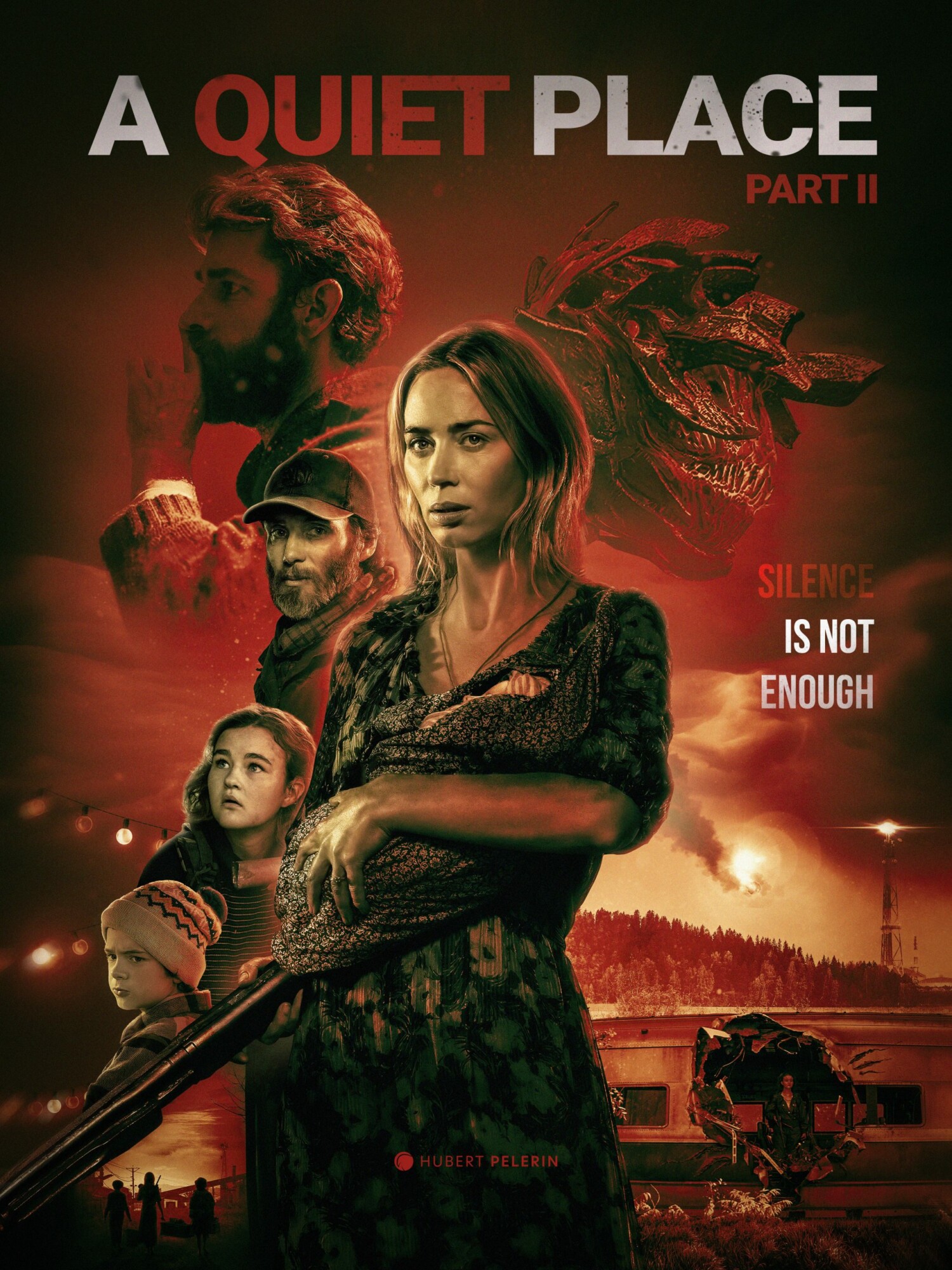
Following the death of Lee Abbott, Part II broadens the geographical scope of the story. Evelyn, Regan, Marcus, and the infant leave their destroyed farmstead to seek out other survivors. They encounter Emmett (Cillian Murphy), a grieving family friend hiding in an abandoned industrial foundry.
The story splits into two parallel arcs:
- The Search for the Signal: Regan uses the audio feedback from her cochlear implant paired with a radio broadcast tower on a nearby island to transmit the weaponized frequency across local radio bands.
- The Foundry Defense: Evelyn and Marcus protect the newborn within improvised soundproof chambers while defending against roaming creatures.
Part II confirms that the aliens cannot swim, making isolated bodies of water natural havens for human populations. It also shows how isolation degrades human morality, contrasting Emmett's despair with Regan's determination to broadcast the killing signal.
A Quiet Place: Day One (2024)
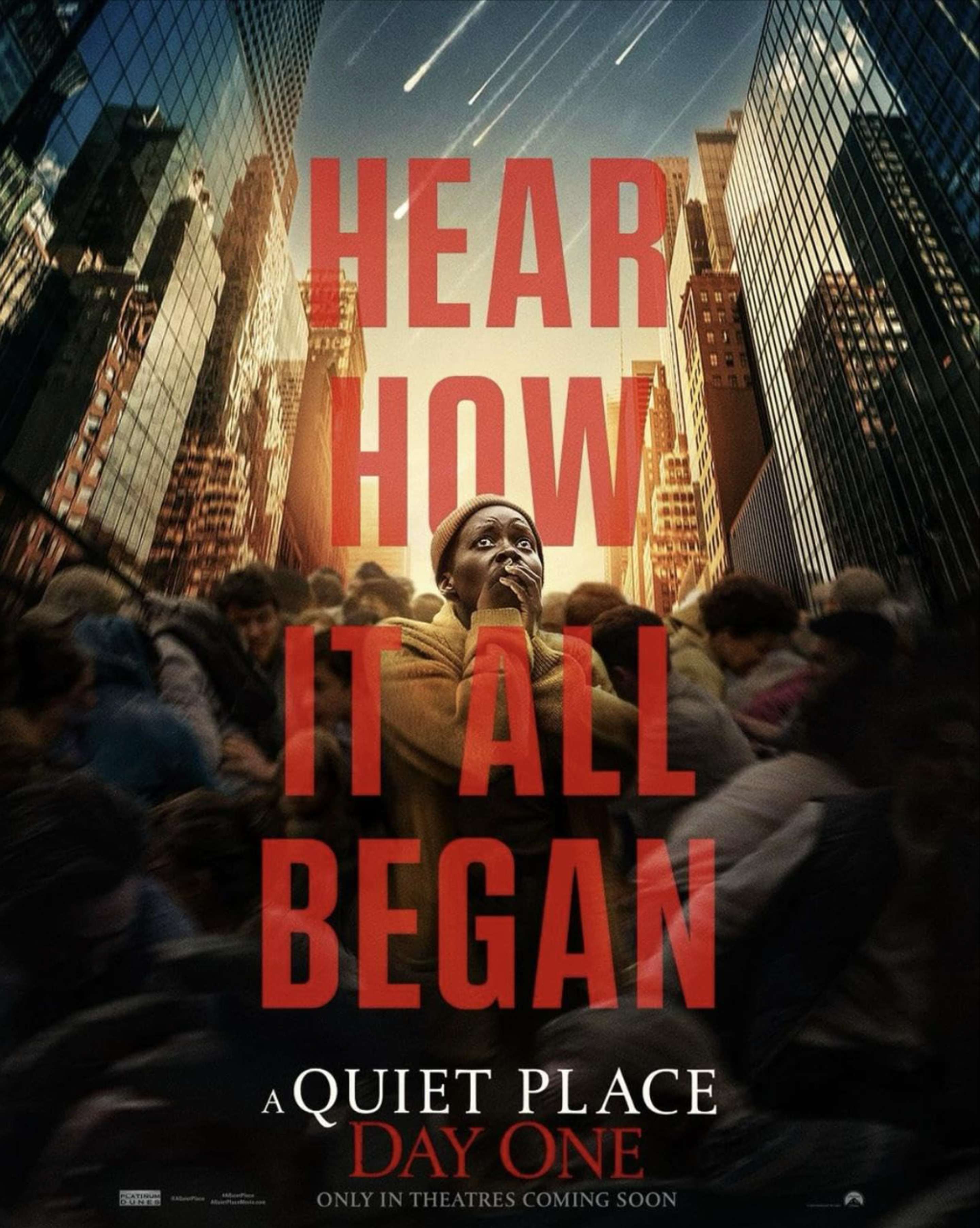
Directed by Michael Sarnoski, Day One shifts the setting from rural isolation to the dense urban grid of Manhattan during the first hours of the attack. The narrative follows Samira (Lupita Nyong'o), a terminally ill hospice patient, her emotional support cat Frodo, and an English law student named Eric (Joseph Quinn).
Unlike the rural settings of the earlier films, Day One depicts the rapid collapse of public infrastructure, emergency military responses, and large-scale evacuations. The film highlights how the National Guard destroys bridges to quarantine the island of Manhattan, leaving citizens stranded alongside thousands of hearing-sensitive monsters. The story focuses on small-scale human connection amid disaster, showing how survivors quickly learned that silence was their only defense before the nature of the threat was fully understood.
Media Expansion and Adaptations
Beyond feature films, A Quiet Place has extended into interactive media to explore sound-based gameplay mechanics.
Video Games: A Quiet Place: The Road Ahead (2024)
Developed by Stormind Games and published by Saber Interactive, A Quiet Place: The Road Ahead is a single-player first-person horror game set within the cinematic universe. Players control Alex Taylor, a young woman suffering from asthma who must navigate a ruined post-apocalyptic landscape.
The game mirrors the films' core tension by making sound design its primary gameplay loop:
- Noise Meters: Players must monitor their ambient surface noise, choosing between wet mud, dry foliage, and creaky floorboards.
- Phobia Mechanics: The protagonist's asthma requires players to manage stress meters and consume inhalers, as heavy breathing or coughing draws nearby creatures.
- Microphone Integration: Optional game settings use the player's real-world microphone to detect ambient noise in their room; unexpected real-world sounds draw creatures in-game.
Technical Mastery: Sound Design and Non-Verbal Storytelling
A defining feature of the A Quiet Place franchise is its use of sound design as a primary storytelling device. Sound supervisors Erik Aadahl and Ethan Van der Ryn developed an audio mix that shifts perspective between objective ambient sound and subjective sensory experiences.
SOUND DESIGN ARCHITECTURE:
- Objective Audio Track: Full environmental fidelity & cues
- Regan's Perspective: Near-total silence, low frequency murmur
- Creature Perspective: Amplified, highly distorted acoustic
Acoustic Perspectives
The film mixes transition between three acoustic perspectives:
- Objective Hearing: Traditional film audio where footsteps, wind, and ambient natural elements are muted to emphasize sudden noises.
- Regan's Acoustic Envelope: When the camera shifts to Regan's point of view, the sound mix cuts to complete silence or a low-frequency hum, reflecting her experience as a deaf person. This element builds empathy and signals to the audience when a creature is approaching unseen.
- Echolocative Audio: Audio cues representing how the creatures hear the environment—amplified clicks, popping sounds, and heavy acoustic distortion.
Visual and Physical Storytelling
Because dialogue is kept to a minimum, the series relies on visual storytelling to show survival tactics:
- Sand Paths: White sand poured over walking paths dampens footstep noise across rural terrain.
- Color-Coded Lighting: Exterior light strips indicate threat levels (warm white for safety, red for immediate danger or silence emergencies).
- Soft Materials: Game boards lack dice, soundproof rooms are lined with thick insulation, and physical items are wrapped in cloth to prevent accidental noise.
Frequently Asked Questions
What is the origin of the creatures in A Quiet Place?
The creatures are extraterrestrial entities that arrived on Earth aboard meteorites. Originating from a dark, harsh planet without light, they evolved hyper-sensitive hearing, dense muscular frames, and armored exoskeletons to survive their native ecosystem and atmospheric entry.
Why does high-frequency sound harm the creatures?
The creatures' armored heads open to expose sensitive internal ears when listening for prey. High-frequency audio feedback—such as the signal from Regan's modified cochlear implant—overloads their acoustic organs, causing extreme disorientation and forcing their facial armor to stay open, leaving them vulnerable to standard weapons.
Do you need to watch A Quiet Place: Day One before the original film?
No. A Quiet Place: Day One is a standalone prequel set in New York City. While it provides context for the initial invasion, watching the original 2018 film first offers a better introduction to the creature mechanics and quiet storytelling that define the franchise.
Can the creatures in A Quiet Place swim?
No. A Quiet Place Part II establishes that the creatures cannot swim due to their heavy body density and armored chitin. They quickly drown in deep water, making islands and offshore boats safe havens for human survivors.
Are there additional Quiet Place movies in development?
Yes. Following the release of A Quiet Place: Day One in 2024, Paramount Pictures has planned a direct sequel to the main storyline, A Quiet Place Part III, designed to complete the story of the Abbott family.
Recommended Viewing Strategy and Next Steps for Fans
To experience the A Quiet Place franchise effectively, match your viewing strategy to your preference for narrative reveal or chronological context:
- For First-Time Viewers (Release Order): Start with A Quiet Place (2018) to learn the creature rules alongside the Abbott family. Follow with A Quiet Place Part II (2020) for the immediate fallout, then watch A Quiet Place: Day One (2024) to see the broader fall of society.
- For World-Building Enthusiasts (Chronological Order): Begin with A Quiet Place: Day One (2024) to witness the initial invasion in Manhattan. Proceed to the opening sequence of Part II, then watch A Quiet Place (2018) and the rest of Part II to track humanity's adaptation over time.
- For Interactive Engagement: Play A Quiet Place: The Road Ahead on modern consoles or PC with microphone detection enabled to experience the physical stress of absolute silence firsthand.