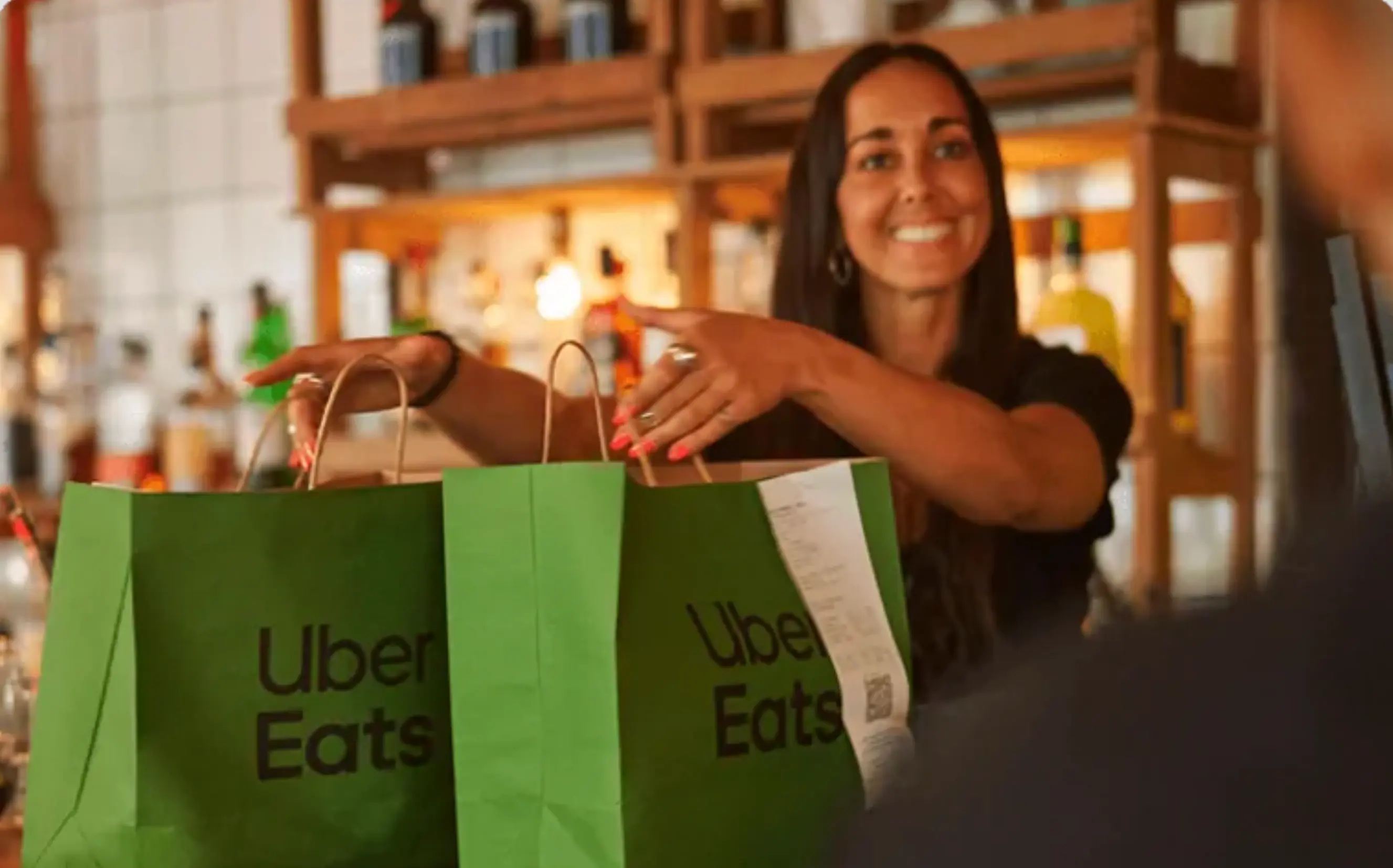
Uber Eats’ advertising strategy centers on transforming the service from a single-use food delivery platform into an indispensable, multi-category quick-commerce network. By leveraging high-budget broadcast commercials, absurdist humor, unexpected celebrity pairings, and data-driven digital channels, the company maintains high top-of-mind awareness while driving subscription adoption through its unified Uber ecosystem.
The Evolution of Uber Eats' Brand Strategy: From Utility to Lifestyle
When Uber Eats launched in 2014 as an extension of Uber’s ride-hailing infrastructure, its initial marketing focused almost entirely on functional messaging: speed, reliability, and restaurant selection. As the on-demand delivery market matured and competition intensified from platforms such as DoorDash and Deliveroo, functional differentiation eroded. Standard delivery fees, arrival time estimates, and restaurant onboarding became baseline industry standards rather than competitive moats.
To capture market share and establish pricing power, Uber Eats pivoted its brand strategy from functional utility to emotional and cultural resonance. The brand shifted its target audience from tech-forward urban professionals seeking convenience to broader household demographics across suburban and international markets.
- Functional Utility Era
- Focus: Speed & Selection
- Message: "Get food fast"
- Channels: Digital Search & Social
- Cultural Resonance Era
- Focus: Celebrity & Humor
- Campaign: "Tonight I'll Be Eating"
- Channels: TV, OOH, Digital
- Platform Ecosystem Era
- Focus: Uber One Loyalty
- Campaign: "Get Almost Anything"
- Channels: Integrated Multi-Channel
This strategic pivot required an overhaul of the platform's visual identity, tone of voice, and campaign structures. Rather than pitching delivery as a luxury for lazy evenings, commercials reframed ordering out as a regular lifestyle choice and an answer to modern decision fatigue. As the platform expanded into grocery, convenience, alcohol, and retail items, Uber Eats adapted its messaging to teach consumers that the app handles more than just prepared restaurant meals.
Core Messaging Architecture: Humorous Anchors and Unexpected Pairings
The centerpiece of Uber Eats' messaging framework is the use of absurdist humor, self-deprecating comedy, and incongruous celebrity pairings. This creative strategy cuts through traditional advertising clutter by prioritizing entertainment value over hard-sell feature demonstrations.
The "Tonight I'll Be Eating..." Paradigm
Launched globally after initial success in Australia, the "Tonight I'll Be Eating..." campaign established Uber Eats' signature commercial formula. The structure paired cultural icons from vastly different genres or generations—such as Patrick Stewart and Mark Hamill, or Simone Biles and Jonathan Van Ness—in ordinary domestic settings, casually debating their dinner orders.
The messaging architecture of this campaign achieved three distinct objectives:
- Disarming Audience Defense Mechanisms: By embedding the promotional offer within comedic banter, the platform reduced commercial friction and increased ad retention.
- Normalizing Multi-Category Ordering: Specific menu calls out highlighted specific dishes, demonstrating the breadth of local restaurant partnerships without listing directory features.
- Establishing Broad Appeal: Juxtaposition of disparate figures allowed the brand to target multiple demographic groups simultaneously within a single 30-second spot.
The Shift to "Get Almost, Almost Anything"
As non-restaurant delivery expanded, Uber Eats faced a distinct positioning challenge: consumers associated the brand name directly with food. The campaign messaging evolved to directly address this perception gap while setting realistic operational expectations.
Campaigns featuring taglines like "Uber Eats Eats Anything" (notably debuting during major television events such as the Super Bowl) depicted celebrities attempting to eat non-food items delivered by the app, such as paper towels, dish soap, and cosmetics. Later iterations refined this concept into the long-running "Get Almost, Almost Anything" narrative.
This messaging subtlely acknowledged logistics realities: while you can order hardware, beauty products, and groceries, there are obvious limits to what a delivery driver can bring to your doorstep. By humorously emphasizing what the platform cannot deliver (such as dynamic memories or historical artifacts), Uber Eats reinforced the wide range of items it can supply.
Channel Distribution Strategy: Orchestrating Mass and Targeted Reach
Uber Eats executes a balanced media-buying strategy that combines broad-reach mass media with precise performance-marketing channels. This omni-channel distribution ensures top-of-mind awareness at the top of the funnel while driving immediate order conversion at the bottom.
- High Impact / Broad Reach
- Linear & Connected TV (Super Bowl, Sports, CTV)
- High-Profile OOH (Billboards, Transit)
- Targeted Performance Engine
- Digital Video & Social (YouTube, TikTok, Meta)
- In-App Cross-Promotion (Uber Rideshare Cross-Sell)
1. Mass Media, Broadcast TV, and High-Impact Live Events
Uber Eats relies heavily on major televised events—particularly live sports, award shows, and seasonal prime-time programming—to establish brand dominance. Participating in events like the NFL Super Bowl serves as an anchor for annual creative campaigns. These commercials generate earned media coverage, pop-culture discussion, and social media commentary that extends the reach far beyond the original broadcast footprint.
2. Connected TV (CTV) and Programmatic Digital Video
To reach younger cord-cutting audiences, Uber Eats allocates significant budget to ad-supported streaming tiers (such as Hulu, Netflix, and Max) alongside YouTube programmatic video. These placements use viewer demographic and geographical data to tailor ad creative by region, showcasing regional restaurant choices or targeted grocery promotions while maintaining the national creative concept.
3. Social Media and Short-Form Creator Content
On platforms like TikTok, Instagram, and X, Uber Eats translates broad broadcast narratives into short-form, mobile-first content. The brand works with creators, micro-influencer networks, and meme channels to adapt campaign themes. Rather than simply re-running 30-second TV ads, social channels feature behind-the-scenes footage, unscripted celebrity interactions, and trending sound formats to drive organic engagement.
4. Out-of-Home (OOH) and Transit Advertising
Hyper-local out-of-home advertising reinforces commercial messaging near high-density retail corridors and commuter networks. Digital billboards and transit wraps display context-aware messages tuned to specific times of day, weather conditions, or local events (for example, targeting evening commuters with dinner prompts or weekend mornings with coffee and grocery messaging).
5. In-App Cross-Promotion within the Uber Ecosystem
A distinct competitive advantage for Uber Eats is its access to the core Uber rideshare user base. In-app notifications, banner ads, and cross-platform incentives inside the main Uber app allow the brand to acquire customers at a lower cost than standalone competitors. Passengers checking ride status are routinely targeted with time-sensitive Uber Eats promotions tied to their destination or arrival time.
Flagship Campaigns and Media Strategy Comparison
The following matrix categorizes Uber Eats' major commercial messaging initiatives, outlining their structural goals, channel distributions, and strategic audience targets:
| Campaign Framework | Primary Brand Objective | Core Messaging Strategy | Key Distribution Channels | Primary Target Audience |
|---|---|---|---|---|
| "Tonight I'll Be Eating..." | Normalize routine food delivery & boost top-of-mind recall | Unexpected celebrity pairs casually ordering specific dinner items | Linear TV, Premium CTV, High-Impact Digital Video | Broad household demographics, Millennials & Gen X |
| "Uber Eats Eats Anything" | Educate market on non-restaurant product offerings | Comedic, absurdist scenarios where celebrities misinterpret app capabilities | Super Bowl, Broadcast TV, Earned PR Media | Urban & suburban families, general consumer base |
| "Get Almost, Almost Anything" | Position platform as everyday quick-commerce solution | Self-deprecating humor defining the vast (yet practical) inventory available | Multi-channel: TV, Social, OOH, Digital Performance | Busy professionals, Gen Z, digital-native shoppers |
| Uber One Cross-Promotions | Drive recurring subscription revenue and retention | Highlight financial savings and zero delivery fees across Rides and Eats | In-app banners, Targeted Email, Paid Search, Social Ad Networks | High-frequency platform users, value-conscious consumers |
| Hyper-Local Merchant Profiles | Support merchant ecosystem and build community equity | Highlight iconic local restaurants and neighborhood cuisine culture | Geo-targeted Social Ads, Localized Digital OOH, YouTube | Neighborhood residents, local food enthusiasts |
Ecosystem Integration: Converting Ad Views into Uber One Subscribers
Commercial advertising for Uber Eats does not operate in isolation; it feeds directly into Uber's broader lifetime customer value (LTV) strategy. A primary metric evaluating marketing success is consumer conversion into Uber One, the platform’s cross-vertical subscription program.
- Mass Market Ad Impression (TV / Digital)
- First-Order Promotion / App Download
- Initial Order Execution & Data Capture
- In-App Upsell to Uber One Subscription
- High-Frequency Retained Customer (Rides + Delivery)
The subscription model changes how commercial messaging functions. Rather than spending performance ad dollars to drive single, transactional orders, campaigns actively promote the combined benefit of free delivery and member discounts across both rideshare and delivery verticals.
This structural alignment creates a compounding customer acquisition loop:
- High-budget celebrity ads capture broad top-of-funnel attention.
- Promo-code offers embedded in commercial spots lower the initial trial barrier for new users.
- Post-first-order communications leverage user data to highlight subscription cost savings.
- Converted Uber One members order at a significantly higher monthly frequency, lowering Uber’s long-term reliance on perpetual discount codes.
By leveraging brand advertising to drive subscription sign-ups, Uber Eats builds a recurring revenue base that stabilizes platform volume during shifting economic conditions.
Strategic Trade-Offs and Brand Execution Challenges
While Uber Eats' brand strategy has generated high awareness and consumer adoption, managing broad messaging channels presents operational and creative challenges.
Balancing Brand-Building with Unit Economics
High-profile campaigns featuring A-list celebrities and prime Super Bowl ad slots require significant capital investment. Uber Eats continuously balances this top-of-funnel brand spending with bottom-of-funnel performance marketing designed to protect margin profitability. If commercial messaging fails to drive conversion to retail, grocery, or subscription tiers, high customer acquisition costs (CAC) can erode unit economics.
Navigating Brand Equity Across Multiple Categories
Positioning a platform as a source for everything risks confusing the core consumer proposition. Consumers naturally form distinct mental models for food delivery, grocery shopping, and parcel dispatch. Uber Eats must carefully calibrate its creative executions so that messaging around retail items does not undermine its core identity as a fast, reliable source for fresh restaurant meals.
Managing Regulatory and Labor Sensitivity
Public perception of delivery platforms is influenced by broader societal debates surrounding driver pay, gig-economy regulations, and merchant commission rates. High-budget, humorous ad campaigns risk negative consumer reaction if launched alongside public disputes regarding courier compensation or partner fees. Consequently, brand campaigns must maintain a culturally sensitive tone that avoids appearing disconnected from driver and merchant realities.
Frequently Asked Questions
What is the main message behind Uber Eats commercials?
The central message of Uber Eats commercials has evolved from basic food delivery convenience to universal daily fulfillment. Modern campaigns emphasize that users can get "almost anything"—from restaurant meals and alcohol to groceries, health items, and personal care products—delivered quickly to their home.
Why does Uber Eats use unusual celebrity pairings in its ads?
Uber Eats pairs contrasting celebrities (such as musicians, athletes, and actors from different genres) to break through standard ad clutter using element of surprise. This creative choice increases audience attention, creates earned media buzz on social platforms, and allows the brand to appeal to multiple demographic segments within a single commercial.
How does Uber Eats measure the success of its advertising campaigns?
Uber Eats tracks advertising success using a combination of brand metrics and direct business outcomes. Key metrics include top-of-mind brand awareness, ad recall, consumer app downloads, first-time user conversions, long-term customer acquisition cost (CAC), and rate of conversion into the Uber One subscription program.
How do Uber Eats commercials promote non-food delivery services?
Uber Eats uses absurdist comedy to re-educate consumers about its inventory. Campaigns like "Uber Eats Eats Anything" depict people humorously attempting to eat non-food items like shampoo or paper towels, using memorable jokes to inform viewers that the app delivers everyday household groceries and retail goods alongside restaurant meals.
Strategic Takeaways for Brand Marketers
Analyzing Uber Eats' advertising approach offers several actionable insights for enterprise brand managers and campaign strategists:
- Pivot from Functional Messaging to Entertainment: Once core operational capabilities become standard across an industry, shift marketing focus toward emotional resonance, distinct creative tone, and cultural moments to sustain brand recall.
- Acknowledge Platform Limitations with Candor: Using self-deprecating humor—such as stating you can get "almost, almost anything"—builds brand authenticity, manages customer expectations, and disarms cynical audiences.
- Align Campaign Creative with Ecosystem Loyalty: Ensure broad brand-building campaigns directly incentivize high-margin behaviors, such as recurring subscription programs (e.g., Uber One) that lock in consumer lifetime value.
- Tailor Creative Executions by Channel: Maintain a central thematic umbrella (such as absurdist celebrity interactions) while customizing asset formats specifically for high-impact broadcast TV, programmatic CTV, and native social channels.