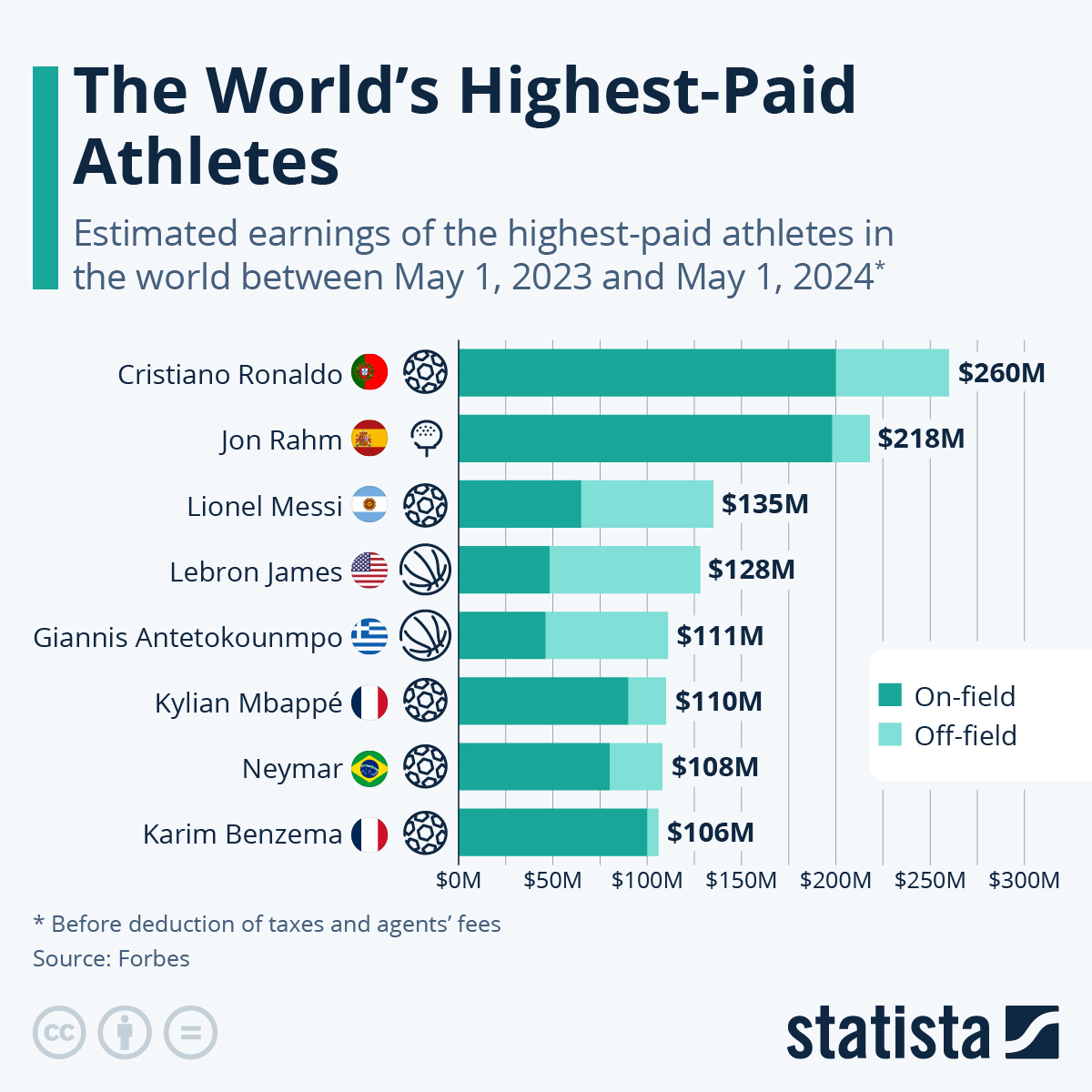
According to the latest Forbes data, Cristiano Ronaldo is the highest-paid athlete in the world, earning an estimated $260 million annually. This record-breaking figure is comprised of $200 million in on-field earnings through his contract with Al-Nassr and $60 million from off-field endorsements, licensing deals, and business ventures.
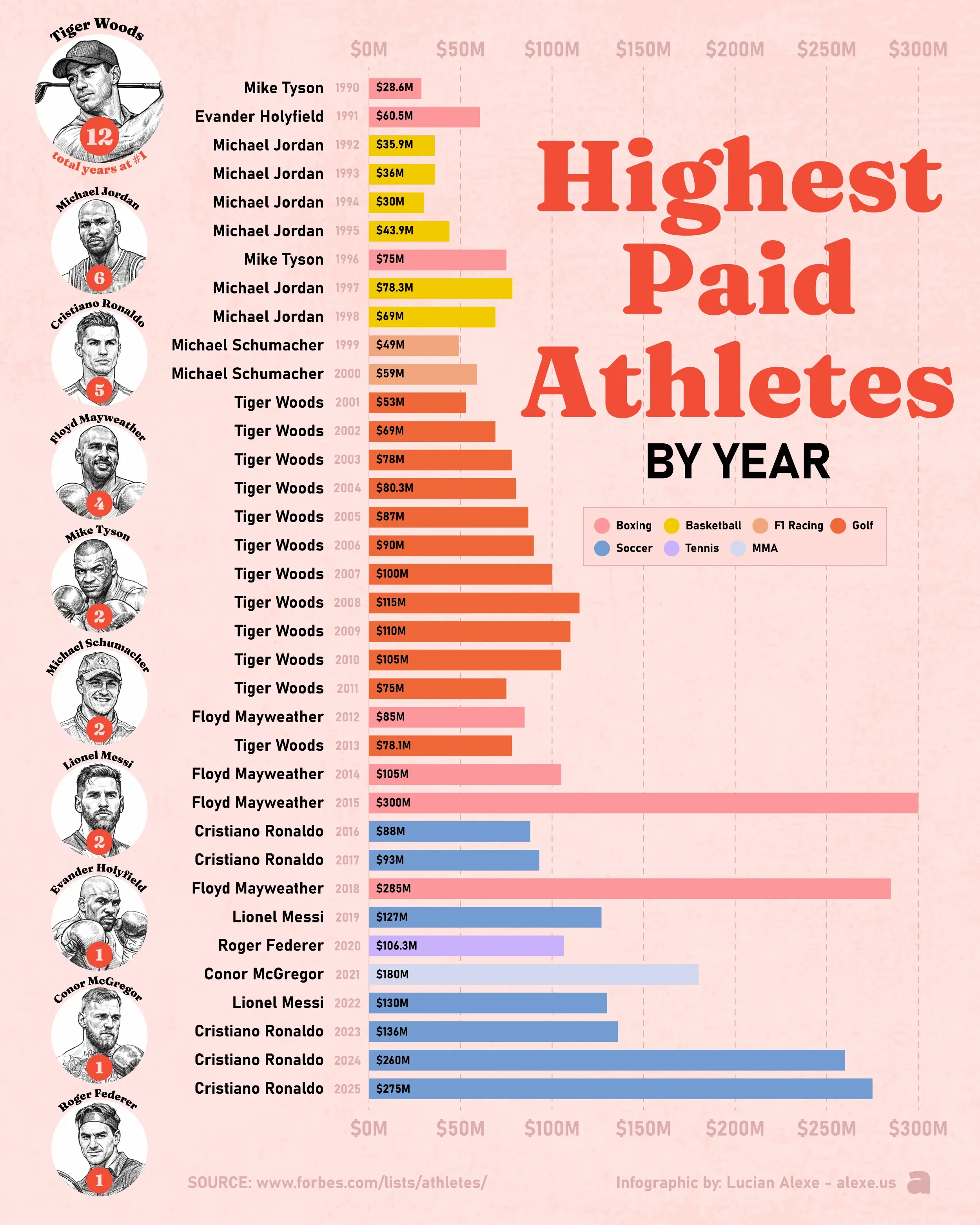
The landscape of professional sports finance has undergone a seismic shift over the last few years. While traditional league salaries in the NBA and NFL continue to climb, the entry of sovereign wealth funds into the global sports market has shattered previous glass ceilings for individual earnings. As of early 2026, the data reflects a period where the "top ten" threshold has stabilized at approximately $100 million, a figure that was once reserved for only the most elite superstars like Tiger Woods or Floyd Mayweather.
The Global Dominance of Cristiano Ronaldo
Cristiano Ronaldo’s return to the top of the Forbes list is not merely a testament to his longevity on the pitch but also a reflection of the changing geography of sports capital. His move to the Saudi Pro League’s Al-Nassr fundamentally reset the market for veteran athletes. His on-field salary, estimated at $200 million per season, is the largest playing contract in the history of the sport.
However, Ronaldo's financial empire extends far beyond his weekly wages. With a social media following that exceeds 900 million across various platforms, he remains the most marketable athlete for global brands. His lifetime partnership with Nike, along with significant deals with Herbalife, Clear, and Binance, provides a steady $60 million "off-field" stream. This diversification is a key component of the Forbes methodology, which balances liquid salary against the long-term value of an athlete’s personal brand.
The LIV Golf Effect: Jon Rahm’s Financial Ascent
Perhaps the most dramatic shift in the recent Forbes rankings is the rise of Jon Rahm. Previously a mainstay in the top 30, Rahm surged to the number two spot following his high-profile move to LIV Golf. Forbes estimates Rahm’s total earnings at $218 million, with a staggering $198 million attributed to on-field earnings.
This figure is largely driven by the upfront signing bonus Rahm received to join the Saudi-backed league. Unlike the PGA Tour, which relies on a meritocratic "play-to-earn" prize money model, LIV Golf introduced the concept of massive guaranteed contracts to the sport of golf. This has created a temporary disparity where golfers can out-earn traditional superstars in soccer and basketball despite having a smaller global commercial footprint.
The "Messi Effect" and Revenue Sharing in the US
Lionel Messi remains a fixture in the top three, with total earnings of approximately $135 million. While his on-field salary at Inter Miami ($65 million) is significantly lower than Ronaldo’s, his off-field portfolio ($70 million) is arguably the most sophisticated in sports.
Messi’s move to Major League Soccer (MLS) introduced a new paradigm for athlete compensation: the revenue-sharing model. In addition to his base salary, Messi receives a cut of subscriptions from the Apple TV "MLS Season Pass" and a share of profits from Adidas. This structure signifies a shift from flat-fee endorsements to equity-based partnerships, allowing athletes to benefit directly from the growth of the leagues and platforms they inhabit.
The NBA’s Escalating Salary Cap and the $100 Million Club
The National Basketball Association (NBA) continues to provide the highest concentration of athletes in the Forbes Top 10. The league’s collective bargaining agreements and massive domestic television deals have ensured that even veteran "max contract" players earn upwards of $40 million to $50 million in base salary alone.
- LeBron James: Ranking consistently in the top five, James earned $128.2 million. His off-field earnings ($80 million) remain the highest in the NBA, supported by his stakes in Blaze Pizza, Fenway Sports Group, and his production company, SpringHill Company.
- Giannis Antetokounmpo: With $111 million in total earnings, "The Greek Freak" represents the new generation of international NBA stars whose wealth is balanced between a super-max contract and global endorsements with brands like Nike and WhatsApp.
- Stephen Curry: Curry’s $102 million earnings are bolstered by his "lifetime" deal with Under Armour, which includes significant equity and his own "Curry Brand" sub-division.
Comprehensive Comparison of the Top 10 Highest-Paid Athletes
The following table breaks down the earnings of the world's top athletes based on the latest verified Forbes reporting cycle. All figures are in USD and represent gross earnings before taxes and agent fees.
| Rank | Athlete | Sport | On-Field Earnings | Off-Field Earnings | Total Earnings |
|---|---|---|---|---|---|
| 1 | Cristiano Ronaldo | Soccer | $200M | $60M | $260M |
| 2 | Jon Rahm | Golf | $198M | $20M | $218M |
| 3 | Lionel Messi | Soccer | $65M | $70M | $135M |
| 4 | LeBron James | Basketball | $48.2M | $80M | $128.2M |
| 5 | Giannis Antetokounmpo | Basketball | $46M | $65M | $111M |
| 6 | Kylian Mbappé | Soccer | $90M | $20M | $110M |
| 7 | Neymar Jr. | Soccer | $80M | $28M | $108M |
| 8 | Karim Benzema | Soccer | $100M | $6M | $106M |
| 9 | Stephen Curry | Basketball | $52M | $50M | $102M |
| 10 | Lamar Jackson | Football | $98.5M | $2M | $100.5M |
Forbes Methodology: How the Rankings are Calculated
Understanding who is the "highest paid" requires a look at the rigorous methodology Forbes employs. The publication tracks earnings between May of the previous year and May of the current year. This timeframe is crucial as it captures the bulk of the European soccer season and the North American playoffs.
On-Field Earnings
These include all prize money, salaries, and bonuses. For athletes in team sports like the NFL or NBA, this includes base salaries and signing bonuses. For individual sports like golf or tennis, it includes tournament winnings and "appearance fees," which are payments made to stars simply for agreeing to participate in an event.
Off-Field Earnings
This category is an estimate of sponsorship deals, licensing fees, and returns from businesses in which the athlete holds a significant stake. Forbes does not include investment income such as interest or dividends but does include payouts from the sale of equity stakes in businesses. For example, when LeBron James sold a minority stake in his production company, that windfall was factored into his off-field total for that year.
Exclusions and Deductions
It is important to note that Forbes reports gross earnings. The figures do not account for:
- Taxes: Which can consume up to 50% of earnings depending on the athlete's jurisdiction.
- Agent Fees: Typically ranging from 3% to 15% of contracts and endorsements.
- Management Expenses: The cost of personal trainers, chefs, and legal counsel.
The Role of Sovereign Wealth in Athlete Compensation
The most significant trend identified in the latest data is the influence of the Saudi Arabian Public Investment Fund (PIF). Through investments in LIV Golf and the ownership of four major Saudi Pro League clubs (Al-Nassr, Al-Hilal, Al-Ittihad, and Al-Ahli), the PIF has effectively decoupled athlete pay from traditional team revenue streams like ticket sales or local TV contracts.
In soccer, players like Karim Benzema and Neymar Jr. entered the top 10 despite being in the twilight of their careers, purely based on the massive tax-free salaries offered in the Middle East. This has forced traditional European clubs and North American leagues to reconsider their own salary structures to remain competitive for global talent.
Frequently Asked Questions
Does Forbes count net worth or annual income?
Forbes’ "Highest-Paid Athletes" list focuses exclusively on annual income within a specific 12-month window. It is not a measurement of total net worth. For example, while Michael Jordan is billionaire and likely wealthier than everyone on this list, he does not appear on the annual earnings list because he is no longer an active athlete receiving a playing salary.
Why are there no female athletes in the top 10?
Historically, there is a significant gender pay gap in professional sports. While the earnings for female athletes are rising—led by stars like Coco Gauff and Iga Świątek—the highest-paid female athletes currently earn in the range of $20 million to $30 million annually. This is primarily due to lower broadcast rights valuations for women's leagues and smaller tournament prize pools, though the gap is narrowing in tennis and basketball.
Are "On-Field" earnings guaranteed?
In the NBA and MLB, contracts are generally fully guaranteed. However, in the NFL, only specific portions of a contract (like the signing bonus) are guaranteed. Forbes includes the full amount of a signing bonus in the year it is received, which is why NFL players like Lamar Jackson often "spike" into the top 10 during the year they sign a new contract, then disappear from the list the following year.
Does endorsement money include social media posts?
Yes. Forbes accounts for "digital influence" in their off-field estimates. For athletes like Cristiano Ronaldo or Virat Kohli, a single sponsored post on Instagram can be valued at over $2 million. These figures are calculated based on industry standards for "cost per mille" (CPM) and direct reporting from agencies.
How does inflation affect these rankings?
While the raw numbers are higher than ever, inflation does play a role. A $100 million salary in 2026 does not have the same purchasing power as it did in 2016. However, the growth in athlete pay has significantly outpaced general inflation, largely due to the explosion in value of global media rights for live sports.
Verifying Athlete Earnings Data
For readers and researchers looking to track these developments, it is essential to rely on primary financial reporting. Forbes remains the gold standard for these rankings due to their access to industry insiders, agents, and forensic accountants. However, secondary verification can often be found through:
- Spotrac or OverTheCap: These databases provide granular details on team sports contracts, including signing bonuses and dead cap hits.
- Annual League Reports: Publicly traded companies or leagues with transparent financial disclosures (like the Green Bay Packers) offer insights into the "salary" side of the equation.
- Endorsement Tracking: Publications like Sportico or Sports Business Journal track the specifics of major shoe deals and corporate partnerships.
The ongoing "arms race" for talent suggests that the $300 million annual earnings barrier may be broken before the end of the decade. As leagues explore new revenue streams—such as jersey patches, private equity investment, and digital collectibles—the financial ceiling for the world’s most elite athletes continues to rise.