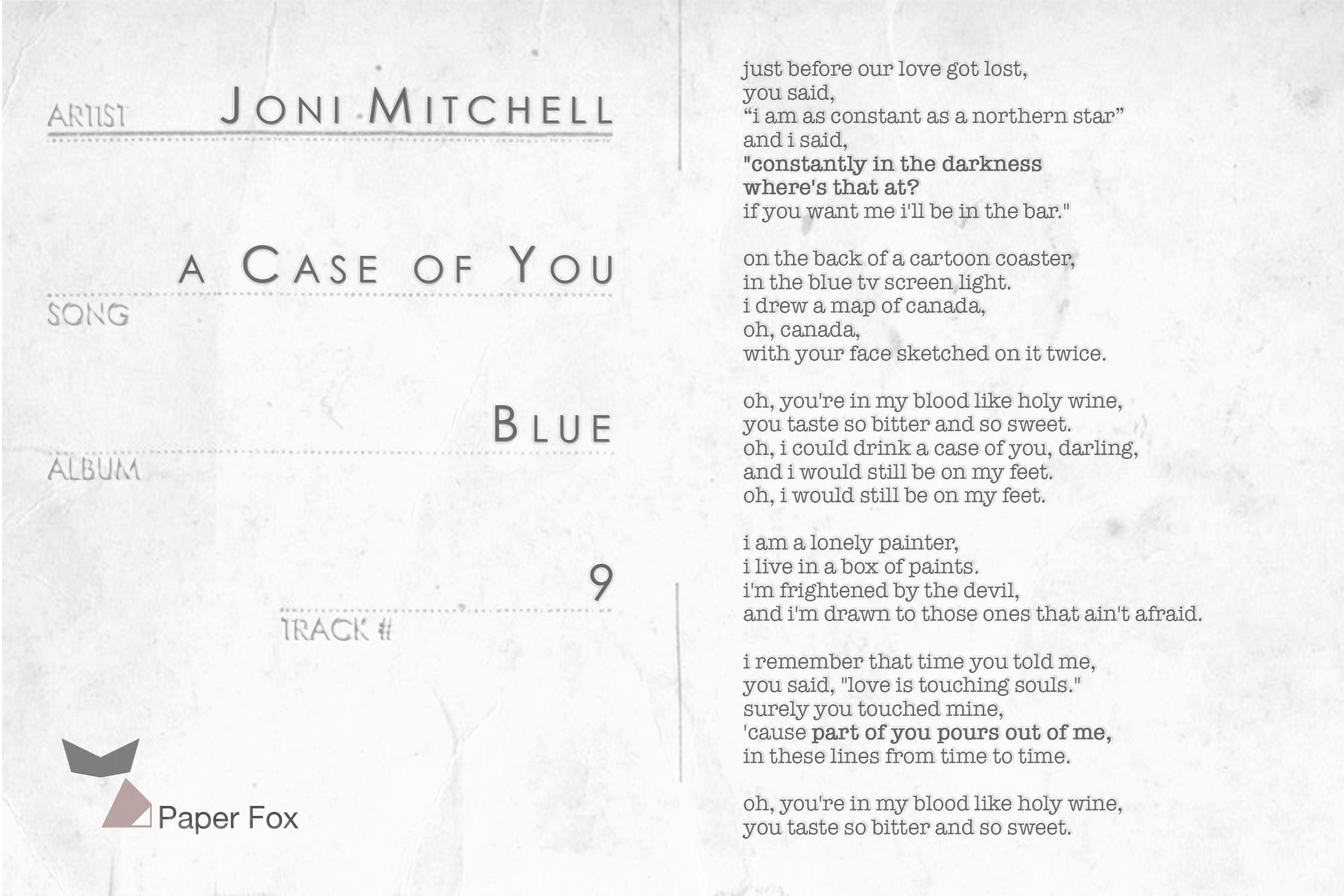
Joni Mitchell’s "A Case of You" is the definitive anthem of vulnerable, sophisticated songwriting, blending raw emotional honesty with intricate musicality. Originally released on the 1971 album Blue, the song analyzes the intoxicating and often painful nature of love through enduring metaphors of geography, religion, and spirit.
The Historical Context of the Blue Era
To understand why "A Case of You" remains a touchstone for songwriters in 2026, one must look back to the cultural landscape of 1971. This was the year Joni Mitchell released Blue, an album that redefined the "confessional" singer-songwriter genre. Before Blue, folk music often leaned toward the political or the broadly romantic. Mitchell pivoted inward, documenting the dissolution of her relationships and her search for self with a surgical precision that was, at the time, startling.
"A Case of You" was recorded during a period of intense personal transition for Mitchell. Having moved away from the lush, orchestrated sounds of her earlier work, she opted for a starker, more intimate arrangement. The song serves as a bridge between her folk roots in Saskatchewan and the sophisticated jazz-pop fusion she would later explore. In the decades since its release, the Library of Congress has preserved Blue in the National Recording Registry, citing its profound cultural and aesthetic impact.
The song’s enduring power lies in its refusal to offer easy resolutions. It is not a "breakup song" in the traditional sense, nor is it a simple love song. It is an autopsy of an influence—an examination of how one person becomes part of another's DNA, for better or worse.
Lyrical Breakdown: Geography, Alcohol, and Devotion
The lyrics of "A Case of You" are a masterclass in metaphor, using three primary motifs: the physical landscape (Canada), the spiritual (communion), and the chemical (intoxication).
The Map of Canada and Identity
The opening lines, "Just before our love got lost you said / I am as constant as a northern star," immediately establish a dialogue between two intellectual equals. The reference to the "northern star" is a direct nod to Shakespeare’s Julius Caesar, suggesting a lover who views himself as unwavering and perhaps a bit arrogant.
Mitchell’s retort—"Constantly in the darkness? Where's that at? If you want me I'll be in the bar"—is one of the most famous dismissals in music history. However, the most striking geographic metaphor follows: "I drew a map of Canada / Oh, Canada / With your face sketched on it twice." This suggests that the subject of the song is as vast and rugged as her homeland, implying that the person has become her environment.
The Sacramental and the Intoxicating
The chorus introduces the central conceit: "I could drink a case of you, darling / And I would still be on my feet." This line masterfully flips the idea of romantic intoxication. To drink a "case" of someone suggests a heavy, perhaps even dangerous, consumption. Yet, Mitchell claims she would remain standing. This indicates both her strength and the "thinness" of the lover’s essence—he is intoxicating, but not enough to floor her.
She further elevates this to a religious experience by mentioning "holy wine" that tastes "bitter and so sweet." By juxtaposing the sacred with the barroom, Mitchell highlights the duality of love: it is something to be worshipped, but it also leaves a harsh aftertaste.
Musical Composition and the Appalachian Dulcimer
While the lyrics of "A Case of You" often receive the most academic attention, the musical architecture is what provides the emotional resonance. In 2026, musicologists still point to this track as a prime example of Mitchell’s "weird" tunings and her mastery of the Appalachian dulcimer.
The Choice of Instrument
The song is anchored by the rhythmic, metallic strumming of a dulcimer. Unlike the guitar, the dulcimer offers a drone-like quality that grounds the song's airy melody. Mitchell played the instrument herself, using a custom tuning that allowed for open chords and unexpected intervals. This creates a sense of space and vulnerability; the music feels as though it is breathing with her.
Collaborations and Harmonies
The original recording features James Taylor on acoustic guitar. Taylor’s understated, finger-style playing provides a warm counterpoint to the sharp, percussive nature of the dulcimer. The interplay between the two instruments mirrors the lyrical theme of two people trying to find a shared rhythm.
Mitchell’s vocal performance is equally technical. She moves from a low, conversational register in the verses to soaring, crystalline high notes in the chorus ("I'm a lonely painter..."). This range illustrates the "lonely painter" persona she adopts—someone who sees the world from a distance but feels every stroke of the brush.
The Muse and the Mystery: Who is the Song About?
A significant part of the "A Case of You" lore involves the identity of the man who inspired it. While Mitchell was famously private about the specific inspirations for her songs, several figures from her life during the late 1960s and early 70s are prime candidates.
- Graham Nash: Mitchell had a well-documented and deeply emotional relationship with Nash. The domesticity and the "love getting lost" themes align with the timeline of their breakup.
- Leonard Cohen: Many analysts believe the "northern star" and the intellectual sparring in the lyrics point toward Cohen. The reference to "holy wine" also mirrors Cohen’s frequent use of religious imagery.
- James Taylor: Though he played on the track, their brief romantic entanglement during the Blue sessions makes him a secondary possibility, though most critics agree the song was written before their relationship peaked.
Ultimately, the song transcends its muse. By the time it reaches the listener, it is no longer about a specific man in a Laurel Canyon bungalow; it is about the universal experience of being "frightened by the devil" and "drawn to those who weren't afraid."
Comparative Analysis of Key Covers
"A Case of You" is one of the most covered songs in the Great American Songbook. Each version highlights a different facet of the original's brilliance.
| Artist | Year | Key Style | Impact/Analysis |
|---|---|---|---|
| Prince | 1983/2002 | Soulful Piano Ballad | Transformed the song into a slow-burn devotional; emphasized the "intoxication" aspect. |
| Diana Krall | 2001 | Jazz Vocal | Brought out the sophisticated harmonic structure; treated the song like a jazz standard. |
| James Blake | 2011 | Minimalist Electronic | Used silence and vocoder layers to highlight the "loneliness" of the painter. |
| Brandi Carlile | 2019 | Folk-Rock Tribute | Stayed true to the original dulcimer roots while adding modern powerhouse vocals. |
| Joni Mitchell | 2022 | Orchestral/Low Register | Her "Joni Jam" performance at Newport showcased how the song ages into a wise, gravelly reflection. |
The Influence and Legacy in 2026
Fifty-five years after its release, "A Case of You" remains a foundational text for modern artists. In 2026, the rise of "hyper-confessional" pop—pioneered by artists who grew up listening to Mitchell—has only reinforced the song's relevance. It taught generations of writers that they did not have to choose between being intellectual and being emotional.
The song’s technical specifications—the use of the dulcimer and non-standard tunings—have also inspired a resurgence in acoustic experimentation. Digital workstations now include "Joni-style" presets, but the human element of her performance remains impossible to replicate perfectly.
Furthermore, the song has survived the shift from physical media to streaming and now to decentralized AI-curated playlists because it possesses "organic complexity." It is a song that reveals something new on the hundredth listen, whether it is a specific harmonic tension in the bridge or a subtle inflection in the word "darling."
Frequently Asked Questions
What instrument is played in "A Case of You"?
Joni Mitchell plays an Appalachian dulcimer on the track. This three- or four-stringed fretted instrument is typically played on the lap. Mitchell used it to create a percussive, drone-heavy sound that distinguished the song from standard folk-guitar tracks of the era.
What is the meaning of "I could drink a case of you"?
The line is a metaphor for the addictive and consuming nature of a deep romantic connection. To "drink a case" suggests a large volume, yet saying she would "still be on my feet" implies that the subject’s influence, while vast, cannot break her spirit or her independence.
Did Prince ever record "A Case of You"?
Yes, Prince was a lifelong fan of Joni Mitchell and covered the song frequently in his live sets. He released a studio version on his 2002 album One Nite Alone.... His version is widely considered one of the best covers, bringing a deep, soulful vulnerability to the lyrics.
Is "A Case of You" about Graham Nash?
While never explicitly confirmed by Mitchell as being solely about one person, it is widely believed to be inspired by her relationship with Graham Nash. Some elements, particularly the intellectual banter, are also thought to be inspired by her time with Leonard Cohen.
Why is the song called a "definitive anthem"?
It is considered a definitive anthem because it encapsulates the "singer-songwriter" movement’s goals: high-level poetry, innovative musicality, and uncompromising emotional truth. It set the standard for how personal a pop song could be.
How to Properly Study the Song
For those looking to go beyond a casual listen, analyzing "A Case of You" requires a multi-sensory approach. First, listen to the original Blue recording with high-fidelity headphones to catch the nuances of the dulcimer’s resonance. Compare this immediately with Mitchell’s live performance at the 1974 Miles of Aisles tour to see how she adapted the song for a full band.
If you are a musician, attempt to learn the song in its original tuning (Open D or similar variants on the dulcimer). Understanding the physical "shape" of the chords provides insight into why the melody moves the way it does. Finally, read Mitchell’s collected lyrics in her book Morning Glory on the Vine to appreciate the punctuation and phrasing she intended, which often reveals hidden layers of meaning not immediately obvious through audio alone.