The Bashid McLean case remains one of the most chilling chapters in New York City’s criminal history, involving the 2013 murder and dismemberment of Tanya Byrd by her son in the Bronx. This analysis focuses on the legal, forensic, and digital media implications of the case, specifically addressing the persistent public interest in unredacted evidence and the ethical boundaries of true crime documentation.
Understanding the 2013 Bronx Matricide and the "No Blur" Digital Phenomenon
As we look back from 2026, the case of Bashid McLean continues to serve as a primary case study for forensic psychologists and digital ethicists. The incident occurred in February 2013 in the Morrisania section of the Bronx. McLean, then 23, killed his 52-year-old mother, Tanya Byrd, following a domestic dispute. The subsequent actions—dismembering her body with a power saw and disposing of the remains in various locations across the neighborhood—shocked the nation.
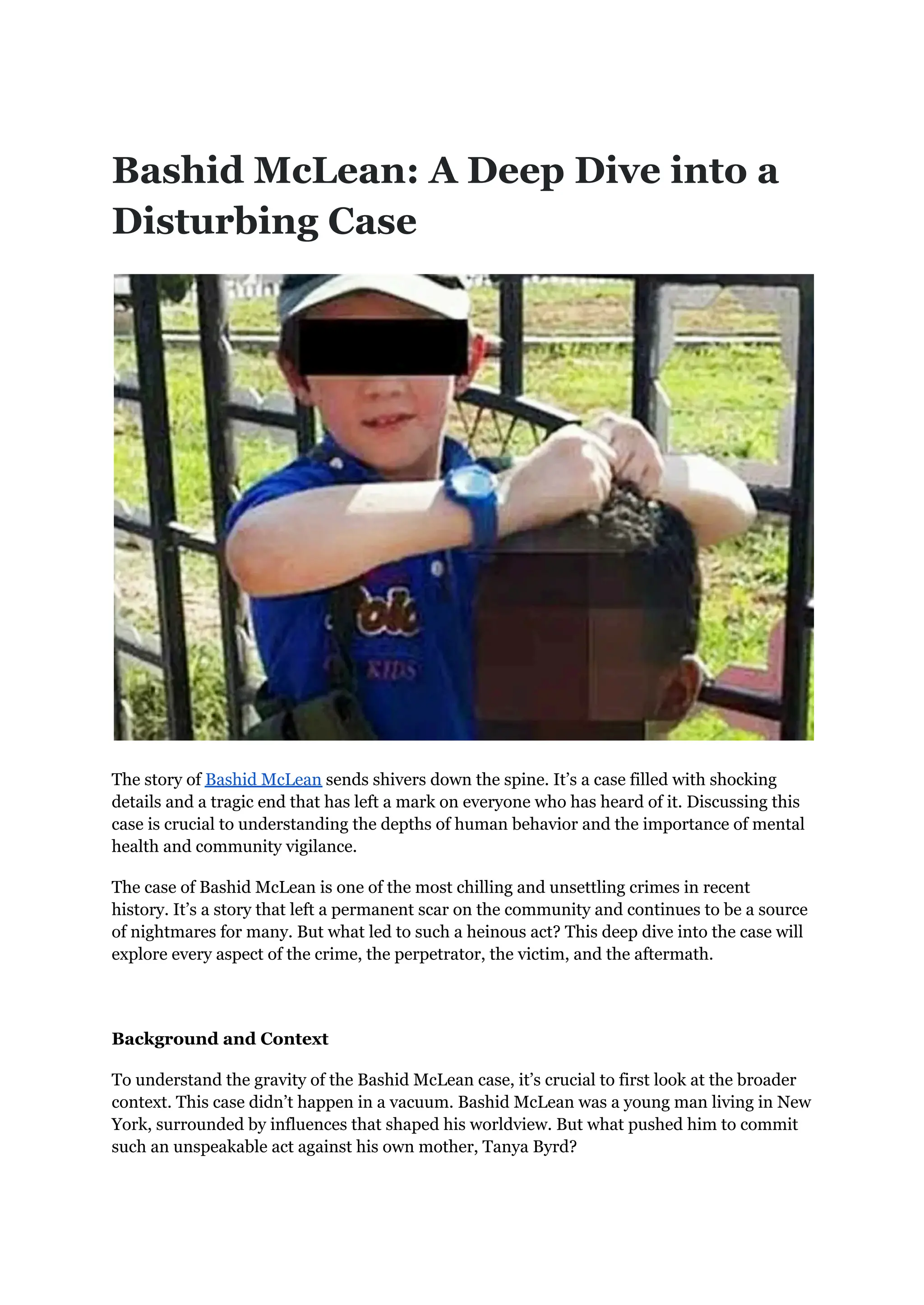
The specific search interest in "no blur" imagery refers to a notorious photograph found on McLean's phone: a "selfie" in which he posed with his mother’s severed head. In the years following the trial, this image became a flashpoint for debates regarding digital sensationalism. In 2026, digital platforms utilize sophisticated AI-driven moderation to restrict the dissemination of such graphic content, yet the historical and forensic interest in the unredacted evidence remains a topic of study for those analyzing "shock media" and its impact on jury perception.
Forensic and Psychological Profile: The Trial of Bashid McLean
The legal proceedings against McLean were centered heavily on his mental state. His defense team argued that he was suffering from profound psychiatric issues, including schizophrenia, and was hearing voices that commanded him to commit the act. This "insanity defense" is a high-stakes legal maneuver in New York State, requiring the defense to prove that the defendant lacked the capacity to understand the nature and consequences of their actions or that the actions were wrong.
Clinical Evaluation Overview
The psychological assessment of McLean revealed a long history of institutionalization and mental health struggles. However, the prosecution successfully argued that the level of calculation involved—buying a power saw, systematically disposing of evidence, and the presence of the "selfie" as a trophy—indicated a clear understanding of the gravity of the crime. The jury ultimately rejected the insanity defense, leading to a conviction of second-degree murder.
Comparative Analysis of Defense and Prosecution Arguments
| Argument Category | Defense Strategy (Psychiatric Focus) | Prosecution Strategy (Criminal Intent) |
|---|---|---|
| Mental Capacity | Argued McLean was in a state of active psychosis and unable to distinguish right from wrong. | Demonstrated "consciousness of guilt" through the concealment of evidence. |
| Digital Evidence | Suggested the "selfie" was proof of a fractured reality and mental break. | Argued the photo was a deliberate trophy, showing premeditation and pride. |
| Physical Evidence | Highlighted the irrational nature of the crime as evidence of insanity. | Focused on the purchase of tools (the saw) as a logical, planned step in the crime. |
| Sentence Outcome | Sought commitment to a psychiatric facility rather than prison. | Secured a sentence of 25 years to life in a maximum-security facility. |
Digital Media Ethics and the "No Blur" Demand in 2026
In 2026, the landscape of true crime consumption has shifted. While earlier decades saw a "wild west" of unredacted forensic photos on the open web, modern regulations and the evolution of Search Engine Results Pages (SERPs) prioritize victim dignity and public safety.
The term "no blur" highlights a persistent tension in the true crime community. On one hand, researchers and students of forensics require access to raw evidence for educational purposes. On the other hand, the viral nature of graphic imagery can traumatize survivors and dehumanize victims. In 2026, New York legal standards regarding the release of "discovery" material (evidence) have tightened, ensuring that graphic images from the McLean file are strictly controlled and generally inaccessible to the public to prevent secondary victimization.
The Impact of the McLean Case on New York Law Enforcement Protocols
The investigation into Tanya Byrd’s death led to several procedural shifts in how the NYPD handles domestic disturbance calls involving individuals with known psychiatric histories. By 2026, these protocols have been fully integrated into the "Crisis Intervention Team" (CIT) frameworks used across the five boroughs.
- Enhanced Forensic Triage: The use of digital extraction tools to immediately identify "trophy" images on suspect devices was streamlined following the McLean case.
- Community Notification Systems: The discovery of remains in public trash receptacles led to revised sanitation and neighborhood watch protocols in the Bronx to ensure rapid response and crime scene preservation.
- Mental Health Record Integration: There is now a more robust (though privacy-protected) bridge between the healthcare system and law enforcement when dealing with high-risk individuals with histories of violent ideation.
Analyzing the 2017 Sentencing and Current Status in 2026
Bashid McLean was sentenced in 2017 to the maximum allowed: 25 years to life. As of 2026, McLean remains incarcerated within the New York State Department of Corrections and Community Supervision (DOCCS) system. His case is frequently cited in parole board training as an example of why "future dangerousness" must be weighed against psychiatric history.
Expert Insight: The Role of Digital Evidence in Sentencing
Senior legal analysts note that the McLean "selfie" was perhaps the single most influential piece of evidence in his trial. It negated the defense’s attempt to paint him as a victim of his own mind. In 2026, as we integrate more AI-generated content into society, the "provenance" or the verified origin of such digital evidence is more critical than ever. The McLean case stands as a precursor to the modern era of "digital fingerprints" in violent crime prosecution.
Psychological Perspectives: Matricide and Dismemberment
Forensic experts classify matricide (the killing of one’s mother) as a rare but significant subset of domestic homicide. When combined with dismemberment, the psychological profile typically points to extreme depersonalization or a desire for total control. In the McLean case, the act of photographing the aftermath added a layer of digital narcissism that has been studied extensively in the decade leading up to 2026.
Researchers have found that the "no blur" interest is often driven by a psychological phenomenon known as "morbid curiosity," which, while natural, is managed in 2026 through refined digital ethics and content warnings that were not as prevalent in 2013.
Frequently Asked Questions Regarding the Bashid McLean Case
What happened to Bashid McLean after the trial? Bashid McLean was convicted of second-degree murder and received a sentence of 25 years to life. As of 2026, he continues to serve his sentence in a New York State maximum-security correctional facility, with his earliest possible release date still years away.
Is the "no blur" photo of Bashid McLean still available? While graphic images occasionally resurface on unregulated corners of the internet, most major search engines and social media platforms in 2026 use advanced filtering to block or blur this content. This is done to adhere to digital safety standards and out of respect for the victim, Tanya Byrd.
Why did the insanity defense fail in this case? The prosecution successfully demonstrated that McLean's actions were methodical and planned. By showing that he purchased a power saw and attempted to hide the remains in different locations, they proved he had "consciousness of guilt," which contradicts the legal definition of insanity in New York.
What was the motive behind the murder of Tanya Byrd? The motive was attributed to long-standing domestic tension and McLean's volatile mental health. Testimony indicated that an argument over McLean's perceived lack of respect and his mother's desire for him to move out precipitated the violent outburst.
How did the "selfie" impact the jury's decision? The "selfie" was devastating for the defense. It provided the jury with a visual representation of McLean's state of mind immediately following the crime—showing a lack of remorse and a sense of triumph rather than the confusion or horror typically associated with a psychotic break.
Conclusion: Lessons for the Year 2026
The Bashid McLean case serves as a somber reminder of the intersection between mental health crises and violent crime. In 2026, the focus has shifted toward prevention and the ethical handling of digital evidence. While the "no blur" aspect of the case continues to draw search traffic, the true legacy lies in the improvements to New York's forensic protocols and the ongoing discussion about how society balances the public's right to information with the fundamental right to human dignity for victims of violent crime.
For those researching the technical aspects of this case or similar forensic studies, it is recommended to consult official legal archives and peer-reviewed forensic psychology journals which provide the necessary context without the sensationalism often found in unredacted digital media.