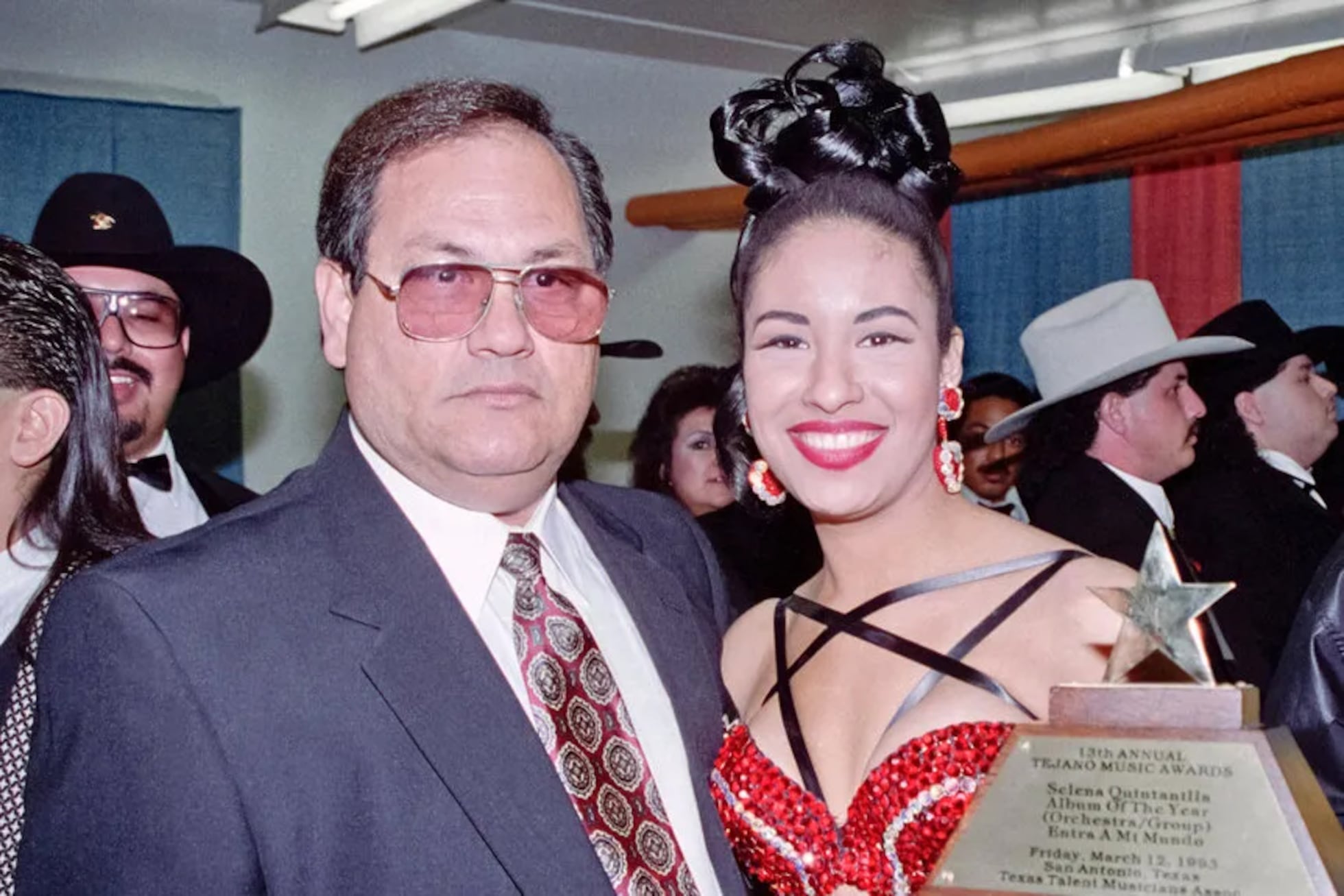
A.B. Quintanilla III is a multi-platinum American record producer, songwriter, and musician best known as the creative force behind his sister Selena’s greatest hits and the founder of the Kumbia Kings. By 2026, his influence remains a cornerstone of Latin music, bridging traditional Tejano sounds with contemporary urban, pop, and R&B elements.
The Early Foundations of Los Dinos
Born Abraham Isaac Quintanilla III on December 13, 1963, in Toppenish, Washington, A.B.’s musical journey was inextricably linked to his family’s relocation to Corpus Christi, Texas. Under the strict but visionary guidance of his father, Abraham Quintanilla Jr., A.B. became the bassist for the family band, Selena y Los Dinos. While his sister Selena took center stage as the vocalist, A.B. spent the 1980s mastering the technical aspects of rhythm and arrangement.
During these formative years, the band struggled to find its footing in a male-dominated Tejano industry. A.B.’s role was not merely as a performer but as a student of the genre. He spent thousands of hours in the studio and in the "Big Bertha" tour bus, analyzing why certain polka rhythms resonated with audiences while others fell flat. By the time the group signed with EMI Latin in 1989, A.B. had transitioned from a competent bassist to a sophisticated producer capable of tailoring a unique sound for his sister’s voice.
The importance of this period cannot be overstated. A.B. was responsible for modernizing the Tejano sound by introducing synthesizers and pop-oriented hooks that moved the genre away from its rural, accordion-heavy roots and toward a polished, radio-friendly format. This evolution was essential for the "crossover" success that the family eventually achieved.
Crafting the Selena Sound: The Producer’s Perspective
The 1990s marked A.B. Quintanilla’s emergence as one of the most successful songwriters in the history of Latin music. He didn't just write songs; he built sonic landscapes that allowed Selena to express a range of emotions, from the heartbreak of "Como la Flor" to the infectious joy of "Bidi Bidi Bom Bom."
The Anatomy of a Hit
A.B.’s production style was characterized by a meticulous attention to the "groove." In tracks like "Amor Prohibido," he blended a traditional cumbia beat with a more structured pop verse-chorus format. This approach was revolutionary at the time because it made the music accessible to non-Spanish speakers while remaining deeply authentic to the Mexican-American experience.
His technical approach often involved:
- Melodic Basslines: Moving beyond simple root-note patterns to create counter-melodies that drove the song.
- Synthesizer Layering: Using modern keyboards to mimic brass sections, giving the music a futuristic yet familiar feel.
- Cultural Fusion: Integrating elements of rock, R&B, and reggae into the standard Tejano framework.
By the mid-90s, A.B. was the primary architect of the Amor Prohibido album, which remains one of the best-selling Latin albums of all time. His ability to anticipate musical trends ensured that the family’s music stayed ahead of the curve, even as the "Latin Explosion" of the late 90s began to take shape.
The Post-Selena Era: Revolutionizing Cumbia with Kumbia Kings
Following the tragic loss of his sister in 1995, A.B. Quintanilla faced the monumental task of redefining his career. He chose to pivot away from the traditional Tejano sound to create something entirely new: Cumbia Urbana. In 1999, he formed A.B. Quintanilla y Los Kumbia Kings.
This group was a radical departure from Los Dinos. It featured a rotating cast of talented vocalists and dancers, blending traditional Mexican cumbia with American hip-hop, R&B, and pop. The Kumbia Kings became a cultural phenomenon, particularly among the youth in both the United States and Mexico. They effectively "democratized" cumbia, making it "cool" for a generation that had previously viewed the genre as something only their parents listened to.
The success of the Kumbia Kings was driven by A.B.’s "remix" mentality. He took classic songs and reimagined them with urban beats, while also penning original hits like "Azúcar" and "Fuiste Mala." This era was marked by high-energy performances and a visual aesthetic that mirrored the burgeoning streetwear culture of the early 2000s.
Comparison of A.B. Quintanilla’s Major Musical Eras
As of 2026, music historians and fans look back at A.B.'s career through several distinct phases. The following table highlights the technical and stylistic shifts across his most prominent projects.
| Feature | Selena y Los Dinos (1980s-1995) | Kumbia Kings (1999-2006) | Kumbia All Starz / Elektro Kumbia (Post-2006) |
|---|---|---|---|
| Primary Genre | Tejano Pop / Modern Cumbia | Cumbia Urbana / R&B Fusion | Electro-Cumbia / Pop Fusion |
| Key Instrumentation | Bass, Keyboards, Drums | Heavy Percussion, DJ scratching, Rap | Electronic Samples, Synths, Bass |
| Target Audience | General Latin/Tejano Market | Youth / Bilingual Audiences | Global Latin Pop / Electronic fans |
| Notable Hits | "Como la Flor," "La Carcacha" | "Na Na Na (Dulce Niña)," "Sabes a Chocolate" | "Parece Que Va a Llover," "Piña Colada Shot" |
| Production Focus | Vocal-centric, clean pop arrangements | Beat-driven, collaborative vocalists | High-energy, dance-floor synchronization |
Technical Contributions and Musical Style
To understand A.B. Quintanilla's legacy in 2026, one must look at his technical contributions to the recording studio. He was an early adopter of digital production tools that allowed for the "cleaning" of live recordings, which was a significant leap forward for the Tejano industry in the early 90s.
The "A.B. Bass" Technique
As a bassist, A.B. developed a specific style of playing that prioritized syncopation. In traditional cumbia, the bass often follows a very predictable "one-two" pattern. A.B. introduced "ghost notes" and slides that added a funkier, more soulful layer to the rhythm section. This technique became so influential that it is still taught to aspiring Latin bassists today.
Arrangement and Songwriting
A.B. possesses a unique "ear" for hooks. He famously took a simple melody his sister was humming and turned it into "Bidi Bidi Bom Bom." His songwriting process often starts with the rhythm—establishing a solid foundation that forces the listener to move—before layering the melody and lyrics. This "rhythm-first" philosophy is why his music remains a staple at weddings, parties, and clubs decades after its initial release.
Legal and Personal Challenges: Navigating the Industry
A.B. Quintanilla’s career has not been without controversy or difficulty. Navigating the music industry as a high-profile producer often led to public disputes regarding the Kumbia Kings brand and personnel. In the mid-2000s, legal battles over management and ownership led to the dissolution of the original Kumbia Kings lineup, resulting in the formation of the Kumbia All Starz.
These challenges highlighted the complexities of managing a "brand" in the Latin music world. While the personnel changed, the "Quintanilla sound" remained consistent. A.B.’s ability to rebuild his brand multiple times serves as a case study in resilience and market adaptability. In later years, he also faced personal health and legal hurdles, including issues related to child support and brief appearances on "Most Wanted" lists for missed hearings—matters he eventually resolved through legal channels and public transparency.
In 2026, these episodes are viewed as part of the "rock star" narrative that often accompanies high-level creative genius, though they also serve as a cautionary tale about the pressures of maintaining a multi-decade career under intense public scrutiny.
The Legacy of A.B. Quintanilla in 2026
By 2026, the legacy of A.B. Quintanilla is more secure than ever. The continued popularity of the Selena Netflix series and various documentaries has introduced a third generation of fans to his work. His role in preserving and expanding his sister’s legacy has been a dual-edged sword: while he is celebrated for keeping her music alive through high-quality remasters and unreleased material, he has also had to defend the family’s management of her estate.
Beyond the Selena connection, A.B. is recognized as a pioneer who broke the "glass ceiling" for Latin producers. Before the massive global success of reggaeton and urban-pop producers like Tainy or Ovy on the Drums, A.B. Quintanilla was already demonstrating that a producer could be a brand in their own right. He proved that Latin music could be commercially viable in the U.S. without losing its cultural heart.
Influence on Current Artists
Today’s leading Latin artists often cite the Kumbia Kings as an early influence on their sound. The fusion of hip-hop and cumbia is now a standard practice in the industry, but it was A.B. who first proved it could dominate the charts. His work provided a blueprint for the "Urban-Regional" movement that continues to grow in 2026.
Frequently Asked Questions
What is A.B. Quintanilla’s most successful song?
While he has many hits, "Como la Flor" is widely considered his most successful and enduring composition. It became the signature song for Selena and remains a cultural anthem. In the Kumbia Kings era, "Na Na Na (Dulce Niña)" achieved massive commercial success across the Americas.
Why did the Kumbia Kings break up?
The original Kumbia Kings split due to internal conflicts between A.B. Quintanilla and other key members, including Cruz Martínez. The disputes centered on management, financial disagreements, and creative direction. This led to the formation of two separate entities: A.B.'s Kumbia All Starz and Cruz Martínez's Los Super Reyes.
Is A.B. Quintanilla still making music in 2026?
Yes, A.B. continues to produce music and perform. While his output has shifted toward more collaborative projects and legacy management, he remains active in the studio, often working with younger artists to help them refine their sound using his decades of production experience.
What instrument does A.B. Quintanilla play?
A.B. is primarily a bassist. His innovative approach to the bass guitar is a defining characteristic of both the Selena y Los Dinos sound and the Kumbia Kings' style. He is also proficient in guitar and keyboards, which he uses extensively during the songwriting process.
How did A.B. Quintanilla contribute to the "Selena" movie and series?
A.B. served as a consultant for both the 1997 Selena film and the 2020 Netflix series. He provided technical details about the band's history, gear, and musical arrangements to ensure the portrayals were as accurate as possible. His character in these productions highlights his pivotal role as the band's creative engine.
Continuing the Quintanilla Musical Heritage
For those looking to explore the technical side of Latin music production or simply enjoy the evolution of the genre, studying A.B. Quintanilla’s discography is an essential step. His career offers a masterclass in how to honor tradition while relentlessly pursuing innovation.
As a next action, listeners should revisit the Amor Prohibido album with a focus on the bass tracks, then transition to the Kumbia Kings’ Amor, Familia y Respeto to hear how A.B. translated those early 90s lessons into a modern urban context. His journey reminds us that the most enduring music is often born from a willingness to break rules and blend worlds that others think don't belong together.