On November 14, 1960, six-year-old Ruby Bridges made history as the first African American child to integrate the all-white William Frantz Elementary School in New Orleans, Louisiana. Escorted past hostile crowds by federal marshals, her courageous walk marked a pivotal milestone in the American Civil Rights Movement and the enforcement of court-ordered school desegregation across the American South.
Legal and Historical Context: The Road to School Desegregation
The story of Ruby Bridges cannot be fully understood without examining the landmark legal decisions and political resistance that preceded her historic walk. In 1954, the Supreme Court of the United States issued its monumental ruling in Brown v. Board of Education of Topeka, declaring state laws establishing separate public schools for Black and white students to be unconstitutional. The decision overturned the 1896 Plessy v. Ferguson precedent, which had legally sanctioned racial segregation under the doctrine of "separate but equal."
Despite the Supreme Court’s directive that desegregation proceed "with all deliberate speed," school districts across the South actively resisted integration. In Louisiana, state legislators and local school boards used regulatory hurdles, administrative delays, and intimidation tactics to stall compliance for six years following the Brown ruling.
To limit the number of Black children entering white schools, the New Orleans school board devised rigorous testing standards specifically for Black students. Out of hundreds of children tested in 1960, only six passed the educational and psychological entrance exams required to enroll in previously all-white institutions. Two of those six students decided to remain at their neighborhood schools. Three girls—Leona Tate, Gail Etienne, and Tessie Prevost—were assigned to desegregate McDonogh No. 19 Elementary School. Six-year-old Ruby Nell Bridges was chosen as the sole Black student to integrate William Frantz Elementary School.
- 1954: Supreme Court rules segregation unconstitutional (Brown v. Board)
- 1954–1960: Southern states enact legal barriers & delay tactics
- 1960: New Orleans administers entrance exams to select Black students
- Nov 14, 1960: Ruby Bridges enters William Frantz Elementary School
November 14, 1960: The Historic First Day at William Frantz Elementary
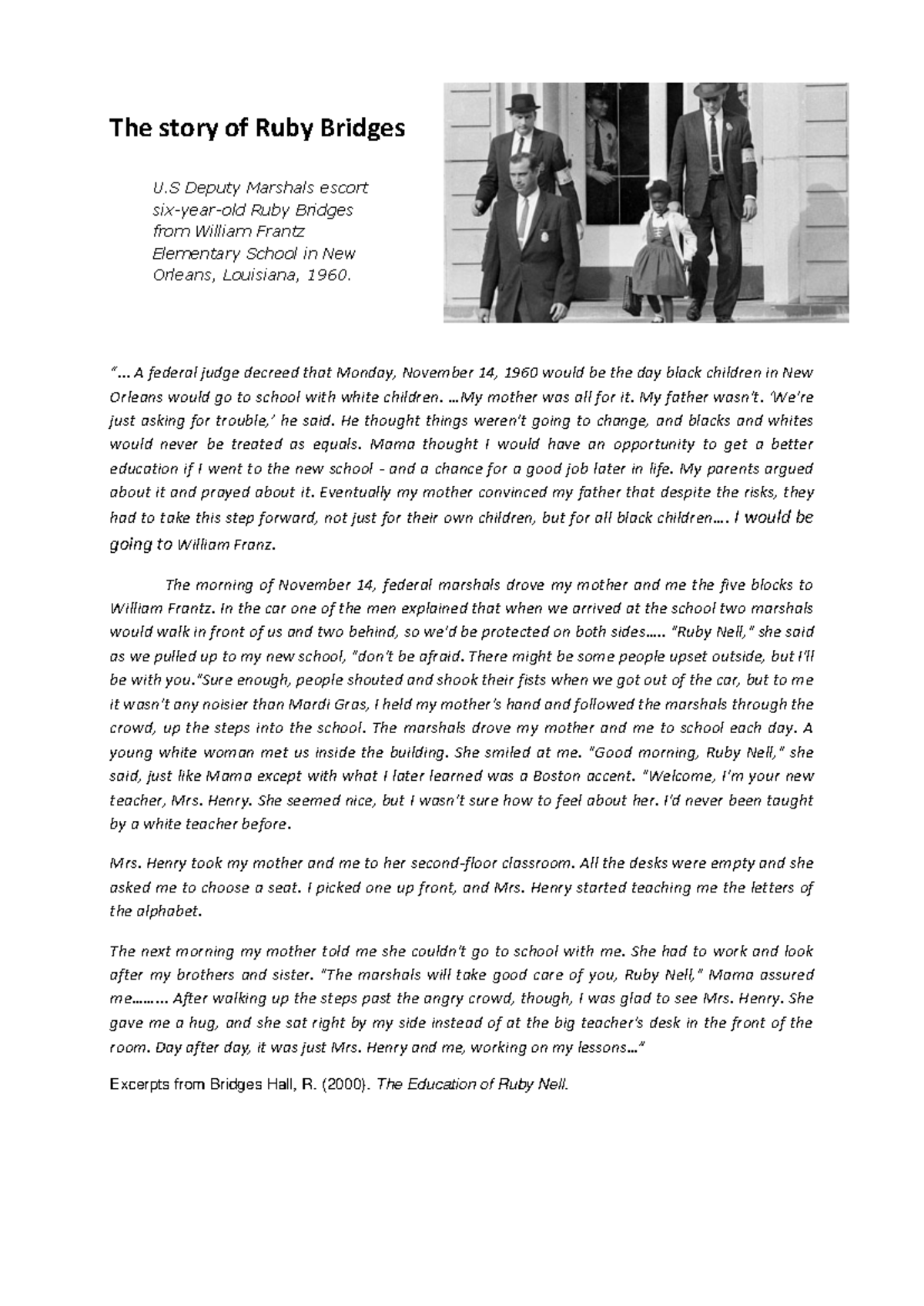
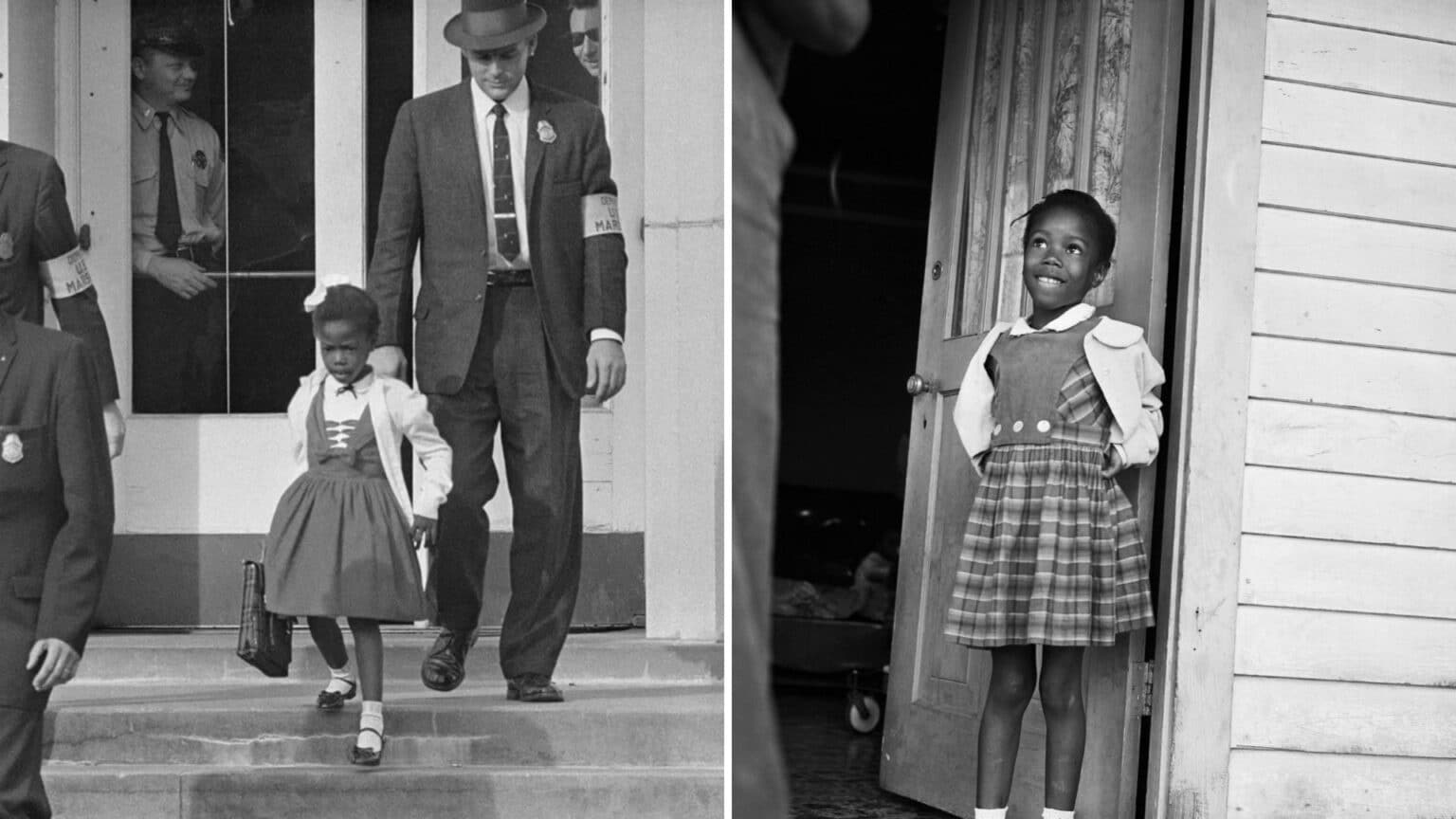
On the morning of November 14, 1960, six-year-old Ruby Bridges walked into William Frantz Elementary School under the direct protection of four federal marshals dispatched by United States District Judge J. Skelly Wright. Because local and state police refused to enforce federal integration mandates, federal officers were required to safeguard the child's constitutional right to attend school.
As Ruby arrived, a hostile mob of white protesters gathered outside the school grounds, screaming threats, chanting segregationist slogans, and throwing objects. Ruby later recalled that, in her child’s perspective, she initially mistook the noisy crowd and thrown objects for a Mardi Gras parade.
On that first day, intense anger from local residents prevented regular classes from operating. White parents surged into the school to pull their children out of classrooms in protest against integration. Due to the chaos and safety concerns, Ruby spent her entire first day sitting in the principal's office alongside her mother, Lucille Bridges.
By the second day, white parents had instituted a mass boycott of William Frantz Elementary. Nearly every white teacher refused to instruct a Black child, leaving the school almost completely deserted except for a few brave staff members and administrators.
The Courage Behind the Scenes: Family, U.S. Marshals, and Teacher Barbara Henry
Ruby Bridges’ integration of William Frantz Elementary required immense sacrifices from her family, her teacher, and the law enforcement officers assigned to safeguard her daily routine.
The Bridges Family
Ruby’s parents, Abon and Lucille Bridges, faced severe economic and personal backlash for their decision to participate in school integration. Abon Bridges, a Korean War veteran, initially voiced concern about sending his daughter into such a volatile environment, fearing for her safety and their family's security. Lucille Bridges, however, strongly believed that integrating the school was essential for providing Ruby with a superior education and opening doors for future generations of African American children.
The consequences for the family were immediate and severe:
- Loss of Employment: Abon Bridges was fired from his job at a local gas station, and Ruby’s grandparents were turned off the farm land in Mississippi where they had worked as sharecroppers for over a quarter-century.
- Community Isolation: Grocery stores in their neighborhood refused to sell food to the family, forcing them to rely on supportive community networks and civil rights groups for daily necessities.
- Safety Threats: Nightly threats against the household required constant vigilance and community protection patrols.
Barbara Henry: A Dedicated Educator
While white teachers refused to enter the classroom with a Black child, Barbara Henry, a Boston native who had recently moved to New Orleans, agreed to teach Ruby. For an entire academic year, Henry taught Ruby as a one-on-one student in an empty classroom.
Despite the solitary environment and the noise of protesters shouting outside their window, Henry created a safe, warm, and academically rigorous space. The bond formed between Ruby and Barbara Henry became a defining element of Ruby’s educational journey, demonstrating the transformative power of empathy and dedicated teaching.
Federal Protection by U.S. Marshals
Four U.S. Marshals—Charles Burks, Al Butler, George Mitchell, and Cecil Miller—escorted Ruby to and from school every single day during the 1960–1961 school year. The marshals walked on all four sides of the young girl to protect her from flying debris, verbal abuse, and physical assault. Their constant presence was a visible symbol of federal authority enforcing constitutional rights against state-level resistance.
Key Milestones in the Life and Legacy of Ruby Bridges
The following table summarizes the key milestones of Ruby Bridges' life and the broader historic context surrounding her integration of William Frantz Elementary School.
| Year | Historical Milestone / Event | Significance and Impact |
|---|---|---|
| 1954 | Born on September 8 in Tylertown, Mississippi | Born the same year as the historic Brown v. Board of Education ruling. |
| 1960 | Passes New Orleans integration entrance exam | Selected as the single Black student to integrate William Frantz Elementary. |
| 1960 | Integrates William Frantz Elementary (Nov 14) | Becomes a national symbol of civil rights and federal integration enforcement. |
| 1964 | Norman Rockwell publishes The Problem We All Live With | Iconography of Ruby escorted by marshals reaches millions via Look magazine. |
| 1999 | Establishes the Ruby Bridges Foundation | Founded to promote tolerance, diversity, and educational equity in schools. |
| 1999 | Publishes autobiography Through My Eyes | Wins the Carter G. Woodson Book Award for detailing her childhood experience. |
| 2001 | Awarded Presidential Citizens Medal | Presented by President Bill Clinton for her extraordinary courage and civic impact. |
| 2011 | Visits President Barack Obama at the White House | Rockwell’s painting displayed prominently outside the Oval Office during her visit. |
| 2026 | Continued educational advocacy and public leadership | Remains an active speaker, author, and civil rights advocate worldwide. |
Cultural Impact: From Norman Rockwell’s Canvas to Global History
Ruby Bridges' walk into history inspired iconic works of art, literature, and public memorialization that keep the story of civil rights desegregation alive across generations.
Norman Rockwell’s The Problem We All Live With
In 1964, renowned painter Norman Rockwell depicted Ruby’s first day at school in a painting titled The Problem We All Live With, published in the January 14 issue of Look magazine. The painting features a small young girl in a pristine white dress walking between four tall, faceless federal marshals, with a blood-red tomato smashed against a concrete wall bearing racial slurs behind them.
The artwork captured the stark moral contrast between innocent childhood and systemic prejudice. In 2011, at the request of President Barack Obama, the painting was installed in the White House outside the Oval Office, where Ruby Bridges reunited with the President to view it in person.
Public Honors and Educational Recognition
Over the decades, Ruby Bridges has received numerous national honors recognizing her contributions to civil rights and education:
- The Presidential Citizens Medal (2001): Recognized for exceptional heroism in advancing civil rights.
- Statues and Memorials: A bronze statue of young Ruby Bridges stands in the courtyard of the former William Frantz Elementary School (now Akili Academy) in New Orleans.
- Children's Literature: Bridges has authored several books, including Through My Eyes (1999), Ruby Bridges Goes to School (2009), I Am Ruby Bridges (2022), and Dear Ruby, Hear Our Love (2024), bringing her message of tolerance directly to young readers.
Lifelong Activism and the Ruby Bridges Foundation
Ruby Bridges did not limit her contributions to history to a single year in elementary school. As an adult, she has dedicated her career to fighting systemic racism, expanding access to quality education, and encouraging youth leadership.
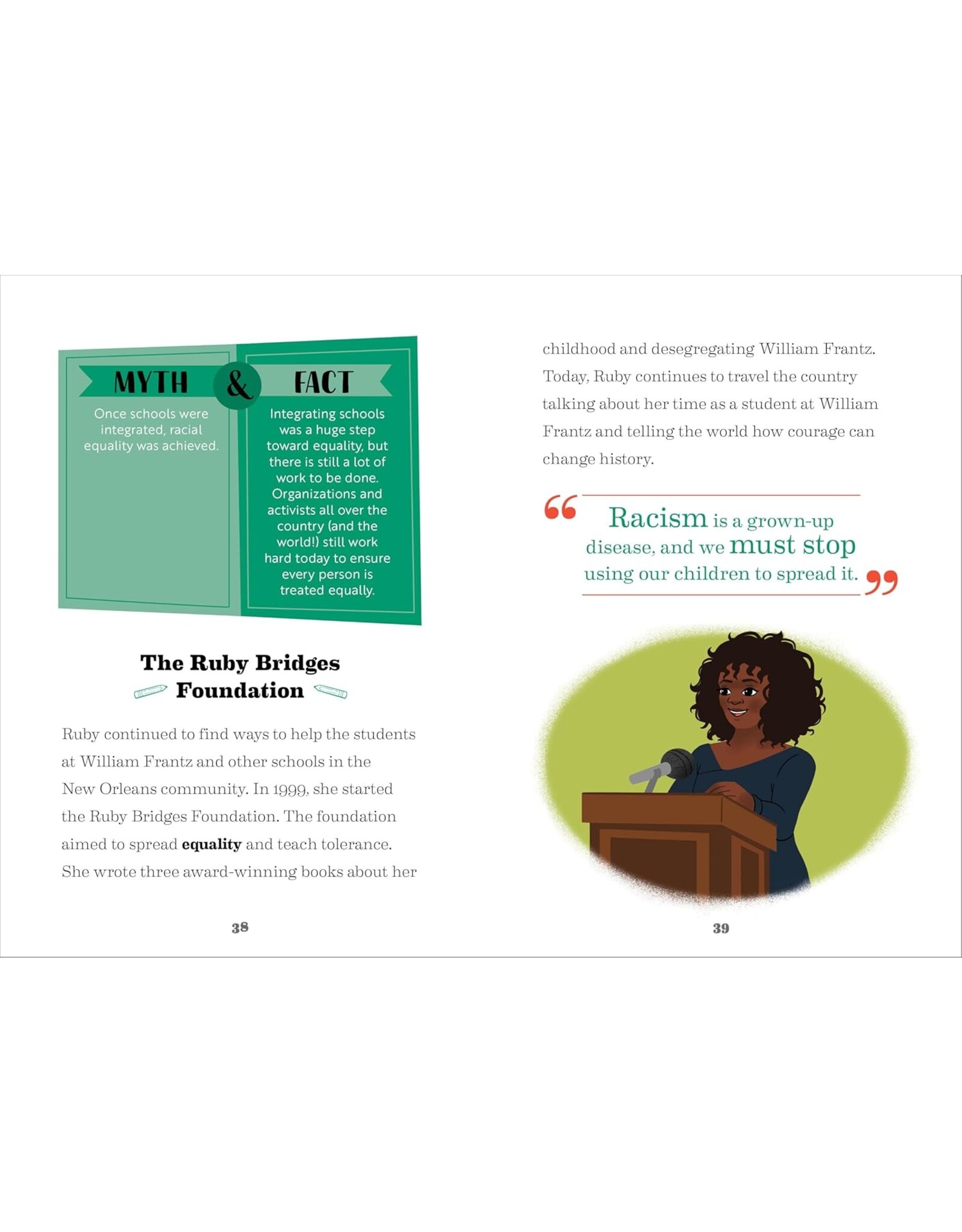
In 1999, she established the Ruby Bridges Foundation, an organization created to foster racial harmony, appreciation of diversity, and equity in public education. The foundation promotes programs that bring students of different backgrounds together, funding resources for underfunded public schools and advocating for character education initiatives.
Through her foundation and public speaking engagements worldwide, Bridges emphasizes that racism is not a natural human trait, but a learned behavior. Her message stresses the vital role that parents, teachers, and communities play in instilling empathy, respect, and courage in future generations.
Frequently Asked Questions
Why was Ruby Bridges chosen to integrate William Frantz Elementary School?
Ruby Bridges was chosen after taking an entrance examination administered by the New Orleans school board to determine eligibility for desegregation. Out of hundreds of Black applicants, six children passed the test. Ruby was the only child assigned to William Frantz Elementary School, while three other children were sent to McDonogh No. 19.
Who was the teacher that taught Ruby Bridges during school integration?
Barbara Henry, a teacher original from Boston, was the only teacher willing to instruct Ruby Bridges at William Frantz Elementary School. She taught Ruby alone in a classroom for the entire 1960–1961 school year after white parents boycotted the school and other teachers refused to teach a Black student.
What role did U.S. Marshals play in Ruby Bridges' story?
Four U.S. Marshals were dispatched by federal judge J. Skelly Wright to escort Ruby Bridges to and from school every day. Because local and state authorities refused to protect her, federal marshals were required to safeguard her physical safety from violent mobs protesting integration.
What is the Ruby Bridges Foundation?
Founded by Ruby Bridges in 1999, the Ruby Bridges Foundation is a non-profit organization dedicated to promoting tolerance, diversity, character development, and equal access to high-quality education for all children.
Preserving the Legacy of Civil Rights in Education Today
The story of Ruby Bridges remains a vital chapter in American history, serving as a powerful reminder of how individual courage can drive systemic legal and social change. Educators, students, and history enthusiasts can continue honoring this legacy through practical actions:
- Integrate Primary Sources in Classrooms: Use historical photography, court records from Brown v. Board of Education, and oral history transcripts to teach students about the legal and social dynamics of the Civil Rights Movement.
- Support Equal Educational Access: Engage with local school boards and community programs that advocate for educational equity, resource funding, and diverse learning environments.
- Promote Inclusive Youth Literature: Introduce young readers to autobiographical works like Through My Eyes and I Am Ruby Bridges to build empathy and historic literacy from an early age.
Understanding Ruby Bridges' walk into history reinforces the principle that protecting civil rights requires ongoing community commitment, vigilance, and dedicated educational advocacy.