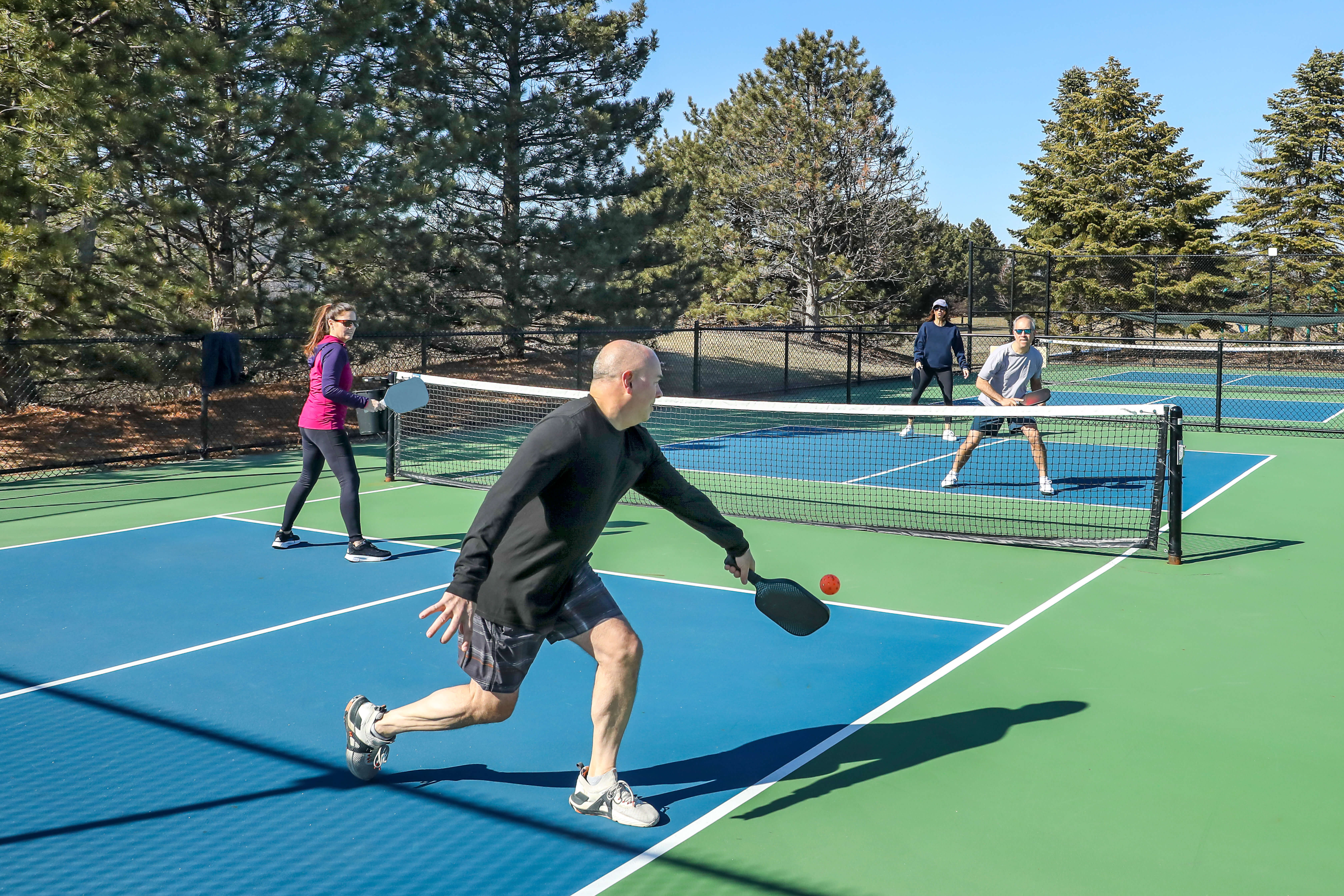
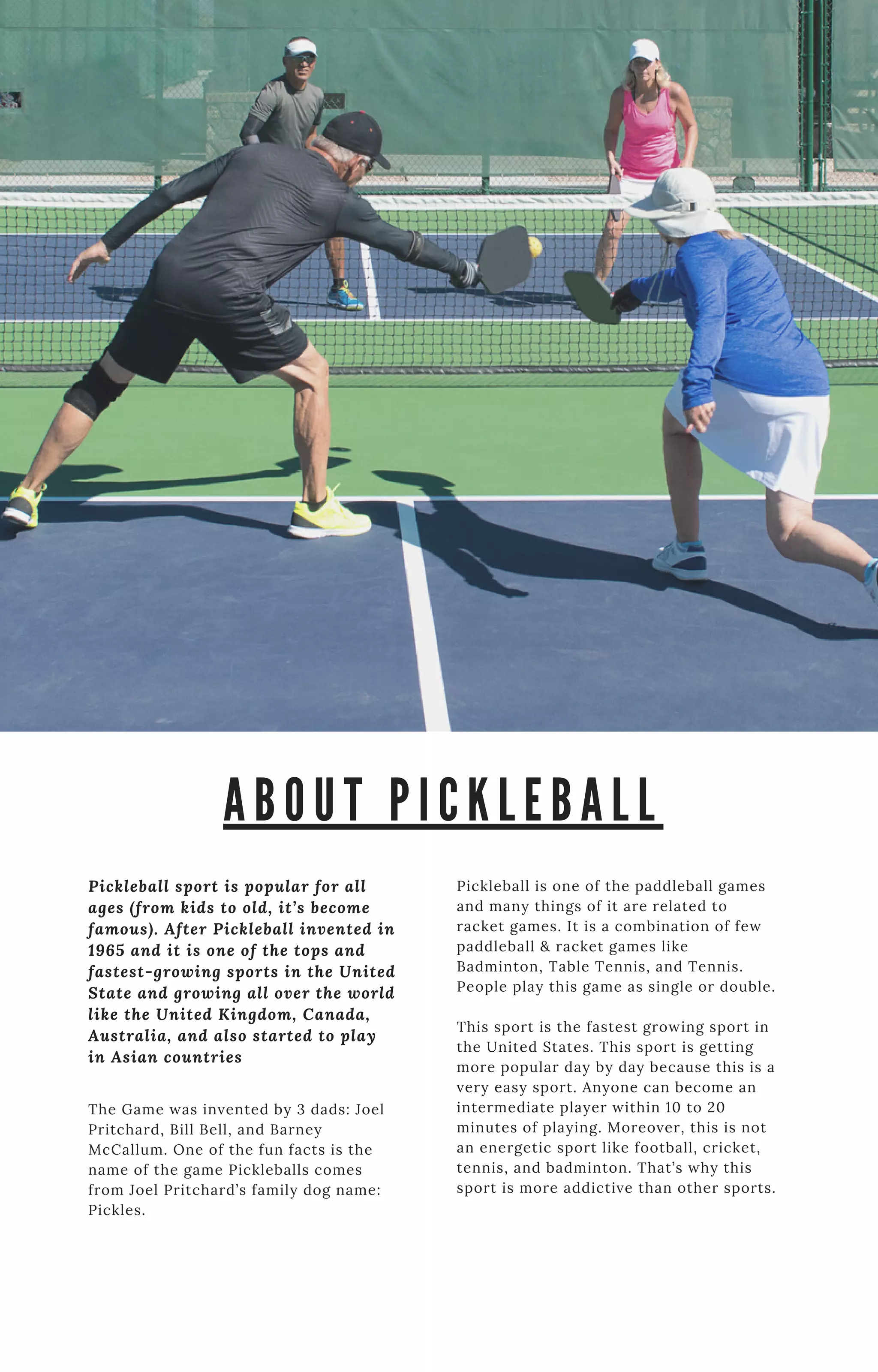
Pickleball is a court sport played with solid paddles and a perforated plastic ball on a 20-by-44-foot court divided by a 34-inch center net. Played as singles or doubles, the game combines elements of tennis, badminton, and table tennis under specific rules including a non-volley zone and mandatory side-out scoring.
Origins and Official Governing Framework
Pickleball was created in the summer of 1965 on Bainbridge Island, Washington, by Joel Pritchard, Bill Bell, and Barney McCallum. Facing a weekend with limited recreational equipment, the founders cobbled together improvised wooden paddles and a perforated plastic ball on an unused badminton court. Over the subsequent decades, the sport evolved from a backyard pastime into a internationally standardized athletic discipline governed by formal regulatory bodies.
The formalization of the sport began with the founding of the United States Amateur Pickleball Association (USAPA) in 1984, which published the first official rulebook. Today, USA Pickleball serves as the national governing body in the United States, maintaining and updating the official rules of play in coordination with international organizations. Worldwide governance is organized primarily through the International Pickleball Federation (IPF) and the Global Pickleball Federation (GPF), which establish uniform court definitions, equipment approval processes, and international tournament sanctioning rules.
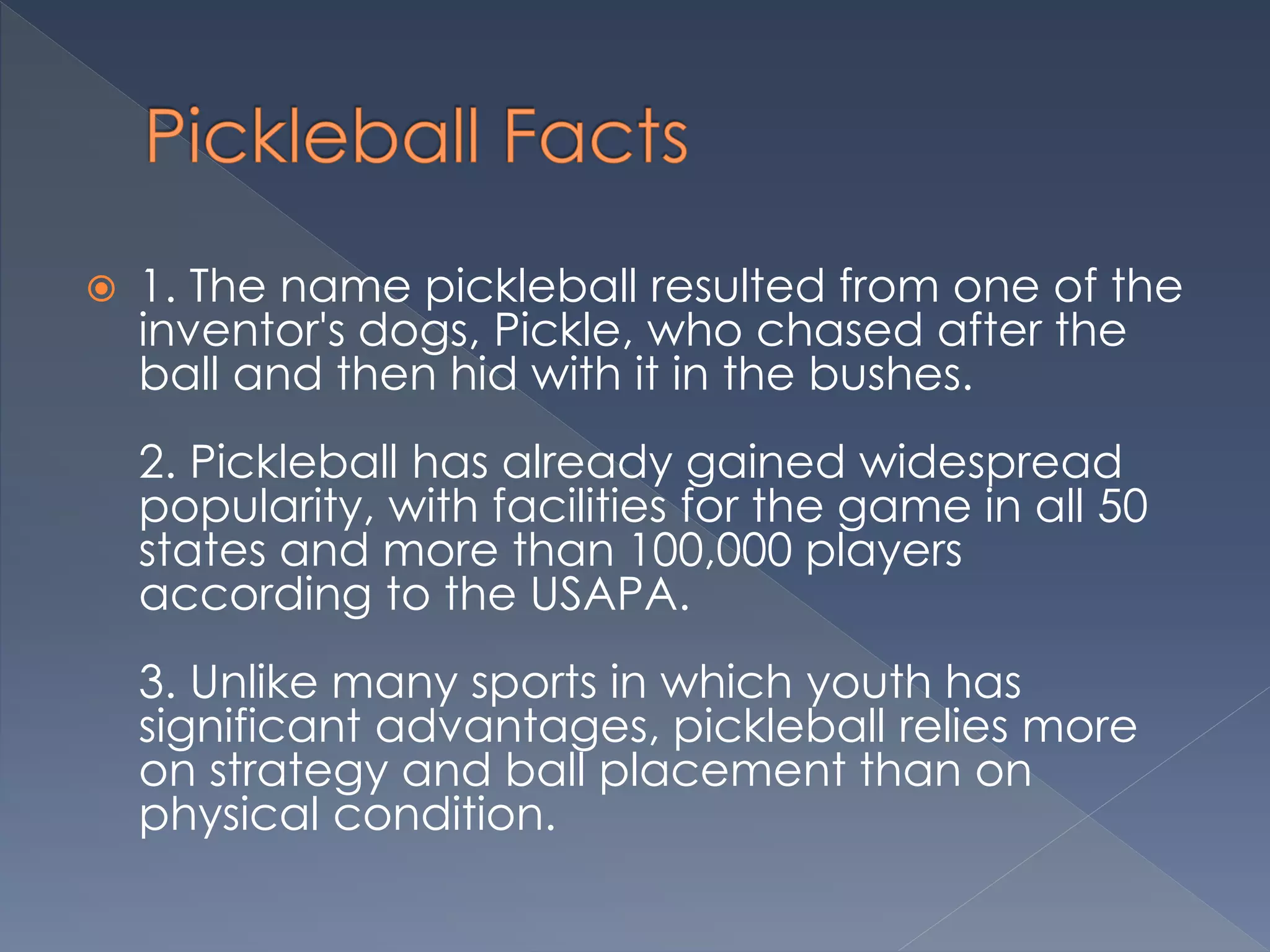
Two competing accounts exist regarding the origin of the name "pickleball." Joan Pritchard, Joel Pritchard’s wife, stated that the name referred to the "pickle boat" in rowing—a boat crewed by leftover oarsmen from different teams. Barney McCallum and local players maintained that the sport was named after the Pritchards' dog, Pickles, who would chase stray balls. Official USA Pickleball historical records acknowledge both accounts, though family documentation supports the rowing vessel terminology as the original inspiration.
Official Court Layout and Equipment Specifications
Precision in court dimensions and equipment engineering distinguishes official play from recreational variations. All sanctioned competitive play adheres to strict numerical standards established by official sanctioning bodies.
- Baseline (20 ft)
- Right Service Court / Left Service Court (15 ft)
- Non-Volley Line
- Non-Volley Zone ("The Kitchen") (7 ft)
- Net Line (34" center / 36" posts)
- Non-Volley Zone ("The Kitchen") (7 ft)
- Non-Volley Line
- Left Service Court / Right Service Court (15 ft)
- Baseline (20 ft)
- Total Court Width: 20 feet
Court Dimensions and Marking
The official pickleball court measures exactly 20 feet (6.10 meters) wide by 44 feet (13.41 meters) long for both singles and doubles play. The total required playing area including out-of-bounds safety margins should measure at least 30 feet wide by 60 feet long, with a preferred tournament footprint of 34 feet by 64 feet.
- Net Height: The net is suspended across the center of the court at a height of 36 inches (91.44 cm) at the sidelines and exactly 34 inches (86.36 cm) at the center.
- The Non-Volley Zone (The Kitchen): A rectangular area extending 7 feet (2.13 meters) from the net on both sides, spanning from sideline to sideline. Lines marking the kitchen are considered part of the kitchen area itself.
- Service Courts: The area between the non-volley zone line and the baseline, bisected by a center line into right and left service courts measuring 10 feet wide by 15 feet long.
Paddle Specifications
USA Pickleball enforces strict specifications for paddles used in sanctioned competition. A paddle must be made of a rigid, non-compressible material such as wood, composite honeycomb, or carbon fiber. The hitting surface must be smooth, without deliberate texturing or grooves that exceed allowable surface roughness thresholds (Rz rating limits).
- Combined Dimensions: The combined length and width of the paddle, including any edge guard and butt cap, cannot exceed 24 inches (60.96 cm).
- Maximum Length: The overall length of the paddle cannot exceed 17 inches (43.18 cm).
- Weight: There are no statutory minimum or maximum weight restrictions, though most competitive paddles range between 7.2 and 8.5 ounces.
Ball Standards
Pickleball balls are hollow, smooth plastic spheres containing molded or drilled holes. Balls must measure between 2.87 and 2.97 inches (7.3 to 7.5 cm) in diameter and weigh between 0.78 and 0.93 ounces (22.1 to 26.5 grams).
- Indoor Balls: Manufactured with 26 larger holes. They are typically lighter and softer, producing a slower flight pattern optimized for indoor hardwood or smooth concrete surfaces.
- Outdoor Balls: Constructed with 40 smaller, precision-drilled holes. Outdoor balls are made of denser, harder plastic to minimize wind resistance and withstand textured asphalt surfaces.
Essential Rules of Play and Scoring Dynamics
Understanding the governing rules of pickleball requires mastering four core mechanics: the service procedure, the two-bounce rule, the non-volley zone restrictions, and side-out scoring.
1. The Service Mechanics
Every rally begins with a service executed diagonally crosscourt into the opponent’s service court. The serve must clear the non-volley zone and its boundary lines. A serve that touches the non-volley zone line is ruled out.
Players may choose between a traditional volley serve and a drop serve:
- Volley Serve: The server hits the ball directly out of the air. At the moment of contact, the server’s arm must move in an upward arc, the highest point of the paddle head must not be above the highest part of the wrist, and contact must occur below waist level (navel level).
- Drop Serve: The server drops the ball from hand or paddle height onto the court surface without imparting momentum (no throwing or bouncing the ball down). Once dropped, the server may strike the ball after it bounces. The upward arc and waist-level restrictions do not apply to the drop serve.
In doubles play, servers must state the score aloud before striking the ball. The score is called as three numbers: Serving Team Score – Receiving Team Score – Server Number (1 or 2).
2. The Two-Bounce Rule
The two-bounce rule mandates that after the ball is served, the receiving team must let the ball bounce before returning it, and the serving team must let the returned ball bounce before hitting it.
Once these initial two bounces have occurred—one on the receive, and one on the return—both teams are permitted to either volley the ball (strike it in the air before it bounces) or play it off a bounce.
- Server Hits Ball
- Receiver Court: BOUNCE 1
- Receiver Hits Return
- Server Court: BOUNCE 2
- Open Play: Volleys or Groundstrokes Allowed
3. Non-Volley Zone (Kitchen) Rules
The non-volley zone (NVZ) prevents players from standing at the net and executing unstoppable down-angled smashes. The primary restrictions include:
- No Air-Attacks inside the NVZ: A player cannot hit the ball directly out of the air while standing inside the NVZ or touching any line defining the zone.
- Momentum Rule: A player’s momentum after executing a volley cannot carry them into the non-volley zone, even if the ball is declared dead before they land. If a hat, paddle, shoe, or item of clothing touches the kitchen during or after a volley, a fault is declared.
- Groundstrokes Permitted: A player may enter the non-volley zone at any time if the ball has already bounced within the court.
4. Scoring Systems: Side-Out vs. Rally Scoring
Standard pickleball matches utilize side-out scoring, meaning a team can score a point only when serving.
- Standard Games: Played to 11 points, with a victory requiring a minimum margin of 2 points.
- Tournament Variations: Matches are frequently played as best two-out-of-three games to 11, or single elimination games to 15 or 21 (win by 2).
- Rally Scoring Exception: In select professional leagues (such as Major League Pickleball), rally scoring is utilized to accelerate match duration. In rally scoring, a point is awarded on every completed rally regardless of which team served.
Technical Comparison Across Racket Sports
To understand pickleball's physical demands, space requirements, and equipment characteristics, it helps to compare it directly to other popular racket and paddle sports.
| Technical Variable | Pickleball | Tennis | Badminton | Padel |
|---|---|---|---|---|
| Court Dimensions | 20 ft × 44 ft | 27 ft × 78 ft (Singles)36 ft × 78 ft (Doubles) | 20 ft × 44 ft | 32.8 ft × 65.6 ft (Enclosed) |
| Net Height | 34 in (Center)36 in (Sidelines) | 36 in (Center)42 in (Sidelines) | 61 in (Center)61 in (Sidelines) | 34.6 in (Center)36.2 in (Sidelines) |
| Primary Ball Type | Perforated plastic (26/40 holes) | Pressurized rubber covered in felt | Feathered or nylon shuttlecock | Depressurized rubber tennis ball |
| Striking Implement | Solid composite/wood paddle | Strung graphite/composite racket | Strung lightweight racket | Solid perforated composite paddle |
| Primary Scoring System | Side-out (First to 11, win by 2) | Game-Set-Match (15-30-40 system) | Rally scoring (First to 21, win by 2) | Game-Set-Match (15-30-40 system) |
| Service Rule | Underhand mandatory | Overhand permitted | Underhand mandatory | Underhand mandatory (bounce serve) |
Core Tactical Concepts: Dinking, Drops, and Positioning
Pickleball relies heavily on tactical positioning, patience, and soft-touch control due to court dimensions and non-volley zone restrictions.
- BASELINE
- Serving / Receiving
- Focus: Depth & Drive
- TRANSITION ZONE
- Resetting / Drops
- Focus: Absorbing Pace
- KITCHEN LINE
- Dinking / Volleys
- Focus: Soft Angles & Sashes
The Third-Shot Drop
The third-shot drop is considered the foundational shot in high-level pickleball. Because the serving team must allow the return to bounce, the receiving team can advance directly to the kitchen line, establishing an immediate spatial advantage.
To neutralize this, the serving team executes a soft, unattackable trajectory shot on their second stroke (the third shot of the rally) designed to land safely inside the opponent's non-volley zone. A successful third-shot drop allows the serving team to move forward from the baseline to the net without granting the opponent an easy overhead attack.
The Dink Rally
A dink is a soft shot hit from a player's non-volley zone into the opponent's non-volley zone. Because the ball lands close to the net and remains low to the ground, it forces the opponent to hit upward, preventing them from attacking.
Dink rallies require disciplined hand-eye coordination, balance, and patience. Players use crosscourt angles and unattackable placements to maneuver opponents out of position until an error occurs or a ball pops up high enough to execute a aggressive volley or overhead smash.
Resetting and Block Volleys
When targeted with hard-driven shots (drives) while moving forward, defensive players use a reset. A reset involves taking the pace off an opponent's aggressive drive by softening the grip and absorbing the ball’s energy, directing it softly into the kitchen. Masterful resetting stops fast-paced exchanges and forces the point back into a slow-paced, tactical dink rally.
Stacking Tactics
Stacking is an advanced court positioning strategy used in doubles play. Standard rules require players to alternate service courts based on score. Stacking allows teammates to remain on their preferred side of the court (for instance, keeping a left-handed player’s forehand in the center of the court) regardless of who is serving or receiving.
- Alignment: Teammates line up together on one side of the court during or before the serve.
- Execution: As soon as the ball is struck, the player out of position shifts laterally across the court to their designated strategic side.
- Result: Players maintain dominant forehand position without violating service rotation rules.
Officiating, Ratings, and Rule Misconceptions
As pickleball has matured into an organized sport, precise rating metrics and official referee guidelines have eliminated traditional area-specific ambiguities.
The DUPR Rating System
The Dynamic Universal Pickleball Rating (DUPR) is the standard global rating system used to measure player skill level across amateur and professional tiers. DUPR uses an algorithm based on match results, point differential, and opponent rating levels.
- 2.0 – 2.5: Novice player learning court layout, fundamental rules, and basic stroke execution.
- 3.0 – 3.5: Intermediate player with consistent serve mechanics, understanding of the third-shot drop, and reliable directional control during medium-paced rallies.
- 4.0 – 4.5: Advanced competitive player capable of consistent resets, strategic stacking, low unforced error rates, and aggressive pace control.
- 5.0+: Elite national and international tournament competitor possessing exceptional court coverage, tactical versatility, and shot precision.
Common Rule Misconceptions
Several rule misunderstandings occur regularly in recreational settings. Official tournament play clarifies these edge cases under USA Pickleball guidelines:
- Line Calls on the Serve vs. In-Play: On the serve, the ball must completely clear the non-volley line; touching the kitchen line on a serve is a fault. However, during play, any ball hitting any part of the outer boundary lines (baselines or sidelines) is ruled in bounds.
- Net Overreach: A player may follow through over the net plane after striking the ball, provided they do not physically touch the net, net posts, or opponent's court surface, and provided the ball crossed to their side of the net prior to contact.
- Court Line Ambiguity: The kitchen line is part of the kitchen area. Touching the line with a foot during a volley attempt constitutes a fault, regardless of whether the foot is fully inside the zone.
Frequently Asked Questions
What is the difference between indoor and outdoor pickleball balls?
Indoor balls feature 26 larger drilled holes and are constructed from softer plastic, producing a slower flight path and higher bounce on wood floors. Outdoor balls feature 40 smaller, precision-drilled holes and denser plastic materials engineered to resist wind effects and withstand abrasive concrete or asphalt court surfaces.
Can a player hit the ball out of the air while standing in the kitchen?
No. Volleying a ball (striking it out of the air before it bounces) while standing inside the non-volley zone, or touching any part of the non-volley line during or after the stroke due to momentum, is an immediate rule violation (fault). A player may only hit a ball inside the kitchen if the ball has first bounced within that zone.
How does scoring work in pickleball doubles?
Points are scored exclusively by the serving team under traditional side-out rules. A team calls their score as three distinct numbers: the serving team's score, the receiving team's score, and the server number (Server 1 or Server 2). Each player on a doubles team continues serving until their team loses a rally, at which point service passes to their partner (except for the very first server of the game, who starts as Server 2).
Is pickleball played on a standard tennis court?
Pickleball can be played on an adapted tennis court, but the dimensions are different. A standard tennis court (36 feet by 78 feet) can accommodate up to four official pickleball courts (20 feet by 44 feet each) if temporary or permanent conversion lines and lower nets are applied.
What is a "let" serve in pickleball?
Under modern official rules established by USA Pickleball, "let" serves (where a serve clips the net tape but lands inside the correct service court) are no longer replayed. If a serve touches the top of the net and lands cleanly inside the receiver’s service box beyond the non-volley line, the ball remains live and play continues normally.
What is the official height of a pickleball net?
An official pickleball net measures 36 inches high at both sidelines (posts) and sags slightly to exactly 34 inches high at the center of the court.
Getting Started: Gear Selection and Player Onboarding
Entering organized pickleball play requires minimal initial gear, but selecting compliant equipment ensures a seamless transition into sanctioned leagues and rated open play.
Step 1: Select USAP-Approved Paddle
Step 2: Choose Indoor/Outdoor Balls
Step 3: Secure Non-Marking Court Footwear
Step 4: Establish Initial DUPR Rating
Select an Approved Paddle: Beginners should choose a mid-weight composite or graphite paddle (7.8 to 8.2 ounces) featuring a polypropylene honeycomb core. Check the official USA Pickleball Equipment Certification List to ensure the model is sanctioned for legal play.
Purchase Correct Surface Balls: Acquire outdoor balls (such as Dura Fast 40 or Franklin X-40) for hard court play, or 26-hole indoor balls if playing primarily on gym floors.
Wear Appropriate Footwear: Use court-specific shoes with lateral ankle support and non-marking rubber soles designed for lateral movements. Running shoes are discouraged due to their high stack height, which increases ankle-inversion injury risks on court surfaces.
Register a Free DUPR Profile: Create an official account on the Dynamic Universal Pickleball Rating system platform to record local match results, track skill progression, and access balanced local open play sessions.