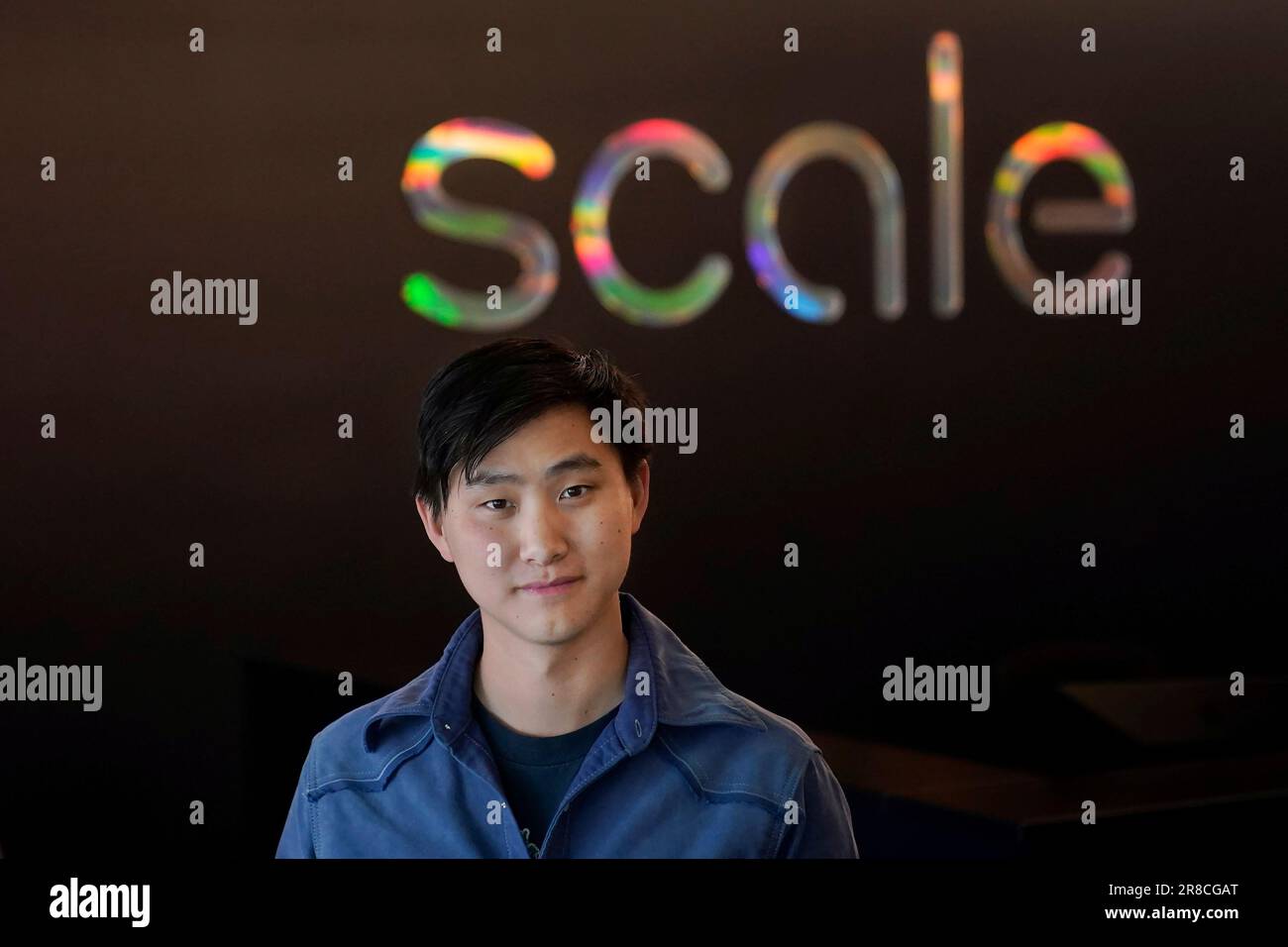
Alexandr Wang is an American technology entrepreneur and the co-founder and CEO of Scale AI, a data infrastructure enterprise powering modern artificial intelligence. Rising from a childhood in Los Alamos to becoming one of the youngest self-made billionaires in tech history, Wang built Scale AI into an essential provider of high-quality training data, model evaluation, and defense AI solutions.
Early Life and Academic Foundations in Los Alamos
Alexandr Wang was born in January 1997 in Los Alamos, New Mexico—a city globally recognized for its history of scientific innovation and high-level research. Raised by parents who were nuclear physicists working at the Los Alamos National Laboratory, Wang grew up in an environment dominated by rigorous quantitative thinking, software development, and theoretical physics.
From an early age, Wang displayed exceptional mathematical and computational aptitude. He competed frequently in national academic competitions, placing among the top performers in the United States of America Mathematical Olympiad (USAMO) and the USA Computing Olympiad (USACO). These early experiences provided him with a deep mastery of algorithmic design, discrete mathematics, and problem decomposition.
Wang attended Los Alamos High School, where his advanced skills allowed him to take college-level mathematics and computer science courses early in his tenure. By his mid-teens, he began seeking practical software engineering experience, securing developer roles that introduced him to production codebase management and enterprise software architecture long before reaching university age.
In 2014, Wang enrolled at the Massachusetts Institute of Technology (MIT), majoring in computer science and mathematics. At MIT, he maintained a perfect grade point average while taking graduate-level coursework in machine learning and artificial intelligence. However, after his freshman year, he recognized that the rate of progress in commercial AI development was outstripping traditional academic timelines, prompting him to take a leave of absence to pursue full-time software engineering and entrepreneurial opportunities.
The Path to Entrepreneurship: MIT, Early Engineering, and Y Combinator
Before founding Scale AI, Wang honed his practical engineering skills across several notable technology companies. At age 17, he worked as a software engineer at Addepar, a wealth management platform, where he focused on data infrastructure and backend engineering. Shortly thereafter, he joined Quora as a tech lead, working on algorithmic feed optimization and recommendation pipelines.
During his time at Quora and through interactions with leading machine learning researchers, Wang identified a recurring structural bottleneck in the AI ecosystem: while algorithms were advancing rapidly due to open-source frameworks and increasing compute capacity, the development of machine learning systems was severely constrained by the lack of high-quality, labeled training data. Enterprise engineering teams were spending vast amounts of high-value developer time manually preparing data sets rather than training models.
Raw Unstructured Data ➔ Scale AI Platform (Human-in-the-Loop + ML QA) ➔ Labeled Datasets & Evaluation ➔ Production AI Models
In the summer of 2016, at age 19, Wang paired with co-founder Lucy Guo to address this problem by applying to the startup accelerator Y Combinator (S16 cohort). Their core thesis was straightforward yet ambitious: build a dedicated enterprise data platform—a "data engine"—that would handle data labeling, data curation, and model verification as a managed software and API service. This venture was named Scale AI.
Building Scale AI: Solving the Data Bottleneck in Artificial Intelligence
Scale AI was established to solve the fundamental data bottleneck hindering practical machine learning deployments. In its initial phase, the company concentrated heavily on computer vision applications, serving autonomous vehicle companies such as Cruise, Waymo, and Toyota. Self-driving software required billions of annotated camera frames, lidar points, and radar inputs to recognize pedestrians, lane markings, and road hazards under diverse environmental conditions.
Scale AI introduced a hybrid approach that combined algorithmic automated pre-labeling with human-in-the-loop review. By leveraging distributed workforce networks (such as Remotasks, later rebranded and evolved into Outlier.ai) managed by strict quality assurance algorithms, Scale AI delivered enterprise-grade dataset accuracy at unprecedented speed and volume.
As natural language processing (NLP) and generative AI emerged as dominant paradigms in machine learning, Wang strategically pivoted Scale AI’s focus to support Large Language Models (LLMs). The company pioneered specialized data pipelines for:
- Reinforcement Learning from Human Feedback (RLHF): Utilizing domain experts, technical writers, and code reviewers to rank, critique, and refine model outputs.
- Red Teaming and Safety Evaluation: Testing AI models against adversarial prompts to detect vulnerabilities, hallucinations, and safety violations before public release.
- Model Benchmarking: Establishing independent performance metrics across diverse specialized domains, including competitive programming, law, and medicine.
Through these solutions, Scale AI became an essential infrastructural partner for major technology companies and AI research labs, including OpenAI, Meta, Google, Anthropic, and Microsoft.
Financial Growth and Key Valuation Milestones
Under Alexandr Wang’s leadership as CEO, Scale AI experienced rapid capital appreciation and operational expansion. The company’s funding trajectory reflects the broader acceleration of enterprise investment in artificial intelligence infrastructure.
| Round / Milestone | Year | Estimated Valuation | Key Investors / Highlights |
|---|---|---|---|
| Y Combinator (S16) | 2016 | ~$10M - $20M | Early seed funding; launch of computer vision annotation API |
| Series B | 2018 | ~$100M - $200M | Led by Index Ventures; expansion into autonomous driving sector |
| Series C | 2019 | $1 Billion | Led by Founders Fund; achieved unicorn status |
| Series D | 2020 | $3.5 Billion | Led by Index Ventures and Tiger Global |
| Series E | 2021 | $7.3 Billion | Led by Dragoneer Investment Group; Wang designated youngest self-made billionaire (2022) |
| Series F | 2024 | $13.8 Billion | $1B raised; led by Accel, with participation from Nvidia, Amazon, Meta, and Intel Capital |
In 2022, Forbes recognized Wang as the world's youngest self-made billionaire at age 25, driven by his controlling ownership stake in Scale AI. By 2024, following its $1 billion Series F funding round, Scale AI secured a $13.8 billion valuation, cementing its position as a central infrastructure pillar of the global AI ecosystem.
Defense Infrastructure and National Security Initiatives
Beyond commercial technology applications, Alexandr Wang recognized early that artificial intelligence would transform geopolitical strategy and national defense. Under his guidance, Scale AI established a major presence within the U.S. defense sector, supplying data infrastructure and software solutions directly to government agencies and the U.S. Department of Defense (DoD).
Commercial AI Data Engine ➔ Scale Donovan Platform ➔ Military Intelligence & Tactical Analysis
A core element of this push was the creation of Scale Donovan, an AI-powered operational platform developed specifically for defense personnel, analysts, and military commanders. Donovan enables defense organizations to ingest massive volumes of unstructured intelligence data—including text, audio, satellite imagery, and sensor feeds—allowing personnel to query operational documents and make tactical decisions in real time.
Wang has become a prominent voice on international AI policy and defense readiness. He has testified before the U.S. Congress, emphasizing several core strategic principles:
- Data Dominance as National Security: Arguing that the nation with the most effective data infrastructure will lead in autonomous systems and strategic intelligence.
- Geopolitical Competition: Highlighting the intensive AI capabilities being developed by strategic competitors, notably China, and urging rapid adoption of commercial technology within the U.S. defense apparatus.
- Public-Private Collaboration: Advocating for streamlined government procurement pipelines to allow frontier technology startups to deploy solutions to defense personnel rapidly.
Scale AI’s enterprise defense contracts include work with the U.S. Army, the Chief Digital and Artificial Intelligence Office (CDAO), and the Joint Artificial Intelligence Center (JAIC).
Leadership Style, Organizational Philosophy, and AI Evaluation
Alexandr Wang’s approach to technology leadership combines extreme operational velocity with strict empirical rigor. Known for maintaining a deeply technical culture inside Scale AI, Wang emphasizes that infrastructure companies must remain agile to adapt to shifts in frontier research.
Focus on Model Evaluation (SEAL)
As generative AI models expanded globally, Wang recognized that raw data collection was only half the problem; objective evaluation was equally critical. To address this, Scale AI launched the SEAL (Scale Evaluation and Alignment Lab) initiative. SEAL provides standardized, third-party benchmarks designed to test model performance across factual accuracy, coding proficiency, mathematical reasoning, and safety parameters.
By offering independent benchmarking, Scale AI created a trusted standard for enterprise procurement, helping corporations evaluate competing LLMs based on empirical performance rather than vendor claims.
Operational Philosophy
Wang’s management style centers on high-density engineering teams, transparent metrics, and continuous iteration. Rather than building speculative products, Scale AI builds in direct response to the operational bottlenecks encountered by frontier AI labs. This philosophy has enabled the company to navigate multiple technological transitions—from computer vision for robotics to RLHF for natural language models, and further into enterprise-grade multi-modal AI evaluation.
Frequently Asked Questions About Alexandr Wang
How did Alexandr Wang start Scale AI?
Alexandr Wang co-founded Scale AI in 2016 alongside Lucy Guo after participating in the Y Combinator startup accelerator. Recognizing that machine learning engineers were constrained by the manual effort required to label training data, Wang built an API-driven platform that combined automated machine learning models with human-in-the-loop annotations to deliver clean datasets to enterprise clients.
Did Alexandr Wang complete his degree at MIT?
No. Alexandr Wang attended the Massachusetts Institute of Technology (MIT) for one year, studying computer science and mathematics, where he maintained a top academic record. He took a leave of absence after his freshman year to work in software engineering roles and subsequently launch Scale AI through Y Combinator.
How did Alexandr Wang become the youngest self-made billionaire?
In 2022, Forbes named Alexandr Wang the world's youngest self-made billionaire at age 25. This milestone was achieved due to the valuation of Scale AI reaching $7.3 billion during its Series E funding round, in which Wang held a substantial equity stake built through his founding leadership.
What is Scale AI’s role in generative AI and LLMs?
Scale AI provides the core data infrastructure required to train, fine-tune, and evaluate Large Language Models (LLMs). This includes custom dataset generation, Reinforcement Learning from Human Feedback (RLHF), red-teaming for safety, and standardized model evaluation through its SEAL initiative.
What is Scale Donovan and how is it used in national defense?
Scale Donovan is an AI platform developed by Scale AI specifically for military and defense applications. It allows defense analysts and commanders to ingest, search, and analyze vast quantities of unstructured intelligence data—such as military reports, satellite imagery, and sensor logs—using natural language queries to support real-time tactical decision-making.
Key Takeaways for Tech Leaders and AI Builders
The trajectory of Alexandr Wang and Scale AI offers actionable lessons for software executives, enterprise technology buyers, and tech entrepreneurs:
- Focus on Ecosystem Bottlenecks: Rather than building consumer-facing application models, Wang built enterprise infrastructure around the single biggest constraint in machine learning: high-quality data processing and model evaluation.
- Adapt Infrastructure to Paradigm Shifts: Scale AI successfully expanded from computer vision for self-driving vehicles into natural language alignment (RLHF) and multi-modal evaluation, demonstrating the necessity of evolving enterprise products alongside underlying scientific shifts.
- Prioritize Rigorous Evaluation and Data Quality: High model parameters cannot overcome poor training data or weak evaluation frameworks. Organizations deploying AI must invest systematically in continuous data curation, alignment, and empirical benchmarking.
- Bridge Commercial Tech and Public Defense: High-growth technology firms can create multi-billion-dollar opportunities by adapting enterprise commercial AI solutions to meet federal and national security requirements.