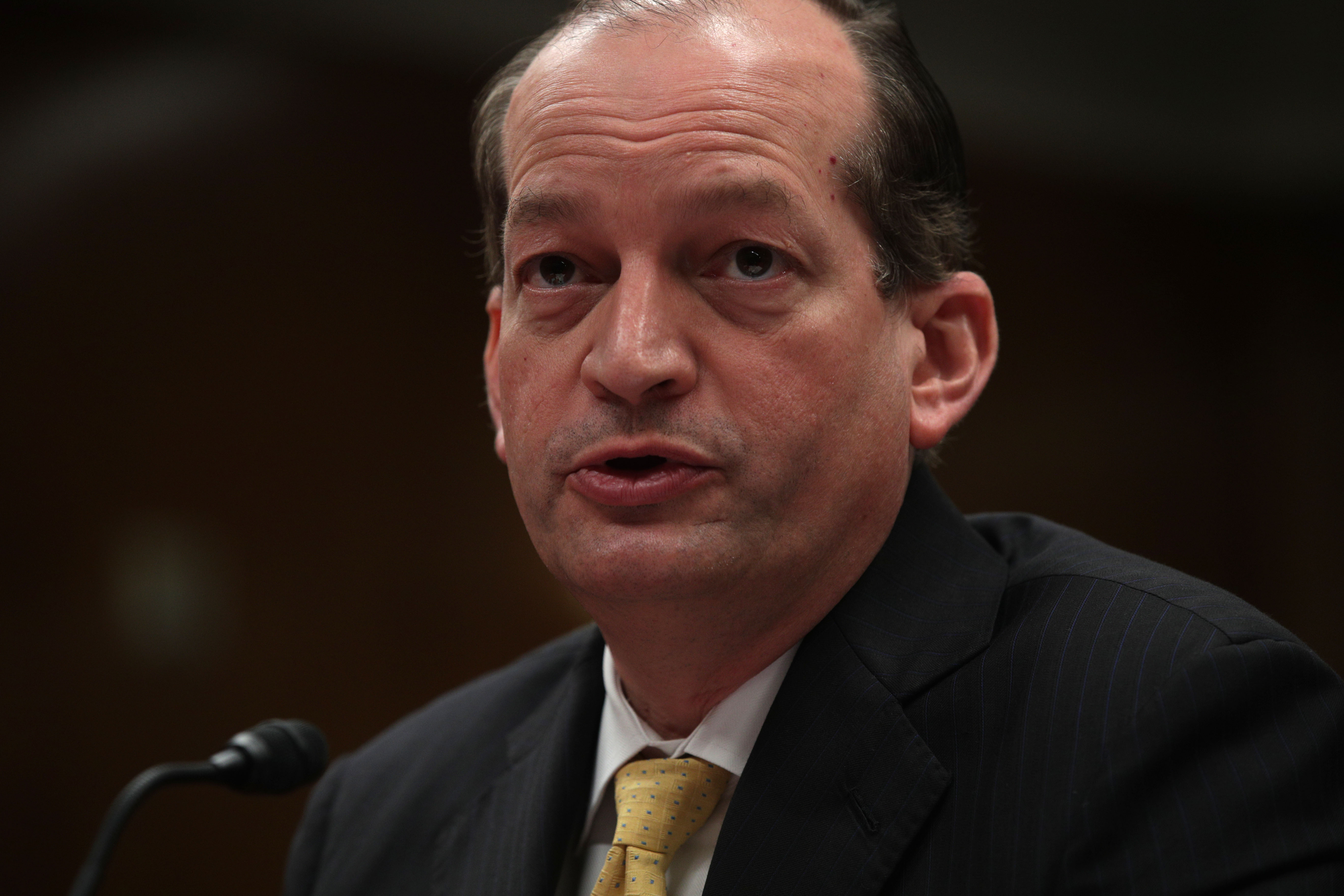
Alex Acosta is an American attorney and politician who served as the 27th U.S. Secretary of Labor from 2017 to 2019. Previously, he held high-ranking positions including U.S. Attorney for the Southern District of Florida and Dean of Florida International University College of Law. His career is characterized by significant legal achievements overshadowed by his role in the 2008 non-prosecution agreement with Jeffrey Epstein.
Early Life and Academic Foundation
Rene Alexander "Alex" Acosta was born in Miami, Florida, to Cuban immigrant parents. His upbringing in a vibrant immigrant community shaped his early understanding of the American legal system and the opportunities afforded by public service. Acosta’s academic journey is one of distinction, beginning at Harvard University, where he earned his Bachelor of Arts in Economics. He continued his education at Harvard Law School, obtaining his Juris Doctor in 1994.
During his time at Harvard, Acosta was recognized for his keen analytical mind and interest in constitutional law. These formative years provided him with the networking opportunities and intellectual rigor required for a career in high-stakes litigation and federal administration. His transition from academia to the professional legal world was marked by prestigious clerkships, most notably serving for Samuel Alito, then a judge on the U.S. Court of Appeals for the Third Circuit (who later became a Supreme Court Justice). This experience positioned Acosta as a rising star within the conservative legal establishment.
Career in the George W. Bush Administration
Acosta’s entry into federal service was accelerated during the George W. Bush administration. In 2002, he was appointed to the National Labor Relations Board (NLRB), where he focused on labor-management relations and the enforcement of the National Labor Relations Act. His tenure at the NLRB was a precursor to his later role as Secretary of Labor, providing him with early exposure to the complexities of federal labor policy.
In 2003, Acosta was confirmed as the Assistant Attorney General for the Civil Rights Division at the Department of Justice. He was the first Hispanic person to hold this position. During his leadership, the division focused on several high-profile areas:
- Religious Freedom: Advocating for the rights of individuals to practice their faith without government interference, particularly under the Religious Land Use and Institutionalized Persons Act (RLUIPA).
- Voting Rights: Managing the enforcement of the Voting Rights Act and addressing allegations of disenfranchisement and voter fraud.
- Human Trafficking: Increasing the prosecution of individuals involved in labor and sex trafficking, an irony that would be noted by critics years later during the Epstein scandal.
His performance in these roles earned him a reputation as a disciplined and efficient administrator, leading to his appointment as the U.S. Attorney for the Southern District of Florida in 2005.
Tenure as U.S. Attorney and the Epstein Controversy
As the U.S. Attorney for the Southern District of Florida, Acosta oversaw one of the busiest and most complex federal districts in the United States. His office handled a wide array of cases, from drug trafficking and white-collar crime to public corruption. However, his tenure is most frequently remembered for the 2008 non-prosecution agreement (NPA) involving billionaire Jeffrey Epstein.
The Epstein case involved allegations of the sexual solicitation of dozens of underage girls at Epstein’s Palm Beach estate. While local police and federal investigators had compiled significant evidence, Acosta’s office negotiated a deal that allowed Epstein to plead guilty to two state-level prostitution charges rather than federal sex trafficking charges. The deal included several highly controversial components:
- Limited Sentencing: Epstein served only 13 months in a county jail with extensive "work release" privileges.
- Immunity for Co-conspirators: The agreement reportedly shielded potential accomplices from federal prosecution.
- Lack of Victim Notification: The deal was reached without notifying the victims, which a federal judge later ruled in 2019 was a violation of the Crime Victims' Rights Act.
Acosta later defended the deal, arguing that at the time, his office believed a state-level conviction and registered sex offender status were the most certain ways to ensure Epstein saw jail time, as the federal case faced evidentiary challenges. Nevertheless, the perceived leniency of the agreement remains a central point of contention in his professional biography.
Leadership at Florida International University
Following his departure from the Department of Justice in 2009, Acosta transitioned to academia, becoming the Dean of the Florida International University (FIU) College of Law. During his eight-year tenure, he was credited with significantly elevating the school’s profile. Under his leadership, FIU Law saw a dramatic increase in its bar passage rates, often ranking as the highest in the state of Florida.
Acosta focused on practical legal training and ensuring that graduates were "practice-ready." He was also instrumental in expanding the school’s clinical programs, providing students with hands-on experience while serving the local community. His time at FIU was generally viewed as a period of stability and growth for the institution, allowing him to maintain a presence in the legal community away from the political fray of Washington, D.C.
U.S. Secretary of Labor (2017–2019)
In February 2017, President Donald Trump nominated Acosta as the Secretary of Labor, following the withdrawal of the initial nominee, Andrew Puzder. Acosta was confirmed by the Senate in April 2017 with a 60–38 vote. As Secretary, Acosta’s agenda was largely aligned with the administration’s focus on deregulation and workforce development.
Key Policy Initiatives
Acosta’s leadership at the Department of Labor (DOL) focused on several core pillars:
- Apprenticeships: He heavily promoted industry-led apprenticeship programs as an alternative to traditional four-year degrees, aiming to bridge the "skills gap" in the American workforce.
- Association Health Plans (AHPs): Acosta oversaw the expansion of AHPs, which allowed small businesses to band together to purchase health insurance, though this initiative faced significant legal challenges from various states.
- Deregulation: The DOL under Acosta sought to roll back or revise several Obama-era regulations, including the "Overtime Rule" and the "Fiduciary Rule," arguing that these regulations imposed undue burdens on businesses.
- Overdose Prevention: He utilized DOL resources to address the opioid crisis, focusing on how addiction impacted workforce participation and vocational rehabilitation.
The 2019 Resignation
Acosta’s tenure as Labor Secretary came to an abrupt end in July 2019. The catalyst was a renewed public and media interest in the Jeffrey Epstein case, sparked largely by investigative reporting from the Miami Herald and a new federal indictment against Epstein by the U.S. Attorney’s Office for the Southern District of New York.
The "Perversion of Justice" series by investigative journalist Julie K. Brown brought the details of the 2008 non-prosecution agreement back into the national spotlight. The resulting outcry led to calls for Acosta’s resignation from both sides of the political aisle. Despite holding a press conference to defend his actions in 2008, Acosta resigned on July 12, 2019, stating that he did not want the controversy surrounding the Epstein deal to distract from the work of the Department of Labor.
| Professional Phase | Organization | Key Focus/Contribution |
|---|---|---|
| Judicial Clerkship | U.S. Third Circuit Court of Appeals | Clerked for Judge Samuel Alito; focused on appellate law. |
| Federal Agency | National Labor Relations Board | Board member; focused on labor-management disputes. |
| Justice Department | Civil Rights Division | Assistant Attorney General; addressed trafficking and voting rights. |
| Prosecution | U.S. Attorney (S.D. Fla.) | Managed federal prosecutions; negotiated the 2008 Epstein NPA. |
| Academia | FIU College of Law | Dean; improved bar passage rates and clinical education. |
| Cabinet Member | U.S. Department of Labor | Secretary; prioritized apprenticeships and deregulation. |
Post-Political Career and 2026 Perspective
Since his resignation in 2019, Alex Acosta has largely retreated from the public eye. In the years following his departure from the Trump administration, he has reportedly engaged in private legal consulting and has maintained affiliations with various legal organizations.
As of 2026, Acosta’s legacy is viewed through a dual lens. Within the legal and conservative policy spheres, he is often remembered as a highly capable administrator who successfully navigated the complexities of the federal bureaucracy and improved the institutions he led. However, in the broader public consciousness, his name remains inextricably linked to the Epstein case. The controversy serves as a landmark example of the debates surrounding prosecutorial discretion, the treatment of victims in the justice system, and the accountability of public officials for past decisions.
His career provides a case study in how a lifetime of public service and academic achievement can be fundamentally reframed by a single, high-profile decision. For modern legal practitioners, the "Acosta precedent" is often cited in discussions regarding the Ethics in Government Act and the long-term implications of non-prosecution agreements.
Frequently Asked Questions
Why did Alex Acosta resign as Secretary of Labor?
Acosta resigned in July 2019 due to the intense public scrutiny surrounding a 2008 non-prosecution agreement he negotiated for Jeffrey Epstein while serving as a U.S. Attorney. He stated that the controversy had become a distraction from the Department of Labor's mission.
What was the "Epstein Deal" negotiated by Acosta?
In 2008, Acosta’s office allowed Jeffrey Epstein to plead guilty to state prostitution charges in Florida rather than federal sex trafficking charges. This deal resulted in a 13-month jail sentence and immunity for potential co-conspirators, a move that was later heavily criticized for its leniency.
What were Acosta's main priorities at the Department of Labor?
His primary focus included expanding apprenticeship programs, promoting Association Health Plans, and implementing a deregulatory agenda that revised several major labor rules related to overtime pay and fiduciary responsibilities.
Was Alex Acosta the first Hispanic Labor Secretary?
No. While Acosta is a prominent Hispanic-American who held the position, Hilda Solis (serving under President Obama) was the first Hispanic person to serve as the U.S. Secretary of Labor. Acosta was, however, the first Hispanic person to serve as Assistant Attorney General for the Civil Rights Division.
What is Alex Acosta's current status in 2026?
As of 2026, Acosta maintains a low public profile. He has not returned to elected office or high-level political appointments, focusing instead on private legal work and continuing his involvement in the South Florida legal community in a non-governmental capacity.
Navigating Legal and Public Accountability
The career of Alex Acosta underscores the importance of transparency and victim advocacy in the American legal system. For students of law and public policy, his trajectory highlights the necessity of considering how current decisions—specifically those involving prosecutorial discretion—will be judged under the lens of future societal standards and investigative scrutiny. To better understand the mechanics of federal appointments and the standards of the Department of Justice, readers should consult official records from the U.S. Department of Labor and the U.S. Department of Justice regarding the standards of conduct and the history of the Civil Rights Division. Reviewing the 2019 judicial rulings regarding the Crime Victims' Rights Act provides further technical insight into the legal errors identified in the 2008 agreement.