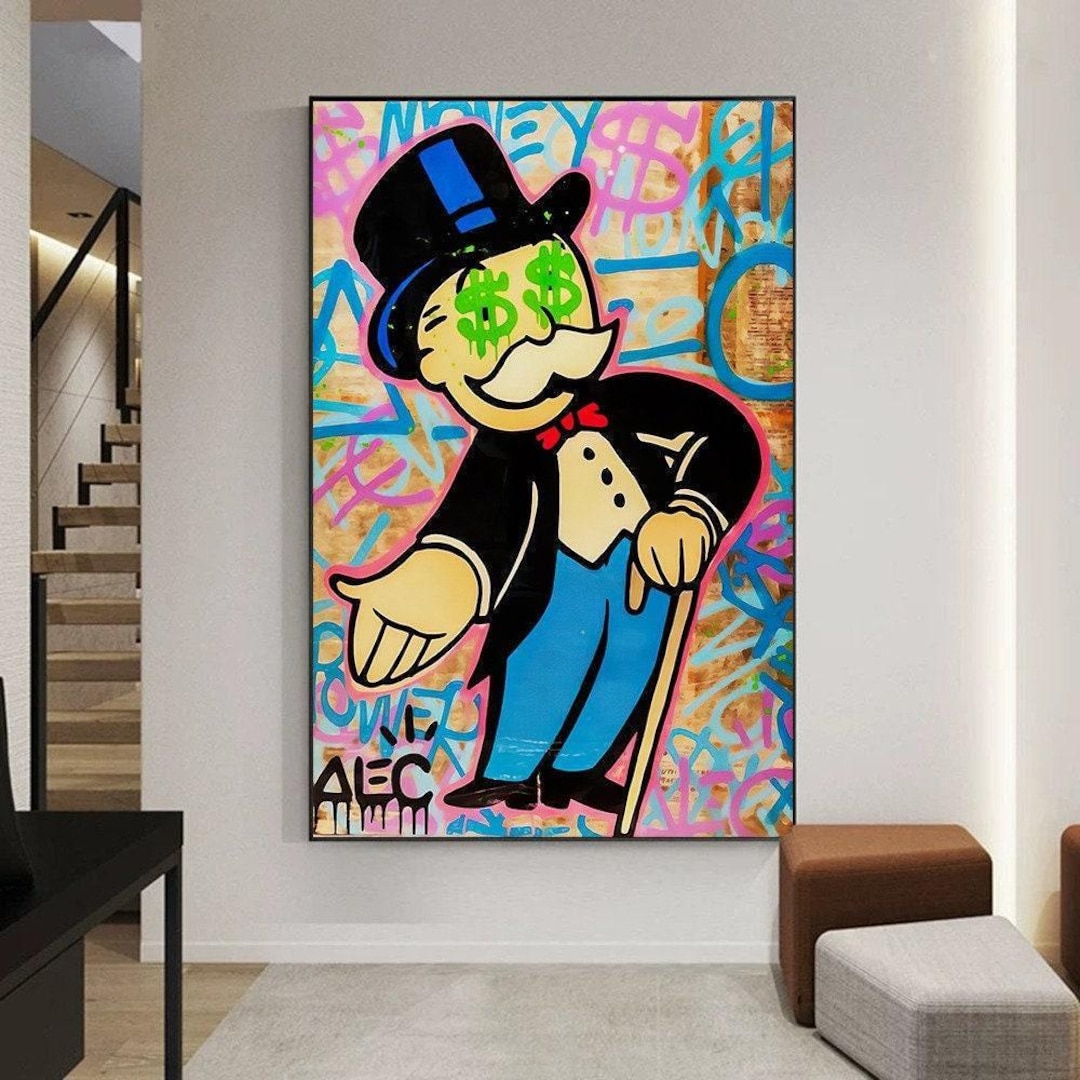
Alec Monopoly, the pseudonym of street artist Alec Andon, is a polarizing figure who projects a "billionaire" lifestyle through art centered on wealth and luxury. While not a literal billionaire, his brand is synonymous with high-end consumption, leading to intense scrutiny on platforms like Reddit regarding his artistic merit, wealthy origins, and commercial success.
The Genesis of Alec Monopoly: From 2008 to 2026
To understand why Alec Monopoly remains a focal point of digital debate in 2026, one must look back to the 2008 financial crisis. Emerging during a period of global economic instability, Andon adopted the character of Rich Uncle Pennybags—the iconic Monopoly Man—as his primary motif. His early work was often seen as a satirical commentary on the banking collapse, featuring the character in various states of distress or triumph.
However, as the decade progressed, the satire appeared to transition into a celebration of the very wealth it once mocked. By the early 2020s, Alec Monopoly had moved from stenciling walls in Los Angeles and New York to becoming a fixture at Art Basel, collaborating with luxury watchmakers like TAG Heuer and Jacob & Co. In 2026, his work remains a staple in the collections of celebrities and ultra-high-net-worth individuals, even as the "street art" community continues to debate his legitimacy.
The transition from a subversive street artist to a luxury lifestyle brand is the crux of the controversy. Critics argue that his work lacks the depth of contemporary peers like Banksy or Retna, while his supporters point to his undeniable market influence and his ability to bridge the gap between street culture and the elite art world.
The "Billionaire" Myth: Dissecting the Net Worth Claims
A common search query and a frequent topic on Reddit threads like r/ArtBusiness and r/Hypebeast is whether Alec Monopoly is actually a billionaire. As of 2026, there is no public financial evidence to suggest that Alec Andon’s personal net worth has reached the billion-dollar mark. Most credible financial analyses place his net worth in the range of $20 million to $50 million, though his lifestyle—replete with private jets, Hermès Birkin bags, and customized supercars—suggests a much higher level of liquidity.
The "billionaire" tag is largely a product of his branding. By naming his brand after the Monopoly game and surrounding himself with symbols of extreme wealth (Richie Rich, Scrooge McDuck, and gold bars), he has created a persona that is indistinguishable from the "one percent." On Reddit, this is often criticized as a "fake it 'til you make it" strategy that eventually became reality. The controversy isn't just about the money he has, but how he uses the image of money to sell art to those who have even more of it.
Why Reddit is the Hub of Alec Monopoly Criticism
Reddit serves as the primary battleground for the Alec Monopoly discourse for several reasons. Unlike Instagram, which is visual-heavy and often moderated by the artist’s team or fans, Reddit’s pseudo-anonymous format allows for deep-dive investigations and unfiltered critiques.
The "Trust Fund" Narrative
One of the most persistent discussions on subreddits like r/StreetArt is the claim that Alec Monopoly comes from a wealthy family (often cited as "trust fund" status). Critics use this to undermine his "street" credentials, arguing that he never faced the systemic struggles often associated with graffiti culture. On Reddit, "authenticity" is the highest currency, and the perception that Alec Andon was "born on third base" makes him an easy target for those who believe street art should be a voice for the marginalized.
Artistic Merit vs. Marketing Genius
The technical side of Reddit (r/GraphicDesign or r/ContemporaryArt) often dissects the simplicity of his work. His use of stencils and pop-culture icons is frequently labeled as "derivative" or "soulless." However, another contingent on Reddit argues that his genius lies not in the brushstroke but in the branding. They view him as a successor to Andy Warhol—an artist who recognized that in a consumerist society, the brand is the art.
The Hasbro Copyright Debate
Reddit users frequently point out the irony of a "rebel" artist using copyrighted characters owned by Hasbro (the Monopoly Man) and Dreamworks (Richie Rich). While most street artists use pop icons, Alec Monopoly’s massive commercialization of these characters often leads to discussions about why he hasn't faced more legal pushback, or if secret licensing deals are in place that compromise his "outlaw" status.
Alec Monopoly vs. Contemporary Peers: A Market Comparison
To understand Alec Monopoly’s standing in 2026, it is helpful to compare him with other artists who occupy similar spaces in the pop-art and street-art markets.
| Feature | Alec Monopoly | Banksy | KAWS (Brian Donnelly) |
|---|---|---|---|
| Primary Theme | Wealth and Luxury | Social and Political Satire | Pop Culture Melancholy |
| Core Icons | Monopoly Man, Richie Rich | Rats, Chimps, Balloon Girl | Companion, Chum |
| Reddit Sentiment | High Criticism (Commercialism) | High Respect (Message) | Mixed (Commercial/Technique) |
| Primary Audience | Ultra-Wealthy, Celebrities | Museums, Activists, Public | Hypebeasts, Collectors, Public |
| Market Strategy | Luxury Partnerships | Anonymous Stunts | Limited Edition Vinyl & Canvas |
| Digital Presence | High (Shows off lifestyle) | Low/Managed (Anonymous) | High (Artist-focused) |
The Investment Value: Collecting Alec Monopoly in 2026
Despite the vocal criticism on Reddit, the market for Alec Monopoly’s work has remained surprisingly resilient through 2026. This resilience is driven by a specific segment of the market: the "new money" collectors who value the lifestyle association of his work.
- Original Canvas Works: His large-scale paintings, often featuring heavy acrylic and spray paint with "diamond dust" finishes, continue to fetch high five-figure and low six-figure sums at private auctions and galleries in Miami and Dubai.
- Luxury Collaborations: Pieces created in partnership with brands like Jacob & Co are particularly prized. These are viewed not just as art, but as dual-asset investments (horology and fine art).
- NFTs and Digital Legacy: After the 2021-2022 NFT boom, Alec Monopoly was one of the few "physical first" artists who maintained a digital presence. In 2026, his "Rags to Riches" NFT collection has evolved into a gated community for his collectors, offering access to exclusive events.
For a collector, the "Reddit controversy" can actually be seen as a positive indicator of cultural relevance. In the art world, being hated by purists is often a sign of commercial dominance.
Verified Timeline of Key Events
- 2008: Alec Monopoly emerges in Los Angeles during the financial crisis.
- 2010: Gained significant notoriety for his "Monopoly Man" stencils in New York City.
- 2016: Named "Creative Creator" for TAG Heuer, marking his definitive shift into the luxury sector.
- 2021: Launched the "Rags to Riches" NFT project, bridging his brand into the metaverse.
- 2024: Expanded into large-scale sculpture, with installations appearing in major financial hubs.
- 2026: Remains one of the most commercially successful living artists, despite ongoing debates regarding his "street" authenticity.
Common Criticisms and Rebuttals
The Reddit discourse usually follows a predictable pattern of "Call-out" and "Defense."
Criticism: "He just uses stencils; there is no talent involved." Rebuttal: Art history is full of stencil users (including Banksy and Shepard Fairey). The value lies in the composition and the cultural statement of the icon chosen.
Criticism: "He’s a sell-out for working with luxury brands." Rebuttal: In the 2026 art economy, the "starving artist" trope is largely dead. Collaborations allow artists to fund larger-scale public works and reach audiences outside of the traditional gallery system.
Criticism: "His lifestyle is a distraction from the art." Rebuttal: For Alec Monopoly, the lifestyle is the performance art. He is living the life of the characters he paints, creating a feedback loop of brand reinforcement.
FAQ
Is Alec Monopoly his real name?
No. His real name is Alec Andon. "Alec Monopoly" is a professional pseudonym and brand name derived from his use of the board game character.
Why does Alec Monopoly always wear a mask or scarf?
Originally, the mask was used to hide his identity from law enforcement due to the illegal nature of graffiti. In 2026, it has become a trademark of his brand, serving more as a fashion statement and a tool for maintaining a sense of "street" mystery, even at high-end events.
Is he a billionaire?
No, there is no public record of Alec Monopoly being a billionaire. While he frequently uses the hashtag #billionaire and depicts extreme wealth, his estimated net worth is in the tens of millions.
Does Hasbro endorse his work?
While Alec Monopoly uses the Monopoly Man extensively, there is no public record of a formal long-term licensing agreement. However, he has avoided major litigation, leading many to speculate that his work is either protected as transformative parody or that a private arrangement exists.
What is the "Rags to Riches" project?
This was his major foray into the NFT and digital art space. It focused on a series of generative characters that expanded his "Monopoly" universe into the blockchain, providing holders with various real-world perks and access to exclusive art drops.
Navigating the Alec Monopoly Market
If you are considering engaging with Alec Monopoly’s work in 2026, whether as a collector or a student of contemporary art, it is essential to separate the online noise from the market data. Reddit provides an excellent window into the cultural impact and the skepticism surrounding him, which is a vital part of his "story" as an artist.
For prospective buyers, focus on his original canvases and physical sculptures. While his digital assets have maintained some value, his physical works remain the bedrock of his financial standing. For students of art history, he remains a fascinating case study in how branding can supersede traditional artistic gatekeeping. Whether you view him as a visionary or a "glorified marketer," his influence on the intersection of street art and high finance is undeniable.