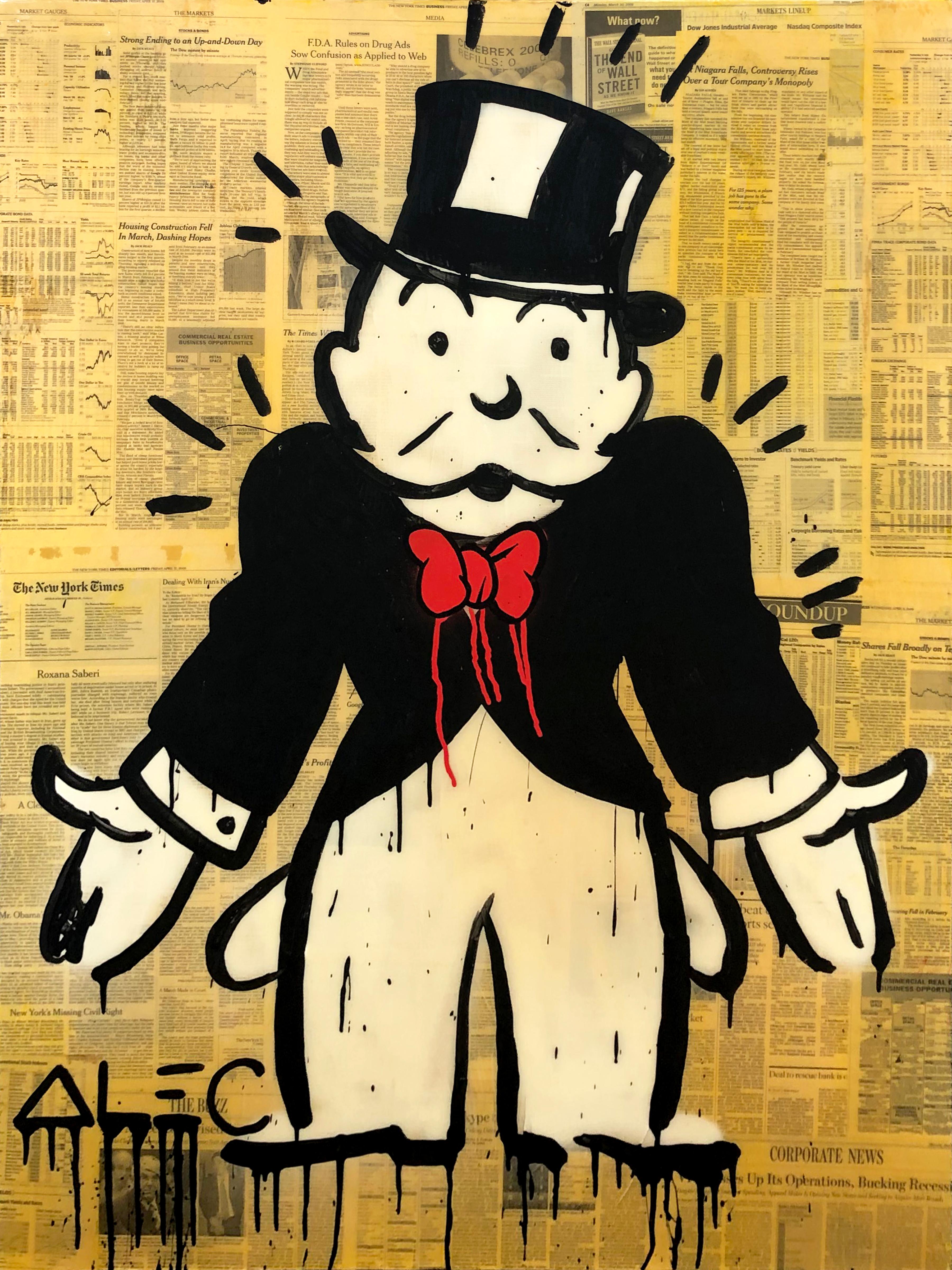
Alec Monopoly is the professional pseudonym of Alec Andon, a world-renowned contemporary street artist whose work centers on the intersection of pop culture, capitalism, and luxury. Famous for his vibrant depictions of the "Monopoly Man," he transformed from an anonymous graffiti artist during the 2008 financial crisis into a global brand icon and high-value investment asset by 2026.
The Origins and Rise of the Alec Monopoly Persona
The story of Alec Monopoly began in the late 2000s against the backdrop of the global financial collapse. Born in New York City to a family of artists, Alec Andon moved to Los Angeles in 2006, but it was the economic turmoil of 2008 that provided his primary creative spark. While banks were being bailed out and the public was reeling from the subprime mortgage crisis, Andon began tagging the streets with the image of Rich Uncle Pennybags—the mascot of the board game Monopoly.
The choice of the Monopoly Man was a calculated piece of social commentary. At the time, the character represented the "face" of the financial industry that many felt had betrayed the public trust. By placing this symbol of corporate wealth in gritty urban environments, Andon subverted the traditional meaning of the character. Initially, his work was seen as a critique of the 1% and the "Bernie Madoff" era of greed. However, as his career progressed, the narrative shifted. The mask he wore—originally to avoid arrest for vandalism—became a signature part of a high-fashion, high-wealth persona.
By the early 2010s, Alec Monopoly had transitioned from illegal street tagging to the gallery circuit. His work was embraced by celebrities and the Hollywood elite, who saw his art not just as a critique of wealth, but as a celebratory badge of success. This dual nature—part rebel, part luxury brand—is the cornerstone of his enduring popularity in 2026.
Iconic Characters and Visual Language
Alec Monopoly’s work is instantly recognizable due to its use of established pop culture icons that symbolize wealth, luck, and the American Dream. While the Monopoly Man remains his primary motif, his repertoire has expanded to include several other "wealth" archetypes:
- Richie Rich: The "poor little rich boy" from Harvey Comics frequently appears in Alec’s work, often holding bags of money or surrounded by luxury goods. Richie represents inherited wealth and youthful exuberance.
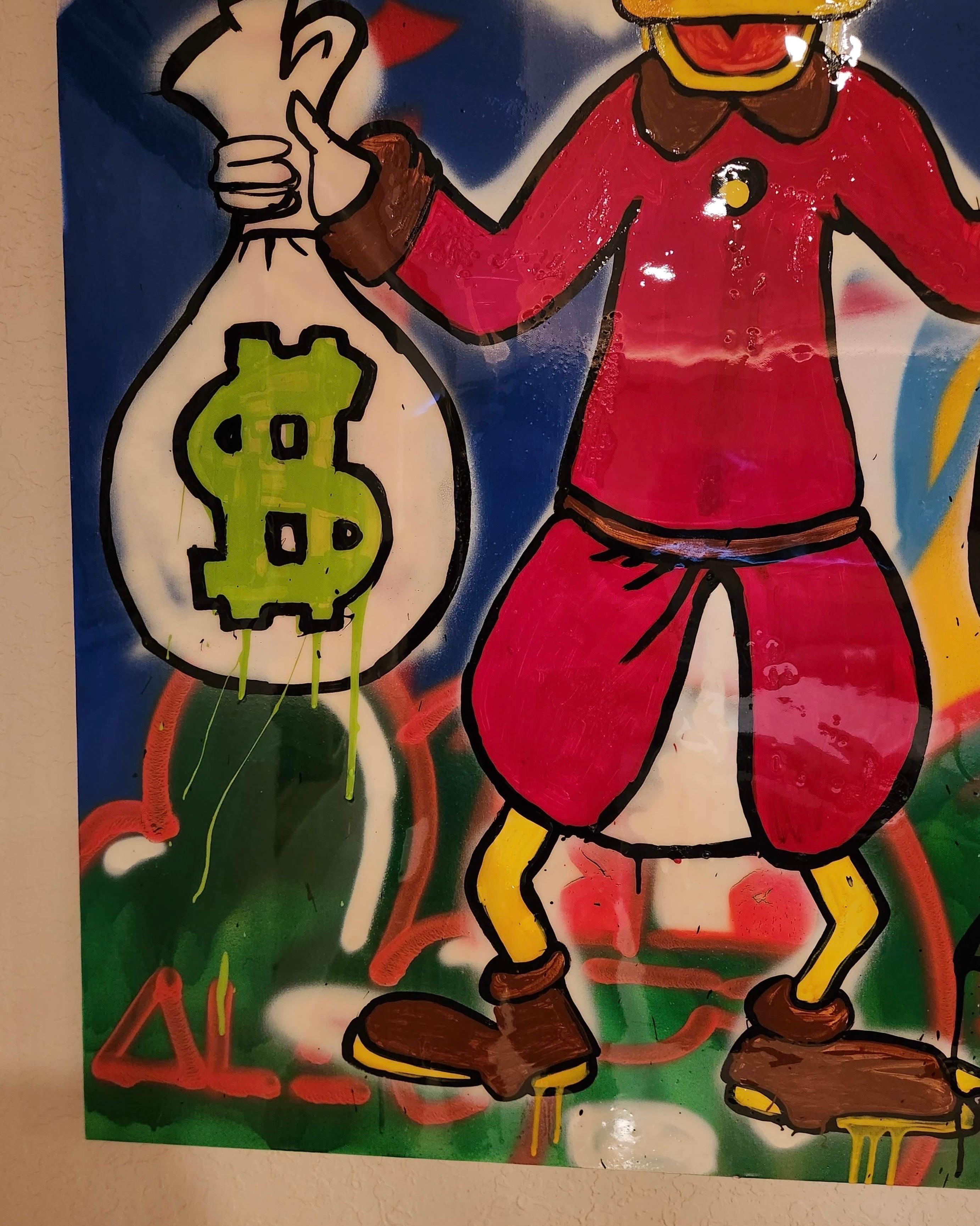
- Scrooge McDuck: Representing the hoarding of gold and the sheer joy of accumulation, Disney’s Scrooge is a recurring figure in Alec’s larger canvases and sculptures.
- The Pink Panther: Used to add a touch of sophistication and wit, this character often acts as a foil to the more aggressive symbols of capitalism.
Visually, Alec’s style is defined by a "neo-pop" aesthetic. He utilizes bright, saturated acrylics and spray paints, often finishing pieces with a thick layer of high-gloss resin. This resin gives the artwork a polished, expensive feel that mirrors the luxury environments where the art is typically displayed. His use of newspaper clippings as background texture adds a layer of "real-world" context, often featuring headlines about the stock market or global trade to ground the fantasy of the characters in economic reality.
Strategic Collaborations and the TAG Heuer Partnership
One of the most significant milestones in Alec Monopoly's career was his appointment as the "Art Provocateur" for the Swiss luxury watchmaker TAG Heuer in 2016. This was not a standard celebrity endorsement; it was a deep integration of street art into the world of "Haute Horlogerie."
Under the leadership of Jean-Claude Biver, TAG Heuer utilized Alec to reach a younger, more "disruptive" demographic. Alec designed watch faces for the Formula 1 and Carrera lines, featuring his signature characters. He also performed live painting events at major retail locations and during Art Basel Miami. This partnership validated the idea that street art could be a luxury commodity.
In the years leading up to 2026, Alec has continued this trend of high-profile collaborations. He has worked with fashion designers like Philipp Plein, creating limited-edition apparel that blends "vandalism" with couture. He has also moved into the hospitality sector, designing entire suites and rooftop murals for luxury hotels in Dubai, Ibiza, and Saint-Tropez. These collaborations have ensured that his brand exists far beyond the confines of a traditional canvas.
The Art Market and Investment Value in 2026
For collectors, Alec Monopoly represents a unique segment of the contemporary art market. While traditionalists sometimes dismiss his work as overly commercial, the secondary market performance tells a different story. His pieces have consistently appeared at major auction houses like Sotheby’s and Christie’s, often fetching prices well above their initial estimates.
As of 2026, the valuation of an Alec Monopoly piece is determined by several factors:
- Medium: Original canvases on wood or metal generally command the highest prices, followed by hand-embellished prints.
- Character Inclusion: Pieces featuring the original Monopoly Man tend to hold their value better than experimental subjects.
- Provenance: Works that were part of his early "street" phase in 2008-2010 are considered blue-chip assets due to their historical significance in his career arc.
Comparative Value of Alec Monopoly Assets (2026 Market Data)
| Asset Type | Primary Market Price (Est.) | Secondary Market Demand | Typical Medium |
|---|---|---|---|
| Original Canvas | $50,000 - $250,000+ | Very High | Acrylic, Spray Paint, Resin |
| Sculpture | $30,000 - $100,000 | High | Bronze, Fiberglass, Neon |
| Hand-Embellished Print | $5,000 - $15,000 | Moderate | Serigraph on Paper |
| Digital/NFT Assets | $2,000 - $20,000 | Volatile | Blockchain-verified Art |
The rise of digital art and NFTs has also seen Alec Monopoly enter the Web3 space. His "Avery & Art" project and various digital drops have allowed him to capture a new generation of collectors who prioritize digital ownership and social status in virtual environments.
Controversy and the "Sell-Out" Debate
No discussion of Alec Monopoly is complete without addressing the tension between his street art roots and his current status as a luxury icon. Within the traditional graffiti community, "tagging" is often seen as an act of rebellion against private property and the commercialization of public space. By collaborating with billion-dollar brands and selling pieces for six figures, some critics argue that Alec has "sold out."
However, defenders of his work argue that his career is a meta-commentary on the art world itself. By becoming the very thing he once critiqued, he exposes the circular nature of capitalism. He hasn't just painted the Monopoly Man; he has become the Monopoly Man. This transition from "vandal" to "mogul" is, in many ways, the ultimate performance art. Furthermore, his success has paved the way for other street artists to find commercial success without the need for traditional gallery gatekeepers.
Verification and Authenticity in the Secondary Market
Due to his popularity, the market has seen a rise in counterfeit Alec Monopoly works. For prospective buyers in 2026, verifying authenticity is paramount. Alec Monopoly works are typically accompanied by a Certificate of Authenticity (COA) from his official studio.
Key verification steps include:
- Signature Analysis: Alec’s signature is often integrated into the graffiti elements of the piece rather than just a corner scrawl.
- Resin Quality: Genuine pieces use a specific high-grade resin that does not yellow over time and has a glass-like finish.
- Direct Provenance: Buying through reputable galleries like Eden Gallery, which has long represented his work, is the safest route for high-value acquisitions.
- Digital Verification: Many of his later works include NFC chips or are linked to blockchain records to prevent forgery.
FAQ: Common Questions About Alec Monopoly
Is Alec Monopoly his real name?
No, his real name is Alec Andon. He adopted the "Alec Monopoly" moniker in 2008 when he began painting the Monopoly Man character on the streets of New York and Los Angeles.
Why does Alec Monopoly wear a mask or cover his face?
Originally, the mask (often a bandana or a surgical mask) was worn to hide his identity from law enforcement because his street art was illegal. Even as he became a legal, commercial success, he maintained the mask as a part of his public persona and "vandal" brand identity.
How much is an Alec Monopoly painting worth in 2026?
Original paintings typically range from $50,000 to over $250,000 depending on size and subject matter. Limited edition prints and digital works are available at lower price points, starting around $2,000 to $5,000.
Where can I see his work in person?
His work is permanently displayed at various Eden Gallery locations worldwide (New York, London, Miami, Mykonos). Additionally, his murals can be found in public spaces in major cities like Los Angeles and Dubai, and in luxury hotels like the W Hotel.
Does he only paint the Monopoly Man?
While the Monopoly Man is his most famous subject, he also heavily features Richie Rich, Scrooge McDuck, and the Pink Panther. He has also created abstract works and customized luxury items like pianos, Hermès Birkin bags, and supercars.
Navigating the Alec Monopoly Market
If you are looking to acquire an Alec Monopoly piece in 2026, your first step should be to define your goal: are you buying for aesthetic enjoyment or as a financial investment? For investment purposes, prioritize original canvases with a documented history of exhibition. For those looking to enter the market at a lower price point, look for hand-embellished prints from authorized publishers, as these often retain their value better than standard digital prints. Always insist on a verified certificate of authenticity and, if purchasing on the secondary market, use a third-party appraisal service to confirm the work's condition and provenance.