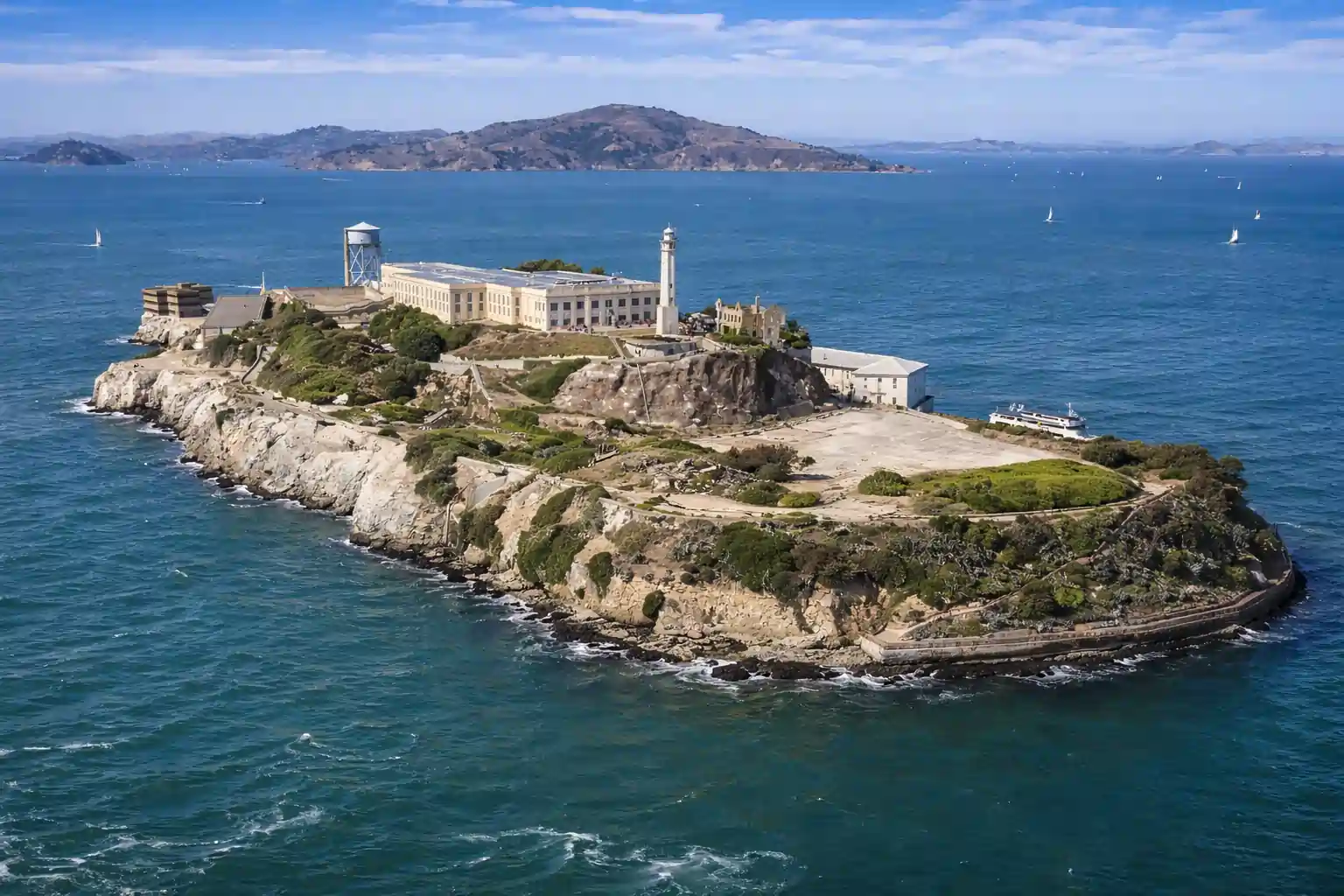
Alcatraz Federal Penitentiary operated as a maximum-security maximum-custody federal prison from 1934 to 1963, housing some of the most dangerous, incorrigible, and high-profile criminals in American history. Located on a desolate island 1.25 miles off the coast of San Francisco, the facility was designed to break the spirits of men who could not be controlled elsewhere, leveraging isolation, cold waters, and uncompromising rules to enforce absolute discipline. While popular culture often focuses on romanticized Hollywood depictions of daring escapes, the shocking true stories of notorious Alcatraz inmates reveal a grim reality of psychological breakdown, brutal violence, and relentless institutional control.
The Origins and Architectural Reality of America’s Most Feared Prison
Before it became a federal penitentiary, Alcatraz Island served as a military fortification and military prison starting in the 1850s. The U.S. Army built the citadel that would eventually form the foundation of the main cellhouse. In 1934, amidst the height of the Public Enemy era of the Great Depression, the Federal Bureau of Prisons took control of the island. Attorney General Homer Cummings and Bureau Director James V. Bennett envisioned a fortress from which escape was mathematically impossible, serving as a psychological deterrent for the era's most notorious gangsters.
The facility’s architecture was deliberately austere and designed to maximize security over prisoner rehabilitation. The main cellhouse contained 336 cell blocks divided into four main tiers: B, C, and D blocks, alongside a specialized section known as "A Block," which was rarely used for long-term housing. Cells were remarkably small, measuring approximately 9 feet long, 4.5 feet wide, and 7 feet high, containing only a cot, a washbasin, a toilet, and a small shelf. Inmates possessed no privacy, and correctional officers maintained a ratio of roughly one guard for every three prisoners, ensuring constant, suffocating surveillance.
Life inside the prison operated under a strict operational code where talking was heavily restricted during the early years, and privileges had to be earned through months of absolute compliance. The daily routine was punishingly monotonous. Inmates spent up to 23 hours a day locked inside their tiny cells, with brief intervals allowed for meals in the communal dining hall and, for well-behaved prisoners, limited recreation time on the yard. The cold, damp microclimate of San Francisco Bay wreaked havoc on prisoners' health, contributing to chronic respiratory issues and psychological distress, setting the stage for the dramatic conflicts that would define the institution's history.
Al Capone: The Fall of Chicago's Most Notorious Mobster
Alphonse Gabriel Capone, universally known as Al Capone, arrived at Alcatraz in August 1934, transferring from the United States Penitentiary in Atlanta after authorities discovered he was still running his criminal empire from behind bars. As one of the earliest high-profile prisoners sent to the island, Capone’s presence cemented Alcatraz’s reputation as an inescapable holding facility for men who believed they were above the law.
Upon arrival, Capone attempted to leverage his wealth and notoriety to secure preferential treatment from guards and fellow inmates. However, the rigid regulations of Alcatraz stripped away his external power. He was assigned inmate number AZ-85 and forced to perform manual labor, including working in the prison's laundry room and scrubbing floors. The isolation and loss of status deeply affected him, and he spent much of his time playing the banjo in the prison band, an activity permitted only after demonstrating compliance.
Capone’s tenure on the island was also cut short by severe medical decline. He was suffering from advanced neurosyphilis, a condition that had gone untreated for years and steadily eroded his cognitive functions. Prison physicians documented his deteriorating mental state, noting symptoms of dementia and erratic behavior. In January 1939, as his physical health collapsed, Capone was transferred out of Alcatraz to the Federal Correctional Institution at Terminal Island in Southern California for medical treatment, before ultimately being released to his family in 1947, where he died shortly thereafter.
Robert Stroud: The Complex Reality of the Birdman of Alcatraz
Robert Stroud remains one of the most famous and misunderstood figures in the history of American penology. Imprisoned for murder in 1909, Stroud spent decades in federal custody, eventually earning the moniker the "Birdman of Alcatraz" after raising and studying birds while incarcerated at Leavenworth Federal Penitentiary. However, popular media portrayals starring Burt Lancaster romanticized Stroud as a gentle, misunderstood ornithologist, masking his true personality and violent prison record.
Stroud was transferred to Alcatraz in December 1942, primarily because prison administrators at Leavenworth found him deeply disruptive, manipulative, and dangerous. Crucially, while Stroud authored notable scientific texts on avian diseases during his time at Leavenworth, Stroud was never allowed to keep birds while imprisoned at Alcatraz. The strict regulations of the island prohibited pet ownership and unauthorized scientific research, meaning his famous academic work ceased the moment he crossed the bay.
At Alcatraz, Stroud spent his time in the segregation units of D Block and later worked in the hospital due to declining health. He was known among guards as a deeply antisocial individual who possessed a brilliant intellect paired with a volatile, sociopathic temperament. He spent his final years on the island advocating for his release and participating in legal battles challenging his confinement, eventually being transferred to the Medical Center for Federal Prisoners in Springfield, Missouri, in 1959, where he died in 1963 without ever tasting freedom again.
The Battle of Alcatraz: The Most Violent Attempt to Take the Island
While numerous inmates plotted escapes by stealth, May 1946 played host to the most violent, bloody confrontation in the prison's history: the Battle of Alcatraz. Orchestrated by inmate Bernard Coy, a bank robber and former convict, the complex plan aimed to exploit weaknesses in the cellhouse security system, overpower guards, seize weapons, and commandeer the prison launch to escape to the mainland.
The plot began when Coy utilized his assignment as a cellhouse orderly to slip through the bars of a gun gallery after greasing his body with lard to squeeze through a narrow opening above the utility corridor. Once inside the gallery, he overpowered an armed guard, stole a Springfield rifle, keys, and a gas billy, and armed his co-conspirators, including Joseph Cretzer, Marvin Hubbard, and Miran Thompson. The inmates successfully took control of a massive section of the cellhouse and locked up nine correctional officers as hostages.
| Inmate Leader | Primary Crime | Role in the Battle of Alcatraz | Ultimate Fate |
|---|---|---|---|
| Bernard Coy | Bank Robbery | Conceived plan; slipped into gun gallery | Killed during the active shootout in the corridor |
| Joseph Cretzer | Murder & Robbery | Guarded hostages; shot captive officers | Killed by military gunfire during the siege |
| Marvin Hubbard | Armed Robbery | Participated in seizing the gun gallery | Executed in the gas chamber at San Quentin |
| Clarence Carnes | Kidnapping & Murder | Joined revolt; refused to fire on hostages | Sentenced to life imprisonment; died in 1973 |
The critical flaw in the inmates' plan was that while they captured the gun gallery keys, they failed to secure the key to the recreation yard door, leaving them trapped inside the main cellhouse with no way to reach the water. When guards discovered the takeover, an intense standoff ensued. The Federal Bureau of Prisons, aided by the U.S. Marine Corps, launched a calculated counter-offensive. Marines utilized mortar fire and tear gas shells to breach the roof and flush out the armed inmates.
When the two-day battle finally concluded on May 4, 1946, the human toll was devastating. Two correctional officers—William Miller and Harold Stites—were killed in the crossfire, alongside 18 other guards wounded. Three of the inmate ringleaders—Coy, Cretzer, and Hubbard—were killed during the firefight, while surviving participants like Miran Thompson and Sam Shockley were subsequently convicted in federal court and executed in the gas chamber at San Quentin State Prison in 1948.
The 1962 Escape: Frank Morris and the Anglins' Masterful Deception
The most famous chapter in the history of Alcatraz occurred on the night of June 11, 1962, when inmates Frank Morris and brothers John and Clarence Anglin executed a meticulously planned breakout that would become the subject of intense investigation and popular fascination. Unlike the brute-force violence of the 1946 battle, the 1962 escape relied on extraordinary patience, engineering ingenuity, and psychological misdirection.
The conspirators spent months carving away the deteriorating concrete around the ventilation grates at the back of their cells using crude tools, including a stolen metal spoon soldered with silver from a dime and the motor from a vacuum cleaner. To conceal their nighttime labor from routine guard checks, they constructed remarkably realistic dummy heads out of a mixture of soap, toilet paper, paint, and real human hair collected from the prison barber shop, placing them on their pillows to simulate sleeping inmates.
On the night of the escape, the trio wriggled through the widened ventilation shafts into an unguarded utility corridor, climbed up to the roof of the cellhouse, and descended to the shoreline. There, they inflated a makeshift raft constructed from over 50 stolen raincoats glued together with rubber cement, using a concertina as an air pump. They launched the raft into the freezing, turbulent waters of San Francisco Bay and vanished into the night.
To this day, the ultimate fate of Morris and the Anglin brothers remains one of the most enduring mysteries in American criminal history. The FBI launched an exhaustive manhunt, recovering the abandoned raft and a paddle on nearby Horseshoe Bay, but no bodies were ever recovered. While federal authorities maintained that the men drowned in the icy, swift currents of the bay, persistent theories, family accounts, and investigative documentaries have long debated whether the trio successfully made it to Marin County and lived out their lives under assumed identities.
The Closure of the Island Fortress
By the early 1960s, the operational reality of running Alcatraz Federal Penitentiary had become economically and logistically unsustainable. The isolated island location required every single drop of fresh water, food supply, and fuel to be transported in by boat or barge, making the cost per inmate nearly triple that of any other federal correctional facility in the United States.
Furthermore, decades of exposure to the corrosive saltwater mist of the Pacific Ocean had severely degraded the structural integrity of the concrete buildings and steel fixtures. Rust was eating through the cell bars, and crumbling masonry posed constant safety hazards. In March 1963, Attorney General Robert F. Kennedy officially ordered the closure of the penitentiary, transferring the final remaining inmates to newer, more cost-effective maximum-security institutions such as the newly constructed United States Penitentiary in Marion, Illinois.
Today, the former prison operates as a major historical landmark managed by the National Park Service as part of the Golden Gate National Recreation Area. Millions of visitors annually tour the desolate cellblocks, walking the same corridors where Al Capone, Robert Stroud, and Frank Morris once lived out their grim sentences. The shocking true stories of these notorious inmates continue to captivate public imagination, serving as a stark reminder of the harsh realities of maximum-security confinement and the relentless human drive to break free from absolute isolation.
Frequently Asked Questions About Alcatraz Prisoners
Could anyone really swim away from Alcatraz and survive?
While federal authorities officially concluded that escapees drowned in the cold, swift currents of San Francisco Bay, several modern endurance athletes and investigative teams have successfully recreated the swim under similar conditions. However, surviving the numbing water temperature, hypothermia, and treacherous rip tides without specialized gear remains an extraordinary physical challenge, which is why the vast majority of escape attempts failed.
Were any women ever imprisoned at Alcatraz Federal Penitentiary?
No women were ever housed at Alcatraz during its 29 years as a federal penitentiary. The facility was strictly reserved for adult male felons who demonstrated extreme behavioral problems, escape risks, or violent tendencies in other federal institutions across the United States.
What happened to the inmates on Alcatraz when the prison closed?
When the penitentiary closed in March 1963, the remaining 27 inmates were systematically transferred to other federal penal institutions across the country, primarily to the maximum-security facility in Marion, Illinois, or federal medical facilities depending on their individual health needs.
How did prisoners spend their daily lives inside their cells?
Inmates spent between 18 and 23 hours a day locked inside their individual cells depending on their behavioral tier. During approved hours, working inmates performed industrial tasks such as sewing mailbags, repairing shoes, or working in the laundry and dining hall, while recreation time on the yard was strictly monitored and restricted.
Are the famous dummy heads from the 1962 escape still on display?
Yes, the original papier-mâché and soap dummy heads used by Frank Morris and the Anglin brothers during their daring 1962 escape were preserved by the Federal Bureau of Investigation and are periodically displayed or documented as part of the historical exhibits managed by the National Park Service on the island.
Strategic Planning and Visitor Advisory
Travelers planning a historical excursion to Alcatraz Island must secure tickets well in advance through the official concessionaire, Alcatraz City Cruises, as tours frequently sell out months ahead. Visitors should dress in warm, layered clothing to combat the notoriously unpredictable, chilly winds of San Francisco Bay and allocate at least three hours to thoroughly experience the audio tour of the main cellhouse and explore the island's grounds.