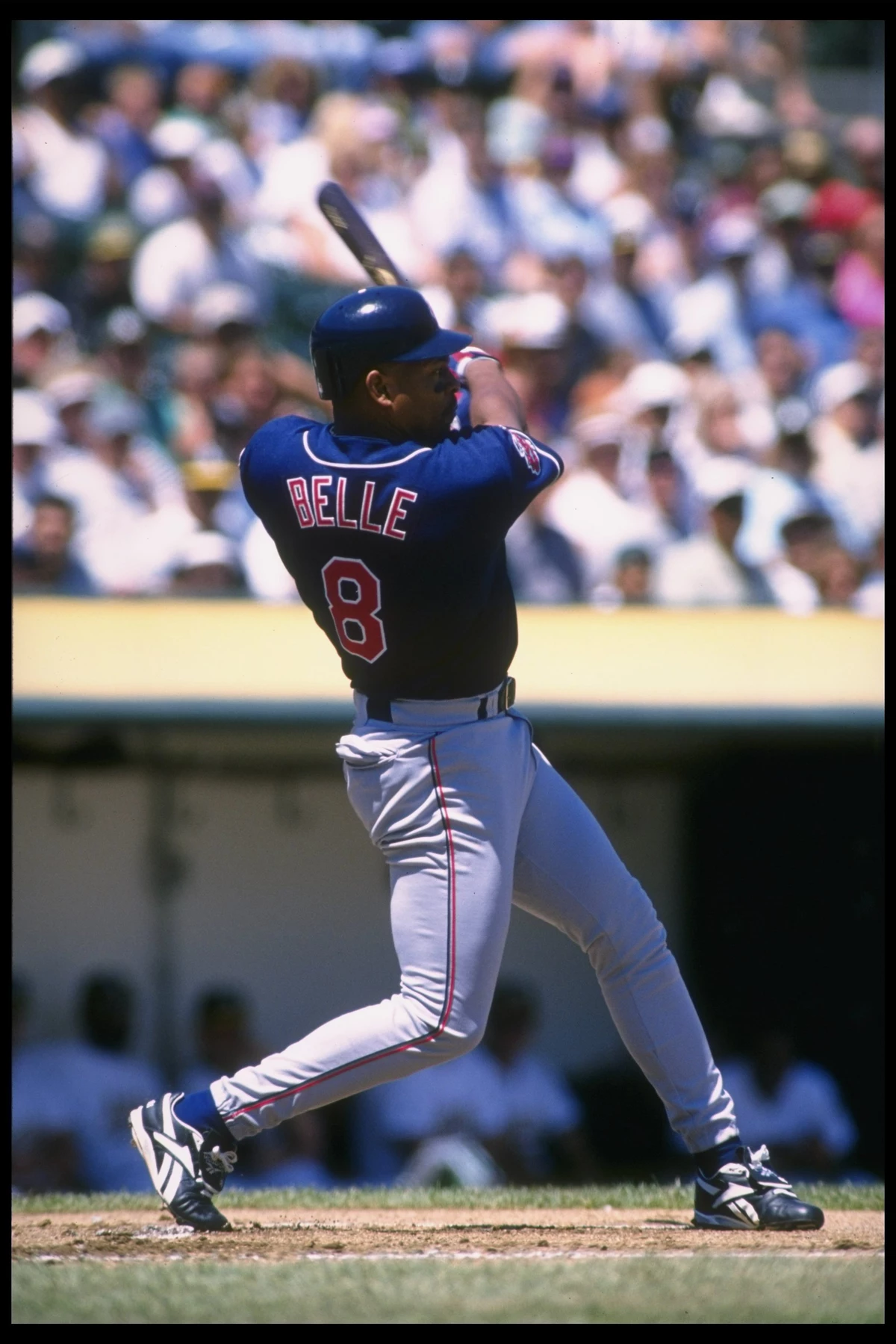
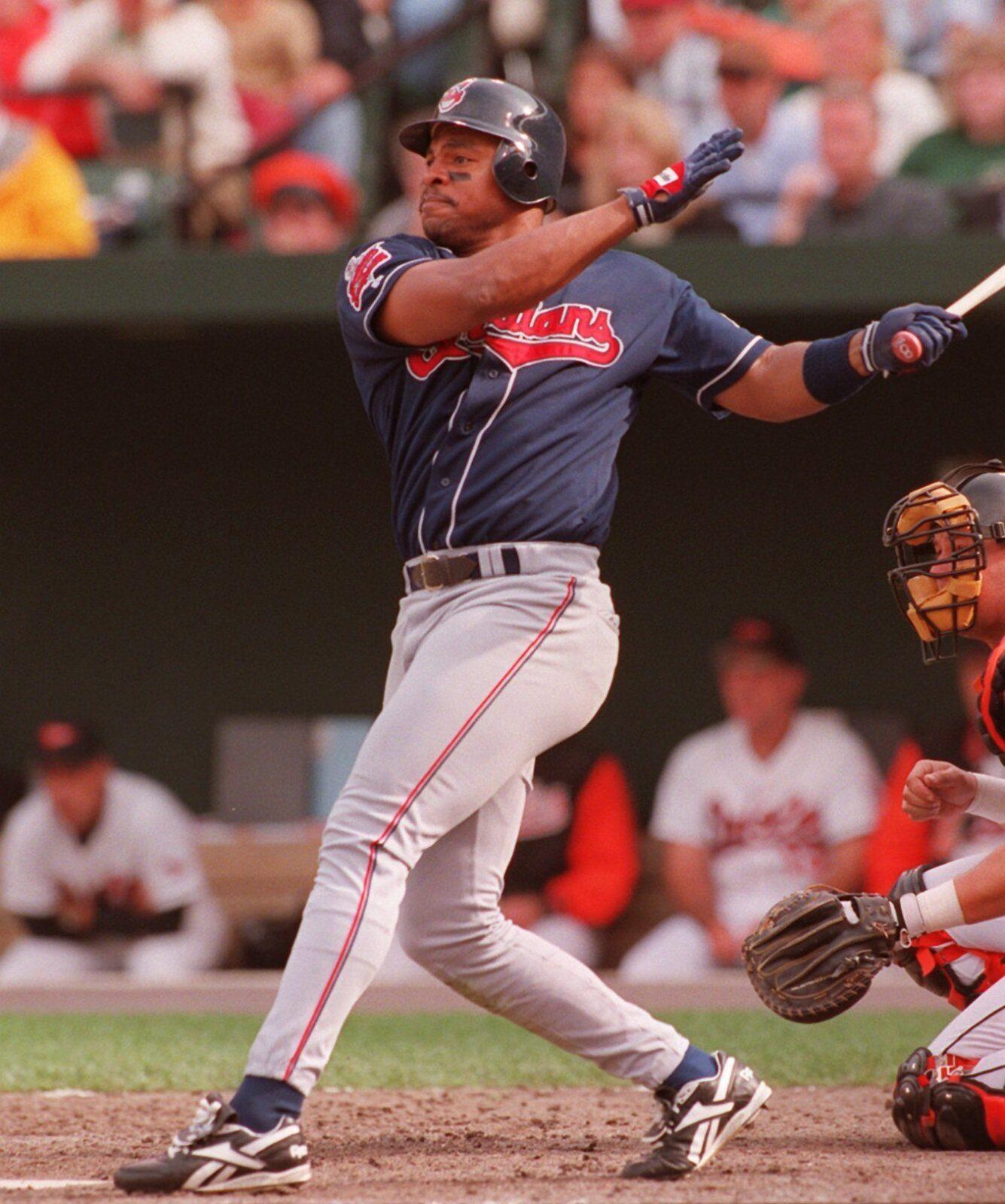
Albert Belle was one of the most productive and feared hitters in Major League Baseball (MLB) during the 1990s, renowned for his immense power, elite run production, and aggressive, often combustible personality. A five-time All-Star, Belle is perhaps best remembered for his 1995 season, where he became the first player in MLB history to record 50 home runs and 50 doubles in a single year.
Early Life and Collegiate Excellence
Born in Shreveport, Louisiana, in 1966, Albert Jojuan Belle developed his baseball talents at a young age, eventually playing collegiate ball at Louisiana State University (LSU). At LSU, Belle’s offensive prowess was evident; he was a key figure in the program’s growth, earning recognition as an All-SEC performer. His collegiate success signaled the arrival of a prototypical power hitter with a disciplined, albeit intense, approach to the game.
The Cleveland Indians selected Belle in the second round of the 1987 MLB Draft. His journey to the major leagues involved overcoming personal behavioral challenges in the minor leagues, a theme that would intermittently follow him throughout his professional tenure. Despite these hurdles, his physical talent was undeniable, characterized by quick hands, immense bat speed, and a high baseball IQ at the plate.
The Dominant Offensive Peak
Belle’s tenure with the Cleveland Indians (1989–1996) solidified his reputation as a feared middle-of-the-order presence. His physical stature and aggressive batting stance made him an intimidating sight for opposing pitchers. During the mid-1990s, Belle became the cornerstone of a burgeoning Cleveland dynasty that reached the World Series in 1995.
His statistical achievements during this era are among the most impressive of the decade. Belle’s 1995 campaign remains a benchmark for power-hitting; he led the American League in home runs (50), RBIs (126), and runs scored (121), all while maintaining a .317 batting average. His ability to hit for both power and average placed him in the upper echelon of MVP candidates for several consecutive years.
Statistical Performance Benchmarks
To understand Belle’s impact, one must examine his consistency during his prime years (1991–1996). The following table illustrates his core offensive output during this high-production window.
| Season | Team | Games | HR | RBI | AVG | OPS |
|---|---|---|---|---|---|---|
| 1991 | CLE | 158 | 28 | 95 | .282 | .838 |
| 1992 | CLE | 141 | 34 | 112 | .279 | .868 |
| 1993 | CLE | 147 | 38 | 129 | .290 | .910 |
| 1994 | CLE | 106 | 36 | 101 | .357 | 1.091 |
| 1995 | CLE | 143 | 50 | 126 | .317 | 1.091 |
| 1996 | CLE | 158 | 48 | 148 | .311 | 1.033 |
The Transition to Chicago and Baltimore
In the 1996 offseason, Belle signed a landmark contract with the Chicago White Sox, valued at $55 million over five years. At the time, this was the richest contract in baseball history. The move was a significant shift for the league, signaling an era of rapidly increasing player salaries. While his production remained high during his two seasons in Chicago—including a 49-home run, 152-RBI campaign in 1998—the team struggled to meet the expectations set by his arrival.
Following his stint in Chicago, Belle utilized an opt-out clause to sign with the Baltimore Orioles in 1999. His time in Baltimore was characterized by continued offensive effectiveness, but the team failed to secure a postseason berth. Despite his individual success, Belle’s career trajectory was eventually curtailed by chronic health issues, specifically degenerative hip osteoarthritis, which forced his retirement following the 2000 season.
Legacy and Professional Conduct
Albert Belle’s legacy is complex and inextricably linked to his personality. On the field, he was a fierce competitor who demanded excellence from himself and his teammates. Off the field and between the lines, he frequently clashed with the media, opponents, and league authorities. His career included several suspensions for on-field conduct and altercations, which often overshadowed his monumental statistical contributions.
In the decades since his retirement, the conversation surrounding Belle has remained focused on whether his offensive numbers—specifically his dominance during the 1990s—warrant greater consideration for the National Baseball Hall of Fame. To date, his candidacy has faced significant resistance from voters, primarily due to his reputation and his conduct, illustrating the subjective nature of the "character clause" in baseball’s voting process.
Frequently Asked Questions
Why is Albert Belle not in the Hall of Fame?
While Belle’s offensive statistics are statistically superior to many players currently in the Hall of Fame, voters have historically penalized him for his volatile on-field behavior, multiple suspensions, and difficult relationship with the media. These behavioral factors have prevented him from achieving the necessary threshold of support among the Baseball Writers' Association of America.
How did Albert Belle’s hip injury impact his career?
Belle suffered from degenerative hip osteoarthritis, a condition that worsened significantly toward the end of his career. Despite having a highly productive season in 2000 with the Orioles, the pain and loss of mobility caused by the condition made it impossible for him to continue playing at a professional level, leading to his retirement at the age of 34.
What was significant about the 1995 MLB season for Albert Belle?
The 1995 season is widely considered his finest. Belle made history by becoming the first player to hit 50 home runs and 50 doubles in a single season. This feat highlighted his status as one of the most complete power hitters in the history of the sport, as he combined high-volume extra-base hits with a high batting average.
How does Albert Belle’s 1996 contract compare to modern standards?
In 1996, Belle’s five-year, $55 million contract made him the highest-paid player in baseball. By 2026 standards, this figure is modest compared to the multi-hundred-million-dollar deals seen in the current market. However, at the time, it set a new precedent for superstar compensation and marked the beginning of a massive inflation in player salaries during the late 90s.
Was Albert Belle considered a defensive liability?
While Belle was primarily valued for his offense, he was a competent defender in the outfield for most of his career. He possessed a strong arm and sufficient range to handle left field in Cleveland. While he was never considered an elite defensive specialist, he was not the liability that some critics often suggested, maintaining adequate metrics throughout his peak years.
Guidance for Aspiring Baseball Analysts
For researchers and fans analyzing the 1990s era, it is essential to view Albert Belle’s career through both a statistical and a historical lens. His raw output—an average of 38 home runs and 119 RBIs per 162 games over his career—places him among the top offensive producers of his generation. When comparing players from this era, one must account for the context of the period, including the variance in park factors and the evolving landscape of league-wide offensive trends. If you are conducting a deep-dive performance analysis, prioritize looking at OPS+ (On-base plus slugging adjusted for ballpark) to normalize his production across his time in Cleveland, Chicago, and Baltimore.