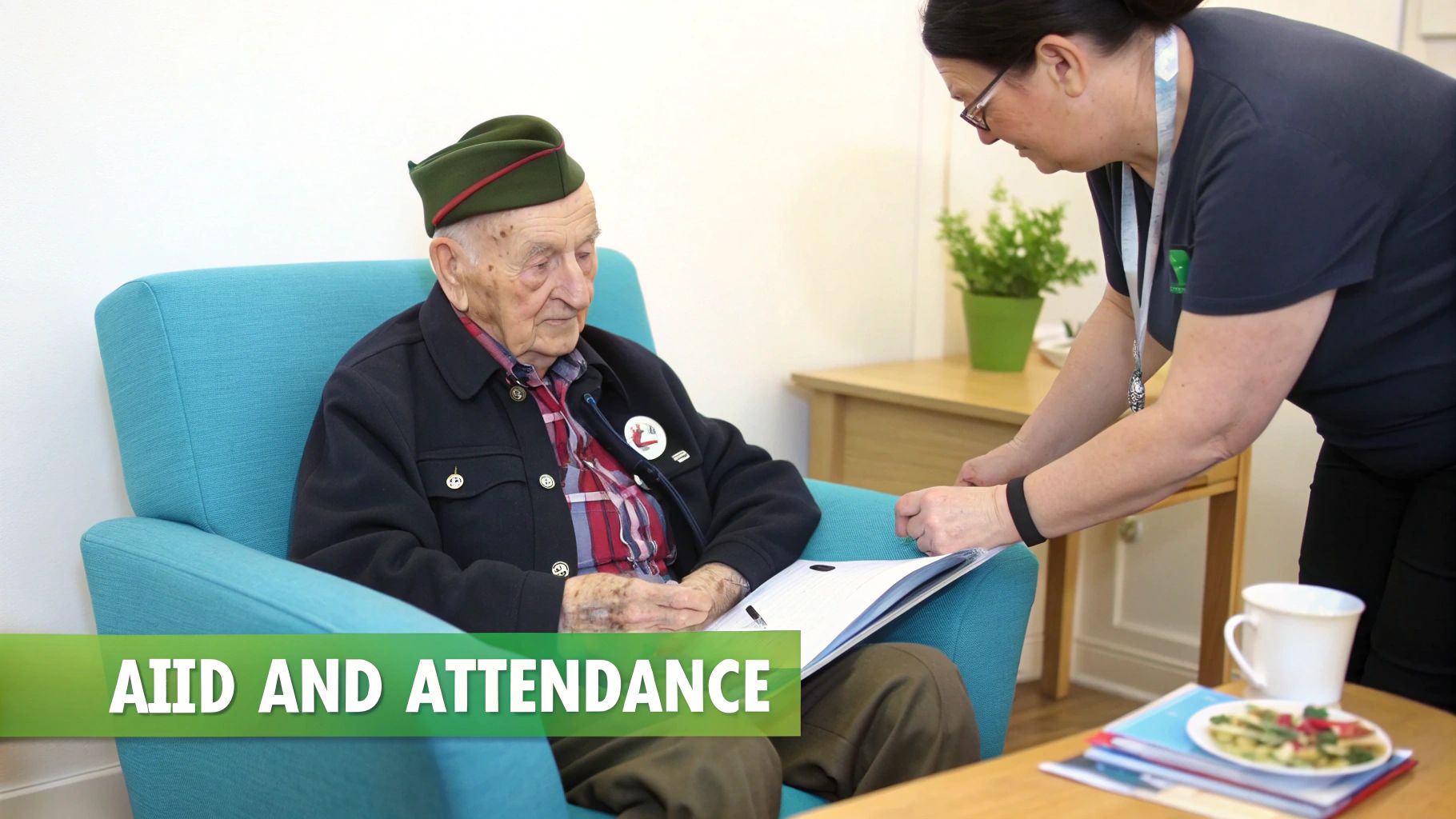
Navigating the financial support available to wartime veterans and their surviving spouses requires accurate, up-to-date figures. The Department of Veterans Affairs (VA) provides the Aid and Attendance (A&A) benefit as an enhancement to the basic Improved Pension. This specialized allowance assists individuals who require the regular aid of another person to perform activities of daily living, are bedridden, reside in a nursing home due to mental or physical incapacity, or have severely limited sight. Understanding the exact 2026 pay rates, eligibility criteria, and administrative processes ensures claimants can accurately project their financial assistance and meet their long-term care needs.
Understanding the 2026 VA Improved Pension and Aid and Attendance Structure
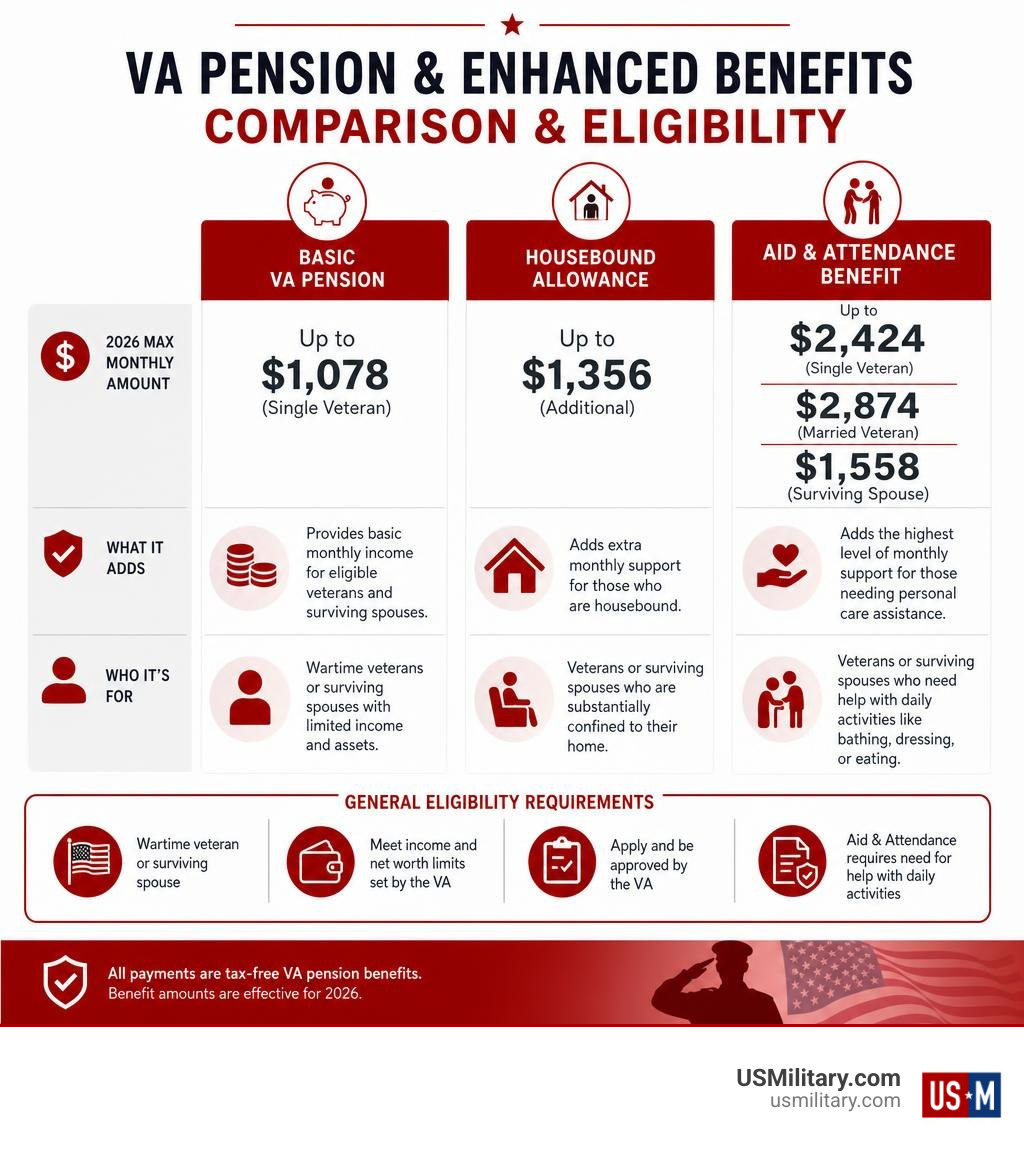
The VA Aid and Attendance benefit is not paid as a standalone check; rather, it is added to a veteran or surviving spouse's Maximum Annual Pension Rate (MAPR). The structure of this financial support depends heavily on the claimant's dependency status, physical condition, and whether they are applying as a veteran or a surviving spouse.
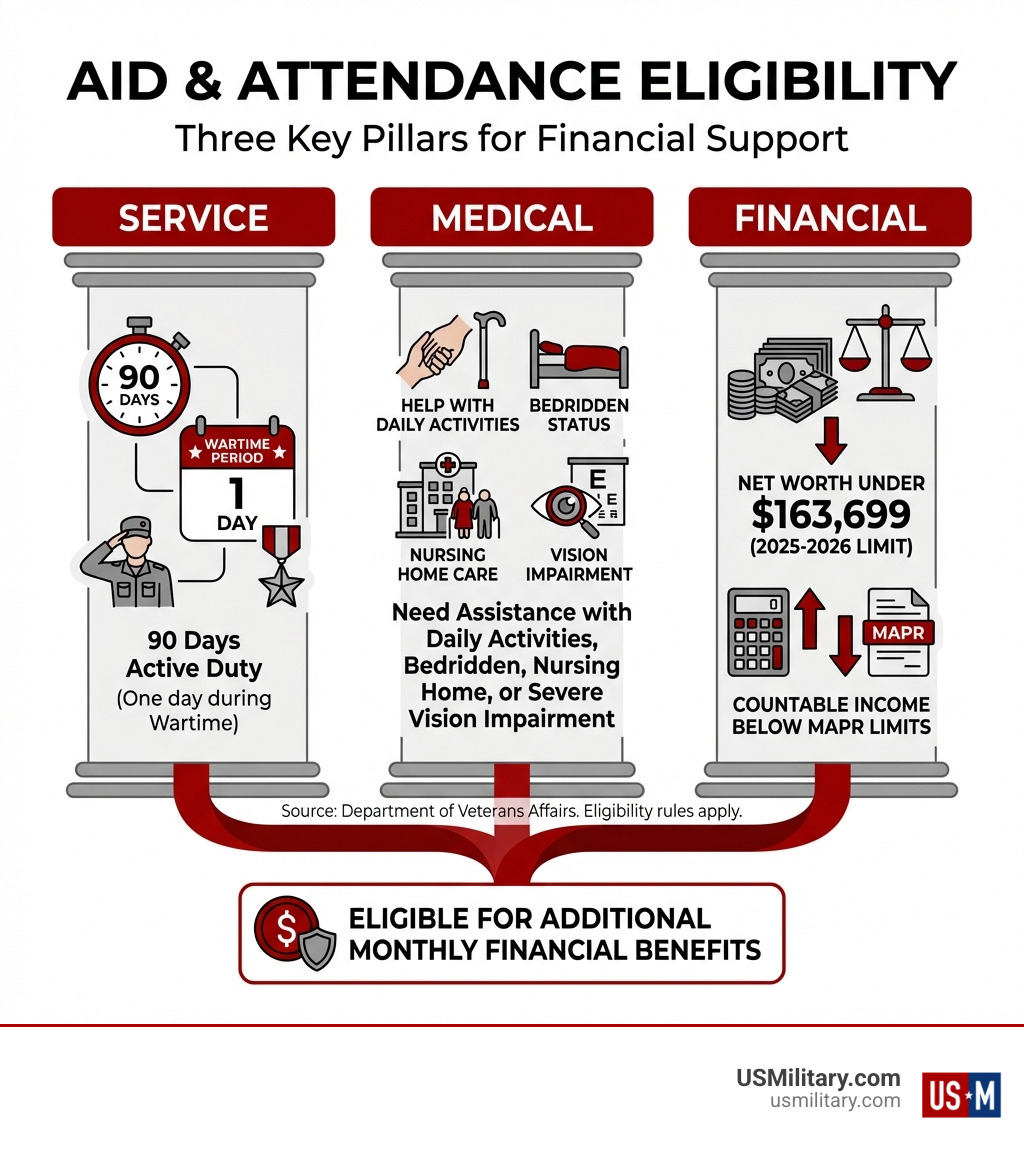
To qualify for A&A, applicants must first meet the baseline requirements for the VA Improved Pension. This includes having active-duty service during a recognized wartime period, being discharged under conditions other than dishonorable, and meeting specific net worth and income thresholds. Once these baseline criteria are satisfied, medical documentation proving the need for daily personal assistance unlocks the higher tier of pension payments known as the Aid and Attendance rate.
Official 2026 Maximum Annual Pension Rates (MAPR) with Aid and Attendance
The Department of Veterans Affairs adjusts pension rates annually based on the Consumer Price Index for Urban Wage Earners and Clerical Workers (CPI-W), incorporating the applicable Cost-of-Living Adjustment (COLA). The following data reflects the official standard metrics and financial tiers for 2026.
| Claimant Status | Baseline Annual Pension (MAPR) | With Aid and Attendance (Annual) | Estimated Monthly A&A Total |
|---|---|---|---|
| Single Veteran | $17,472 | $29,607 | $2,467 |
| Veteran with One Dependent (Spouse/Child) | $22,865 | $35,000 | $2,916 |
| Two Veterans Married to Each Other | $22,865 | $39,285 | $3,273 |
| Surviving Spouse (No Dependents) | $11,721 | $19,045 | $1,587 |
| Surviving Spouse with One Dependent | $14,484 | $21,811 | $1,817 |
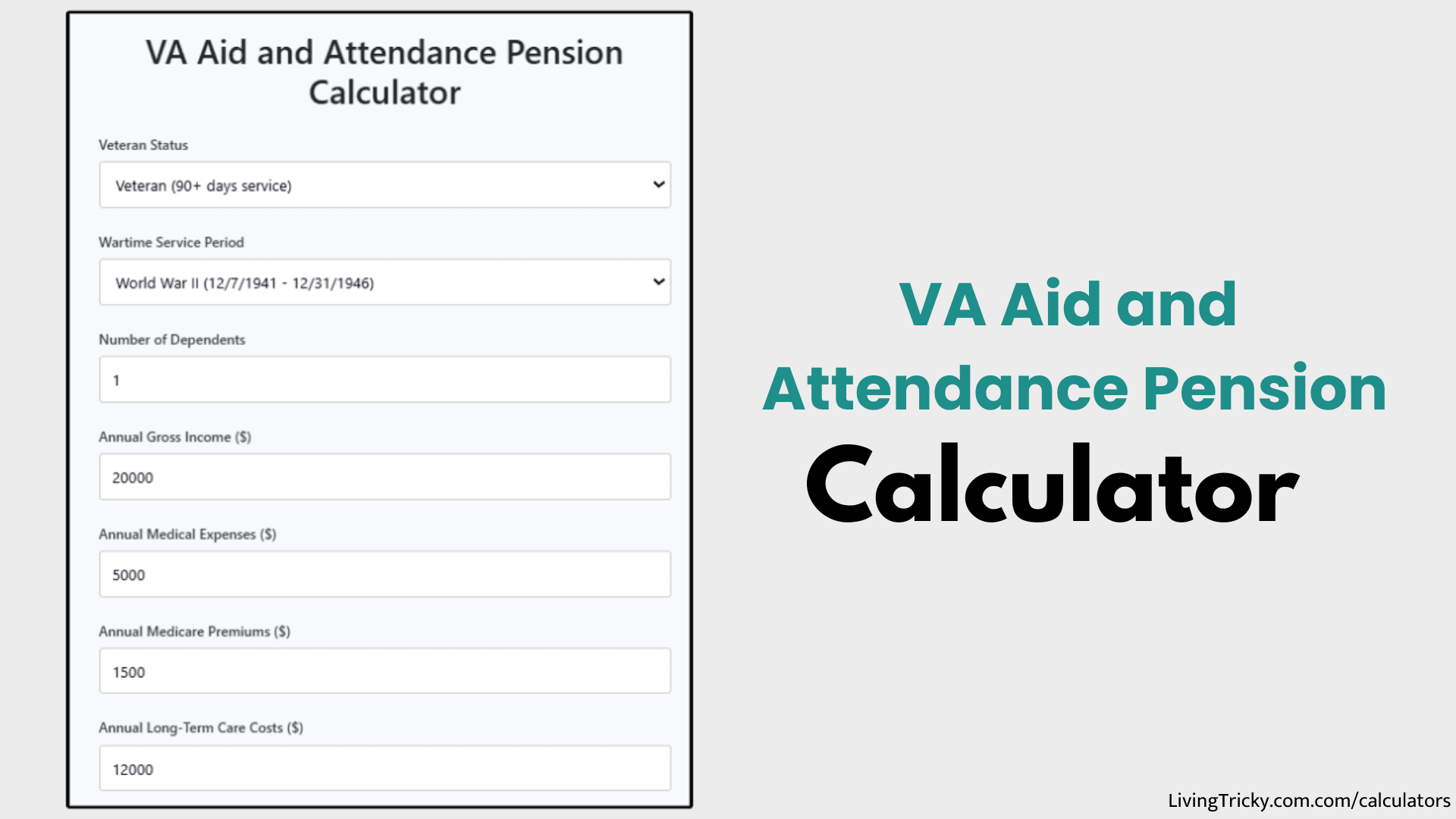
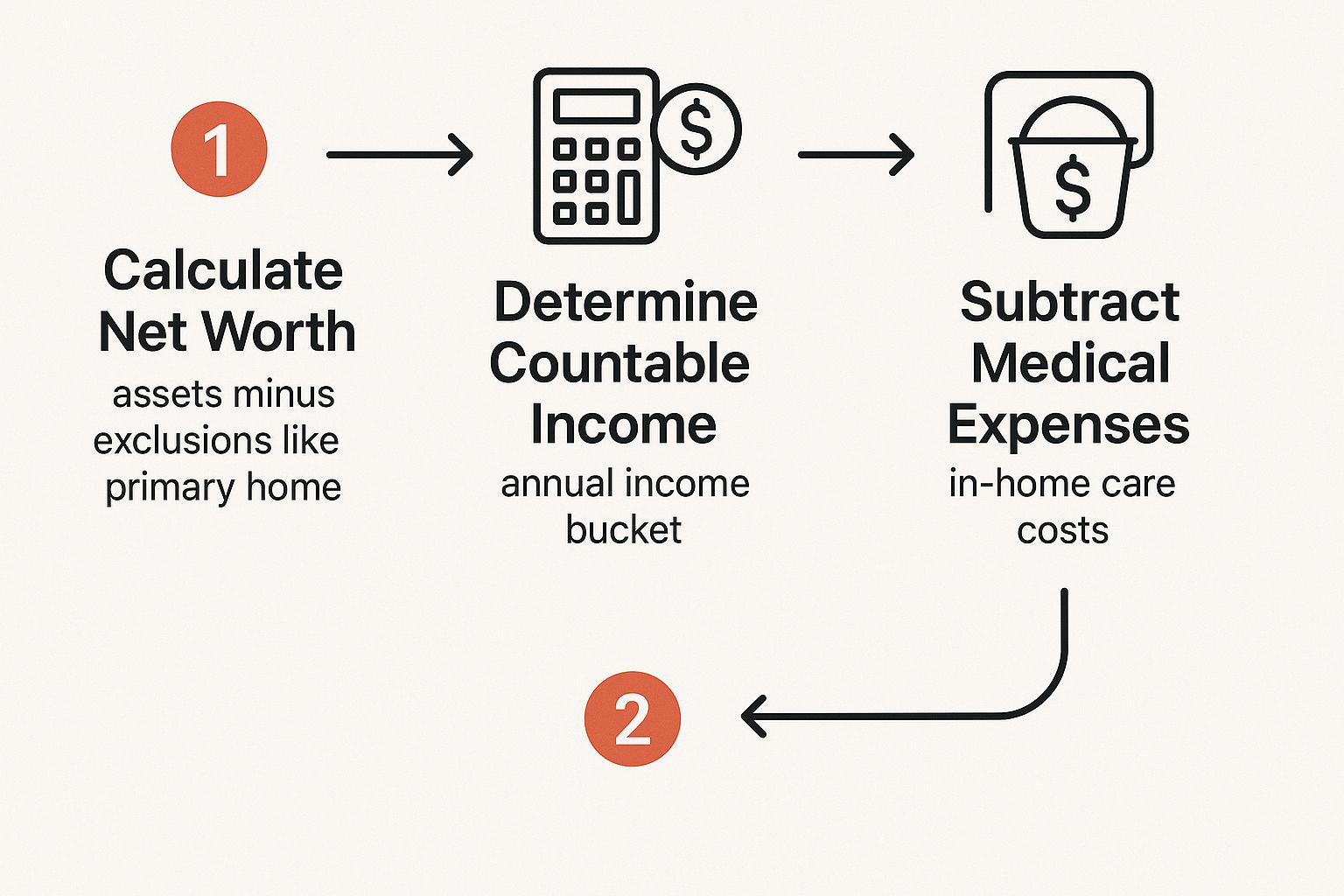
Important Financial Distinction: The figures outlined in the table above represent the Maximum Annual Pension Rate. The actual financial payout a claimant receives is calculated by taking this MAPR figure and subtracting their countable family income. Consequently, medical expenses that exceed a certain threshold can be deducted to lower countable income, thereby maximizing the final monthly benefit.
Core Eligibility Requirements for the 2026 Benefit Cycle
Securing approval for the Aid and Attendance benefit demands strict adherence to statutory eligibility guidelines enforced by the Veterans Benefits Administration (VBA). Meeting these benchmarks is mandatory before any disbursement from the pay chart can be authorized.
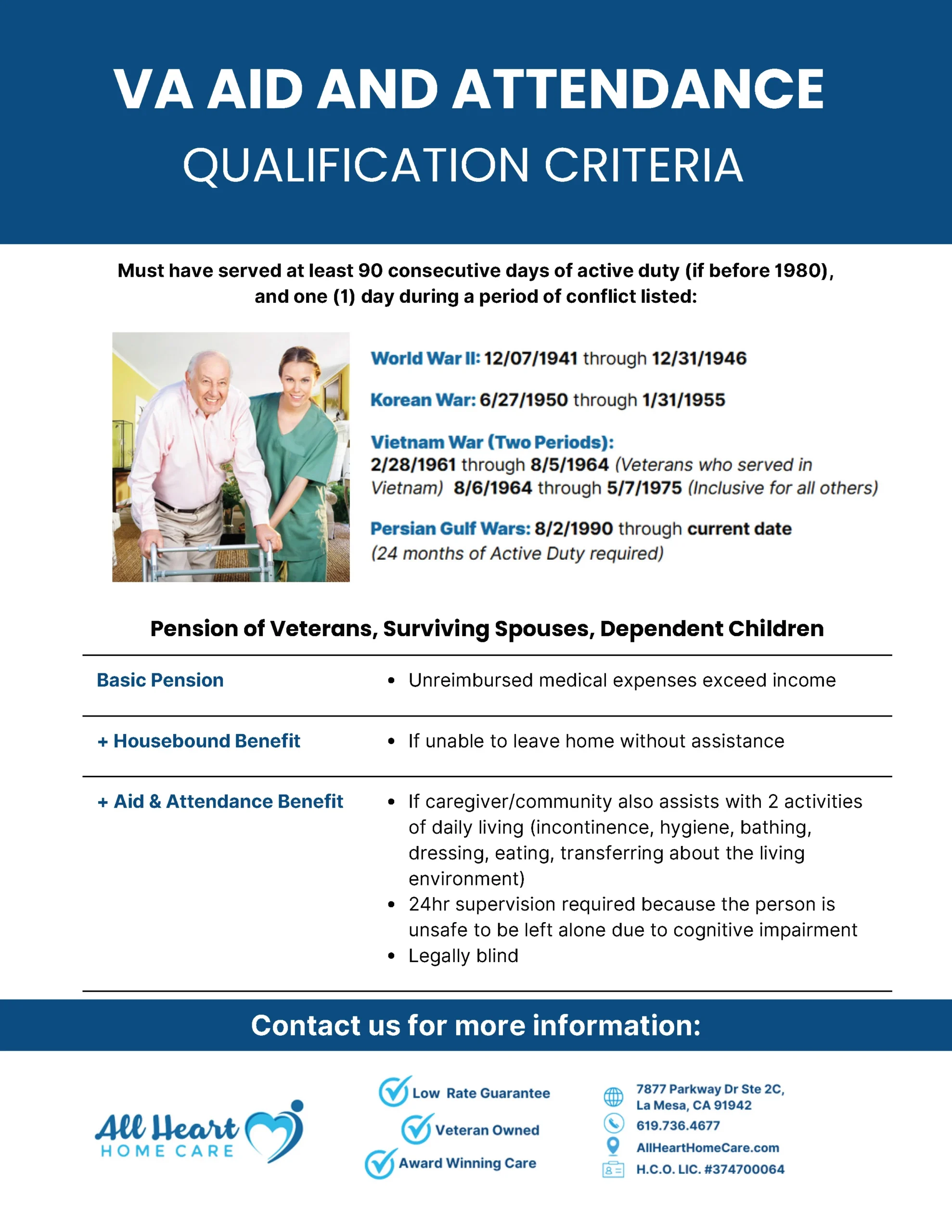
- Wartime Service Requirement: The veteran must have served at least 90 days of active duty, with at least one day during a designated period of war (such as World War II, the Korean Conflict, the Vietnam War, or the Gulf War). Individuals entering service after September 7, 1980, generally must have served 24 months or the full period for which they were called to active duty.
- Clinical Necessity: A licensed physician, physician assistant, or nurse practitioner must complete examination forms certifying that the claimant requires assistance with daily functions such as bathing, dressing, feeding, or toileting, or that they are legally blind or confined to a bed.
- Net Worth Limits: For 2026, the net worth limit for VA pension eligibility is pegged to the community spousal resource allowance, typically evaluated alongside the annual IRS limits. Generally, combined countable income and assets cannot exceed strict regulatory ceilings, though primary residences and standard vehicles are typically excluded from asset calculations.
- The Look-Back Period and Asset Transfers: The VA enforces a 36-month look-back period on asset transfers. Moving financial assets below fair market value during this window to artificially qualify for the pension can trigger a penalty period of up to five years of ineligibility.
Step-by-Step Application Guide for Veterans and Families
Filing a successful claim for the Aid and Attendance benefit requires meticulous documentation and adherence to procedural workflows. Missing medical evidence or failing to complete required forms correctly is the primary reason for delayed processing times at regional VA processing centers.
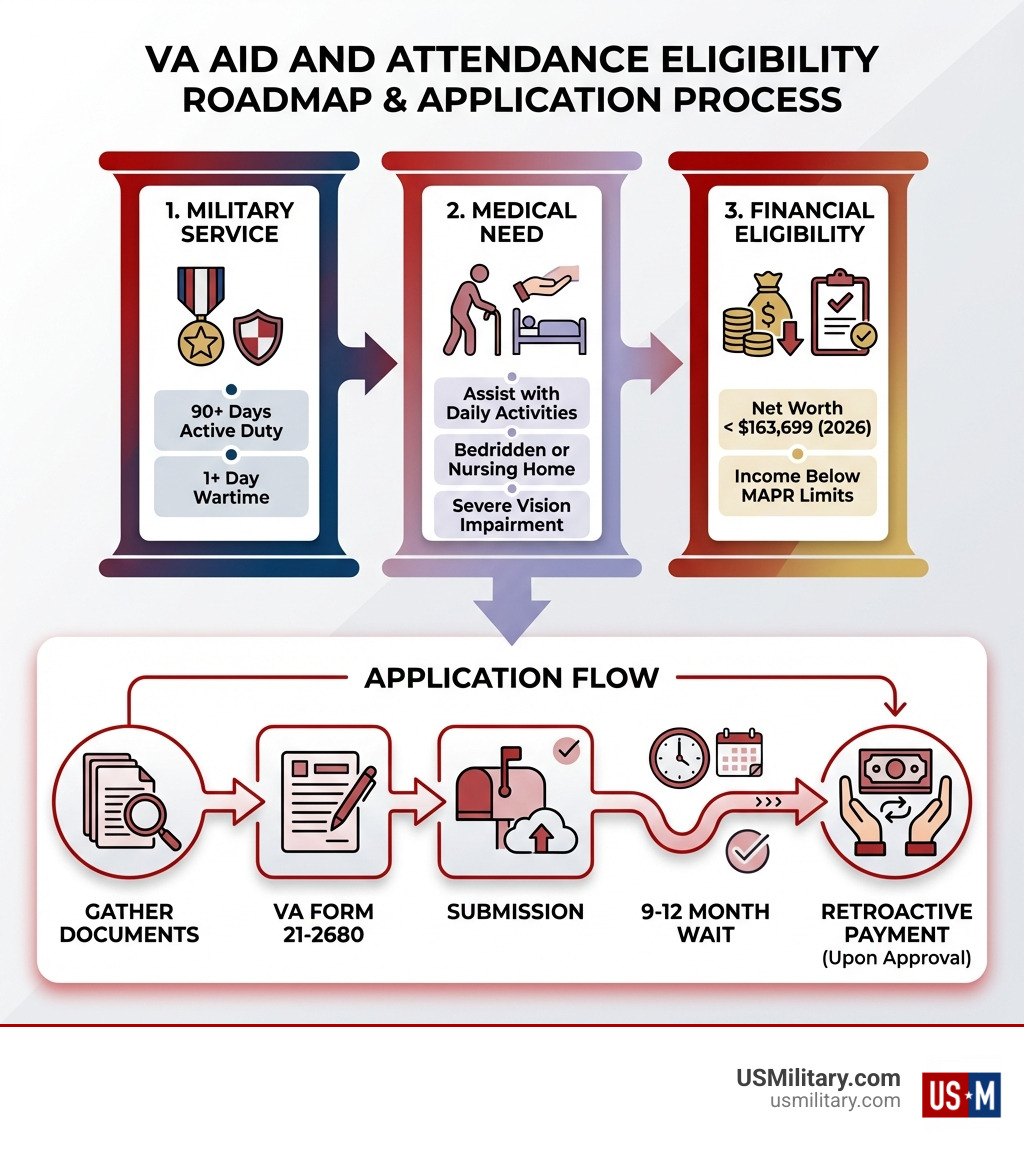
- Gather Essential Military and Personal Records: Locate the veteran's DD Form 214 or equivalent discharge papers, marriage certificates, and Social Security numbers for all household dependents.
- Obtain Medical Evidence: Schedule an appointment with the primary attending physician to complete VA Form 21-2680 (Examination and Pending Status Report). The physician must detail the specific physical or mental limitations necessitating daily personal care.
- Compile Financial Declarations: Fill out VA Form 21P-527EZ (for veterans) or VA Form 21P-534EZ (for surviving spouses). Gather clear statements detailing monthly income, bank statements, investment accounts, and itemized medical expenses.
- Submit the Claim Package: File the completed forms electronically through the official VA website portal or mail the physical documentation packet to the appropriate regional pension intake center. Retain copies of all submitted paperwork and tracking numbers for future follow-up.
- Respond to VA Development Letters: Monitor mail and online portals closely for any requests for additional evidence, clarification, or scheduled independent medical evaluations from the VA regional office.
Expert Operational Advice: Always maintain a detailed, itemized ledger of recurring medical expenses, including home care provider invoices, assisted living facility fees, and health insurance premiums. Submitting these unreimbursed medical expenses directly reduces countable income, which can substantially increase the final monthly pension disbursement tier.
Comparing Care Options: Home Care vs. Assisted Living Facilities
Families frequently weigh whether to deploy VA pension funds toward home-based care or residential facilities. Each option carries distinct financial and logistical realities.
- In-Home Care Services: Utilizing A&A funds to hire home health aides offers personalized one-on-one support in a familiar environment. However, managing private aides or home care agencies requires administrative oversight, scheduling coordination, and backup care planning during staff absences.
- Assisted Living Communities: Residential facilities provide structured environments with 24-hour staff availability, social programming, and built-in safety features. While more expensive upfront, these facilities streamline medication management and daily care, and many accept VA benefit payments directly through designated veteran financial assistance programs.
Frequently Asked Questions
What is the maximum monthly Aid and Attendance payout for a single veteran in 2026?
A single veteran qualifying for the maximum annual pension rate with Aid and Attendance receives approximately $2,467 per month. This figure varies slightly based on statutory cost-of-living adjustments and the veteran's exact countable income deductions.
Can a veteran receive both VA disability compensation and Aid and Attendance pension?
No, a veteran generally cannot receive simultaneous payments from both the VA Disability Compensation program and the VA Improved Pension with Aid and Attendance. The VA typically awards the benefit that provides the higher financial payout to the claimant.
What medical conditions automatically qualify someone for Aid and Attendance?
Conditions that render an individual bedridden, require assistance with multiple activities of daily living, mandate placement in a nursing home due to physical or cognitive decline, or involve severe visual impairment qualify for review. However, every claim requires formal medical certification via VA Form 21-2680.
How long does it take for the VA to process an Aid and Attendance claim?
Processing times vary depending on regional office workloads and the completeness of the initial application package. Submitting fully documented medical evidence and financial disclosures electronically typically accelerates the review timeline, which can range from several months to over a year.
Are payments from the Aid and Attendance benefit taxable by the IRS?
No, benefits disbursed by the Department of Veterans Affairs, including Improved Pensions and Aid and Attendance enhancements, are entirely tax-free and do not need to be reported as gross income on federal or state tax returns.
What happens if a claimant's net worth exceeds the 2026 threshold?
If a claimant's net worth and annual income exceed the regulatory limit established for that calendar year, the application will be denied. However, legitimate spend-down strategies, such as paying off existing consumer debt or purchasing irrevocable funeral trusts, can sometimes bring assets within acceptable limits.
Navigating the financial intricacies of veteran benefits ensures that those who served our nation receive the dignified care they deserve. By leveraging the updated 2026 pay chart figures and maintaining meticulous documentation, families can successfully secure the resources required to support their loved ones. To initiate a claim or explore personalized eligibility scenarios, visit the official Department of Veterans Affairs website or consult an accredited veterans service officer (VSO) in your local region.