Ahmad Khan Rahami is an American citizen convicted of planting pressure-cooker bombs in New York City and Seaside Park, New Jersey, in September 2016. His actions triggered a multi-state manhunt that concluded with a shootout in New Jersey, culminating in multiple federal terrorism convictions and a life sentence.
Background and Early Life
Ahmad Khan Rahami was born on January 23, 1988, in Afghanistan. His family immigrated to the United States and settled in Elizabeth, New Jersey, where his father operated a fried-chicken restaurant named First American Fried Chicken. Rahami attended Thomas Jefferson High School in Elizabeth and later worked at the family business.
Before the 2016 bombings, Rahami traveled to Pakistan and Afghanistan on multiple occasions. Reports from federal investigators and family testimony indicated that during these trips, particularly an extended stay in Quetta, Pakistan, Rahami underwent a ideological transformation, becoming increasingly radicalized and expressing vocal anti-American sentiments. These shifts went largely unreported to law enforcement by family members, despite domestic disputes and legal troubles involving his father and local authorities over the operation and operating hours of the family restaurant.
The September 2016 Bombing Campaign
The sequence of events leading to Rahami's capture began on the morning of September 17, 2016, in Seaside Park, New Jersey. A pipe bomb placed in a plastic garbage can exploded along the route of a charity marine race. Because the event had been delayed, the blast occurred before runners reached the location, resulting in no injuries.
Later that same day, a second, more powerful device exploded on West 23rd Street in the Chelsea neighborhood of Manhattan, New York City. The device, constructed using a pressure cooker filled with shrapnel and powered by a flip-phone timer, detonated inside a metal dumpster. The explosion injured 31 people and caused widespread property damage.
A third device—an unexploded pressure-cooker bomb packed with steel bearings and connected to a cell phone—was discovered by authorities a few blocks away on West 27th Street.
| Location | Date | Device Type | Outcome |
|---|---|---|---|
| Seaside Park, New Jersey | Sept. 17, 2016 | Pipe bomb in plastic container | Exploded prematurely; zero injuries. |
| Chelsea, Manhattan, NY | Sept. 17, 2016 | Pressure-cooker bomb in dumpster | Exploded; 31 injured, significant property damage. |
| Chelsea (West 27th St.), NY | Sept. 17, 2016 | Pressure-cooker bomb | Recovered unexploded; safely dismantled. |
| Elizabeth, New Jersey | Sept. 18, 2016 | Multiple pipe/backpack bombs | Discovered near train station; one detonated during robotic disposal. |
Investigators quickly linked the devices through forensic evidence, including purchase receipts, latent fingerprints, and digital traces left on unexploded components. Surveillance footage from Chelsea captured a man later identified as Rahami transporting and placing the explosive packages.
Manhunt and Capture in Linden, New Jersey
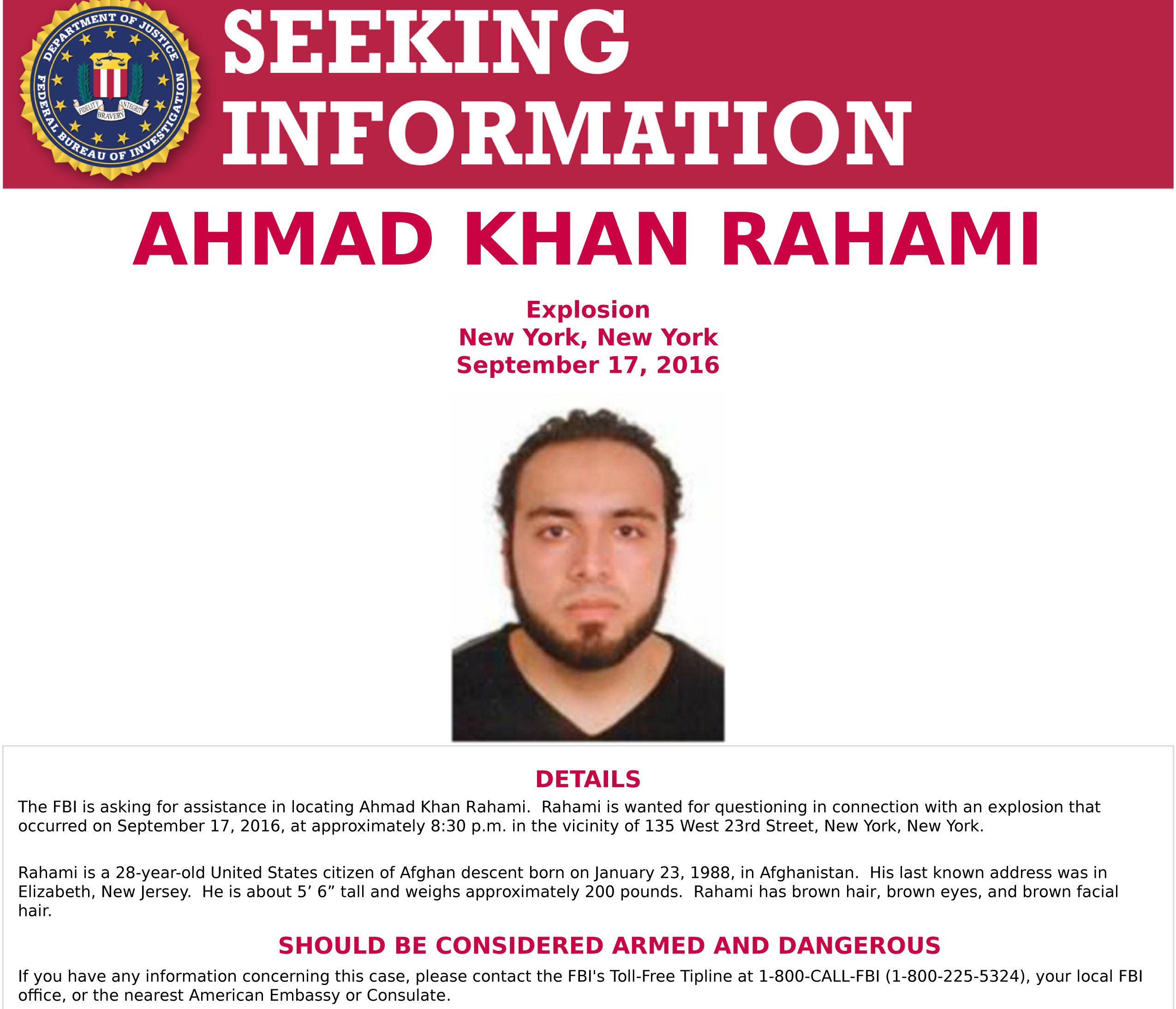
Following the identification of Rahami as a primary suspect, the Federal Bureau of Investigation (FBI) issued a public alert and disseminated his photograph nationwide on the morning of September 19, 2016. Law enforcement agencies flooded the New York metropolitan area with warnings urging citizens to report his whereabouts.
The manhunt concluded hours later in Linden, New Jersey. A local bar owner noticed a man sleeping in the doorway of his establishment and recognized him from the broadcast alerts. The business owner contacted the Linden Police Department.
When Officer Kevin Ryan approached Rahami to investigate, Rahami drew a handgun and fired at the officer, striking him in the ballistic vest. A gunfight ensued between Rahami and responding police officers. Rahami sustained multiple gunshot wounds before being subdued and taken into custody.
Federal Investigation and Ideological Motivations
Following his arrest, federal investigators searched Rahami's belongings and recovered a handwritten journal. The notebook contained explicit references to Osama bin Laden, Anwar al-Awlaki, and other prominent extremist figures. The writings detailed grievances against U.S. military operations in Iraq, Afghanistan, and Syria, and expressed a desire to carry out violent jihad against American targets.
Digital forensics further revealed that Rahami had downloaded bomb-making instructions and propaganda materials produced by foreign terrorist organizations. Prosecutors established that Rahami acted as a self-radicalized lone actor inspired by international terrorist ideology, though investigators found no direct command-and-control link connecting him to operational cells overseas.
Trial, Verdict, and Sentencing
In October 2017, Rahami stood trial in the U.S. District Court for the Southern District of New York. Prosecutors presented extensive forensic evidence, surveillance video, DNA matches, and entries from his personal journal.
On February 13, 2018, a federal jury found Rahami guilty on all eight counts against him, including:
- Use of a weapon of mass destruction
- Bombing a public place resulting in property damage
- Attempted use of a weapon of mass destruction
- Destruction of property by means of fire or explosives
- Discharge of a firearm during a crime of violence
On February 13, 2019, U.S. District Judge Richard Berman sentenced Rahami to multiple consecutive terms of life imprisonment without the possibility of parole. During the sentencing hearing, the judge emphasized the premeditated nature of the attacks and the sheer fortune that prevented mass casualties during the Chelsea and Seaside Park detonations.
Ongoing Implications and Security Impact
The case of Ahmad Khan Rahami remains a notable benchmark in modern domestic counter-terrorism and urban security planning. The incident accelerated the deployment of advanced surveillance networks across major metropolitan centers, particularly in New York City, where public-private camera integration aided the rapid identification and tracking of the suspect.
Additionally, the investigation highlighted challenges in identifying radicalized individuals before violent acts occur, especially when warning signs observed by family members or acquaintances go unreported to law enforcement. Security agencies continue to utilize the case in briefings regarding improvised explosive device (IED) detection, rapid inter-agency coordination, and public-private cooperation during active metropolitan manhunts.