Age verification serves as the critical gatekeeping mechanism that digital platforms, physical merchants, and service providers use to confirm that an individual meets the statutory minimum age required to access restricted goods, services, or online content. By establishing robust identity confirmation processes, organizations comply with evolving regulatory mandates designed to protect minors from harmful materials, prevent underage purchasing of age-restricted items such as alcohol, tobacco, and gambling services, and maintain platform integrity across diverse jurisdictions.
Understanding the Regulatory Landscape and Legal Requirements
The demand for rigorous age verification has accelerated globally due to legislative actions aimed at enhancing child online safety and consumer protection. Jurisdictions worldwide have enacted laws requiring digital service providers, social media platforms, and e-commerce websites to implement dependable age-checking mechanisms. In the United States, legislation like the Children's Online Privacy Protection Act (COPPA) sets foundational rules for handling data from minors, while various state-level laws increasingly mandate age assurance for adult-oriented content and online gaming.
Similarly, the European Union's Audiovisual Media Services Directive (AVMSD) and the Digital Services Act (DSA) impose strict duties on platforms to protect minors, prompting member states to establish localized compliance frameworks. Compliance failure carries severe financial and legal penalties, forcing organizations to transition from superficial self-declaration pop-ups—such as simple checkboxes asking users to confirm they are over 18 or 21—to technically advanced, verifiable proof systems. These regulatory expectations require a careful balance between strict enforcement and adherence to data minimization principles, ensuring that compliance efforts do not compromise user privacy or expose sensitive personal identifiable information (PII) to unnecessary security risks.
Primary Technical Methods Used for Age Verification
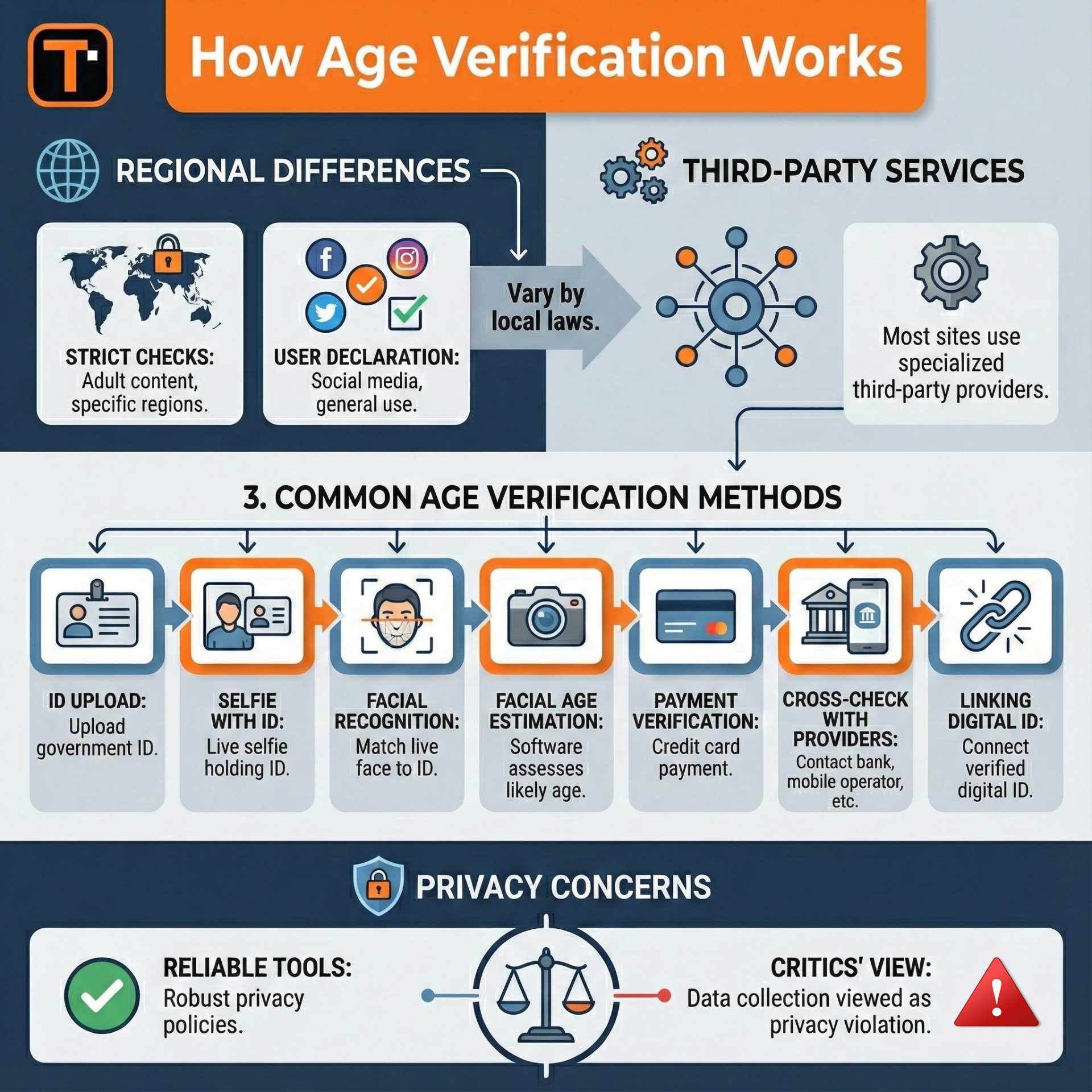
Organizations deploy a diverse array of technical approaches to confirm user ages, each balancing accuracy, friction, cost, and privacy protection differently. Selecting the appropriate method depends on the risk profile of the service, statutory requirements, and the acceptable user friction threshold for onboarding or checkout.
| Verification Method | Privacy & Security Level |
|---|---|
| Document Scanning / ID Upload | High Accuracy / Moderate Privacy |
| Biometric Facial Estimation | Moderate-High / High Privacy |
| Credit Card / Financial Auth | Moderate Accuracy / Low Friction |
| Knowledge-Based Authentication | Moderate Accuracy / High Friction |
Document Scanning and Government ID Matching
Document verification involves users uploading an image of a government-issued identification document, such as a passport, driver’s license, or national identity card. Automated software analyzes the document for security features, extracts the date of birth, and often matches the photograph against a live selfie captured via the user's device webcam or smartphone camera. This method offers high legal certainty and accuracy but introduces friction and raises user privacy concerns regarding the handling and temporary storage of sensitive identity documents.
Facial Age Estimation Technologies
Facial age estimation uses computer vision and artificial intelligence algorithms to analyze facial features from a static image or real-time video stream to estimate an individual's age. This approach does not require users to possess or upload official identity documents, preserving anonymity because the system estimates age without extracting or storing a person's legal identity. While modern liveness detection protocols effectively prevent spoofing via printed photographs or pre-recorded videos, accuracy can vary slightly across diverse demographics, making it a popular privacy-forward option for medium-risk environments.
Credit Card and Financial Account Verification
Financial-based verification relies on the fact that traditional banking products and credit cards legally require holders to be of majority age. Platforms perform a micro-transaction or authorize a zero-value check through a payment gateway, validating that the user controls an active financial account associated with an adult identity. While this method integrates smoothly into existing e-commerce checkouts and involves minimal friction, it excludes unbanked populations and cannot verify the age of minors who illegally access adult financial instruments.
Knowledge-Based Authentication and Database Checks
Knowledge-based authentication (KBA) queries credit bureaus or public records databases using personal details like name, address, and social security number to generate dynamic questions that only the true identity holder can answer. Alternatively, authoritative database checks verify user-submitted attributes directly against trusted government or commercial registries. Although effective for high-security applications, KBA creates significant friction, has high abandonment rates, and fails for younger demographics lacking established credit or public records histories.
Balancing Privacy, Security, and User Experience
Implementing age verification creates an inherent tension between rigorous security, regulatory compliance, and seamless user experience. Excessive friction during onboarding directly diminishes conversion rates and drives users toward unregulated, unsafe alternatives. Consequently, modern verification architectures prioritize privacy-preserving technologies that minimize data collection and storage.
Privacy-enhancing cryptographic techniques, such as zero-knowledge proofs (ZKPs) and decentralized identity wallets, allow users to prove they meet a specific age threshold (e.g., "Over 18") without revealing their exact date of birth, name, or underlying identification documents to the service provider. In these frameworks, a trusted issuer cryptographically signs an age credential stored on the user's device. When interacting with a restricted platform, the user's device generates a mathematical proof confirming eligibility, satisfying regulatory mandates while eliminating honeypots of sensitive consumer data that cybercriminals might target in data breaches.
Operational Challenges and Common Implementation Mistakes
Organizations deploying verification systems frequently encounter technical, operational, and user-centric obstacles that can undermine compliance efforts and alienate customers. Understanding these pitfalls helps system architects design more resilient workflows.
- Over-reliance on Self-Declaration: Utilizing unverified birthdate entry fields or simple checkboxes provides zero legal protection or regulatory compliance in jurisdictions requiring robust age assurance.
- Ignoring Accessibility and Inclusion: Failing to provide alternative verification paths for individuals lacking specific government-issued IDs, smartphones, or traditional banking accounts creates discriminatory barriers to legal goods and services.
- Inadequate Data Retention Policies: Storing raw identity documents, biometric templates, or financial records longer than legally necessary increases organizational exposure under strict data protection regulations like the GDPR.
- Ignoring Spoofing and Fraud Vectors: Deploying basic facial analysis or document upload tools without advanced liveness detection leaves systems vulnerable to presentation attacks using deepfakes, stolen photos, or synthetic identities.
Future Outlook for Digital Identity and Age Assurance
The future of age verification points toward interoperable digital ecosystems and decentralized trust frameworks. As governments establish national digital identity frameworks and decentralized wallets, third-party verification silos will likely give way to standardized, user-controlled credentials. This evolution will allow individuals to carry verifiable age attributes on their mobile devices, authenticating instantly across multiple platforms with maximum privacy and zero data leakage. Organizations that adopt modular, privacy-first verification strategies today will be best positioned to adapt as global regulatory standards continue to tighten and mature.
Frequently Asked Questions
What is the difference between age verification and age estimation?
Age verification definitively confirms a user's exact legal age or date of birth through authoritative documents, databases, or financial instruments. Age estimation uses technologies like facial analysis algorithms to calculate an approximate age range based on physical characteristics without requiring official identification documents.
Does age verification require users to upload personal identification?
Not always. While document scanning and ID matching require official identification, alternative methods such as facial age estimation, open banking verification, and zero-knowledge cryptographic credentials allow users to prove they meet age requirements without exposing private documents or personal identities.
How do privacy laws impact age verification requirements?
Privacy regulations like the GDPR and CCPA require organizations to practice data minimization, meaning they must only collect the minimum personal data necessary for their stated purpose. Effective age verification systems balance this by utilizing privacy-preserving methods that confirm age status without permanently storing raw identification documents or sensitive biometric data.
Can minors bypass age verification checks?
While advanced systems incorporating liveness detection, database cross-referencing, and cryptographic credentials make bypassing extremely difficult, determined minors occasionally attempt circumvention using adult credentials, stolen financial cards, or manipulated images. Continuous algorithm updates and multi-factor security protocols help mitigate these evasion attempts.
What happens to the personal data submitted during verification?
Compliant platforms are bound by strict data retention and privacy policies that dictate how long verification data is held. In many modern privacy-forward implementations, raw identity documents and biometric scans are immediately destroyed or hashed after the authentication check concludes, leaving only an anonymous validation token.
Establishing a Compliant Verification Workflow
To successfully deploy age verification within an organization, start by conducting a comprehensive audit of your platform's regulatory obligations, risk exposure, and user demographics. Map out the exact legal thresholds required for your specific products or services across your target operational jurisdictions. Next, select a verification partner or technical architecture that aligns with your privacy commitments, ensuring support for multiple fallback methods to accommodate diverse user populations. Finally, establish clear data retention schedules, implement robust security encryption for data in transit and at rest, and continuously monitor verification success rates and fraud attempts to refine the onboarding experience.