Adventure tourism safety relies on a rigorous integration of operator certification, comprehensive risk assessment, and informed participant preparation. By aligning internal operational protocols with international standards—such as ISO 21101—and maintaining strict equipment maintenance logs, tour providers can effectively mitigate inherent environmental risks while ensuring regulatory compliance in high-stakes wilderness and recreational settings.
Defining the Scope of Adventure Tourism Risk
Adventure tourism is defined by activities that involve a degree of physical exertion, a specialized skill set, and inherent environmental uncertainty. Unlike conventional leisure travel, adventure tourism requires active participation where the outcome is often influenced by the traveler’s actions and the provider’s management of external variables. Safety in this niche is not merely the absence of accidents; it is the active management of risk through layered defenses.
At the core of this management is the distinction between "perceived risk" and "actual risk." For the participant, the allure of adventure lies in the former, while the provider’s legal and ethical responsibility lies in the latter. Managing this gap requires identifying potential hazards—such as weather volatility, equipment fatigue, medical emergencies in remote locations, and human error—before they manifest as incidents.
Industry Standards and Regulatory Frameworks
The global adventure tourism industry is increasingly governed by formal standards that harmonize safety protocols across international borders. The most significant of these is the ISO 21101:2014, which provides a framework for an Adventure Tourism Safety Management System (SMS). This standard requires organizations to establish a context for their operations, define policy, identify hazards, and conduct documented risk assessments.
In addition to ISO standards, regional and national regulatory bodies often dictate mandatory certifications for specialized activities such as mountaineering, whitewater rafting, or skydiving. Operators must verify that their guides hold current certifications from recognized bodies—such as the International Federation of Mountain Guides Associations (IFMGA) or equivalent national bodies—as these serve as the primary indicator of technical proficiency and emergency response training.
Component Verification and Equipment Maintenance
The technical integrity of equipment is a non-negotiable pillar of safety. Adventure operators must implement a robust "Check, Test, and Record" protocol for all life-critical gear. This involves not only initial purchase verification—ensuring gear meets CE or UIAA standards—but also rigorous tracking of usage lifecycles.
For example, climbing ropes, carabiners, and life jackets have definitive manufacturer-mandated retirement dates regardless of their visual condition. Maintenance logs must be kept current, detailing the history of each piece of equipment, including dates of purchase, hours of use, and any incidents of high-impact stress. In 2026, the reliance on digital asset management software has become the industry benchmark for ensuring that no piece of critical equipment inadvertently remains in service beyond its functional life.
Comparison of Risk Management Elements
The following table outlines the distinct responsibilities shared between operators and participants during adventure activities.
| Feature | Operator Responsibility | Participant Responsibility |
|---|---|---|
| Risk Assessment | Identifying environmental & technical hazards | Disclosing medical conditions & skill limits |
| Equipment | Procuring and retiring certified gear | Adhering to usage and fitting instructions |
| Training | Providing site-specific safety briefings | Following instructions during the activity |
| Emergency | Managing evacuation and communication | Maintaining composure and signaling distress |
| Documentation | Maintaining permits and insurance | Signing informed consent and waivers |
Operationalizing Risk Mitigation
Effective safety management requires a proactive approach to environmental monitoring. Operators must utilize hyper-local meteorological data to inform the "go/no-go" decision-making process. This includes setting clear, predetermined thresholds for conditions like wind speed, water levels, or temperature fluctuations that mandate a cancellation or route change.
Beyond environmental factors, the human element remains the most significant variable. Briefings must be conducted in a language the participant understands, covering not only the technical mechanics of the activity but also the "failure protocols." Participants should know exactly what to do if they lose their footing, become separated from the group, or experience equipment malfunction. This "psychological preparation" is often the difference between a minor incident and a catastrophic outcome.
The Role of Insurance and Liability
Adventure tourism safety is inextricably linked to insurance coverage. Providers must maintain robust public liability insurance that specifically covers high-risk activities. Participants should be aware that standard travel insurance often includes "adventure activity exclusions." Verifying that one's insurance policy provides explicit coverage for the specific class of adventure activity being undertaken is a critical step in the pre-departure phase.
In 2026, legal precedents in adventure tourism increasingly favor organizations that can prove strict adherence to their own documented internal policies. Consequently, the meticulous documentation of pre-activity briefings and the verification of participant fitness levels serve not just as safety measures, but as fundamental legal protections for the operator.
Managing Medical Emergencies in Remote Settings
When adventure tourism takes place in remote or wilderness areas, the availability of professional medical support is significantly delayed. The "Golden Hour" principle—the timeframe where prompt medical treatment provides the highest likelihood of survival—is often impossible to meet in deep wilderness.
Therefore, safety planning must include a "Self-Reliance Protocol." This includes:
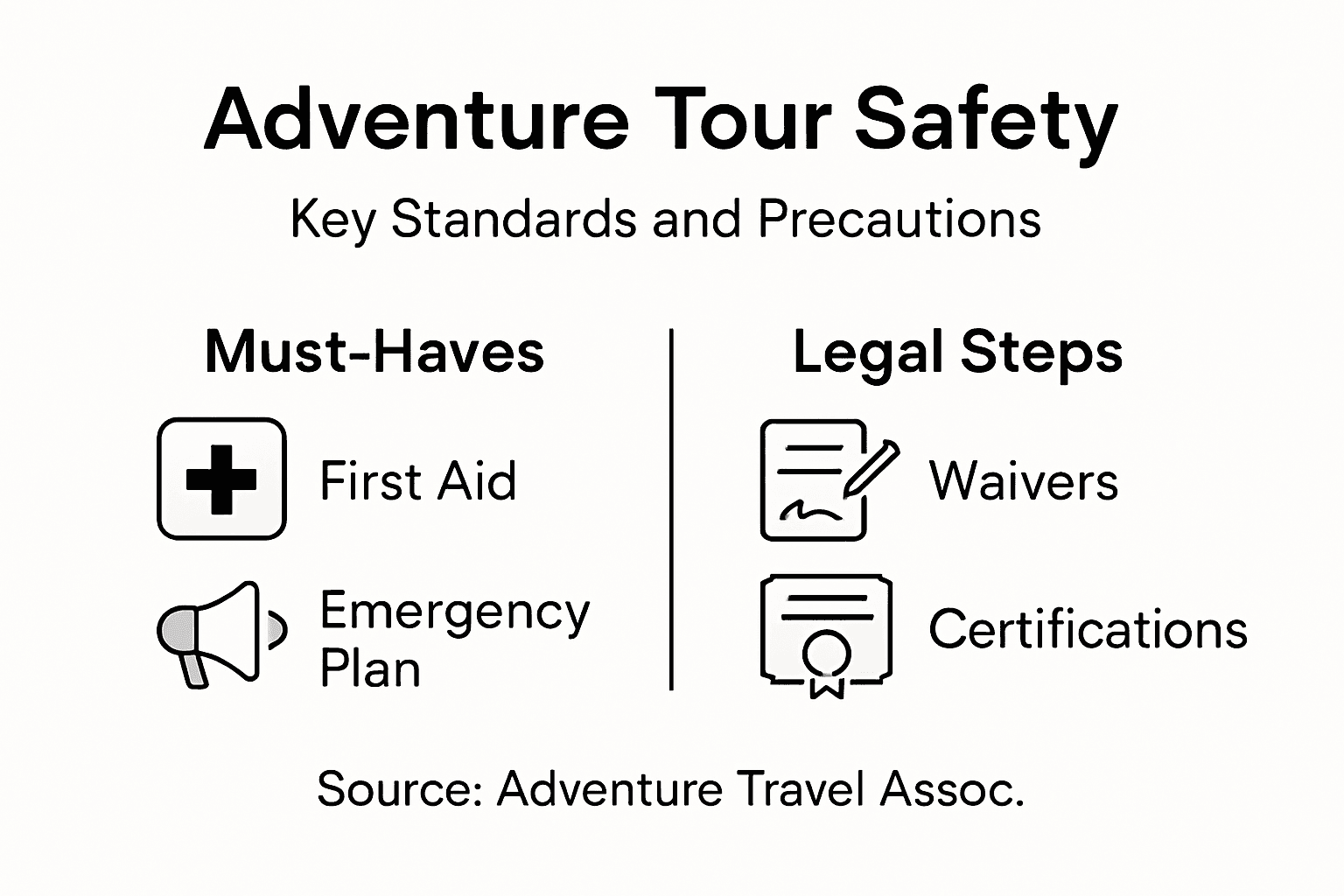
- Certified First Responders: Ensuring at least one guide per group holds a Wilderness First Responder (WFR) certification.
- Communication Redundancy: Maintaining multiple methods of communication, such as satellite communicators, VHF radios, and personal locator beacons (PLBs).
- Evacuation Planning: Establishing pre-approved extraction points and maintaining current contact lists for local Search and Rescue (SAR) services.
Frequently Asked Questions
How do I verify the safety credentials of an adventure tour provider?
Start by requesting their specific safety management documentation or evidence of ISO 21101 certification. Cross-reference their guide credentials with national or international governing bodies for the specific activity, such as the American Mountain Guides Association (AMGA) or local equivalents. Avoid providers who cannot clearly articulate their emergency evacuation procedures.
What should be included in a pre-activity safety briefing?
A professional briefing must cover the specific risks inherent to the terrain, a clear explanation of how to use safety equipment, a demonstration of emergency signals, and a direct inquiry into the participant's physical limitations or medical concerns. It should be an interactive session where the guide ensures every participant understands the safety instructions before commencing.
Are waivers legally binding in all jurisdictions?
Waivers of liability are common in adventure tourism, but their enforceability varies significantly by jurisdiction. In many regions, a waiver cannot absolve an operator of "gross negligence" or intentional harm. While they are essential for clarifying the assumption of risk, they do not replace the operator’s duty of care.
What equipment should a participant always verify before starting?
Always inspect personal protective equipment (PPE) such as harnesses, helmets, and life jackets for signs of fraying, cracking, or damage to buckles. Ensure that all equipment fits correctly according to the manufacturer’s instructions and that you are briefed on how to perform a "buddy check" with your fellow participants.
Implementing a Personal Safety Checklist
Before engaging in any adventure activity, use the following sequence to ensure you are adequately prepared:
- Verify Credentials: Confirm the guide or company is licensed and insured for the specific activity.
- Review the Policy: Read the fine print of your travel insurance to ensure the activity is not on an exclusion list.
- Disclose Honestly: Provide accurate information regarding your health, fitness level, and previous experience.
- Inspect Gear: Conduct a manual check of all PPE provided to you and ask for a replacement if you identify any signs of wear.
- Listen to the Briefing: Treat the safety briefing as the most important part of the trip; if the instructions are unclear, ask for clarification before starting.