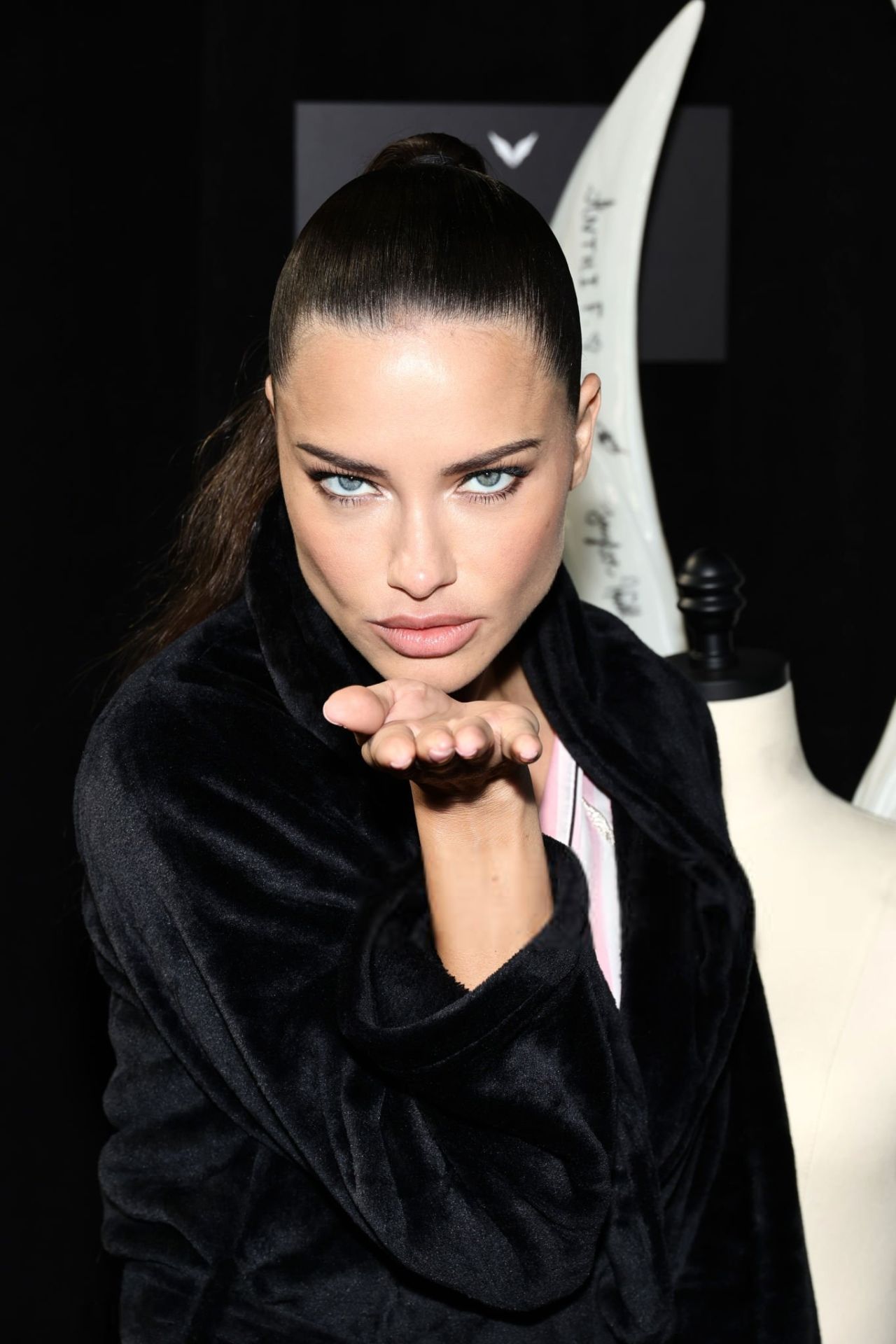
Adriana Lima’s runway career is defined by her record-breaking nineteen-year tenure as a Victoria’s Secret Angel and her rare ability to bridge the gap between commercial appeal and high-fashion editorialism. From her 1999 debut to her emotional 2018 retirement and subsequent returns, she established a legacy of longevity and technical mastery.
The Brazilian Genesis and Early Professional Trajectory
Adriana Lima’s ascent to the pinnacle of the fashion world began in Salvador, Bahia, Brazil. Discovered at a young age, her first major milestone occurred when she won Ford’s "Supermodel of Brazil" contest at age 15, subsequently placing second in the 1996 Ford "Supermodel of the World" competition. This early success facilitated her move to New York City, where her runway profile began to take shape within the competitive landscape of the late 1990s.
During her early years in New York, Lima was not immediately pigeonholed as a commercial model. She walked for esteemed designers such as Anna Sui, Cynthia Rowley, and Vera Wang. Her early runway style was characterized by a youthful, yet intense gaze that caught the attention of casting directors. This period was crucial for her technical development; she learned to adapt her gait to suit the varying requirements of "grunge" aesthetics and the burgeoning minimalism of the late 90s. By the time she signed her first major contracts, she had already established a reputation for professional discipline and a unique "look" that blended her Afro-Brazilian, Portuguese, and Swiss heritage.
The Victoria’s Secret Era: A Record-Breaking Legacy
While many models achieve fame through a variety of brands, Adriana Lima’s name is inextricably linked with Victoria’s Secret (VS). She made her debut on the VS runway in 1999 at the age of 18. Her presence was so immediate that she was contracted as an "Angel" in 2000, a title she would hold until 2018. This nineteen-show run is the longest in the company’s history, making her the undisputed matriarch of the brand.
Lima’s role at Victoria’s Secret was not merely as a participant but as a cornerstone of their marketing strategy. She was chosen to open the show five times (2003, 2007, 2008, 2010, and 2012). Opening a show is a technical and symbolic responsibility; the lead model sets the energy and tempo for the entire production. Lima’s ability to command the stage, often while wearing wings weighing over 20 pounds, solidified her status as a "pro’s pro" in the industry.
The Fantasy Bra Milestones
One of the most significant metrics of a model’s status within Victoria’s Secret is the selection to wear the "Fantasy Bra"—a multi-million dollar piece of wearable art. Lima is one of the few models to have worn the Fantasy Bra three times:
- 2008 Black Diamond Fantasy Miracle Bra: Valued at $5 million, featuring 3,575 black diamonds and 117 certified 1-carat round white diamonds.
- 2010 Bombshell Fantasy Bra: Valued at $2 million, designed by Damiani and featuring 3,000 brilliant-cut white diamonds and light blue sapphires.
- 2014 Dream Angels Fantasy Bra: Lima wore one of two "twin" bras alongside Alessandra Ambrosio. Each was valued at $2 million and featured 16,000 handset gems.
These milestones highlight her consistent marketability and the brand's immense trust in her as their primary representative.
Crossing into High Fashion: The High-End Runway Portfolio
A common critique of commercial models is their supposed inability to translate to the "high-fashion" runways of Paris and Milan. Adriana Lima effectively dismantled this stereotype. Throughout the 2000s and 2010s, she maintained a presence on the runways of the world’s most prestigious fashion houses.
Her collaboration with Riccardo Tisci during his tenure at Givenchy was a turning point. Tisci, known for his dark, romantic, and often gothic aesthetic, saw in Lima a face that could convey both intensity and elegance. She became a regular fixture in Givenchy shows, often appearing alongside high-fashion icons like Mariacarla Boscono.
Furthermore, Lima’s appearance in the Prada Fall/Winter 2010 show was a watershed moment for the industry. At a time when high fashion was dominated by extremely thin, often adolescent-looking models, Miuccia Prada’s decision to cast Lima—a woman known for her athletic, womanly physique—signaled a shift toward a more diverse representation of beauty on the runway. Other notable high-fashion runway appearances include:
- Christian Dior: Walking for John Galliano, where her theatrical flair was utilized to full effect.
- Valentino: Showcasing her ability to pivot to a more refined, classic European elegance.
- Alexander McQueen: Demonstrating her capacity for avant-garde presentation.
- Balmain: Under Olivier Rousteing, where she fit perfectly into the "Balmain Army" aesthetic of strong, empowered femininity.
Analysis of the Lima "Power Walk": Technical Precision
What separates a supermodel from a standard runway model is often their "walk"—the specific cadence, posture, and energy they bring to the catwalk. Adriana Lima’s walk is frequently analyzed by fashion historians and aspiring models alike. It is characterized by several technical elements:
- The Rhythmic Cadence: Unlike the "stomp" popular in the early 2000s, Lima utilized a rhythmic, flowing stride that matched the beat of the music with mathematical precision.
- The "Predatory" Gaze: Lima was famous for her intense eye contact with the camera at the end of the runway. She famously avoided smiling until she reached the "pit" (the area where photographers congregate), creating a dramatic reveal.
- Shoulder Stability: Despite the heavy, often unwieldy wings she wore for Victoria's Secret, her upper body remained remarkably stable, allowing the garments to be displayed without distraction.
- The Pivot: Her turns were sharp and economical, ensuring that she never lost her light or her connection with the audience.
This technical mastery allowed her to remain relevant for over two decades. In an industry that often discards models by their mid-20s, Lima was still headlining major shows well into her late 30s.
Critical Milestones and Industry Impact
To understand the scope of Lima's career, it is helpful to look at her milestones in a comparative context. As of 2026, her records for Victoria's Secret remain largely unchallenged.
| Year | Milestone | Context / Significance |
|---|---|---|
| 1999 | Victoria's Secret Debut | Entered the mainstream fashion consciousness at age 18. |
| 2000 | Named an "Angel" | Signed the contract that would define her career for 18 years. |
| 2003 | First Show Opening | Established as the "lead" of the VS brand. |
| 2008 | First Fantasy Bra | The Black Diamond Fantasy Bra solidified her as a top-tier earner. |
| 2010 | Prada F/W Show | Proved commercial models could dominate high-fashion runways. |
| 2012 | Opened VS Show (Post-Baby) | Walked only 8 weeks after giving birth, showing immense dedication. |
| 2014 | Twin Fantasy Bras | A historic moment shared with Alessandra Ambrosio. |
| 2018 | Final VS Runway | Retired with a standing ovation and the title of "Greatest Angel." |
| 2024 | Victoria’s Secret Return | Participated in the brand's reimagined fashion show era. |
The Second Act: Runway Returns and the 2020s Evolution
Following her emotional 2018 retirement, many assumed Adriana Lima’s runway days were over. However, the 2020s saw a strategic "second act." As the fashion industry moved toward a "legend" centric model—valuing the name recognition and technical skill of veteran models—Lima found herself back in high demand.
In 2023 and 2024, she made high-profile appearances that proved her "power walk" was as sharp as ever. Her return to the Victoria’s Secret Fashion Show in 2024 (the "reimagined" version of the event) was a major media event. It served as a bridge between the "Angel" era and the modern, more inclusive direction of the brand. By 2026, Lima has transitioned into a role that combines occasional high-stakes runway appearances with a mentorship position, often seen backstage guiding the next generation of Brazilian models on runway technique and brand longevity.
Her late-career runway work for designers like Schiaparelli and Alexander Wang further demonstrated her versatility. In these appearances, she moved away from the "Angel" persona toward a more "High Priestess of Fashion" aesthetic—darker, more mature, and focused on the architectural silhouette of the clothing.
Why was Adriana Lima’s 2018 retirement so significant?
Her 2018 retirement marked the end of an era because she was the last of the "original" super-Angels who had transitioned the brand from a catalog business to a global entertainment phenomenon. The standing ovation she received mid-walk was a rare break in the professional decorum of the runway, acknowledging her nineteen years of service and her role as a global ambassador for the brand.
How many times did Adriana Lima open the Victoria’s Secret Fashion Show?
Adriana Lima opened the Victoria's Secret Fashion Show five times (2003, 2007, 2008, 2010, and 2012). Opening the show is considered the highest honor for a model in that production, as it requires the most stamina and the ability to set the tone for the entire televised event.
Did Adriana Lima ever walk for high-fashion brands outside of Victoria’s Secret?
Yes, extensively. While she is most famous for her commercial work, she was a favorite of designers like Riccardo Tisci (Givenchy), Marc Jacobs, and Miuccia Prada. She walked in major fashion weeks in New York, Milan, and Paris for brands including Dior, Louis Vuitton, Valentino, and Balmain.
What is considered the most iconic "Lima moment" on the runway?
While subjective, many critics point to the 2010 Victoria's Secret opening. Coming off a year-long hiatus, she opened the show with a level of confidence and "theatrical fire" that many believe revitalized the brand's image during a period of economic transition. Others cite her 2018 final walk as her most iconic due to its emotional weight.
How has Adriana Lima influenced the current generation of runway models?
Lima pioneered the "commercial-couture" crossover. She taught a generation of models that being a "brand face" for a commercial giant like VS did not have to come at the expense of high-fashion credibility. Her emphasis on physical fitness and athletic preparation for the runway also set a standard that is now common practice among top-tier models.
Strategic Guidance for Studying Lima’s Runway Legacy
For those looking to analyze or emulate Adriana Lima’s success, the focus should not be on her physical attributes alone, but on her professional consistency and technical adaptability.
- Analyze the Footwork: Aspiring models should watch her 2003-2012 runway footage to observe her "weight shift." She never leaned too far back or forward, maintaining a center of gravity that allowed for effortless movement in heavy couture.
- Study the Camera Connection: Lima’s ability to find the "red light" (the active camera) is unparalleled. She treated the runway as a 360-degree stage, ensuring she was "on" for the live audience and the television viewers simultaneously.
- Longevity through Brand Loyalty: Her career is a masterclass in how to build a mutually beneficial relationship with a single brand while maintaining enough external prestige to work for others. She became synonymous with Victoria's Secret, which gave her a level of job security and "star power" that few freelance models ever achieve.
- The 2026 Perspective: In the current 2026 landscape, her career serves as a blueprint for the "Supermodel as an Institution." She proves that a model's value can increase with age if they master the technical aspects of the craft and maintain a strong, recognizable professional identity.