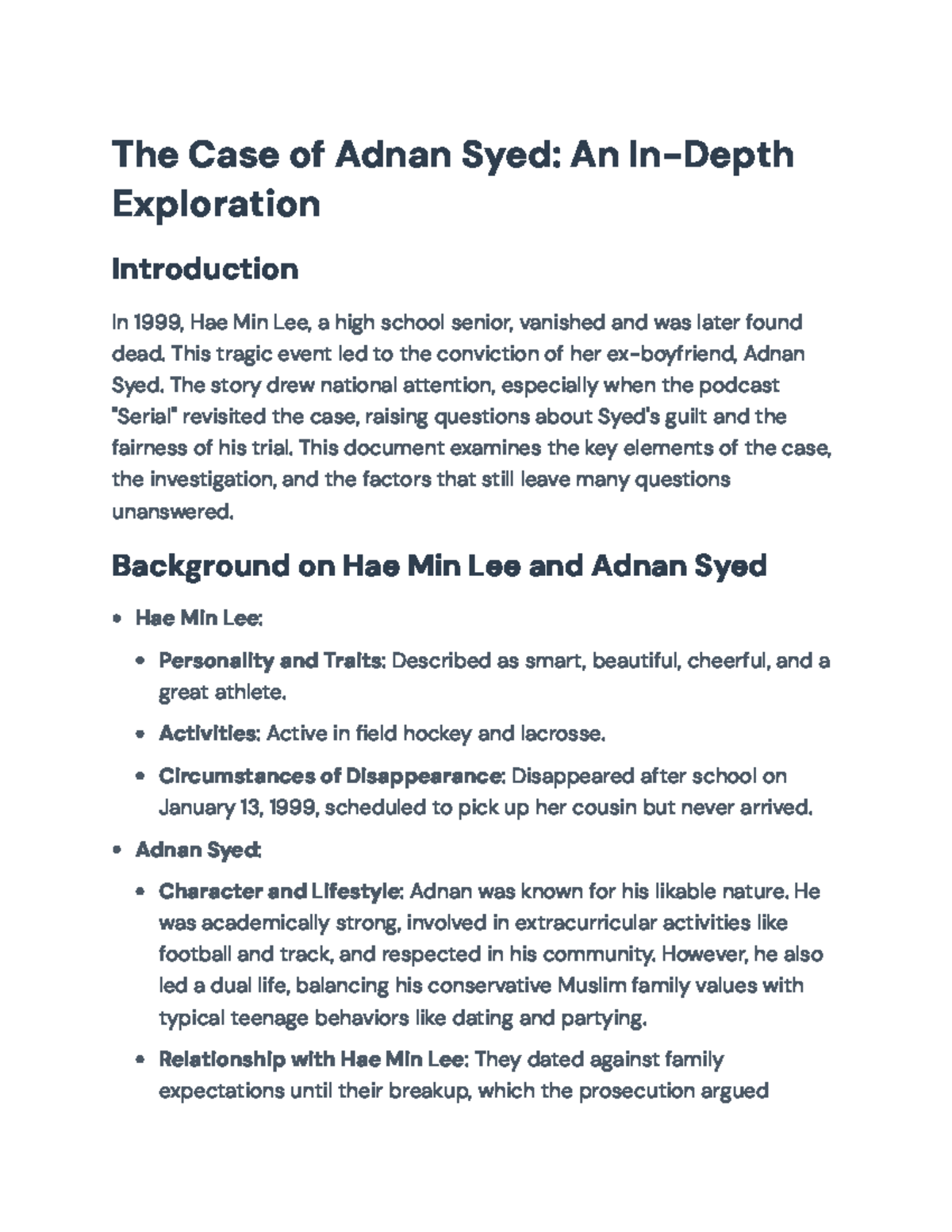
The Adnan Syed case represents one of the most scrutinized criminal proceedings in modern American history, centering on the 1999 murder of Hae Min Lee in Baltimore, Maryland. Following his conviction in 2000, Syed spent over two decades in prison before a series of legal challenges, fueled by new evidence and procedural scrutiny, led to the vacating of his conviction in 2022. The case provides a critical look at the intersection of prosecutorial discretion, DNA evidence standards, and appellate review.
The Foundation of the Case: 1999–2000
In early 1999, Hae Min Lee, a high school student in Baltimore County, disappeared, and her body was subsequently discovered in Leakin Park. The state’s case against Adnan Syed, who was Lee’s ex-boyfriend, relied heavily on the testimony of a single acquaintance, Jay Wilds, who claimed to have assisted Syed in disposing of the body. Throughout the initial trial in 2000, the prosecution presented a narrative of a "scorned lover" motivated by honor and jealousy.
The defense, led by attorney Cristina Gutierrez, attempted to challenge the timeline of the murder and the lack of physical evidence linking Syed to the scene. However, the jury found Syed guilty of first-degree murder, kidnapping, and robbery. He was sentenced to life in prison plus 30 years. At the time, the conviction appeared final, closing a chapter that had gripped the Baltimore community.
Procedural Scrutiny and Appellate Challenges
The legal battle for Syed did not end with his conviction. Over the next two decades, the case evolved through multiple tiers of the Maryland court system. The primary legal hurdle for the defense was the exhaustion of state remedies; Syed had to prove that his trial counsel was ineffective or that new, exculpatory evidence warranted a new trial.
A critical point in the legal progression occurred when appellate courts reviewed the performance of Cristina Gutierrez. The defense argued that her failure to interview a potential alibi witness, Asia McClain—who claimed she was with Syed at a library during the time of the murder—constituted ineffective assistance of counsel. While this argument faced significant resistance from the state, it served as a catalyst for deeper investigations into the integrity of the original trial. These proceedings underscored the complexity of post-conviction relief, where the bar for proving constitutional violations is exceptionally high.
The Role of DNA Evidence and Brady Violations
The most significant shift in the legal status of the case occurred in 2022. The Baltimore State’s Attorney’s Office, in collaboration with the defense, performed a thorough review of the original case files. Two major factors emerged that undermined the state’s original trial:
- Brady Violations: Prosecutors discovered that the state had failed to disclose information regarding two other potential suspects who were known to investigators at the time of the original trial. Under Brady v. Maryland, the prosecution is constitutionally required to turn over any exculpatory evidence to the defense. The failure to disclose these alternate suspects effectively denied Syed the right to a fair trial.
- DNA Testing: Recent forensic advancements allowed for modern DNA testing on items of evidence from the original investigation, including clothing items found with the victim. The tests did not yield a match for Syed, and in some instances, identified the DNA profiles of other individuals.
These revelations led the presiding judge to vacate Syed’s conviction in September 2022. The state eventually dropped all charges, asserting that the integrity of the original case could no longer be sustained under the current evidence.
Comparison of Key Legal Milestones
The trajectory of the case shifted dramatically based on evolving legal interpretations and forensic capabilities. The following table highlights the contrast between the initial prosecution and the eventual vacatur.
| Phase | Core Evidence Focus | Legal Status | Primary Outcome |
|---|---|---|---|
| 2000 Trial | Witness testimony, timeline | Convicted | Life imprisonment |
| 2016 Post-Conviction | Alibi witness availability | Remanded/Appealed | New trial granted, later reversed |
| 2022 Review | Brady disclosures, DNA | Vacated | Conviction overturned |
| 2023–2026 | Appellate finality | Dismissed | Charges dropped permanently |
Common Misconceptions Regarding the Verdict
Public perception of the Adnan Syed case is often influenced by media narratives, which can sometimes conflate the legal outcome with a definitive declaration of innocence. In the eyes of the law, the vacating of a conviction and the subsequent dismissal of charges mean that the state no longer has sufficient evidence to prove guilt beyond a reasonable doubt according to current procedural standards. It does not necessarily constitute a factual finding of innocence in the historical sense, but rather a recognition that the legal process leading to the original conviction was fundamentally flawed.
Observers often ask whether the emergence of new suspects implies Syed’s involvement is impossible. The legal system, however, operates on the standard of whether the state can overcome the presumption of innocence. When the state’s narrative is compromised by non-disclosure of evidence and inconclusive forensic testing, the legal remedy is the dismissal of the case, regardless of the ultimate truth of the events of 1999.
The Impact of Modern Forensic Standards
The Adnan Syed trial serves as a landmark case for the application of DNA evidence in cold cases. In the late 1990s, forensic testing was less refined than it is today, and many items were not processed with the level of sensitivity current laboratories maintain. The re-examination of this case highlighted a broader movement within the American judicial system to revisit "closed" cases where modern technology could provide clarity that was previously inaccessible.
This development has prompted many jurisdictions to review their own archival evidence procedures. The focus has moved toward ensuring that material evidence is preserved in a manner that allows for future testing, recognizing that judicial finality should not come at the cost of excluding potentially exculpatory scientific data.
Frequently Asked Questions
Did the DNA evidence prove Adnan Syed was innocent?
The DNA testing conducted in 2022 did not definitively prove innocence in the sense of providing an alibi for the exact time of the murder. Instead, it showed that Syed’s DNA was not present on the items tested, and the presence of other individuals' DNA cast significant doubt on the prosecution’s original theory of the crime, contributing to the decision to drop the charges.
What is a Brady violation and why did it impact this case?
A Brady violation occurs when the prosecution fails to disclose evidence that is favorable to the defendant. In this case, the state did not disclose that other individuals were identified as potential suspects who had motive and opportunity. This omission violated the defendant's constitutional right to a fair trial.
Why was the conviction vacated after 22 years?
The conviction was vacated due to a combination of newly discovered evidence regarding alternative suspects and the failure of the state to disclose that information to the defense team at the time of the original trial. The combination of these procedural errors rendered the original conviction legally unsustainable.
Is the case against Adnan Syed officially closed?
Yes. As of 2026, the charges against Adnan Syed have been formally dismissed, and the state has concluded its involvement in the prosecution. There is no active legal proceeding regarding this matter in the Maryland court system.
Can the state reopen the case in the future?
Under the principle of double jeopardy, an individual cannot be prosecuted again for the same offense once the charges have been dismissed and the case has reached finality. Therefore, the state cannot reopen the case against Syed for the murder of Hae Min Lee.
Next Steps for Understanding Case Legality
If you are researching this case for academic or professional purposes, it is recommended to review the official filings from the Circuit Court for Baltimore City. These documents contain the primary source material regarding the motions to vacate and the specific arguments presented by both the prosecution and the defense. Accessing the transcripts of the 2022 hearings provides the most accurate context for understanding how the legal system reconciles historical convictions with modern procedural requirements.