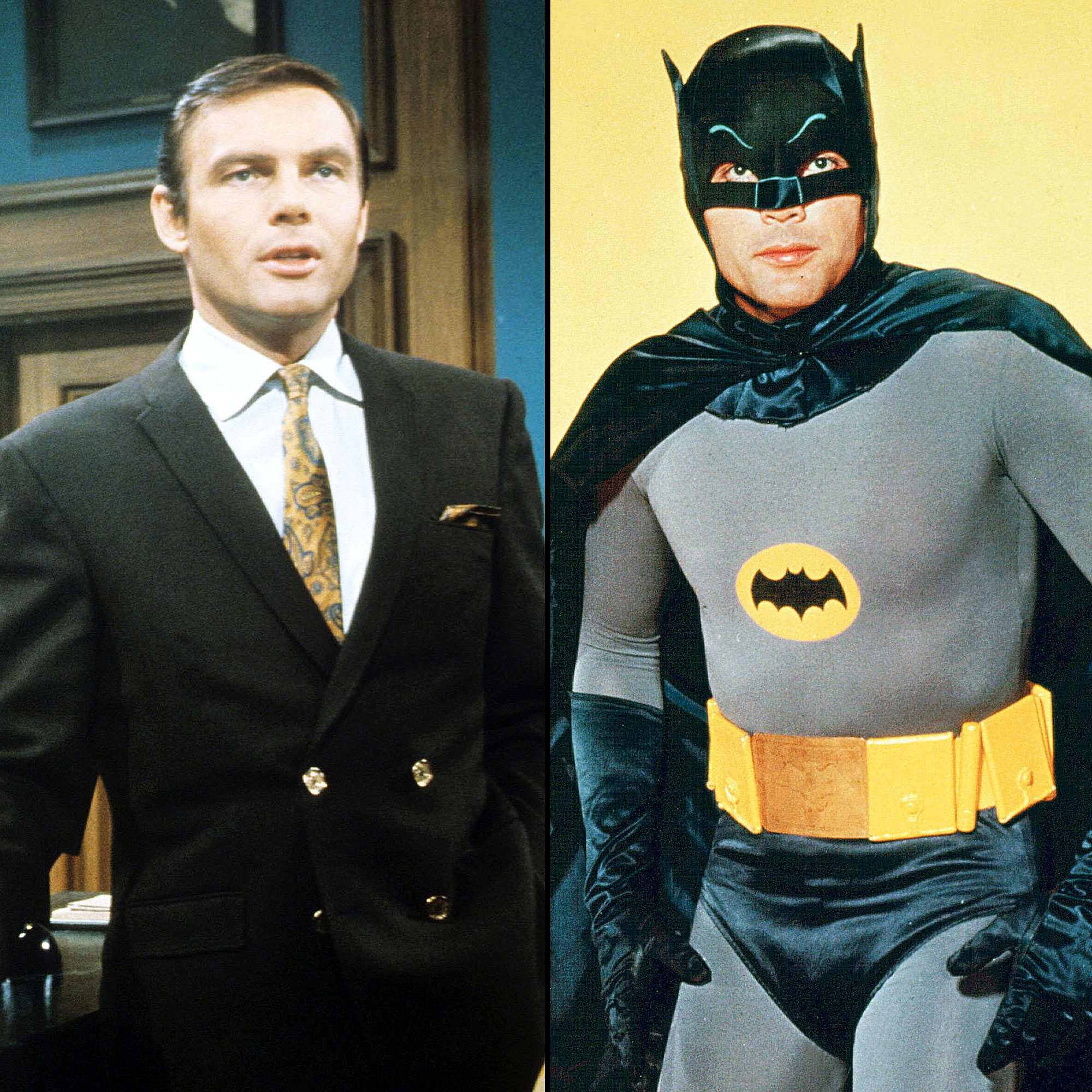
Adam West was an American actor who became a permanent fixture of pop culture through his deadpan, campy portrayal of Batman in the 1960s. Beyond the cowl, West successfully navigated decades of typecasting to reinvent himself as a beloved voice actor and meta-comedic icon, leaving an indelible mark on the superhero genre and television history.
From Walla Walla to the Batcave: The Early Years of William West Anderson
Born William West Anderson on September 19, 1928, in Walla Walla, Washington, the man who would become Adam West did not initially set out to be a superhero. His early life was rooted in the Pacific Northwest, where he developed a deep appreciation for literature and the arts at Whitman College. After a stint in the United States Army, where he worked as an announcer for the American Forces Network, West moved to Hawaii to pursue a career in television.
In Hawaii, he landed a role on a local variety program called The El Leon Show. It was during this period that he adopted the stage name "Adam West," a choice he later described as a practical move for a Hollywood-bound actor. His early film and television work in the late 1950s and early 1960s was characterized by steady, if not revolutionary, roles in Westerns and police procedurals, such as 77 Sunset Strip and The Detectives.
His big break came not from a dramatic audition, but from a Nestlé Quik commercial in which he played a James Bond-style character named Captain Q. This performance caught the attention of producer William Dozier, who was searching for an actor who could play a superhero with a straight face while surrounded by the absurd. Dozier saw in West the perfect blend of leading-man looks and a subversive, dry wit that would define the mid-century superhero aesthetic.
The 1966 Batman Phenomenon: A Masterclass in Camp
When Batman premiered on ABC in January 1966, it was a cultural earthquake. Unlike the gritty, psychologically tormented versions of the character that would dominate the late 20th and early 21st centuries, West’s Batman was a "Bright Knight." The show was a high-octane explosion of Pop Art, complete with "POW!" and "BAM!" on-screen graphics, Dutch angles, and a vibrant color palette that mirrored the comic books of the Silver Age.
The Mechanics of West’s Performance
The brilliance of Adam West’s performance lay in his absolute sincerity. While the scenarios were preposterous—ranging from fighting a rubber shark to competing in a surfing contest against the Joker—West played Bruce Wayne and Batman with a rigid, almost Puritanical sense of duty. This "deadpan" delivery was essential to the show's "camp" appeal; the humor came from the contrast between the high-stakes gravity of West’s performance and the low-stakes absurdity of the plot.
West understood that for the show to work for both children and adults, it had to be played straight. Children saw a hero who taught them about the importance of seatbelts and homework, while adults saw a biting satire of authority figures and the "establishment." This dual-layered appeal catapulted West to international superstardom, but it also created a professional gilded cage that would take him decades to escape.
The Impact on the Superhero Genre
The 1966 series was so influential that it actually dictated the direction of the Batman comic books for years. Characters like Batgirl were introduced or popularized to coincide with the show. However, the show’s eventual cancellation in 1968 after 120 episodes led to a "Batman fatigue" that saw the character’s popularity wane until the comic book industry moved toward darker interpretations in the late 1980s. For West, the end of the series marked the beginning of a challenging chapter in his career.
Navigating the "Batman Curse": The Wilderness Years
Following the cancellation of Batman, Adam West faced the classic Hollywood struggle of extreme typecasting. To the industry and the public, he was Batman. Producers were hesitant to cast him in serious dramatic roles because they feared the audience would only see the man in the grey tights. This period, often referred to by fans as West’s "wilderness years," saw him taking guest spots on shows like Fantasy Island, The Love Boat, and Maude.
Despite the professional frustrations, West remained remarkably resilient. He spent much of the 1970s and 80s making personal appearances at car shows, circuses, and comic conventions. While some actors might have become bitter about their association with a single role, West eventually learned to lean into it. He recognized that his portrayal of Batman had brought joy to millions, and he began to view his legacy with a sense of pride rather than resentment.
During this era, West also began to explore voice acting, a field that would eventually facilitate his career resurgence. He provided the voice for Batman in several animated series, including The New Adventures of Batman (1977) and Super Friends: The Legendary Super Powers Show (1984). These roles kept him connected to the DC Universe and ensured that his voice remained the definitive sound of the character for a generation of children.
The Voice Acting Renaissance: From Icon to Meta-Parody
The late 1990s and early 2000s marked a dramatic shift in Adam West’s career trajectory. Instead of fighting his association with camp and kitsch, he embraced it through self-parody. This transition began with guest appearances on shows like The Simpsons and Johnny Bravo, where he played exaggerated, eccentric versions of himself.
The Mayor Adam West Era
The most significant turning point of his later career was his casting in Seth MacFarlane’s animated sitcom Family Guy. Starting in 2000, West voiced "Mayor Adam West," a fictionalized, hallucinatory version of himself who governed the town of Quahog. The character was brilliant precisely because it leveraged West's signature authoritative voice to deliver nonsensical, bizarre dialogue.
This role introduced West to a completely new demographic—Millennials and Gen Z—who may have never seen a single episode of the 1966 Batman series. By playing a version of himself that was untethered from reality, West reclaimed his narrative. He was no longer just "the guy who played Batman"; he was a comedic powerhouse capable of sophisticated, meta-textual humor. He continued this role until his death in 2017, with the show eventually retiring the character as a mark of respect.
Comparing the Key Eras of Adam West’s Career
As of 2026, historians and media critics view West’s career as a trilogy of distinct phases. The following table highlights the evolution of his public persona and professional output.
| Career Phase | Primary Focus | Notable Works | Cultural Impact |
|---|---|---|---|
| The Leading Man (1954–1965) | Dramatic and Western roles | 77 Sunset Strip, Robinson Crusoe on Mars | Established him as a versatile, reliable Hollywood actor. |
| The Bright Knight (1966–1968) | High-concept superhero camp | Batman (TV Series & Movie) | Defined the superhero aesthetic for the 1960s; created a global icon. |
| The Icon in Exile (1969–1989) | Guest appearances & voice work | Super Friends, The Love Boat | Maintained the Batman legacy while struggling with typecasting. |
| The Meta-Icon (1990–2017) | Self-parody and animation | Family Guy, The Simpsons | Rebranded as a comedic genius; achieved multi-generational appeal. |
Cultural Impact and Posthumous Recognition in 2026
Nearly a decade after his passing in June 2017, Adam West’s influence remains a cornerstone of the entertainment industry. He is often credited with saving the Batman franchise during a period when the comic books were facing declining sales. By bringing the character into the mainstream consciousness, he ensured that the Dark Knight remained a viable commercial entity for future filmmakers like Tim Burton and Christopher Nolan to eventually reimagine.
In 2026, West is remembered not just for the character he played, but for the grace with which he handled fame. He was a regular fixture at fan conventions until the very end of his life, always ready with a witty remark or a classic "Bato-signal" gesture. His star on the Hollywood Walk of Fame (awarded in 2012) remains a popular pilgrimage site for fans of all ages.
Furthermore, the "Westian" style of delivery—the perfectly timed pause and the overly dramatic emphasis on mundane words—has influenced a generation of voice actors and comedians. Shows like The Venture Bros. and The Tick owe a significant debt to the groundwork West laid in the 1960s. He proved that superheroes could be funny without losing their heroism, a lesson that modern cinematic universes continue to grapple with.
FAQ: Understanding the Man Behind the Mask
What caused the death of Adam West?
Adam West passed away on June 9, 2017, at the age of 88, following a short but brave battle with leukemia. He died peacefully in Los Angeles, surrounded by his family. His death triggered a massive outpouring of grief from the entertainment community, with the city of Los Angeles famously shining a "Bat-Signal" onto City Hall in his honor.
Did Adam West ever regret playing Batman?
While he initially struggled with the typecasting that followed the show, West eventually grew to embrace the role completely. In his autobiography, Back to the Batcave, he expressed deep gratitude for the fans and the opportunities the character provided. He often stated that if he had the choice to do it all over again, he wouldn't change a thing.
Was Adam West the first actor to play Batman?
No, but he was the first to play him in a full-color television series. Lewis Wilson played Batman in the 1943 film serial, and Robert Lowery took over the role in the 1949 serial Batman and Robin. However, West is widely considered the first actor to make the character a household name and a global superstar.
How much was Adam West’s net worth at the time of his death?
At the time of his passing in 2017, Adam West had an estimated net worth of approximately $30 million. This wealth was accumulated through his decades of television work, lucrative voice-acting roles, personal appearances, and smart management of his likeness and brand.
Did Adam West do his own stunts in the 1966 series?
While West was physically active and performed many of the fight sequences himself, the more dangerous stunts (such as high-altitude climbing or complex acrobatics) were handled by his stunt double, Hubie Kerns. West and Burt Ward (Robin) were known for doing a significant amount of their own "stage fighting," which contributed to the authentic feel of the show's choreographed brawls.
Continuing the Legacy: How to Explore West’s Work Today
For those looking to experience the magic of Adam West in 2026, the best starting point remains the remastered 1966 Batman series, which is available on most major digital platforms and high-definition physical media. Watching the series with an understanding of its satirical intent reveals a depth of performance that is often missed on a first glance.
Beyond the cape, fans should seek out his voice work in Family Guy (seasons 2 through 15) to see the evolution of his comedic timing. For a deeper dive into his personal life, his autobiography provides a candid and often humorous look at the highs and lows of a life spent in the spotlight. Adam West remains a testament to the power of reinvention and the enduring appeal of a hero who isn't afraid to have a little fun.