Adam Scott is an elite Australian professional golfer, most famous for becoming the first Australian to win the Masters Tournament in 2013. With 14 PGA Tour titles and over 30 professional wins globally, he is widely regarded as possessing one of the most technically proficient swings in golf history.
The Foundations of an Australian Icon
Adam Scott’s journey to the pinnacle of professional golf began in Adelaide, South Australia, before his family relocated to the Sunshine Coast. Born into a golfing family—his father, Phil Scott, was a professional golfer and club manufacturer—Adam was immersed in the mechanics of the game from an early age. This early exposure provided him with a sophisticated understanding of equipment and technique that many of his peers would not develop until much later in their careers.
As an amateur, Scott’s talent was immediately evident. He was a member of the Golf Australia National Squad and moved to the United States to play collegiate golf at the University of Nevada, Las Vegas (UNLV). During his time as a Rebel, he honed his skills against top-tier collegiate competition, eventually deciding to turn professional in 2000. Unlike many young pros who struggle through the lower-tier circuits, Scott made an almost immediate impact on the European Tour (now the DP World Tour), securing his first professional win at the 2001 Alfred Dunhill Championship in South Africa.
His early career was characterized by a rapid ascent through the Official World Golf Ranking, fueled by a partnership with legendary coach Butch Harmon. Harmon, who had famously worked with Tiger Woods, helped Scott refine a swing that many analysts began to call "the blueprint." By the time he reached his mid-twenties, Scott had already established himself as a perennial threat in international competition, possessing a rare combination of power off the tee and surgical precision with his iron play.
Anatomizing the "Perfect" Golf Swing
To understand Adam Scott’s career overview, one must analyze the technical consistency of his ball-striking. For over two decades, Scott has been the standard-bearer for traditional swing aesthetics. His motion is defined by a wide, stable base, a perfectly on-plane takeaway, and a balanced finish that remains unchanged regardless of the pressure.
The "Scott Swing" is often used by instructors as a visual aid for students. The primary reason for its effectiveness is the synchronization between his upper body rotation and his arm swing. This timing allows him to maintain high clubhead speeds without sacrificing control. In an era where many players have moved toward "power-first" mechanics that put significant strain on the lower back, Scott’s fluid, rhythmic approach has contributed to his remarkable longevity. As of 2026, he remains one of the few players from his generation who has stayed consistently competitive against much younger, "bomb-and-gouge" style hitters.
However, Scott’s career has not been without technical challenges. While his long game has rarely faltered, his putting has been the subject of intense scrutiny and evolution. For several years, he utilized a long "broomstick" putter anchored to his chest, a method that helped him stabilize his stroke and led to his greatest successes. When the USGA and R&A implemented the anchoring ban in 2016, Scott was forced to reinvent his short game, showcasing his adaptability by transitioning between various putting grips and styles to remain a world-class performer.
The 2013 Masters: A Historic Triumph for Australia
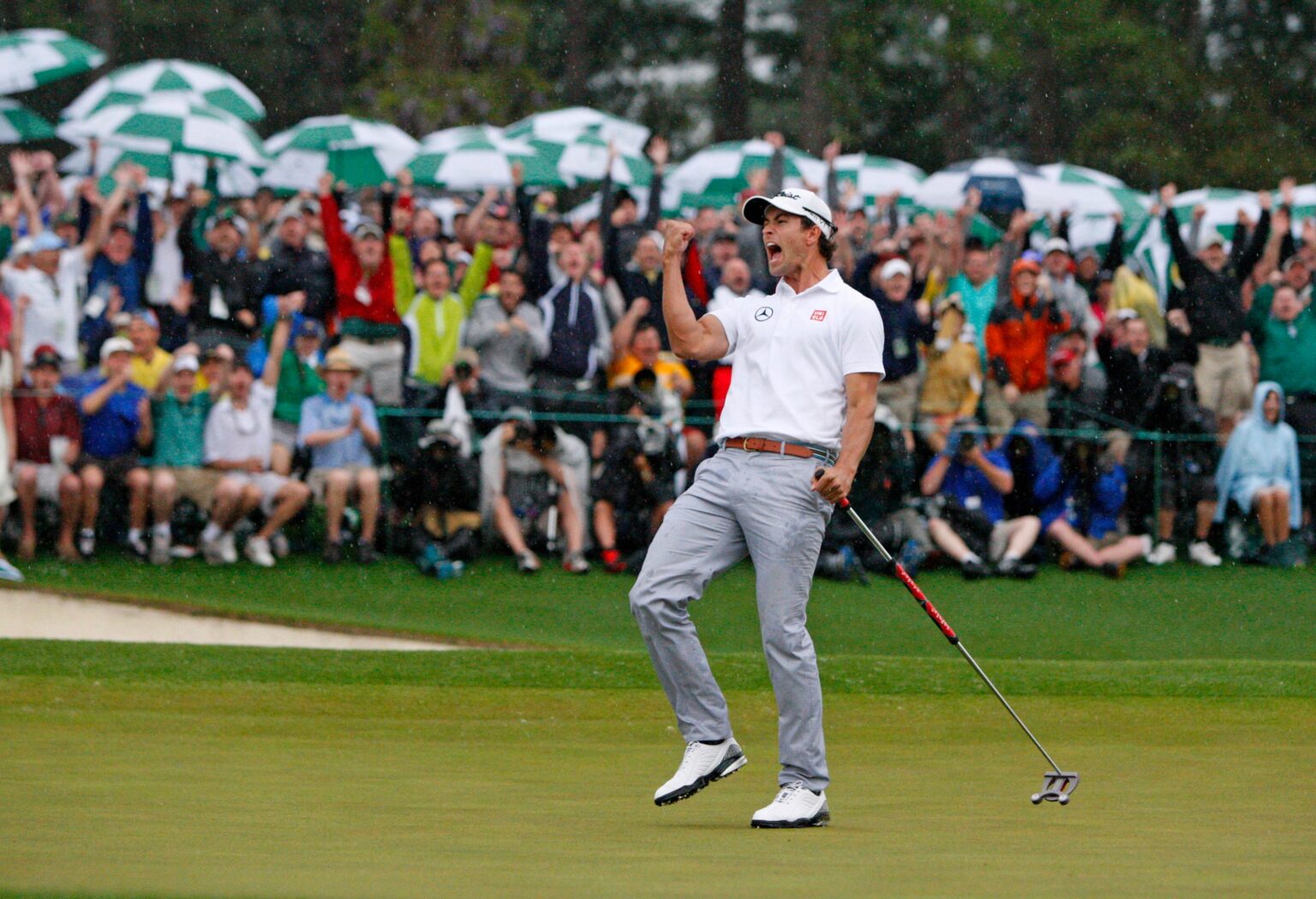
The defining moment of Adam Scott’s professional profile occurred in April 2013 at Augusta National Golf Club. Entering the tournament, no Australian had ever donned the Green Jacket, despite many close calls from legends like Greg Norman. Scott’s victory was not just a personal milestone; it was a moment of national redemption for Australian golf.
The final round of the 2013 Masters was a masterclass in psychological resilience. Scott faced a grueling duel with Angel Cabrera in rainy conditions. On the 72nd hole, Scott drained a 20-foot birdie putt, famously shouting "C'mon Aussie!" as the ball disappeared into the cup. While Cabrera matched him to force a playoff, Scott eventually secured the victory on the second playoff hole (the par-4 10th) with a 12-foot birdie putt in the fading twilight.
This victory was particularly significant because it came less than a year after his heartbreaking collapse at the 2012 Open Championship at Royal Lytham & St. Annes, where he bogeyed the final four holes to lose by one stroke to Ernie Els. The ability to rebound from such a public and painful defeat to win the very next year at Augusta solidified Scott's reputation as one of the mentally toughest players of his era.
Evolution of Performance: Putter Transitions and Equipment
Throughout his career, Adam Scott has been a loyal brand ambassador for Titleist, utilizing their equipment to maintain his high standards of performance. His gear selection reflects a player who values both traditional feel and modern technological advantages.
| Category | Typical Equipment Specification | Significance |
|---|---|---|
| Driver | Titleist TSR series (various lofts) | Focuses on high-launch, low-spin stability for distance. |
| Irons | Titleist 620 MB (Muscle Back) | Traditional blades that allow for maximum shot-shaping and feedback. |
| Putter Style | Long Putter (Unanchored) / L.A.B. Golf | Transitioned to "Link.1" or "Mezz.1" models to improve stability. |
| Golf Ball | Titleist Pro V1 | Provides the specific compression needed for his high swing speeds. |
| Footwear | FootJoy | Maintains a classic look consistent with his professional image. |
The transition from the anchored putting stroke to his current method is perhaps the most documented equipment shift in modern golf. Scott has experimented with the "Arm Lock" method and various counterbalance putters, eventually finding success with the L.A.B. Golf "Directed Force" technology. This willingness to experiment with "non-traditional" equipment—despite his "traditional" swing—highlights a pragmatic approach to the game: he uses whatever technology maximizes his statistical output on the greens.
Strategic Leadership and the PGA Tour Policy Board
As his career progressed into the 2020s, Scott took on a more significant role in the governance of professional golf. During a period of unprecedented upheaval in the sport, Scott was elected as a Player Director on the PGA Tour Policy Board. This role placed him at the center of negotiations involving the tour's structure, the rise of LIV Golf, and the formation of PGA Tour Enterprises.
In 2026, Scott’s influence is viewed as a stabilizing force. He has been a vocal advocate for the "Signature Events" model, which aims to bring the world’s best players together more frequently, while also ensuring that the tour remains a meritocracy with pathways for up-and-coming talent. His veteran perspective has been vital in balancing the commercial interests of the tour with the traditional values of the game.
His leadership extends beyond the boardroom. On the course, he has become a mentor to a new generation of Australian golfers, including Min Woo Lee and Cam Davis. His longevity—marked by a career that has spanned the peak of the Tiger Woods era through the modern "distance revolution"—makes him a unique bridge between different eras of professional golf.
Comprehensive Career Milestones
While the Masters remains his crowning achievement, Scott’s resume is filled with victories that would define a hall-of-fame career on their own. He won the 2004 Players Championship at TPC Sawgrass, becoming the youngest winner of the event at the time. This victory is often cited as the "Fifth Major," and winning it against a peak-performance field served as the definitive proof that Scott belonged among the elite.
His consistency is further evidenced by his performance in the World Golf Championships (WGC). Scott won the 2011 WGC-Bridgestone Invitational and the 2016 WGC-Cadillac Championship. These wins, coming five years apart, demonstrate his ability to maintain a high ceiling of performance across different phases of his life. Furthermore, his stint as World No. 1 in 2014, although lasting only 11 weeks, was a mathematical reflection of several years of sustained excellence.
Major Championship Performance Summary
- Masters Tournament: Winner (2013)
- The Open Championship: 2nd (2012), T3 (2013)
- U.S. Open: T4 (2015)
- PGA Championship: T3 (2006, 2018)
Key Questions About Adam Scott's Career
Why did Adam Scott switch to the long putter?
Scott transitioned to the long putter in 2011 after a period of struggling with short-range consistency. He sought a method that would reduce the influence of his hands and wrists in the stroke. The change was almost immediately successful, leading to a runner-up finish at the 2011 Masters and his eventual victory in 2013. Even after the anchoring ban in 2016, he continued using a long putter, albeit held away from his body, to maintain a similar pendulum-like feel.
Has Adam Scott ever won on the DP World Tour?
Yes, Scott has 11 victories on the DP World Tour (formerly the European Tour). His wins span across the globe, including titles in South Africa, China, Singapore, and Qatar. This international success earned him a reputation as a "global player," willing to travel and compete outside the United States to grow the game and test his skills in varying conditions.
What is the Adam Scott Foundation?
The Adam Scott Foundation is a charitable organization established by the golfer to provide opportunities for children and young people. The foundation focuses on education and healthcare, specifically in Australia and Asia. Scott has often used his professional platform to raise funds and awareness for youth-based initiatives, emphasizing the importance of giving back to the community that supported his rise.
Who is Adam Scott’s current caddie?
Throughout his career, Scott has worked with several high-profile caddies, most notably Steve Williams (formerly Tiger Woods’ caddie) during his 2013 Masters win. In recent years, he has reunited with Steve Williams on a part-time basis while also working with other veteran loopers. His choice of caddies usually reflects a preference for experienced professionals who understand the nuances of major championship pressure.
How many times has Adam Scott played in the Presidents Cup?
As of 2026, Adam Scott holds the record for the most appearances for the International Team in the Presidents Cup. He has been a cornerstone of the team since his debut in 2003. While the International Team has struggled to defeat the United States during his tenure, Scott has been the emotional and competitive leader for the squad, often pairing with younger players to help them acclimate to the unique pressure of match play.
Future Outlook and Legacy
As Adam Scott enters the twilight of his competitive career, his focus has shifted toward two primary goals: securing a second major championship and ensuring the long-term health of the PGA Tour. His physical fitness remains impeccable, allowing him to maintain a swing speed that rivals players ten years his junior. This "ageless" quality suggests that Scott will remain a factor in major championships for years to come.
Ultimately, Adam Scott’s legacy will be defined by more than just his 2013 Masters victory. He will be remembered as a player who handled both triumph and heartbreak with equal grace, a technical purist who kept the "classic" swing alive in a power-driven era, and a statesman who stepped up to lead his sport during a time of crisis. For fans and aspiring professionals, his career serves as a masterclass in longevity, adaptability, and professional conduct.