Building a successful actor film career requires a strategic combination of professional craft training, high-quality marketing materials, and an aggressive pursuit of industry representation. In 2026, the path to success centers on mastering self-tape technology, maintaining a robust digital presence on casting databases, and understanding the nuances of union eligibility through SAG-AFTRA to ensure long-term financial and professional protection.
The Foundational Pillars of Professional Acting
A film career is rarely built on "luck" or "discovery" in the modern era. Instead, it is a professional enterprise that begins with rigorous training. While some actors find success through natural charisma, the longevity of a career is usually tied to a mastery of specific techniques. In 2026, the industry distinguishes clearly between "stage" and "screen" techniques.
Acting for the camera requires an understanding of intimacy and subtlety that differs significantly from theatrical performance. Actors must learn to manage their energy within a "close-up" versus a "wide shot" and understand the technical constraints of a film set, such as hitting marks without looking down and maintaining continuity across multiple takes. Training often involves studying specific methods, such as Meisner, which emphasizes truthful spontaneity, or the Chubbuck Technique, which focuses on objective-based acting.
Beyond the craft, the foundation of an actor's career involves "business of the business" education. This includes understanding how to read a call sheet, the hierarchy of a film crew (from the Director to the Key Grip), and the legalities of standard talent contracts. Aspiring actors often spend the first 12 to 24 months of their career in "on-camera" classes specifically designed to bridge the gap between emotional performance and technical execution.
Essential Marketing Assets for the Modern Actor
In the digital-first environment of 2026, your marketing materials act as your 24/7 sales team. Casting directors (CDs) process thousands of submissions for a single role, meaning your assets must meet professional standards instantly to avoid being filtered out.
Professional Headshots
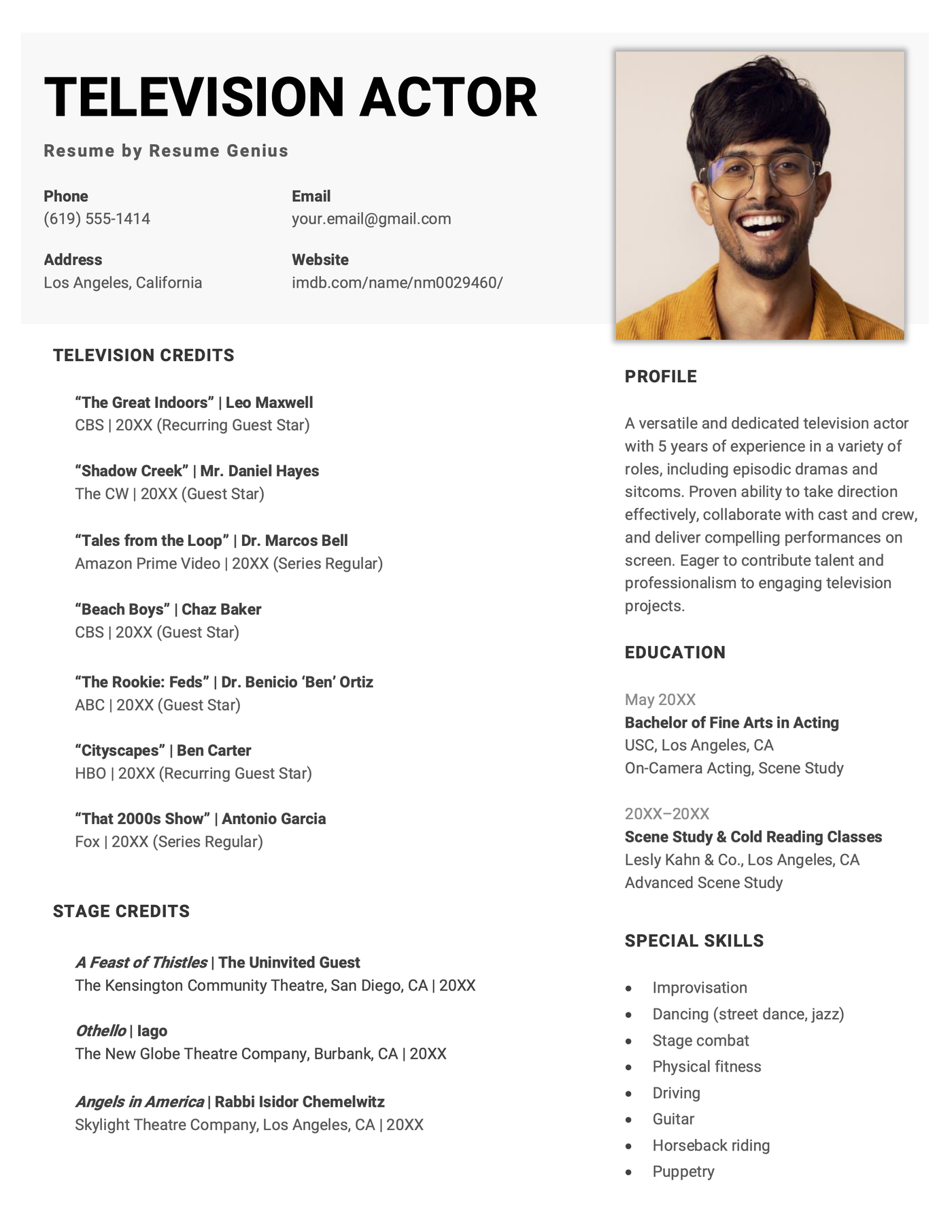
The headshot remains the most important tool in an actor's arsenal. Unlike the stylized portraits of the past, contemporary headshots must look exactly like the actor on a "good hair day." Industry standards currently demand high-resolution, color photos that highlight specific "looks" or archetypes, such as the "young professional," the "blue-collar worker," or the "edgy antagonist."
The Demo Reel and "Clips"
A demo reel is a 60-to-90-second compilation of an actor's best on-screen work. However, the 2026 trend has shifted toward "vertical clips"—short, 15-to-30-second segments of a single scene. These allows casting directors to quickly verify an actor’s ability to handle specific genres or dialects. If an actor does not have professional footage from a film set, "high-production value" self-tapes or professionally shot "speed reels" are acceptable alternatives to demonstrate proficiency.
Casting Profiles and IMDb
Maintaining an active presence on industry-standard databases is non-negotiable.
- Actors Access: The primary portal for theatrical (film and TV) breakdowns in North America.
- Casting Networks: Primarily used for commercial casting but increasingly relevant for television.
- IMDbPro: The professional version of the Internet Movie Database. It serves as the industry’s resume, documenting credits, representation, and "StarMeter" rankings which reflect industry interest.
Navigating the Casting Process and Self-Taping
The traditional "in-room" audition has largely been replaced by the self-tape. Mastering this process is a technical requirement for any actor film career in 2026. An actor is now expected to own—or have constant access to—a home studio setup consisting of a neutral backdrop (usually "audition blue" or grey), a ring light or three-point lighting system, and a high-quality directional microphone.
The self-tape process involves more than just acting; it requires the actor to act as their own cinematographer and editor. Submissions must be framed correctly (usually a medium close-up), labeled according to specific instructions (e.g., "Name_Role_Agency"), and delivered via secure links like Vimeo or specialized casting platforms.
Once a self-tape impresses a casting director, the actor may move to a "Callback" or a "Chemistry Read," which are increasingly held via live video conferencing software like Zoom. During these sessions, the ability to take "adjustments"—on-the-spot changes to the performance requested by the director—is the primary metric for whether an actor is "bookable."
Professional Representation: Agents and Managers
While an actor can find "unrepresented" work through open casting calls, a sustainable film career generally requires professional representation. Agents and managers serve distinct but overlapping roles in an actor’s trajectory.
| Feature | Talent Agent | Talent Manager |
|---|---|---|
| Primary Focus | Procurement of employment and contract negotiation. | Long-term career strategy, branding, and personal guidance. |
| Legal Authority | Licensed by the state to solicit work; can legally sign contracts for clients. | Not licensed to solicit work in many jurisdictions; focuses on "managing" the artist. |
| Commission | Strictly capped (usually 10% for union work). | Generally higher (15% to 20%). |
| Client Volume | Typically handles a large roster of actors. | Handles a smaller, more curated "boutique" roster. |
| Communication | Transactional; focused on auditions and bookings. | Frequent; focuses on headshot choices, class selection, and PR. |
Finding representation involves "submission cycles" where actors send their headshots, reels, and resumes to agencies. In 2026, most reputable agencies do not accept "blind" email attachments; they prefer submissions through their website portals or, ideally, via a referral from a respected casting director or a current client.
The Role of Unions: SAG-AFTRA in 2026
Joining the Screen Actors Guild-American Federation of Television and Radio Artists (SAG-AFTRA) is a major milestone in an actor's film career. The union provides essential protections, including minimum pay scales (the "Scale"), health and pension benefits, and strictly regulated working conditions regarding hours, safety, and meal breaks.
Post-2023 industry shifts have made union membership even more critical, particularly regarding the use of Artificial Intelligence and digital likenesses. SAG-AFTRA contracts now include specific language requiring "informed consent" and compensation if an actor's image or voice is used to train AI models or create digital "synthespians."
To join the union, an actor must usually become "SAG-Eligible" (SAG-E). This is typically achieved through the "Taft-Hartley" process, where a producer hires a non-union actor for a union role because they possess a specific skill or look that cannot be found within the union. Alternatively, an actor can gain eligibility by working three days as a "Union Background" performer on a SAG-AFTRA production.
Financial Realities and Career Progression
The financial trajectory of an actor film career is notoriously non-linear. Most actors maintain "survival jobs"—flexible employment that allows them to leave for auditions or filming on short notice. In 2026, many actors have transitioned to "remote-flexible" roles in tech, writing, or digital marketing to support their creative pursuits.
Career progression generally follows a standard hierarchy:
- Background/Extra: Non-speaking roles used to fill out the world of the film.
- Featured Background: Non-speaking but prominent on camera.
- Under-5/Day Player: Roles with fewer than five lines, typically working for one or two days.
- Supporting Role: Character-driven roles that support the lead protagonists.
- Lead/Series Regular: The primary focus of the production, involving significant screen time and contract negotiations.
Actors must also manage their careers as a business entity. This involves tracking "deductible" expenses such as headshots, classes, union dues, and travel. Many professional actors eventually form an S-Corp or LLC to manage their income and take advantage of tax benefits related to the "qualified performing artist" status.
Do I need to live in Los Angeles or New York to have a film career?
While LA and NYC remain the primary hubs, "production centers" like Atlanta, Vancouver, London, and Albuquerque have become significant markets. In 2026, many actors begin their careers in these regional hubs to build credits before moving to the "major leagues" of Los Angeles. The rise of self-taping has made it possible to audition for major roles from anywhere, though you must usually be willing to "work as a local" (provide your own housing and travel) in the production city.
How do I know if an acting "school" or "agent" is a scam?
A reputable talent agent never charges an upfront fee to "sign" you or requires you to use a specific photographer. They earn money only when you do (via commission). Similarly, while acting classes cost money, they should offer audited sessions or clear syllabus details. Any "talent search" that requires a large payment for "modeling packages" or "guaranteed placement" is a red flag.
What is a "Taft-Hartley," and how does it affect my career?
A Taft-Hartley is the legal filing that allows a non-union actor to work on a union set. Once you are Taft-Hartleyed, you become "SAG-Eligible." You can work one union job as a non-member, but for your second union job, you are generally required to join the union and pay the initiation fee (which in 2026 is approximately $3,000, depending on the local jurisdiction).
How important is social media for a film actor in 2026?
Social media is a secondary but valuable tool. While "follower counts" rarely determine casting for serious dramatic roles, a professional Instagram or TikTok presence can showcase your personality, "type," and special skills (like horse riding or martial arts). It serves as a supplementary portfolio that casting directors might check to see your "vibe" and professional conduct.
Can I start an acting career later in life?
Yes. The film industry requires actors of all ages to fill realistic worlds. "Mature" actors (ages 40+) often face less competition than the 18–25 demographic and can find consistent work in commercial and "procedural" television. The key is to lean into your current "type" rather than trying to look younger.
Strategic Next Actions for Aspiring Actors
To advance an actor film career in 2026, individuals should first audit their current materials. If you do not have a professional-grade self-tape setup, that should be your primary investment. Second, enroll in a reputable "Acting for the Camera" class to ensure your technique is calibrated for the screen. Finally, focus on "micro-credits"—short films, student films, and independent projects—to build the footage necessary for a demo reel. These smaller sets provide the essential "on-set" experience required to handle the pressure of larger, union-regulated productions. Consistent daily effort in craft and networking is the only reliable path to a sustainable career in the film industry.