Action Park, the notorious amusement park that operated in Vernon, New Jersey, from 1978 to 1996, is remembered as the most dangerous theme park in history. With at least six confirmed deaths and thousands of documented injuries, its legacy serves as a foundational case study in the critical importance of rigorous engineering, proactive regulation, and disciplined safety management in the amusement industry.
The Historical Context of Action Park’s Safety Record
To understand the safety failures of Action Park, one must examine the environment in which it was conceived. Founded by Eugene Mulvihill and his company, Great American Recreation (GAR), the park was built on a philosophy of "user-controlled" thrills. Unlike modern parks where safety is automated and passive, Action Park required guests to control their own speed, direction, and safety. In the regulatory vacuum of the late 1970s and early 1980s, this approach led to a catastrophic series of accidents.
As of 2026, Action Park remains a cautionary tale used by risk managers and safety engineers. The park was divided into three main areas: the Motor World, the Alpine Center, and the Waterworld. Each area presented unique hazards, often exacerbated by the fact that many rides were designed in-house by individuals without formal engineering backgrounds in amusement ride physics. This lack of professional oversight, combined with a workforce composed primarily of under-trained teenagers, created a "perfect storm" for liability and physical harm.
The park's reputation was so pervasive that it earned nicknames like "Traction Park," "Accident Park," and "Class Action Park." Despite the humor often found in retrospective documentaries, the human cost was significant. The injuries ranged from "Alpine Slide" abrasions—colloquially known as "road rash"—to complex fractures, near-drownings, and ultimately, fatalities.
Verified Fatalities: A Timeline of Tragically Avoidable Incidents
Between 1980 and 1987, six deaths were officially linked to the park’s operations. These incidents highlight the diverse range of hazards present across the facility.
- July 8, 1980 (Alpine Slide): George Lopez, a 19-year-old employee, died when his car jumped the track on the Alpine Slide, causing him to strike his head on a rock. This incident highlighted the danger of the slide’s design, which used a fiberglass and concrete track that was unforgiving at high speeds.
- July 24, 1982 (Kayak Experience): Jeffrey Nathan, age 27, was electrocuted when he stepped out of his kayak to assist a distressed relative. An underwater fan, used to create current, had a short circuit that electrified the water.
- August 1, 1982 (Tidal Wave Pool): Donald DePass, age 15, drowned in the park’s massive wave pool. This was the first of three drownings in this specific attraction.
- August 1982 (Roaring Springs): George Pallas, age 27, suffered a fatal heart attack shortly after plunging into the park's "Roaring Springs" ride. The shock of the exceptionally cold spring water was cited as a contributing factor.
- August 27, 1984 (Tidal Wave Pool): Gregory Grandchamps, age 20, drowned in the wave pool, further cementing the attraction's nickname: "The Grave Pool."
- July 18, 1987 (Tidal Wave Pool): An 18-year-old male drowned in the wave pool, marking the final fatality during the park’s original management era.
These deaths were not merely "accidents" in the traditional sense; many were the result of systemic failures in maintenance, guest supervision, and electrical safety standards that would be considered criminal by modern 2026 safety benchmarks.
Technical Analysis of Major Attraction Failures
The hazards at Action Park were not limited to a single ride but were symptomatic of a broader failure to respect the laws of physics and human biology. Several attractions stand out for their specific engineering and operational flaws.
The Alpine Slide
The Alpine Slide was a 2,700-foot track made of fiberglass, concrete, and asbestos. Guests rode on small sleds equipped only with a handbrake. If a guest failed to brake, the sled could easily reach speeds that would cause it to fly off the track. Conversely, if a guest braked too hard, the sled behind them could collide with them. The resulting injuries usually involved "road rash," where the abrasive track material would peel away layers of skin upon impact.
The Cannonball Loop
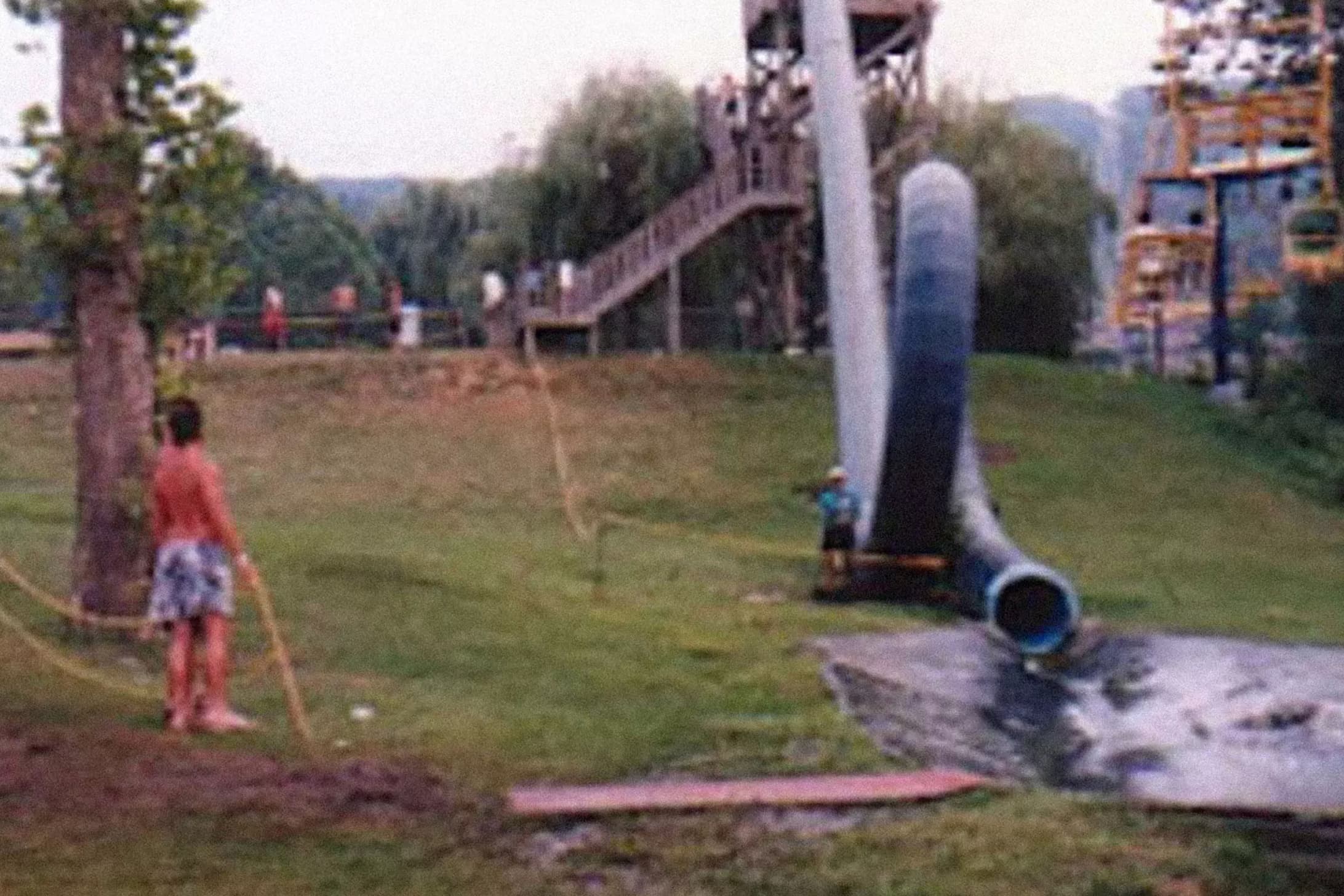
Perhaps the most iconic symbol of Action Park’s recklessness was the Cannonball Loop—a water slide with a full vertical loop. The ride was only open for a short period in the mid-1980s because it was fundamentally flawed. The physics of a circular loop (rather than a clothoid loop used in modern roller coasters) subjected riders to extreme G-forces. Several riders emerged with bloody noses or impacted teeth because their heads would whip forward and hit the slide’s interior. Legend has it that the park offered employees $100 to test the ride, and many who did came out with significant bruising.
The Tidal Wave Pool
The "Grave Pool" was dangerous due to a combination of size and volume. The pool could hold up to 1,000 people, and the waves were generated in such a way that they created strong undercurrents. Lifeguards at the Tidal Wave Pool reportedly made dozens of rescues every weekend—far more than at any other water park in the country at the time. The sheer density of people meant that a struggling swimmer could easily go unnoticed beneath the surface.
Comparative Data of Notable Action Park Hazards
The following table summarizes the primary risks associated with the park's most famous attractions and the safety lessons derived from them.
| Attraction | Primary Risk Factor | Notable Incident Type | Modern Safety Legacy |
|---|---|---|---|
| Alpine Slide | High-speed friction & track ejections | Head trauma, severe abrasions | Transition to mountain coasters with captive tracks |
| Tidal Wave Pool | Extreme turbulence & guest density | Multiple drownings | Required lifeguard ratios & water-level monitoring |
| Kayak Experience | Underwater electrical systems | Electrocution | Strict grounding & GFCI requirements for water rides |
| Cannonball Loop | Improper vertical G-loadings | Spinal/Dental injuries | Use of CAD/physics modeling for all slide designs |
| Motor World | Unregulated speeds & carbon monoxide | Head-on collisions | Remote speed governors & high-impact bumpers |
The Role of Alcohol and Staffing in Injury Rates
Beyond the engineering failures, the "culture" of Action Park contributed significantly to its injury rates. Unlike the highly regulated environments of Disney or Six Flags, Action Park was notorious for its lax enforcement of rules.
Staffing Concerns: The vast majority of the park’s employees were teenagers, some as young as 14. These employees were often tasked with managing complex safety protocols with minimal training. Reports from former staff suggest that "operator error" was common, as many lifeguards were more interested in socializing than monitoring the dangerous wave pools. In 2026, amusement park operators are required to undergo rigorous certification (such as those provided by Jeff Ellis & Associates), but in the 1980s, such standards were largely non-existent or ignored by GAR management.
Alcohol Availability: The park sold beer at numerous kiosks, and guests were often seen navigating high-speed rides while intoxicated. This impaired judgment led to reckless behavior on the Alpine Slide and the Motor World tracks, significantly increasing the frequency of high-impact collisions. The combination of "user-controlled" rides and intoxicated users proved to be a lethal mix.
Legal and Regulatory Impact on New Jersey Law
Action Park’s safety record was so poor that it eventually forced the state of New Jersey to overhaul its amusement park regulations. For years, Gene Mulvihill evaded high insurance premiums by creating his own offshore insurance company (London International Reinsurance), which essentially meant the park was self-insured and unaccountable to third-party safety audits.
The frequent injuries led to the state tightening the Amusement Ride Safety Act. These changes mandated:
- Standardized inspections by the New Jersey Department of Community Affairs (DCA).
- Mandatory reporting of all injuries requiring medical attention.
- Required liability insurance from legitimate, third-party providers.
The park eventually closed in 1996 following financial struggles and the weight of numerous lawsuits. While it reopened under new management as Mountain Creek Waterpark, the original "wild west" era of Action Park ended, replaced by a culture of compliance and safety engineering that defines the industry today.
Modern Safety Lessons for Water Park Visitors
The legacy of Action Park serves as a reminder that safety is a shared responsibility between the park operator and the guest. While modern 2026 safety standards are exceptionally high, the following lessons remain relevant:
- Respect Ride Physics: Never attempt to bypass safety restraints or change your body position on water slides. Most modern injuries occur when guests attempt to go faster or slower than the ride was engineered for.
- Acknowledge Personal Limits: Attractions like wave pools and deep-water slides require a certain level of swimming proficiency. Even with lifeguards present, personal swimming ability is the first line of defense against drowning.
- Evaluate Staff Vigilance: A safe park is one where staff are actively scanning the water and enforcing rules. If you notice distracted lifeguards or non-functional safety equipment, report it to management or choose to leave the facility.
- The Importance of Maintenance: Visible rust, cracked fiberglass, or loose railings are indicators of poor maintenance cultures. While Action Park hid many of its flaws, modern guests should be observant of the facility's overall condition.
Frequently Asked Questions
How many people actually died at Action Park?
There are six confirmed deaths directly attributed to the park's attractions. These occurred between 1980 and 1987 and involved drowning, electrocution, heart failure from cold-water shock, and head trauma.
Is Action Park still open today?
The original Action Park closed in 1996. The site was redeveloped and currently operates as Mountain Creek Waterpark. While it occupies the same location, it operates under entirely different safety standards, professional management, and modern regulatory oversight.
Why wasn't Action Park shut down sooner?
The park was a major employer and taxpayer in Vernon, New Jersey. Additionally, Gene Mulvihill used complex legal and financial maneuvers, including self-insurance, to avoid the scrutiny that would have come from traditional insurance underwriters.
What was the most dangerous ride at Action Park?
Statistically, the Tidal Wave Pool was the most dangerous, as it was the site of three out of the six fatalities. However, the Alpine Slide was responsible for the highest volume of non-fatal injuries, primarily due to "road rash" and collisions.
How did the Cannonball Loop work?
The Cannonball Loop was a vertical loop slide. It relied on the rider's momentum to carry them through the 360-degree turn. Due to the circular (rather than elliptical) shape of the loop, riders experienced high G-forces that caused neck strain and facial injuries, leading to its near-immediate closure.
Navigating Modern Amusement Safety Standards
For those looking to ensure their safety at amusement parks in 2026, the most important step is to verify that the park adheres to ASTM International F24 Committee standards. This committee develops the global benchmarks for design, manufacturing, and operation of amusement rides. Before visiting a park, you can often check their safety record through state regulatory agencies or organizations like the International Association of Amusement Parks and Attractions (IAAPA). Always follow posted age, height, and health restrictions, as these are calculated based on the specific physical stresses each ride places on the human body.