Accent adaptation is the process of modifying speech patterns—either through conscious human effort or real-time digital transformation—to increase intelligibility and reduce communicative friction between speakers of different linguistic backgrounds. In 2026, this field has evolved from a niche linguistic study into a critical technological infrastructure that supports globalized business, remote collaboration, and inclusive digital experiences.
The core objective of accent adaptation is not to erase cultural identity, but to bridge the gap in "processing fluency." When a listener encounters an unfamiliar accent, their brain must work harder to decode phonemes, which can lead to fatigue, misunderstanding, or unconscious bias. Whether through soft-skills training or the deployment of real-time AI voice conversion, adaptation ensures that the message remains the priority, regardless of the speaker's native phonetic structure.
The Linguistic Foundation: Communication Accommodation Theory
At its heart, human accent adaptation is rooted in Communication Accommodation Theory (CAT), developed by Howard Giles in the 1970s. This theory posits that individuals adjust their speech—including accent, dialect, and vocabulary—to emphasize or minimize the social differences between themselves and their interlocutors.
Convergence and Divergence
There are two primary modes of adaptation in a social context:
- Convergence: This occurs when a speaker shifts their speech patterns to match those of the listener. In a business setting, a consultant might subconsciously adopt the cadence and vowel sounds of a client to build rapport and ensure clarity.
- Divergence: This is the opposite, where a speaker emphasizes their unique accent to signal group identity or maintain social distance.
In the professional sphere of 2026, the focus is almost entirely on "functional convergence." This is the deliberate adjustment of specific sounds that are known to cause the most significant comprehension hurdles. For example, a speaker might focus on "word-final consonants" or "syllable-timed vs. stress-timed" rhythms to ensure a global audience can follow their presentation without cognitive strain.
The Rise of AI-Powered Accent Adaptation in 2026
The most significant shift in the mid-2020s has been the maturation of real-time AI accent adaptation. This technology uses deep learning models to intercept a digital audio signal and transform the speaker's accent into a "target" accent (often a more localized or standardized version) with near-zero latency.
Unlike early voice modulation tools, modern AI adaptation preserves the speaker's unique vocal timbre, emotion, and inflection. The result is a voice that sounds exactly like the original speaker, but with the phonetic clarity of the listener's native or preferred accent. This has become a standard feature in international VoIP (Voice over IP) platforms and customer service interfaces.
How the Technology Works
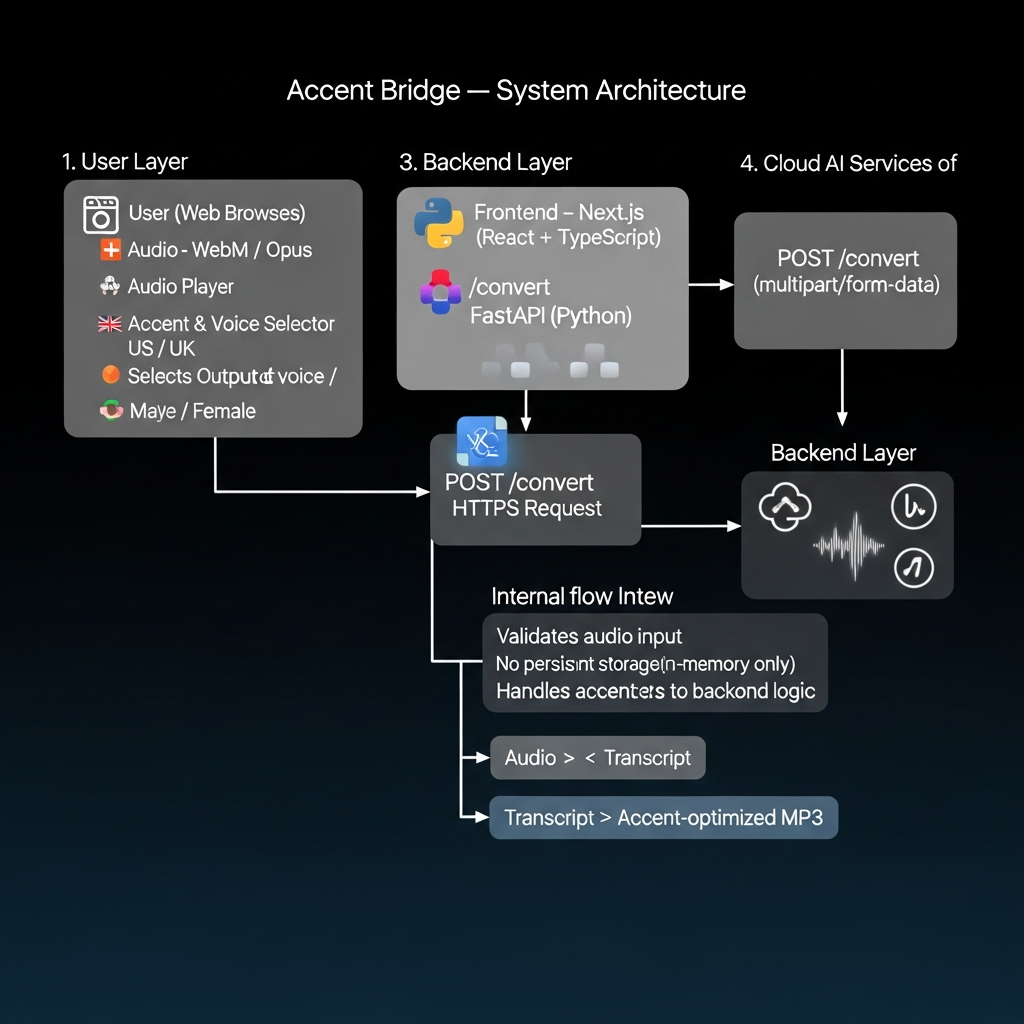
The technical architecture of an AI accent adaptation system generally follows a three-step process:
- Acoustic Analysis: The system breaks down the incoming audio into its fundamental components, separating the "content" (the words) and the "prosody" (rhythm and pitch) from the "accent" (specific phonetic renderings).
- Phoneme Mapping: The AI identifies specific phonemes that differ between the source and target accents. For instance, it might adjust the "rhoticity" (the way 'r' sounds are pronounced) or the height of certain vowels.
- Neural Synthesis: Using a trained model—often based on Generative Adversarial Networks (GANs) or Diffusion models—the system reconstructs the audio in real-time. The goal is to keep the "identity" of the voice identical while shifting the "phonetic map."
Practical Applications Across Global Industries
The demand for accent adaptation is driven by the necessity of clear communication in high-stakes environments. As we navigate the professional landscape of 2026, several sectors have emerged as primary adopters of these solutions.
Global Business Process Outsourcing (BPO)
For decades, call centers in Southeast Asia and Eastern Europe invested heavily in "accent neutralization" training for employees. This was often a long, arduous process with mixed results. In 2026, many BPOs have shifted to a hybrid model. While agents still receive basic linguistic training, real-time AI adaptation handles the heavy lifting, allowing agents to speak naturally in their native accent while the customer hears a localized version. This has significantly reduced agent burnout and increased "First Call Resolution" rates.
Telehealth and International Medicine
In healthcare, a misunderstanding can have life-altering consequences. Specialist consultants often provide remote advice to clinics across the globe. Accent adaptation software ensures that medical terminology is pronounced with standard clarity, reducing the risk of diagnostic errors caused by phonetic confusion. This is particularly vital in emergency triage situations where every second of "decoding time" matters.
Immersive Gaming and Meta-Environments
The gaming industry uses accent adaptation to enhance player immersion. In multiplayer environments, players can choose "linguistic skins" that adapt their real-time voice chat to match the world of the game. For example, a player in a fantasy RPG might have their voice adapted to sound like a specific in-game faction, all while maintaining their natural speech patterns and emotional nuances.
Implementation Framework: Human vs. AI Adaptation
When an organization decides to address communication gaps, it must choose between training its workforce or deploying technological solutions. The following table compares the two primary approaches to accent adaptation as they stand in 2026.
| Feature | Human-Led Adaptation (Training) | AI-Driven Adaptation (Software) |
|---|---|---|
| Primary Goal | Skill acquisition and cultural fluency. | Immediate intelligibility and clarity. |
| Time to Results | Months of consistent practice. | Instantaneous upon deployment. |
| Authenticity | High; reflects the speaker's actual effort. | Variable; depends on the quality of the model. |
| Scalability | Low; requires individual coaching. | High; can be deployed to thousands of users. |
| Cost Structure | High upfront cost for trainers/time. | Subscription-based (SaaS) or per-minute. |
| Flexibility | Limited to the speaker's ability. | Dynamic; can switch between target accents. |
| Mental Load | High for the speaker (constant monitoring). | Low; the speaker speaks naturally. |
Technical Requirements and Integration
For businesses looking to integrate accent adaptation software into their 2026 workflows, several technical prerequisites must be met to ensure a seamless experience.
- Low Latency Infrastructure: For real-time conversation, the delay between the speaker talking and the adapted audio reaching the listener must be under 150 milliseconds. Modern edge computing and optimized neural networks are essential to achieve this "invisible" transformation.
- High-Fidelity Audio Capture: AI models require clean input. Background noise cancellation and high-quality microphones are necessary to prevent the AI from "hallucinating" or distorting the speech during the transformation process.
- API Integration: Most adaptation tools now function as "virtual microphones." They sit between the hardware and the communication software (such as Zoom, Teams, or proprietary BPO platforms), requiring minimal change to existing software stacks.
- Privacy and Security Standards: Since the software processes live audio, it must comply with data protection regulations such as GDPR or the AI Act. In 2026, leading providers use "on-device" processing where the audio never leaves the user's computer, ensuring total privacy.
Ethical Considerations and Identity
The rise of accent adaptation technology has not been without controversy. Critics argue that "smoothing over" accents can lead to linguistic homogenization and the devaluing of cultural heritage.
Preserving the "Self" in Speech A major focus for developers in 2026 is ensuring that adaptation does not become a tool for "linguistic passing" that erases a person’s background. The most ethical implementations are those that are user-controlled. A speaker should have the agency to turn the adaptation on or off and to choose the degree of adaptation.
Furthermore, there is the risk of "accent bias" being encoded into the AI. If the "standard" target accent is always a specific prestige dialect, it reinforces the idea that other accents are "lesser." To combat this, modern systems are being trained on a more diverse array of "intelligible" English (or other languages), focusing on clarity rather than conformity to a single cultural standard.
Optimizing Your Adaptation Strategy
If you are an individual or an organization looking to improve communication through accent adaptation, consider these steps:
- Audit Your Needs: Identify if the barrier is "understanding" (phonetics) or "context" (slang and culture). Tech solves phonetics; training solves context.
- Focus on Key Phonemes: If opting for human training, don't try to change every vowel. Focus on the sounds that most frequently lead to "word confusion" (e.g., the 'p' and 'b' distinction in some languages).
- Test with Your Audience: Use A/B testing in call centers or client interactions. Do customers respond better to a 20% adaptation or a 100% adaptation? Often, a "light touch" that preserves some of the original character is perceived as more trustworthy.
- Maintain Transparency: In some jurisdictions in 2026, it is considered best practice (or even a legal requirement) to disclose when AI is being used to modify a voice.
Frequently Asked Questions
Does accent adaptation change the words I say?
No. Accent adaptation focuses strictly on the "phonetic" and "prosodic" layers of speech. It changes how the words are pronounced (the sounds, the rhythm, and the pitch) without altering the actual vocabulary or syntax of your sentences.
Will using an AI adaptation tool make me lose my natural accent?
On the contrary, using AI adaptation can actually help you maintain your natural accent. Because the software handles the clarity for the listener, you do not need to constantly monitor and strain your own speech patterns, allowing you to speak more comfortably and authentically in your own voice.
Is this technology only available for English?
While English was the initial focus due to its role as a global lingua franca, by 2026, robust accent adaptation tools exist for Mandarin, Spanish, Arabic, Hindi, and several other major global languages. These tools help bridge dialectical gaps (e.g., adapting an Argentinian accent for a listener in Spain).
What is the difference between accent neutralization and accent adaptation?
Accent neutralization is an older term that implies "removing" an accent to sound like a native speaker. Accent adaptation is a more modern, inclusive term that focuses on "adjusting" speech for the specific purpose of clarity, often keeping the speaker's identity intact.
How much does professional accent adaptation software cost?
In 2026, individual licenses for "virtual microphone" adaptation tools typically range from $15 to $30 per month. Enterprise solutions for BPOs are usually priced based on volume, often costing a few cents per minute of adapted audio.
Next Steps for Global Communicators
To effectively leverage accent adaptation, the best approach is one of Linguistic Empathy. If you are a speaker with a strong accent, experimenting with real-time AI tools can provide an immediate boost in professional confidence and listener comprehension. If you are a business leader, implementing these tools can unlock a truly global talent pool, ensuring that your best experts are heard and understood, regardless of where they were born.
The goal for the remainder of 2026 and beyond is to move toward a world where "how" we speak never prevents "what" we say from being understood. Start by testing a reputable AI adaptation platform on your next international call to experience the difference in cognitive ease for yourself.