Abduction narratives are structured first-person or reported accounts of individuals being forcibly seized by non-human entities or unknown captors, subjected to physical or psychological procedures, and subsequently returned to their normal environment. Rooted in traditional folklore, captivity literature, and modern UFO encounters, these stories reflect a complex intersection of neurobiological experiences, psychological phenomena, narrative conventions, and evolving societal anxieties about bodily autonomy.
The Historical Evolution of Abduction Stories
While the modern public primarily associates abduction narratives with extraterrestrial encounters, the underlying narrative architecture long predates the space age. Comparative folklorists observe that the core elements of the abduction archetype—unexplained paralysis, transport to an unfamiliar realm, intrusive inspection, and subsequent return with missing time—have recurred across human cultures for centuries.
In medieval European folklore, stories of fairy abductions ("changelings" and spirit travel) mirrored many modern alien claims. Individuals reported being taken by supernatural beings into hidden subterranean mounds, subjected to strange banquets or physical tests, and returned to find that time had elapsed differently in the human world. Similarly, 17th and 18th-century European-American captivity narratives, such as the widely circulated 1682 account by Mary Rowlandson, documented physical abduction by rival groups, establishing a literary template focused on survival, spiritual testing, trauma, and societal reintegration.
The transition to technology-centered abduction literature occurred alongside the rise of science fiction pulps in the early 20th century and the emerging flying saucer phenomenon of the post-World War II period. The watershed moment for the modern alien abduction subtype occurred in September 1961 with the experience reported by Betty and Barney Hill in New Hampshire. Their account—brought to broad public awareness through John G. Fuller’s 1966 book The Interrupted Journey—established the canonical sequence of the alien abduction narrative: lights in the sky, vehicle disablement, small gray beings, medical examination, and missing time recovered through hypnotic regression.
By the late 1980s, works such as Whitley Strieber’s Communion (1987) and Budd Hopkins’s Missing Time (1981) transformed these accounts from niche subcultural reports into major literary and media tropes, cementing a standardized vocabulary of imagery that continues to influence contemporary popular culture.
Structural Anatomy: The Six Classic Stages
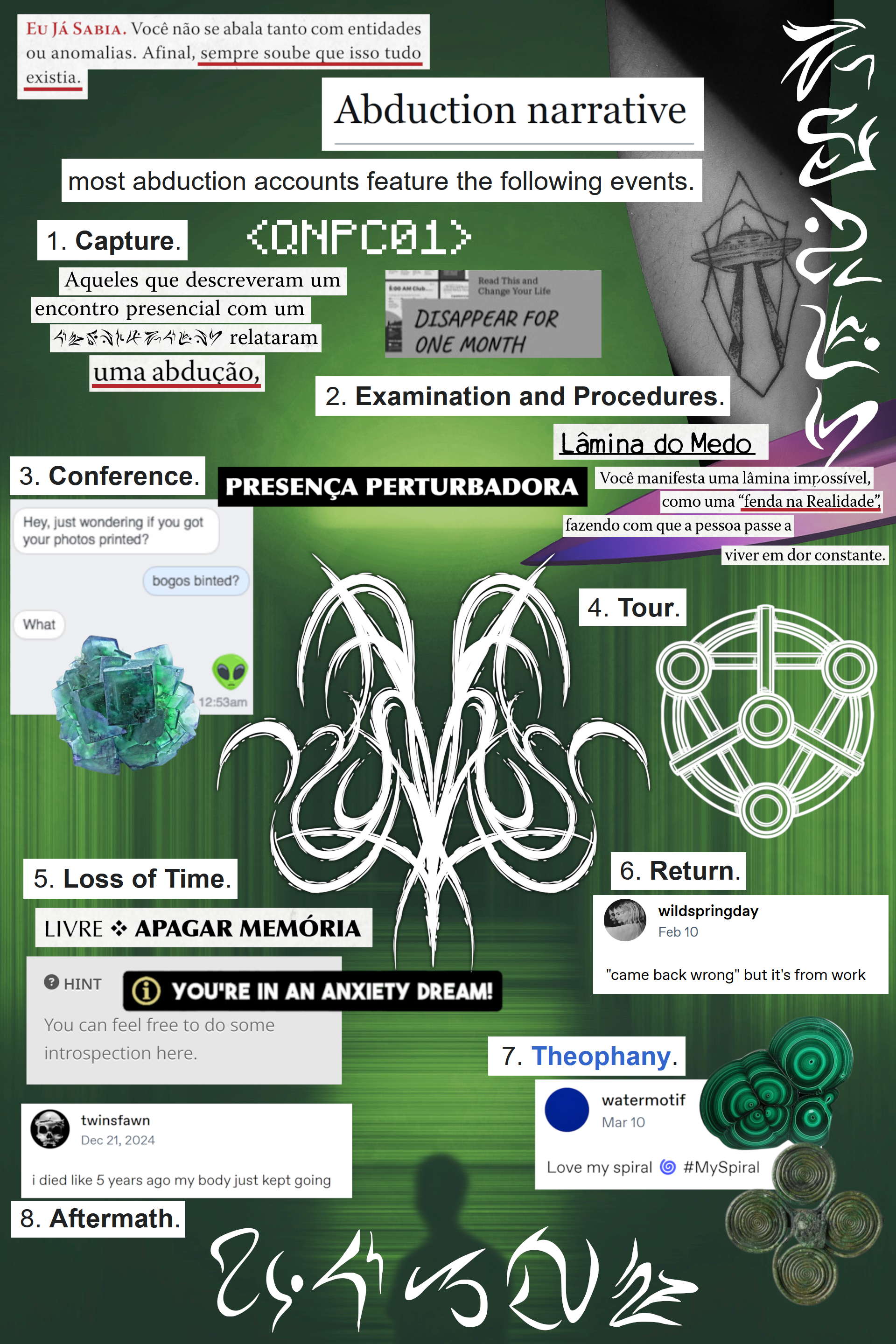
In his landmark folkloric analysis Abduction: The Cosmic People-Snatching Phenomenon (1987), folklorist Thomas E. Bullard conducted a systematic content analysis of hundreds of abduction reports. Bullard identified that despite geographic and demographic variations among informants, mature abduction narratives consistently adhere to a predictable six-stage sequence.
- Capture: Disorientation & immobilization
- Examination: Intrusive physical or mental probing
- Conference: Direct telepathic communication
- Tour: Inspection of the alien environment
- Epiphany: Warnings, vision or spiritual msg
- Return: Re-entry with physical signs
1. Capture
The narrative opens with the subject being immobilized, often in a remote setting or inside their bedroom. Normal environmental sensory cues are silenced, replaced by an eerie stillness often called the "oz factor." The subject experiences involuntary paralysis before being levitated or escorted into an unfamiliar craft or vessel.
2. Examination
The central and most detailed phase involves intrusive medical or scientific procedures. Entities examine the subject’s body on a raised table, using specialized instruments to extract tissue, probe organs, or scan neurological activity. This phase frequently features themes of reproductive inspection or genetic sampling.
3. Conference
Following the examination, the subject interacts directly with a primary captor or leader figure. Communication occurs non-verbally through telepathy, where the entity conveys information regarding their origins, intentions, or physiological nature.
4. Tour
In a subset of fully developed narratives, the captors show the subject the interior of the vessel, specialized technology, or views of distant planetary bodies. This serves to establish the technologically or spiritually superior status of the abductors.
5. Epiphany
The entities convey a broader message, often apocalyptic or ecological in nature. The subject is shown visions of environmental catastrophe, nuclear war, or cosmic evolution, charging them with a moral or warning mission upon their return to society.
6. Return
The subject is returned to the point of initial contact or a nearby location, frequently exhibiting physical markers such as unexplained scars, soreness, or disoriented orientation. A period of "missing time"—ranging from hours to days—remains unaccounted for until memory retrieval efforts begin.
Psychological and Neurobiological Frameworks
Mainstream scientific and psychological research approaches abduction narratives not as empirical physical events, but as complex psychological expressions resulting from specific neurological phenomena, cognitive vulnerabilities, and socio-cultural conditioning.
- Neurological Trigger
- e.g., Sleep Paralysis, REM Intrusion
- Disorienting Sensation
- Paralysis, Chest Pressure, Presence Sensor
- Cultural Schema / Expectation
- Modern Alien Motif / Historical Demon Motif
- Memory Consolidation & Regression
- Hypnotic Confabulation, Retrospect Framing
- Articulated Abduction Narrative
Sleep Paralysis and REM Intrusion
The most frequently identified neurobiological mechanism underlying bedroom abduction reports is sleep paralysis accompanied by hypnagogic (falling asleep) or hypnopompic (waking up) hallucinations. During sleep paralysis, the brain awakens from rapid eye movement (REM) sleep while muscle atonia (body paralysis) remains active.
This state is often accompanied by intense feelings of dread, chest pressure, and vivid multisensory hallucinations—including the strong perception of an ambient "intruder" in the room. When individuals experiencing sleep paralysis attempt to make sense of the terror, they frame the sensation using culturally accessible scripts, translating neuromuscular paralysis into abduction by extraterrestrials or supernatural entities.
Hypnotic Regression and Confabulation
A critical factor in the proliferation of detailed abduction stories is the historical reliance on hypnotic regression to retrieve lost memories of "missing time." Cognitive psychologists, notably Dr. Elizabeth Loftus, have demonstrated that hypnosis does not act as a recording playback mechanism; rather, it creates a highly suggestible state prone to memory distortion, confabulation, and false memory syndrome.
When hypnotists use leading questions or hold preconceived beliefs about alien contact, subjects often inadvertently construct elaborate, highly vivid narratives that feel entirely real. Once these false memories are consolidated, subjects display physiological stress responses when recalling them that are identical to genuine traumatic memories.
Temporal Lobe Lability
Neuroscientific studies, including research into temporal lobe lability, suggest that individuals with higher neurological sensitivity in the temporal lobes are more prone to vivid mystical, anomalous, or out-of-body experiences. When combined with high levels of psychological absorption—the capacity to become completely immersed in imaginative experiences—individuals are significantly more likely to interpret ambiguous events as extraordinary encounters.
Cultural and Sociological Functions
From a sociological perspective, abduction narratives function as modern myth-making. Sociologists of religion observe that as Western societies secularized throughout the 20th century, traditional religious frameworks for understanding good, evil, and miraculous intervention were increasingly replaced by technological and cosmic frameworks.
Abduction stories reflect acute contemporary anxieties:
- Loss of Bodily Autonomy: The intrusive medical examination motif mirrors societal anxieties regarding cold clinical medicine, genetic engineering, and the loss of physical agency in an increasingly bureaucratic medical system.
- Technological Helplessness: The overwhelming technological superiority of the abductors highlights human vulnerability in an era dominated by rapid, inscrutable technological advancement.
- Ecological Dread: The epiphany phase, dominated by visions of planetary ruin, serves as a secularized apocalyptic warning regarding environmental degradation and nuclear proliferation.
Comparative Analysis of Abduction Narrative Types
The structure and themes of abduction accounts vary significantly depending on historical context, structural motifs, and the perceived nature of the captor entities.
| Narrative Type | Primary Era / Context | Captor Characteristics | Core Examination Motifs | Dominant Psychological / Cultural Function |
|---|---|---|---|---|
| Folkloric / Fairy Abduction | Pre-Industrial Europe | Fairies, elves, spirits, subterranean beings | Consumption of supernatural food, physical replacement (changelings) | Explaining sudden illness, infant mortality, and community disappearances |
| Historical Captivity Narrative | 17th–19th Century Frontier | Rival human groups, hostile military forces | Forced integration, spiritual endurance testing, forced travel | Reinforcing cultural identity, religious faith, and frontier survival ethics |
| Classic UFO Encounter | Post-1961 (Post-Hill Case) | Gray aliens, clinical extraterrestrial scientists | Intrusive tissue extraction, reproductive sampling, missing time | Processing fears of clinical intrusion, bio-technology, and technological vulnerability |
| Transpersonal / High-Strangeness | Late 20th Century–Present | Multidimensional beings, light entities, interdimensional travelers | Telepathic downloads, energetic realignment, consciousness expansion | Secular spirituality, search for cosmic purpose, and coping with existential trauma |
Analytical Methodologies for Researchers and Scholars
Scholars analyzing abduction narratives across folklore, literature, and psychology employ several standardized methodological approaches to deconstruct texts without making unsupportable empirical claims.
Scholarly Analysis Framework
- Textual Content Analysis
- Map motifs against Stith Thompson's Index & Bullard Typology
- Contextual Provenance Verification
- Isolate pre-hypnosis claims from post-hypnosis details
- Neurobiological & Psychological Profiling
- Screen for sleep paralysis, absorption, and trauma history
- Sociocultural Framing
- Correlate themes with contemporary media & societal stress
1. Textual Content Analysis
Researchers systematically map narrative motifs against folklore classification systems, such as the Stith Thompson Motif-Index of Folk-Literature, or Thomas Bullard's structural typology. By isolating recurring elements (e.g., F220 "fairies take mortals to world under hill" vs. modern craft entry), scholars track how stories adapt across generations.
2. Contextual Provenance Verification
When evaluating an account, researchers separate details reported spontaneously from those retrieved through hypnosis or guided imagery. Discrepancies between initial police or medical statements and post-hypnotic session transcripts provide critical evidence of narrative drift and confabulation.
3. Neurobiological and Psychological Profiling
Clinicians and researchers evaluate informants using standardized psychometric instruments, such as the Dissociative Experiences Scale (DES) and the Tellegen Absorption Scale (TAS). This helps determine whether the reported events correlate with sleep disruption, high suggestibility, or underlying trauma responses.
4. Sociocultural Framing
Cultural studies scholars evaluate the narrative against the media environment contemporary to the report. For example, researchers routinely check whether details in an abduction account mirror themes from sci-fi television broadcasts, films, or popular books released immediately prior to the reporting date.
FAQs
What is the earliest documented alien abduction narrative?
The 1961 experience of Betty and Barney Hill in New Hampshire is widely recognized by researchers as the prototype for the modern alien abduction narrative. While earlier reports of contact existed (such as Antonio Villas Boas in Brazil in 1957), the Hill case was the first to combine lights in the sky, physical capture, medical examination, missing time, and retrieval through hypnotic regression into a widely publicized narrative framework.
How does hypnotic regression influence abduction stories?
Hypnotic regression significantly increases the risk of false memory creation and confabulation. Under hypnosis, individuals are hyper-suggestible and highly motivated to satisfy the perceived expectations of the hypnotist. Studies demonstrate that details retrieved under hypnosis are frequently influenced by media tropes, leading questions, and popular culture rather than accurate historical memories.
What role does sleep paralysis play in reported abductions?
Sleep paralysis accounts for a substantial percentage of bedroom-based abduction reports. During sleep paralysis, a person experiences temporary immobility while transitioning into or out of sleep, accompanied by vivid hypnagogic or hypnopompic hallucinations. The combination of paralysis, chest pressure, intense panic, and visual or auditory hallucinations closely matches the initial capture stage of classic abduction narratives.
Are abduction narratives found across different cultures globally?
Yes, but their specific visual and thematic details vary based on local cultural scripts. While Western accounts heavily feature Gray aliens, clinical spacecraft, and medical technology, reports from non-Western or non-industrialized regions more frequently involve traditional spirits, cultural folk figures, or ancestral entities, demonstrating that the human mind uses locally available concepts to interpret anomalous sensory experiences.
What is the structural difference between contactee and abductee narratives?
Contactee narratives, which predominated in the 1950s, feature benevolent, humanoid beings who invite human subjects voluntarily for peaceful dialogue and philosophical guidance. In contrast, abductee narratives, which emerged predominantly after 1961, are non-consensual, clinically intrusive, traumatizing, and involve non-humanoid, highly detached entities.
Best Practices for Researching Abduction Narratives
When conducting literary, psychological, or folkloric research into abduction narratives, maintain strict analytical standards to separate narrative motifs from physical claims:
- Prioritize Primary Source Materials: Analyze original audio recordings, unedited hypnotic transcripts, and initial written statements rather than secondary book adaptations, which are frequently edited for narrative structure and dramatic effect.
- Apply Cross-Disciplinary Frameworks: Combine folkloric motif analysis with neurobiological data (such as sleep research) and cognitive psychology (such as false memory research) to understand the full scope of the phenomenon.
- Control for Media Contamination: Always cross-reference the timing of an informant's report with popular contemporary media releases (films, television shows, science-fiction novels) to identify thematic borrowing and cultural transmission.
- Maintain Methodological Neutrality: Focus analytical efforts on how the narrative is constructed, why specific motifs recur, and what societal function the narrative serves, rather than debating physical authenticity outside empirical evidence.