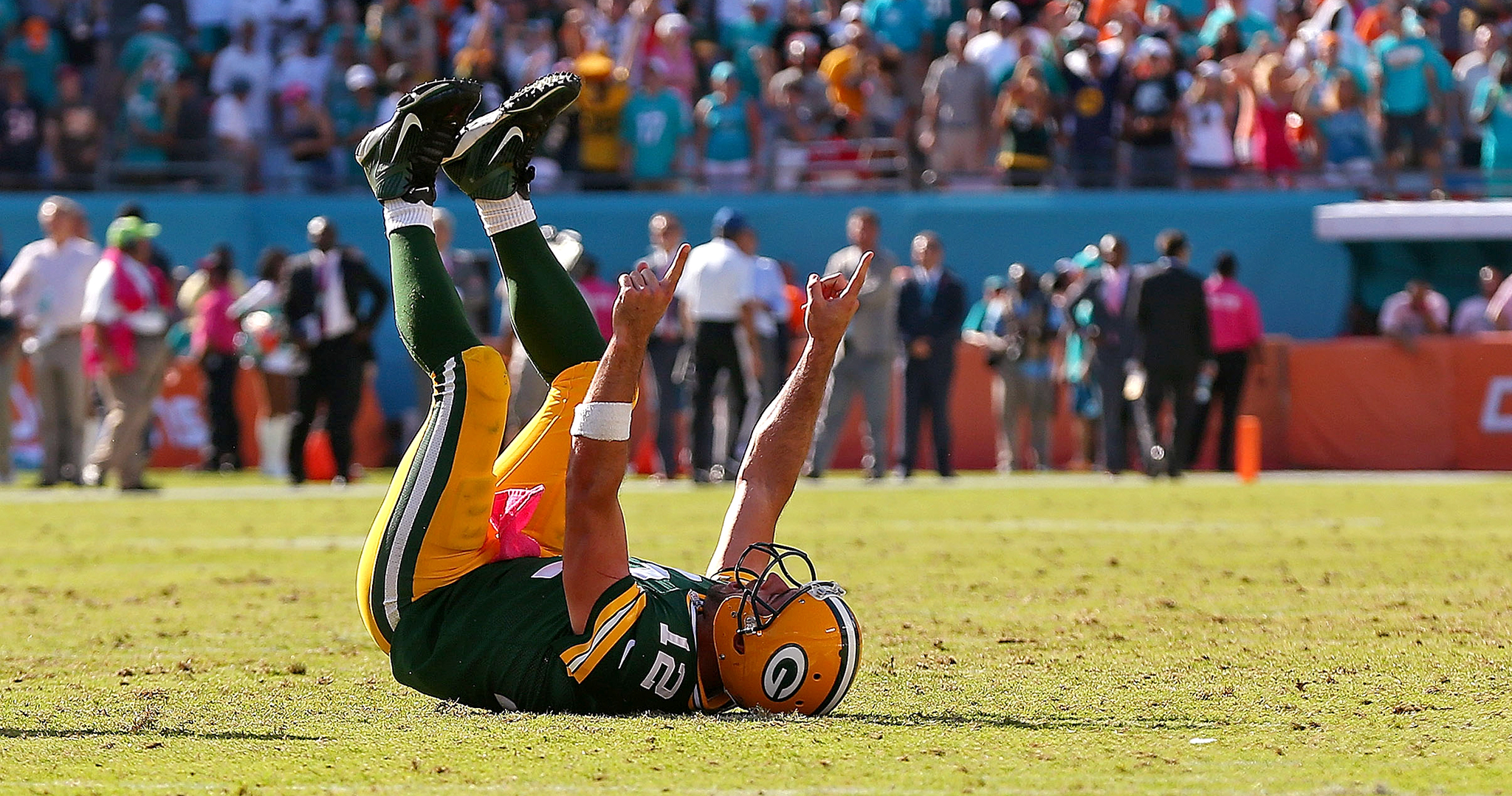
Aaron Rodgers' celebrations, led by the legendary "Championship Belt," are more than just post-score flair; they are psychological markers of his Hall of Fame career. From silencing Chicago crowds with "I Own You" to his persistent captain's photobombs, these moments define his legacy across the Packers and Jets eras through 2026.
Throughout his tenure in the NFL, Aaron Rodgers has established himself not only as one of the most mechanically gifted quarterbacks to ever play the game but also as one of its most charismatic and, at times, polarizing figures. For Rodgers, a touchdown is rarely just six points; it is an opportunity to communicate with the fans, the opposing sidelines, and the history of the league itself. As we look back from the perspective of 2026, his repertoire of celebrations serves as a roadmap of his journey from a chip-on-his-shoulder backup to a four-time MVP and a veteran leader in New York.
1. The Championship Belt (The "Discount Double Check")
The "Championship Belt" is arguably the most recognizable individual celebration in modern NFL history. Its origins date back to the mid-2000s, long before Rodgers became a household name. Originally used by Rodgers and his teammates during practice as a tribute to professional wrestling—specifically the "Big Gold Belt" used in the WWE and WCW—it became a staple of his game-day persona during the Green Bay Packers' 2010 Super Bowl run.
The gesture involves Rodgers mimicking the action of fastening a heavyweight title belt around his waist. While it began as an internal team joke, it exploded into the mainstream via a series of State Farm insurance commercials, where it was rebranded as the "Discount Double Check." What makes this celebration "epic" is not just the gesture itself, but the context in which Rodgers used it. He would deploy it after rushing touchdowns, particularly those where he evaded several defenders.
By 2010, the "Belt" had become a symbol of his ascent. During the playoffs that year, Rodgers used it to signal that he had finally arrived. However, the celebration’s legacy is also defined by those who tried to use it against him. Throughout the 2010s, defenders who sacked Rodgers would often mock him by performing the "Belt" gesture. In almost every instance, Rodgers responded with a scoring drive, leading to the "Rodgers Curse," where mocking the belt seemingly guaranteed a loss for the opponent.
2. "I Own You" – The Soldier Field Statement
In terms of pure emotional intensity and historical significance within a rivalry, nothing tops Rodgers’ "I Own You" moment against the Chicago Bears on October 17, 2021. The Green Bay-Chicago rivalry is the oldest and most storied in the NFL, and Rodgers had dominated the Bears for over a decade. Late in the fourth quarter at Soldier Field, Rodgers scrambled for a six-yard touchdown to seal the game.
After crossing the goal line, Rodgers didn't go for the "Belt." Instead, fueled by the vitriol of the Chicago crowd, he turned to the stands and shouted, "I still own you! I still own you! I’ve owned you all my life!" The moment was caught perfectly by the broadcast microphones and immediately went viral. It was a rare instance of a player breaking the "fourth wall" of professional sports to address an entire fanbase's collective trauma.
Statistically, the claim was hard to argue. At that point, Rodgers had a career record of 22-5 against the Bears. The celebration was epic because it encapsulated Rodgers’ defiant personality. He wasn't just celebrating a touchdown; he was asserting dominance over a franchise and its city. Even in 2026, this remains the gold standard for trash-talking celebrations, representing a peak moment of "villain-era" Rodgers that fans in Green Bay still cherish and fans in Chicago still loathe.
3. The Art of the Captain’s Photobomb
While most of Rodgers' celebrations occur after a touchdown, his most consistent and subtle "highlight" is the pre-game photobomb. This tradition began early in his career as a way to loosen up the team and poke fun at the self-serious nature of official NFL photography.
The premise was simple: during the weekly photo of the team captains at midfield, Rodgers (who was not always a captain in his early years) would find a way to sneak into the background. Sometimes he would strike a goofy pose, other times he would simply stare intensely at the camera from behind a teammate's shoulder.
As the years progressed, this became a highly anticipated ritual for fans. Even after Rodgers became a perennial captain himself, the "photobomb" spirit continued in various forms, including during televised interviews and team portraits. It showcased a different side of the quarterback—one that was playful and intentionally irreverent. It serves as a reminder that despite his intense competitive fire, Rodgers always viewed the game through a lens of individual expression and humor.
4. The Lambeau Leap and the NY Transition
The Lambeau Leap is a Green Bay Packers tradition started by LeRoy Butler in 1993, but Aaron Rodgers helped carry it through two decades of excellence. While Rodgers was never the most frequent "leaper" (preferring to save his energy or let his receivers take the spotlight), his leaps were always calculated.
Ranking Rodgers' Lambeau Leaps requires looking at the 2014-2016 era, where he was arguably at his athletic peak. He would often wait for the crowd to settle before choosing a specific spot in the end zone, usually the "715" area, to jump into the arms of the fans. These moments solidified his bond with the Wisconsin faithful.
When Rodgers moved to the New York Jets in 2023, there was much speculation about how he would adapt his celebration style. After returning from his 2023 Achilles injury, Rodgers’ celebrations in 2024 and 2025 took on a more "elder statesman" feel. He often replaced the high-energy "Belt" with a sophisticated "handoff" celebration or a simple, emphatic point to his young playmakers like Garrett Wilson. This transition showed an evolution from the individualistic superstar to the veteran mentor, though he would still occasionally "put the belt on" during high-stakes divisional games to remind the league that the old Rodgers was still there.
Ranking the Most Epic Celebration Highlights
The following table ranks Rodgers’ celebrations based on their cultural impact, the difficulty of the play preceding them, and the narrative significance of the game.
| Celebration Name | Year | Opponent | Context/Impact | Significance Rating |
|---|---|---|---|---|
| "I Own You" Shout | 2021 | Chicago Bears | Sealed a rivalry win; became a permanent NFL meme. | 10/10 |
| The Super Bowl Belt | 2011 | Pittsburgh Steelers | The "Belt" performed on the world's biggest stage (Super Bowl XLV). | 9.5/10 |
| The "Relax" Gesture | 2014 | Chicago Bears | Follow-up to his famous "R-E-L-A-X" quote after a blowout win. | 8.5/10 |
| The Handoff/Guitar | 2024 | Miami Dolphins | A veteran Rodgers showing he still had the "swagger" in NY. | 7.5/10 |
| The Mockery Response | 2012 | Houston Texans | Rodgers threw 6 TDs after J.J. Watt mocked "The Belt." | 9.0/10 |
| The Captain Photobomb | Various | N/A | A career-long tradition of background humor. | 8/10 |
5. The "Mockery" Highlights: When Celebrations Backfire
An essential part of the Aaron Rodgers celebration lore is the "Mockery Highlight." Because Rodgers' "Belt" was so iconic, it became a target for every defensive player who managed to get the better of him. However, history shows that mocking Aaron Rodgers is a dangerous game.
In 2012, the Houston Texans' J.J. Watt—then at the height of his powers—sacked Rodgers and performed the "Belt." Rodgers responded by throwing six touchdown passes in a dominant 42-24 victory. Similar scenarios played out with Stephen Tulloch of the Detroit Lions and various players from the Minnesota Vikings.
These highlights are "epic" because they don't just feature Rodgers; they feature his influence on the entire league. The fact that elite defenders felt the need to "take the belt" from him was a testament to his status. In 2026, when analysts discuss the most intimidating players of the 21st century, they often point to these specific games where a simple celebration fueled a legendary performance.
6. The Psychological Component of Post-Play Flair
To understand why Rodgers' celebrations resonate so deeply, one must look at the psychological warfare of the NFL. Rodgers has always been an "intent" based player. Nothing he does on the field is accidental. When he performs a celebration, he is often targeting a specific narrative or a specific opponent.
- Defiance: Using celebrations to answer critics (e.g., the "Relax" era).
- Dominance: Establishing a hierarchy in a rivalry (e.g., the Bears games).
- Camaraderie: Bringing humor to a high-stress environment (e.g., photobombs).
By the time he reached the latter stages of his career with the Jets in 2025 and 2026, his celebrations became a way to bridge the gap between his legendary past and the team's future. He would often use his celebrations to draw attention to his teammates, a subtle shift from the "Championship Belt" era where he was the singular focus.
Frequently Asked Questions
What was Aaron Rodgers' first major celebration?
The "Championship Belt" (or "Discount Double Check") was Rodgers' first major individual celebration. It gained national prominence during the 2010 NFL season, particularly during the Packers' run to Super Bowl XLV. He had used it in practice and smaller games previously, but it became his signature move during that championship year.
Why did Rodgers stop doing the "Championship Belt" as often?
As the "Belt" became heavily associated with State Farm commercials, Rodgers began to use it more sparingly to avoid it feeling purely like a marketing gimmick. Additionally, after years of opponents mocking the move, Rodgers evolved his celebrations to include more spontaneous emotional outbursts, such as the "I Own You" moment in Chicago, which felt more authentic to the specific game situation.
Is the "I Own You" celebration considered unsportsmanlike?
At the time, it generated significant debate. While the NFL is generally strict about taunting, Rodgers was not penalized during the game because he was addressing the crowd rather than a specific opposing player. In the years since, it has been viewed more as a legendary moment of sports trash-talk rather than a violation of league rules.
Did Aaron Rodgers continue his celebrations with the New York Jets?
Yes, though they evolved. After joining the Jets, Rodgers embraced his role as a veteran leader. While he occasionally brought back the "Belt" for high-leverage moments, he also developed new rituals with his younger receivers. His celebrations in New York were often characterized by a "calm cool" demeanor, reflecting his status as an established legend in a new market.
How did the "Rodgers Photobomb" start?
The photobombing started as a joke during his time as a backup and early starter in Green Bay. Rodgers wanted to see if he could get into the official captains' photos taken by NFL photographers before the game. It became a challenge for him to remain as inconspicuous as possible while still being clearly visible in the final shot.
Future Legacy of the Rodgers Signature Style
As we look toward the Hall of Fame induction that inevitably awaits Aaron Rodgers, his celebrations will be featured as prominently in his highlight reels as his "Hail Mary" passes and back-shoulder fades. They represent the personality of a player who refused to be just another "cog in the machine."
For fans and young athletes, the takeaway from Rodgers' celebration history is the importance of individual expression within a team framework. Whether it was the swagger of the "Belt" or the raw honesty of the Soldier Field outburst, Rodgers showed that the NFL is at its best when its greatest stars are allowed to be their most authentic selves. If you are looking to relive these moments, the best next action is to view the official NFL "Mic'd Up" archives from 2010 to 2022, where the audio context of these celebrations provides a deeper layer of appreciation for his legendary career.