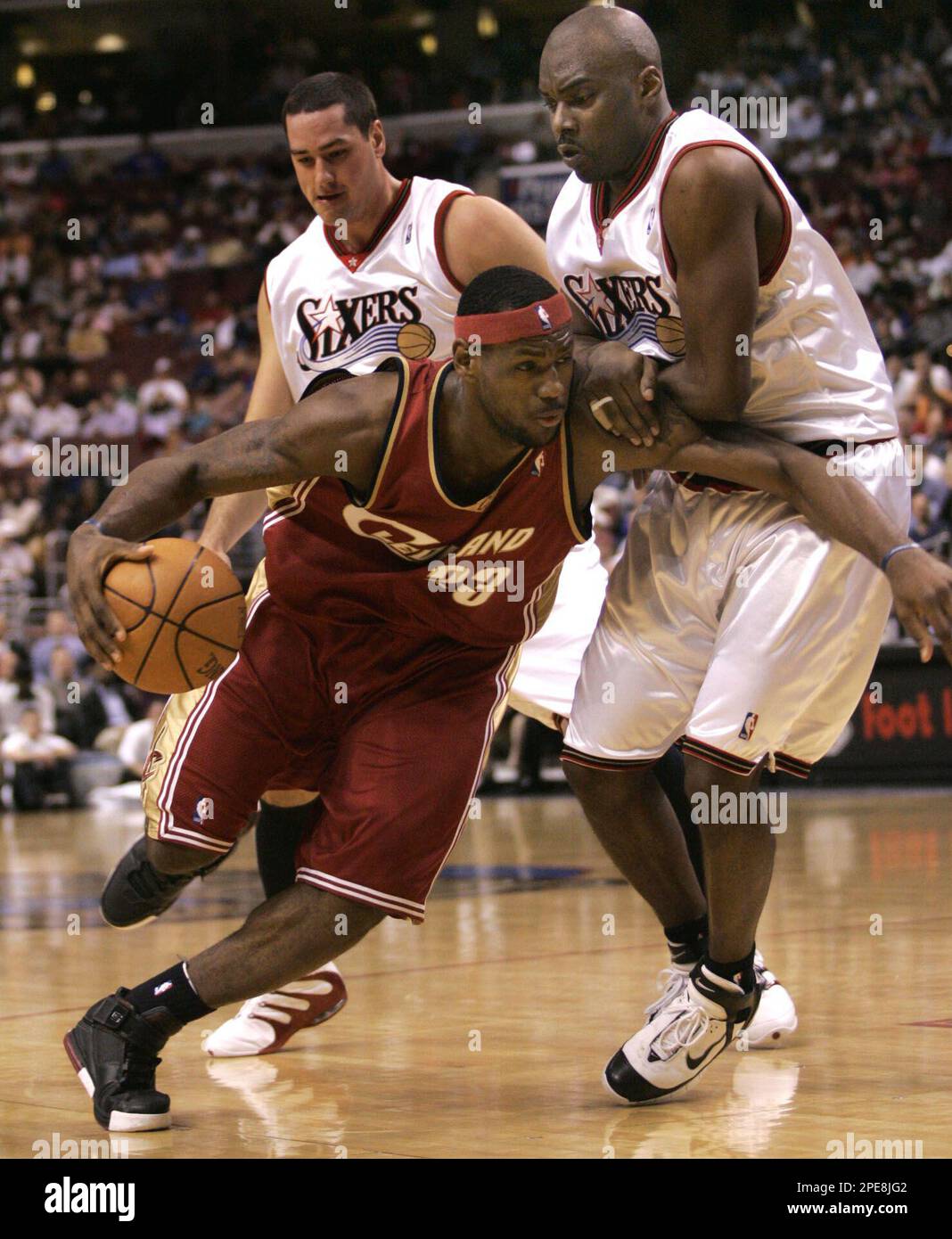
Aaron McKie remains one of the most respected figures in Philadelphia basketball history, serving as the "glue guy" and defensive heartbeat of the 2001 NBA Finals team. His legacy is defined by his 2001 NBA Sixth Man of the Year award, his seamless chemistry with Allen Iverson, and a versatile statistical profile that prioritized winning over individual glory.
The Philadelphia Roots of a Local Legend
To understand Aaron McKie’s legacy with the 76ers, one must first recognize his deep-rooted connection to the city of Philadelphia. Born and raised in North Philadelphia, McKie’s journey to the NBA was a homecoming long before he ever donned the Sixers' jersey. He starred at Simon Gratz High School and later became a standout at Temple University under the legendary John Chaney. This local pedigree earned him a level of respect and patience from the notoriously demanding Philadelphia fan base that few others enjoyed.
McKie was originally drafted 17th overall by the Portland Trail Blazers in 1994. After stints in Portland and Detroit, he arrived in Philadelphia via trade in 1997. It was here that his professional identity truly solidified. While many players struggle with the transition from a starter to a bench role, McKie embraced it, becoming the quintessential professional. His ability to read the game, provide veteran leadership, and execute Larry Brown’s demanding defensive schemes made him indispensable during the late 1990s and early 2000s.
The narrative of McKie’s career is not just about points and rebounds; it is about the transition from a local prospect to a foundational piece of a championship-contending roster. In the eyes of Philadelphia fans, McKie represented the "blue-collar" work ethic the city prides itself on—underrated, tough, and fundamentally sound.
The 2000-2001 Breakthrough: NBA Sixth Man of the Year
The pinnacle of Aaron McKie’s individual career occurred during the historic 2000-2001 season. While Allen Iverson was the undisputed MVP and the face of the franchise, McKie was the engine that kept the second unit running and the closer who stabilized the fourth quarter. His performance that year earned him the NBA Sixth Man of the Year Award, making him the first 76er to receive the honor.
During this campaign, McKie averaged 11.6 points, 5.0 assists, and 4.1 rebounds per game. These numbers, while respectable, do not fully capture his value. McKie was essentially a "Swiss Army Knife" for coach Larry Brown. He could play both guard positions and small forward, allowing the Sixers to experiment with different lineups. When Iverson needed to move off the ball to focus on scoring, McKie would take over the primary ball-handling duties. When a lockdown defender was needed for the opponent's best perimeter scorer, McKie was often the primary choice.
His durability and consistency were vital during a season where the Sixers were frequently hampered by injuries. McKie’s ability to remain a steadying presence allowed the team to secure the top seed in the Eastern Conference. His 2001 season was highlighted by back-to-back triple-doubles in late December against the Sacramento Kings and the Atlanta Hawks, a rare feat that underscored his all-around utility.
Analyzing the Career Stats: Beyond the Box Score
Aaron McKie’s statistical profile reflects a player who prioritized efficiency and role-playing over volume shooting. While his career averages might appear modest to a casual observer, his impact on the "Advanced Stats" of the early 2000s was significant. He was a high-IQ player who rarely made mistakes, evidenced by his consistently positive assist-to-turnover ratio.
The following table highlights McKie’s production during his prime years with the Philadelphia 76ers, illustrating his evolution from a rotation player to an elite sixth man.
| Season | Games Played | Points Per Game | Rebounds Per Game | Assists Per Game | Steals Per Game | FG% |
|---|---|---|---|---|---|---|
| 1997-98 | 81 | 3.9 | 3.0 | 2.4 | 1.4 | 34.7% |
| 1998-99 | 50 | 4.8 | 2.8 | 2.0 | 1.3 | 40.1% |
| 1999-00 | 82 | 8.0 | 3.0 | 2.9 | 1.3 | 41.1% |
| 2000-01 | 76 | 11.6 | 4.1 | 5.0 | 1.4 | 47.3% |
| 2001-02 | 48 | 12.2 | 4.0 | 3.7 | 1.2 | 41.2% |
| 2002-03 | 80 | 9.0 | 4.4 | 3.5 | 1.6 | 42.9% |
| 2003-04 | 75 | 9.2 | 3.4 | 2.6 | 1.1 | 37.6% |
| 76ers Career | 532 | 7.4 | 3.3 | 2.7 | 1.2 | 40.3% |
McKie’s value was often found in "clutch" moments and defensive stops that didn't always show up in a standard box score. He was a master of the "extra pass," the secondary assist, and the defensive rotation that forced a shot-clock violation. In an era before "Win Shares" and "Player Efficiency Rating (PER)" were mainstream, McKie was the player that coaches pointed to when explaining how to play the game "the right way."
Defensive Versatility and On-Court Intelligence
Defense was the calling card of the Larry Brown era in Philadelphia, and Aaron McKie was one of its primary architects. At 6'5" with a long wingspan and a high basketball IQ, McKie possessed the physical tools and the mental discipline to guard three positions. This was particularly crucial when playing alongside Allen Iverson, who, despite his brilliance, was often a defensive liability due to his size.
McKie frequently took the tougher defensive assignment, allowing Iverson to conserve energy for the offensive end. Whether he was chasing Reggie Miller around screens or trying to contain a larger wing like Vince Carter, McKie relied on positioning and anticipation rather than pure athleticism. He understood opponents' tendencies and was excellent at "shrinking the floor," a defensive concept where players crowd the ball handler to limit passing lanes.
His intelligence extended to the offensive side of the ball. McKie was one of the few players Iverson fully trusted to run the offense. He was an extension of the coaching staff on the floor, often seen gesturing to teammates to get into their proper sets. This cerebral approach to the game is what eventually led many to predict his transition into coaching long before he retired as a player.
Post-Season Heroics and the 2001 Finals Run
While the regular season established his value, the 2001 NBA Playoffs cemented McKie’s legacy. During that grueling run through the Eastern Conference, McKie's scoring average jumped to 14.6 points per game. He was a vital scoring threat when teams double-teamed Iverson, often hitting timely mid-range jumpers or corner threes.
In the Eastern Conference Semifinals against the Toronto Raptors, McKie was essential in neutralizing Toronto's secondary options while contributing significant scoring. His performance in Game 7 of that series—a high-stakes, one-point victory—demonstrated his "big game" temperament. He wasn't afraid of the moment, which earned him the moniker of a "clutch" performer in Philadelphia circles.
During the Finals against the Los Angeles Lakers, McKie faced the daunting task of helping defend Kobe Bryant. While the 76ers ultimately fell in five games, McKie’s effort and versatility were praised by both teammates and opponents. He finished the 2001 postseason having played nearly 39 minutes per game, a testament to his fitness and the trust Coach Brown placed in him.
Transition to Coaching and Philadelphia Roots
Following his retirement from playing in 2007, McKie immediately transitioned into the coaching ranks. He spent six seasons as an assistant coach for the 76ers (2007–2013), serving under several head coaches and helping mentor a new generation of guards. His ability to communicate complex defensive strategies and his reputation as a "player's coach" made him a valuable asset on the bench.
His journey eventually led him back to his alma mater, Temple University. After serving as an assistant under Fran Dunphy, McKie was named the head coach of the Owls in 2019. During his tenure, which lasted through 2023, he emphasized the same principles that defined his playing career: toughness, defensive accountability, and community involvement.
By 2026, McKie remains a prominent figure in the Philadelphia basketball ecosystem. Whether through his involvement with the 76ers alumni or his continued mentorship of local youth, his impact transcends his playing days. He is often cited by current NBA players from the Philadelphia area as a primary influence, both for his skill on the court and his conduct off it.
The Lasting Legacy of a "Glue Guy"
The term "glue guy" is often used as a backhanded compliment for players who lack elite scoring ability, but in Aaron McKie's case, it is a badge of honor. His legacy is a reminder that championship-level teams are not built on superstars alone; they require selfless individuals willing to fill the gaps, defend the best players, and prioritize the team's success over individual accolades.
McKie's relationship with Allen Iverson is perhaps the most telling aspect of his legacy. Iverson, often a polarizing figure, has frequently referred to McKie as his favorite teammate and a brother. This bond was forged in the fires of the 2001 season, where McKie’s steady presence allowed Iverson to flourish.
For the Philadelphia 76ers, Aaron McKie represents an era of grit and defiance. He was the local kid who made good, the bench player who became a star in his role, and the veteran who became a teacher. His jersey may not hang in the rafters alongside Iverson or Erving, but his contribution to the fabric of Philadelphia basketball is just as indelible.
Frequently Asked Questions
What award did Aaron McKie win with the 76ers?
Aaron McKie won the NBA Sixth Man of the Year Award following the 2000-2001 season. He was the first player in Philadelphia 76ers history to receive this honor, recognized for his scoring, playmaking, and defensive versatility coming off the bench.
How many triple-doubles did Aaron McKie have?
McKie recorded two triple-doubles during his NBA career, both of which occurred in the same week during the 2000-2001 season. On December 27, 2000, he had 19 points, 10 rebounds, and 14 assists against the Sacramento Kings, followed by another triple-double against the Atlanta Hawks on December 30, 2000.
Why was Aaron McKie so important to Allen Iverson's success?
McKie was crucial because he served as a secondary ball-handler and a primary defender. This allowed Iverson to play the "shooting guard" role more effectively without the constant fatigue of bringing the ball up the court or defending the opponent's best perimeter scorer. McKie’s high basketball IQ and unselfishness provided the perfect balance to Iverson's high-volume scoring.
Did Aaron McKie play for any teams other than the 76ers?
Yes, McKie was drafted by the Portland Trail Blazers and played there from 1994 to 1997. He also had a brief stint with the Detroit Pistons (1997) before being traded to Philadelphia. He ended his playing career with the Los Angeles Lakers (2005–2007).
What was Aaron McKie’s role after he retired from the NBA?
After retiring, McKie became a coach. He served as an assistant coach for the Philadelphia 76ers for six years and later became the head coach of the Temple University men’s basketball team from 2019 to 2023. He continues to be an active figure in the Philadelphia basketball community.
Future Outlook and Commemoration
For fans looking to honor or study the legacy of Aaron McKie, the best course of action is to revisit the 2001 NBA Playoff archives. His performance in the Eastern Conference Finals against Milwaukee and his defensive stands against Toronto provide a masterclass in role-playing at the highest level. Furthermore, his career serves as a blueprint for modern "3-and-D" players, emphasizing that defensive versatility and a high basketball IQ are timeless assets in the professional game.