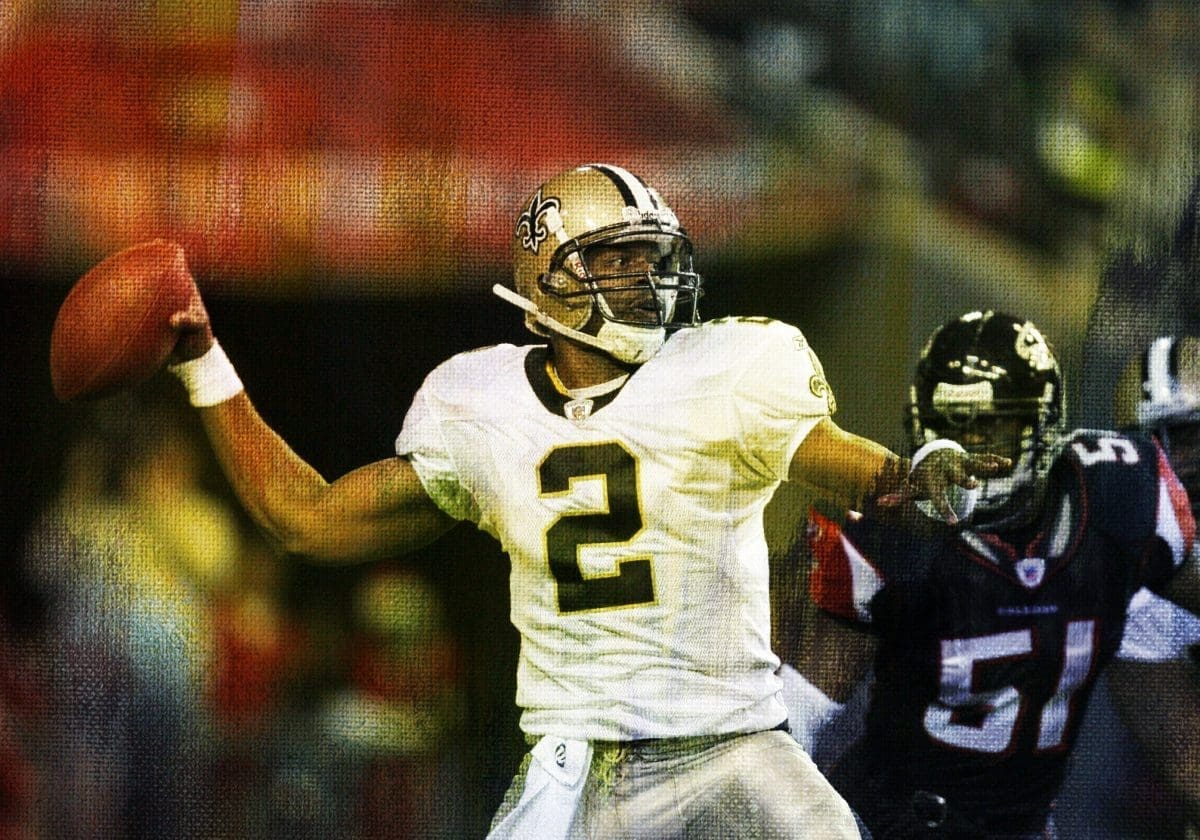
Aaron Brooks was the dynamic dual-threat quarterback who orchestrated the New Orleans Saints' first-ever playoff victory in 2000. Known for his arm strength and mobility, Brooks provided stability and excitement for a franchise long searching for an identity. As of 2026, his legacy is viewed through a lens of historical appreciation for his role in bridging the Saints' difficult "Aints" era to their eventual Super Bowl success.
The Meteoric Rise: From Charlottesville to New Orleans
The ascent of Aaron Brooks is a narrative of preparation meeting opportunity. Born in Newport News, Virginia—a region famous for producing high-caliber athletic talent—Brooks attended the University of Virginia. During his collegiate career, he established himself as a versatile playmaker, showcasing an ability to extend plays with his legs while maintaining downfield vision. His performance at Virginia caught the attention of NFL scouts, leading to his selection by the Green Bay Packers in the fourth round of the 1999 NFL Draft.
In Green Bay, Brooks found himself in an enviable learning environment. He sat behind Brett Favre, one of the most durable and prolific passers in league history. This period was instrumental in Brooks' development, as he absorbed the nuances of the West Coast offense under the tutelage of coaches like Mike Holmgren and Ray Rhodes. However, with Favre firmly entrenched as the starter, Brooks’ path to the field was blocked.
The turning point occurred in July 2000. The New Orleans Saints, desperate for a spark at the quarterback position, traded a third-round pick and linebacker K.D. Williams to the Packers for Brooks and tight end Lamont Hall. Initially brought in as a backup to veteran Jeff Blake, Brooks was thrust into the starting role in Week 12 of the 2000 season after Blake suffered a foot injury. He didn’t just fill the void; he ignited the offense, leading the Saints to a 3-2 finish in the final five games and securing a wild-card berth. The "rise" culminated in a historic Wild Card win against the defending champion St. Louis Rams, where Brooks threw for 266 yards and four touchdowns.
Statistical Analysis: The Numbers Behind the Performance
To understand the impact of Aaron Brooks, one must look beyond the win-loss column and examine the statistical consistency he maintained during his prime years. Between 2000 and 2005, Brooks was the primary signal-caller for New Orleans, a period characterized by high-octane offensive production and significant statistical milestones.
During his tenure with the Saints, Brooks became the first quarterback in franchise history to throw for over 3,000 yards in five consecutive seasons. In an era before the league shifted toward extreme pass-heavy schemes, these numbers were indicative of a top-tier starter. His mobility was a crucial component of his statistical profile; he was frequently among the league leaders for rushing yards by a quarterback, often providing the "escape valve" for an offensive line that struggled with consistency.
| Season | Team | Games | Passing Yards | Passing TDs | INTs | Rushing Yards | Rushing TDs |
|---|---|---|---|---|---|---|---|
| 2000 | NO | 9 | 1,514 | 9 | 6 | 130 | 2 |
| 2001 | NO | 16 | 3,832 | 26 | 22 | 328 | 1 |
| 2002 | NO | 16 | 3,572 | 27 | 15 | 235 | 2 |
| 2003 | NO | 16 | 3,541 | 24 | 8 | 196 | 2 |
| 2004 | NO | 16 | 3,810 | 21 | 16 | 210 | 2 |
| 2005 | NO | 13 | 2,882 | 13 | 17 | 114 | 1 |
| 2006 | OAK | 8 | 1,105 | 3 | 8 | 54 | 0 |
| Total | 94 | 20,261 | 123 | 92 | 1,501 | 13 |
Brooks' 2003 campaign is often cited by analysts as his most efficient year. He threw 24 touchdowns against only 8 interceptions, posting a passer rating of 88.5. This season proved that when provided with a balanced rushing attack—led by Deuce McAllister—and a primary target like Joe Horn, Brooks could operate as a highly disciplined and effective pocket passer.
Technical Skillset and Playing Style
Aaron Brooks was a precursor to the modern "dual-threat" quarterback. Standing 6'4" and weighing approximately 220 pounds, he possessed the prototypical frame for an NFL quarterback but combined it with the agility of a much smaller player. His primary strength was his arm talent; Brooks could make every throw on the route tree, from the deep post to the sideline out-route.
However, his playing style was often a subject of debate among the Saints faithful. His tendency to "play loose" led to spectacular touchdowns but also resulted in head-scratching turnovers. This "gunslinger" mentality was likely a byproduct of his time spent watching Brett Favre. In the early 2000s, NFL offenses were transitionary, and Brooks was often asked to carry the team when the defense faltered.
Critically, Brooks was exceptional at vertical passing. His chemistry with Joe Horn and Willie Jackson allowed the Saints to stretch defenses, making them one of the most explosive units in the NFC. Despite his occasional lapses in judgment—most famously symbolized by a backwards pass during a pressured play—his ability to create "off-script" remains a hallmark of his technical legacy.
The 2005 Season and the Katrina Displacement
No discussion of Aaron Brooks' career is complete without addressing the 2005 NFL season. Following the devastation of Hurricane Katrina, the Saints were displaced from New Orleans, playing their home games in San Antonio and Baton Rouge. The psychological and physical toll on the players was immense. Brooks, as the face of the franchise, bore the brunt of the criticism as the team struggled to a 3-13 record.
This season marked the beginning of the end for Brooks in New Orleans. The lack of a stable home environment, combined with mounting interceptions and a perceived lack of leadership during the crisis, led to his benching in favor of Todd Bouman late in the season. When the Saints hired Sean Payton in 2006 and subsequently signed Drew Brees, Brooks was released, ending a six-year chapter that was as tumultuous as it was ground-breaking.
His final season with the Oakland Raiders in 2006 was hampered by injuries and a struggling offensive line, leading to his retirement shortly thereafter. In hindsight, 2026 historians recognize that the 2005 collapse was less about Brooks' diminishing talent and more about the extraordinary circumstances surrounding a franchise in exile.
2026 Future Outlook: Legacy, Real Estate, and Recognition
As we look at Aaron Brooks from the vantage point of 2026, his "future outlook" is defined by his legacy within the New Orleans community and his successful post-football business ventures. Unlike many athletes who struggle after retirement, Brooks transitioned into property development and community revitalization.
Brooks has spent much of the last decade focusing on his hometown of Newport News, Virginia. He has been involved in several multi-million dollar redevelopment projects aimed at providing upscale housing and retail space to underserved areas. This transition from "field general" to "community developer" has reshaped his public image from a polarizing athlete to a respected businessman.
In New Orleans, the passage of time has been kind to Brooks. While Drew Brees set the gold standard for the franchise, fans in 2026 increasingly recognize Brooks as the man who gave them their first taste of postseason glory. There is ongoing discussion regarding his induction into the Saints Ring of Honor. While his career stats may not mirror the astronomical numbers of the current era, his role in legitimizing the Saints during the early 2000s is indisputable.
Factors Influencing His 2026 Legacy Standing:
- The "First" Factor: Being the first QB to win a playoff game for a 33-year-old franchise (at the time) carries permanent weight.
- Statistical Foundation: He still ranks high in many franchise passing categories, despite the "Brees Era" rewriting the record books.
- Post-Career Conduct: His lack of controversy and focus on philanthropy have kept his name in high regard.
Frequently Asked Questions
Was Aaron Brooks related to Michael Vick?
Yes, Aaron Brooks and Michael Vick are second cousins. Both grew up in the Newport News area of Virginia, a region often referred to as "757," which has produced numerous NFL players. Their shared athleticism and mobility were often compared during their concurrent careers in the NFL.
Why was Aaron Brooks traded from the Green Bay Packers?
Brooks was traded because the Packers had an entrenched Hall of Fame starter in Brett Favre. The Packers’ management realized Brooks had starting potential that would be wasted on the bench. They capitalized on his high trade value to acquire defensive depth, while New Orleans desperately needed a young, mobile quarterback to modernize their offense.
What is Aaron Brooks' most famous game?
His most famous game is the 2000 NFC Wild Card matchup against the St. Louis Rams. Brooks threw for 266 yards and four touchdowns, leading the Saints to a 31-28 victory. It was the first playoff win in the history of the New Orleans Saints franchise, which had been in existence since 1967.
Does Aaron Brooks hold any NFL records?
While he does not hold major league-wide records, he holds several "firsts" for the New Orleans Saints. He was the first Saints QB to achieve three consecutive 20-TD seasons and the first to lead the team to a postseason win. At the time of his departure, he held many of the franchise's passing records, though most have since been surpassed by Drew Brees.
What has Aaron Brooks been doing since retiring from the NFL?
Since retiring, Brooks has become a successful real estate developer. He has focused on large-scale urban development projects, particularly in Virginia. He also remains active in charitable endeavors, often supporting youth sports and educational initiatives in his hometown.
Final Perspective: Recognizing the Architect of Change
The story of Aaron Brooks is one of a pioneer. Before the "Black and Gold" were synonymous with Super Bowl aspirations, Brooks was the player who proved that winning was possible in New Orleans. His career was a blend of electrifying highs and frustrating lows, yet his impact on the franchise's trajectory cannot be overstated.
In 2026, the most practical way to honor Brooks' contribution is through continued advocacy for his place in franchise history. For students of the game, Brooks serves as a case study in how context—such as the trauma of Hurricane Katrina—can impact an athlete's statistical decline and public perception. His transition into a successful business leader further rounds out a legacy of resilience. As the NFL continues to evolve into a league dominated by mobile, strong-armed passers, Aaron Brooks should be remembered as one of the early archetypes who paved the way for the modern era of the quarterback position.