The 25th Amendment provides the definitive legal framework for addressing vacancies in the presidency and vice presidency, as well as procedures for handling presidential disability. It ensures executive continuity by clarifying that the Vice President becomes President upon a vacancy, establishing a process to fill a vacant Vice Presidency, and outlining how power is transferred during periods of presidential inability.
The Historical Necessity of the 25th Amendment
To understand the 25th Amendment, one must first recognize the constitutional ambiguity that preceded its ratification in 1967. Prior to this, Article II, Section 1, Clause 6 of the U.S. Constitution was famously vague. It stated that in the case of the "Removal of the President from Office, or of his Death, Resignation, or Inability to discharge the Powers and Duties of the said Office, the Same shall devolve on the Vice President."
The ambiguity lay in the phrase "the Same." Did it refer to the office of the presidency or merely the powers and duties of the office? When William Henry Harrison died in 1841, John Tyler asserted that he had become the President, not merely an "Acting President." While this became the "Tyler Precedent," it was never formally codified, leading to recurring concerns during the illnesses of Presidents like James A. Garfield and Woodrow Wilson.
The catalyst for change was the assassination of John F. Kennedy in 1963. In the nuclear age of the 1960s, the prospect of a vacant Vice Presidency or a President who was alive but incapacitated (such as in a coma) became a matter of national security. Senator Birch Bayh and Representative Emanuel Celler led the effort to draft a clear, procedural amendment to resolve these gaps. As of 2026, the 25th Amendment remains the cornerstone of executive stability, ensuring that the "nuclear football" and executive authority always have a clear, constitutionally mandated wielder.
Section 1: Permanent Presidential Succession
Section 1 of the 25th Amendment is brief but foundational. It states: "In case of the removal of the President from office or of his death or resignation, the Vice President shall become President."
This section officially codified the Tyler Precedent. It removed any legal doubt that the Vice President does not merely "act" as President but undergoes a full status change. Upon taking the oath of office, the Vice President assumes the title, the salary, and the full constitutional authority of the presidency for the remainder of the term.
This section has been invoked only once: on August 9, 1974, when Richard Nixon resigned. Upon Nixon’s resignation, Gerald Ford immediately became the 38th President of the United States. Without Section 1, Nixon's resignation might have triggered a constitutional crisis regarding the legitimacy of Ford’s status as a full President versus an interim administrator.
Section 2: Filling a Vice Presidential Vacancy
Before the 25th Amendment, if the Vice Presidency became vacant—whether through death, resignation, or the Vice President’s succession to the presidency—the office remained empty until the next general election. For significant portions of American history, the nation functioned without a Vice President.
Section 2 changed this by mandating that: "Whenever there is a vacancy in the office of the Vice President, the President shall nominate a Vice President who shall take office upon confirmation by a majority vote of both Houses of Congress."
This process is unique because it is the only time the Vice President is appointed rather than elected by the Electoral College. It requires a "double check" from the legislative branch, as both the House of Representatives and the Senate must confirm the nominee. This was utilized twice in quick succession during the 1970s:
- Gerald Ford (1973): Appointed by Nixon after Spiro Agnew resigned.
- Nelson Rockefeller (1974): Appointed by Ford after Ford ascended to the presidency.
In 2026, this mechanism ensures that even in times of extreme political upheaval, the line of succession can be quickly replenished, preventing a scenario where the presidency could fall to the Speaker of the House (the next in line under the Presidential Succession Act of 1947).
Section 3: Voluntary Transfer of Power
Section 3 addresses the scenario where a President knows they will be temporarily unable to perform their duties—most commonly due to medical procedures involving anesthesia.
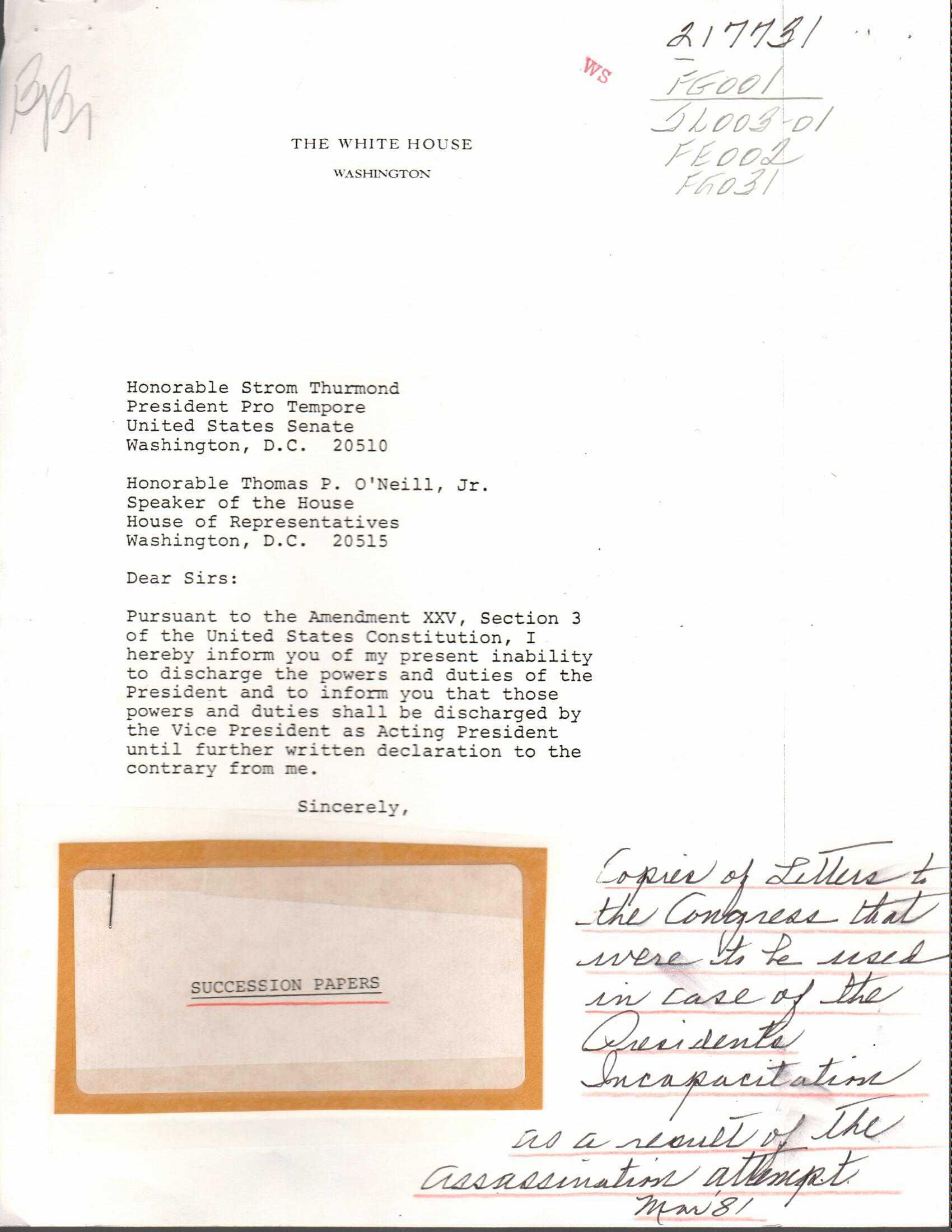
To invoke Section 3, the President must transmit a written declaration to the President pro tempore of the Senate and the Speaker of the House of Representatives. From that moment until the President sends a second written declaration stating they are fit to resume, the Vice President serves as Acting President.
Notable Invocations of Section 3
- Ronald Reagan (1985): Transferred power to George H.W. Bush for eight hours during colon surgery. (Reagan was cautious not to explicitly name the 25th Amendment in his letter, though the procedure followed it exactly).
- George W. Bush (2002 and 2007): Formally invoked Section 3 during routine colonoscopies, transferring power to Dick Cheney.
- Joe Biden (2021): Transferred power to Kamala Harris for a brief period during a medical evaluation.
Section 3 is a tool of administrative prudence. it allows the executive branch to function seamlessly without the risk of a "power vacuum" while the Commander-in-Chief is unconscious or otherwise temporarily disabled.
Section 4: Involuntary Transfer of Presidential Power
Section 4 is the most complex and controversial part of the amendment. It provides a mechanism for the Vice President and the Cabinet to remove a President who is "unable to discharge the powers and duties of his office" but is either unable or unwilling to step aside voluntarily.
The Trigger Mechanism
To initiate Section 4, the Vice President and a majority of the "principal officers of the executive departments" (the Cabinet) must send a written declaration to the Speaker of the House and the President pro tempore of the Senate. At this point, the Vice President immediately becomes Acting President.
The Conflict Resolution Process
If the President later declares in writing that no inability exists, they resume their powers. However, the Vice President and the Cabinet have four days to challenge this. If they do, the issue goes to Congress. Congress must assemble within 48 hours and has 21 days to decide the matter. A two-thirds vote in both the House and the Senate is required to keep the Vice President as Acting President. If the vote falls short of this high threshold, the President resumes their duties.
Section 4 has never been invoked. It is designed to be difficult to use, acting as a safeguard against "palace coups" while providing a solution for a President who might be physically alive but mentally or neurologically incapacitated (e.g., severe stroke or advanced dementia).
Comparison of Constitutional Succession and Removal
| Feature | Section 1 (Succession) | Section 3 (Voluntary) | Section 4 (Involuntary) | Impeachment (Art. I & II) |
|---|---|---|---|---|
| Trigger | Death, Resignation, Removal | President's written notice | VP + Cabinet notice | House Impeachment |
| New Status of VP | Becomes President | Acting President | Acting President | VP becomes President |
| Permanence | Permanent | Temporary | Temporary/Contested | Permanent |
| Congressional Role | None (Automatic) | Acknowledgment | 2/3 vote to sustain | Senate Trial (2/3 to convict) |
| Grounds | Vacancy of office | President's discretion | Physical/Mental Inability | High Crimes/Misdemeanors |
Critical Nuances: Defining "Inability"
One of the primary debates surrounding the 25th Amendment is the lack of a specific definition for "inability." The framers of the amendment intentionally left the term vague to cover a wide range of unforeseen circumstances.
In a legal context, "inability" is generally understood to mean a condition that prevents the President from making or communicating decisions. It is not intended to be used for political disagreements or a President's low approval ratings. The distinction between a "bad President" and an "unable President" is critical; the former is addressed via elections or impeachment, while the latter is addressed via the 25th Amendment.
Furthermore, the "other body" provision in Section 4 allows Congress to replace the Cabinet in the process of declaring a President unable. Congress could, by law, designate a group of medical experts or a different committee to work with the Vice President. However, as of 2026, no such "other body" has been established by statute.
Practical Guidance for Monitoring Executive Stability
For legal professionals, educators, and the public, monitoring the status of the 25th Amendment often involves tracking the "line of succession" and Cabinet appointments. In times of national crisis, the following steps are typical for ensuring constitutional adherence:
- Verification of Letters: Any transfer of power under Section 3 or 4 must be documented by physical or digital letters sent to the Speaker of the House and the President pro tempore of the Senate.
- Cabinet Quorum: For Section 4 to be valid, a majority of the 15 "executive departments" (State, Treasury, Defense, etc.) must agree. Acting Secretaries generally count toward this majority, though this has been a point of legal debate.
- The 21-Day Clock: If a President contests a Section 4 removal, the public should look for a formal Congressional session. The high 2/3rds bar ensures that only a broad, bipartisan consensus can strip a President of power against their will.
FAQ: Common Questions About the 25th Amendment
Can the Vice President and Cabinet remove the President for being unpopular?
No. Section 4 is specifically designed for "inability to discharge the powers and duties of the office." Using it for political reasons would likely fail in Congress, as it requires a two-thirds majority in both chambers to sustain—a higher threshold than the majority required for impeachment or the two-thirds of the Senate required for conviction.
Who counts as the "Cabinet" for the 25th Amendment?
The "principal officers of the executive departments" refers to the heads of the 15 core departments: State, Treasury, Defense, Justice, Interior, Agriculture, Commerce, Labor, Health and Human Services, Housing and Urban Development, Transportation, Energy, Education, Veterans Affairs, and Homeland Security. White House staff or other "Cabinet-rank" officials who do not lead these specific departments do not have a vote.
What happens if the Vice President and the President both become incapacitated?
The 25th Amendment does not directly address a double vacancy. In such a case, the Presidential Succession Act of 1947 applies. The order of succession would move to the Speaker of the House, followed by the President pro tempore of the Senate, and then the Cabinet secretaries in the order their departments were created.
Is the President still "President" during a Section 3 transfer?
Technically, the President retains the office but not the powers. The Vice President serves as "Acting President." Once the President transmits a letter stating they are able to resume, the "Acting" status of the Vice President immediately terminates, and the President regains full authority.
Can the 25th Amendment be used to remove a President permanently?
Section 1 is used for permanent removal (death, resignation, or after a successful impeachment). Section 4 is generally intended for temporary disability, but if the disability is permanent (such as irreversible brain damage), Section 4 would effectively result in the Vice President serving out the remainder of the term as Acting President.
Strategic Oversight and the Future of Succession
Understanding the 25th Amendment is essential for maintaining a stable republic. It serves as the "fail-safe" of the American government, ensuring that the executive branch never remains headless. As the nature of health, medicine, and political warfare evolves, the interpretations of "inability" may continue to be scrutinized.
However, the primary takeaway for 2026 remains the same: the 25th Amendment is not a weapon for political removal, but a precise surgical instrument for medical and functional necessity. It balances the need for immediate action in a crisis with robust procedural checks to prevent the subversion of the democratic will. Those interested in the continued health of the U.S. constitutional system should prioritize the study of these procedures as a means of distinguishing between political conflict and genuine executive incapacity.