The 22nd Amendment to the United States Constitution establishes a strict limit on presidential terms, decreeing that no person shall be elected to the office of the President more than twice. Ratified in 1951, this amendment transformed a historical custom established by George Washington into a permanent legal mandate to prevent executive overreach.
The Historical Custom of the Two-Term Limit
For nearly 150 years, the United States followed an unwritten rule regarding presidential tenure. After serving two terms, George Washington, the nation’s first president, voluntarily stepped down in 1796. His decision was not born of legal necessity but of a profound desire to demonstrate that the American presidency was not a lifetime appointment or a monarchy in disguise. This "Washingtonian tradition" became a cornerstone of American political culture.
Throughout the 19th and early 20th centuries, several presidents contemplated or sought a third term, but none were successful. Thomas Jefferson, James Madison, and James Monroe all followed Washington’s lead, further solidifying the custom. Ulysses S. Grant sought a third non-consecutive term in 1880 but failed to secure the nomination. Theodore Roosevelt, having served nearly all of William McKinley’s second term and one full term of his own, sought a third term in 1912 under the Bull Moose Party banner but was defeated.
The adherence to this custom was seen as a vital safeguard for democracy. Proponents of the informal limit argued that it encouraged a healthy rotation in office, prevented the accumulation of excessive power within a single executive branch, and ensured that the government remained responsive to the changing will of the electorate. However, because it was only a tradition, it remained vulnerable to extraordinary national circumstances.
The Catalyst: Franklin D. Roosevelt and the Four-Term Presidency
The tradition was decisively broken by Franklin D. Roosevelt (FDR) during one of the most tumultuous periods in American history. As the world moved toward global conflict and the United States continued to grapple with the Great Depression, Roosevelt argued that the stability of leadership was paramount. In 1940, he broke the long-standing precedent by running for and winning a third term. In 1944, in the midst of World War II, he won a fourth term.
While Roosevelt’s supporters argued that "changing horses in midstream" would be disastrous for the country, his critics were alarmed. The prospect of a "president for life" shifted from a theoretical fear to a political reality. Following Roosevelt’s death in 1945, shortly after beginning his fourth term, there was a significant surge in political will to codify the two-term limit into the Constitution.
The Republican Party, which had been out of the White House for over a decade, made the presidential term limit a central part of their platform during the 1946 midterm elections. After gaining control of both the House and the Senate in the 80th Congress, they moved quickly to propose what would become the 22nd Amendment. The goal was to ensure that the "Roosevelt exception" would never happen again, regardless of a president's popularity or the severity of a national crisis.
Legislative Path and the Ratification Process
The proposal for the 22nd Amendment was introduced in the House of Representatives in early 1947. The debates surrounding the amendment reflected deep-seated philosophies about executive power and democratic choice. Supporters of the amendment argued that a constitutional limit was necessary to protect the Republic from potential dictatorship. Opponents, including some prominent Democrats, argued that the amendment was an "insult" to Roosevelt’s memory and that it undemocratically limited the people's right to choose their leader.
The Joint Resolution (H.J. Res. 27) passed the House on February 6, 1947, and the Senate on March 12, 1947, with several amendments. After the House concurred with the Senate’s version, the proposal was sent to the states for ratification on March 21, 1947.
The ratification process took nearly four years. Per the requirements of Article V of the Constitution, three-fourths of the states (36 out of the 48 states at the time) needed to approve the amendment. On February 27, 1951, Minnesota became the 36th state to ratify the amendment, making it a formal part of the U.S. Constitution.
Notably, the amendment included a "grandfather clause" that exempted the sitting president at the time of its proposal. This meant that Harry S. Truman, who had succeeded FDR, was technically eligible to run for another term in 1952. However, after a poor showing in the New Hampshire primary, Truman opted not to seek re-election, effectively honoring the spirit of the new law.
Analyzing the Legal Text of the 22nd Amendment
The 22nd Amendment is relatively brief but contains specific nuances regarding how terms are counted, particularly for those who ascend to the presidency from the vice presidency.
Section 1: The Two-Term Rule
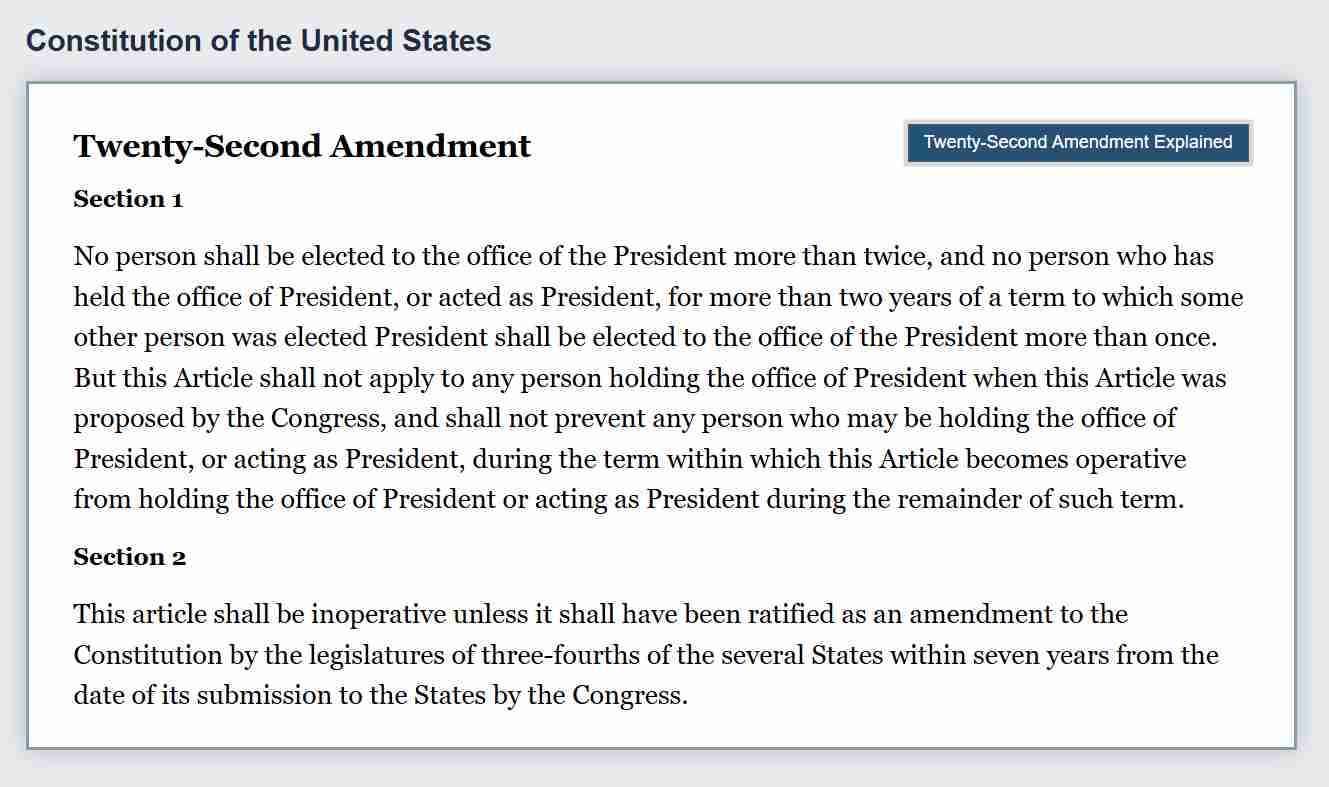
The core of the amendment states: "No person shall be elected to the office of the President more than twice, and no person who has held the office of President, or acted as President, for more than two years of a term to which some other person was elected President shall be elected to the office of the President more than once."
This language creates two distinct rules:
- The Absolute Limit: If you are elected to the presidency, you can only be elected one more time.
- The Succession Rule (The 10-Year Maximum): If a Vice President (or another official in the line of succession) takes over for an elected president and serves more than two years of that remaining term, they can only be elected to the presidency once in their own right. If they serve two years or less of the remaining term, they remain eligible to be elected twice. This creates a theoretical maximum of 10 years in office for a single individual.
Section 2: Ratification Deadline
Section 2 of the amendment established a seven-year window for ratification by the states. This was a standard procedural clause used in several 20th-century amendments to ensure that the constitutional change reflected a contemporary consensus rather than a slow accumulation of support over decades.
Presidential Eligibility and Succession Scenarios
The following table clarifies the eligibility of individuals based on various paths to the Oval Office under the 22nd Amendment.
| Scenario | Service Duration | Eligibility for Future Election | Total Possible Years |
|---|---|---|---|
| Directly Elected President | 4 Years (1st Term) | Eligible for one more election | 8 Years |
| VP Succeeds (Early in Term) | Over 2 Years remaining | Eligible for one more election | >6 to 10 Years |
| VP Succeeds (Late in Term) | 2 Years or less remaining | Eligible for two more elections | Up to 10 Years |
| President Resigns/Dies in 2nd Term | Any duration | Not eligible for further election | N/A |
| Former 2-Term President | 8 Years served | Prohibited from being elected again | 8 Years |
This structure ensures that the "two-term" spirit is maintained while providing flexibility for the vice presidential succession process. It prevents a scenario where a Vice President could serve nearly a full term and then still be elected twice, which would result in nearly 12 years of continuous power.
Criticisms and the "Lame Duck" Effect
Since its ratification, the 22nd Amendment has been the subject of ongoing debate among political scientists and legal scholars. One of the primary criticisms is the creation of the "lame duck" phenomenon. Because a second-term president cannot run for re-election, their political capital often diminishes during their final two years in office. Members of Congress, foreign leaders, and even the president's own cabinet may begin to look toward the next administration, making it more difficult for the sitting president to advance a legislative agenda.
Opponents of the amendment also argue that it is fundamentally undemocratice. They contend that if the majority of the American people wish to keep a successful and capable leader in office, they should have the right to do so. In times of extreme national crisis, critics argue, the 22nd Amendment could force a change in leadership at a moment when continuity is most needed.
Conversely, proponents argue that the amendment is a necessary check on the "imperial presidency." They suggest that the limit forces political parties to cultivate new talent and prevents the development of a personality cult around a single leader. By ensuring a regular turnover of the nation’s highest executive, the amendment encourages ideological renewal and prevents the stagnation that can occur when a single individual holds power for decades.
Legal Limitations and Professional Guidance
While the 22nd Amendment provides a clear framework for presidential term limits, its interaction with other parts of the Constitution—specifically the 12th Amendment—remains a topic of academic discussion. The 12th Amendment states that "no person constitutionally ineligible to the office of President shall be eligible to that of Vice-President of the United States." This has led some to question whether a two-term former president could serve as Vice President.
Disclaimer: This article provides historical and legal analysis for educational purposes. It does not constitute legal advice. Constitutional interpretation can vary based on judicial precedent and legislative action. For specific legal inquiries regarding constitutional law or eligibility, consult a qualified legal professional or official government resources from the Library of Congress.
Practical Implications for Modern U.S. Governance
As of 2026, the 22nd Amendment continues to define the strategic planning of every U.S. presidential administration. The certainty of a departure date influences everything from judicial appointments to long-term treaty negotiations. It creates a predictable cycle of political transition that is rare in many other forms of government.
The amendment also impacts how political parties manage their primary schedules and fundraising. Because a president is "termed out" after eight years, the "open seat" election every eight years (or four, if a president loses re-election) serves as a massive reset button for the national political landscape. This cycle ensures that no single political faction can maintain an unbreakable grip on the executive branch, maintaining the balance of power envisioned by the Founders, even if they did not initially include these specific limits in the original text of 1787.
Can the 22nd Amendment be repealed?
Yes, like any other amendment, it can be repealed through the process outlined in Article V. This would require a two-thirds vote in both the House and Senate, followed by ratification by three-fourths of the state legislatures. Several attempts have been made in Congress to introduce repeal legislation over the decades, but none have gained significant traction.
Does the 22nd Amendment apply to the Vice President?
No, the 22nd Amendment specifically limits the number of times a person can be elected to the office of the President. There is currently no constitutional limit on how many terms a person can serve as Vice President. However, the 12th Amendment’s eligibility requirements create a complex legal debate about whether a two-term president could ever be in the line of succession as VP.
Was Harry Truman the last president who could have served more than two terms?
Yes. Harry Truman was specifically exempted by the amendment’s "grandfather clause" because he was the sitting president when the amendment was proposed. Every president following Truman, starting with Dwight D. Eisenhower, has been strictly bound by the two-term limit.
What happens if a President serves two non-consecutive terms?
The 22nd Amendment applies to the total number of times a person is elected, regardless of whether the terms are consecutive. If a person is elected to the presidency once, loses a re-election bid, and then wins in a later cycle, they have been elected twice and are thereafter ineligible to run for the office again.
Could a former two-term president be appointed to a cabinet position?
Yes. The 22nd Amendment limits election to the presidency. It does not prohibit a former president from serving in other capacities within the government, such as a Cabinet Secretary, a member of Congress, or a Supreme Court Justice (as William Howard Taft did). However, their eligibility to succeed to the presidency through the Presidential Succession Act would be legally contested.
Exploring Constitutional Literacy and Civic Engagement
Understanding the 22nd Amendment is essential for any citizen interested in the mechanics of American democracy. It serves as a reminder that the U.S. government is a system of laws, not of men, and that even the most powerful office in the world is subject to constraints. To further your understanding of executive power and constitutional history, consider reviewing the Constitution Annotated provided by the Congressional Research Service. Engaging with primary sources, such as the Federalist Papers (specifically No. 69 and No. 71), can provide deeper context into the original debates regarding presidential tenure and the balance of power.