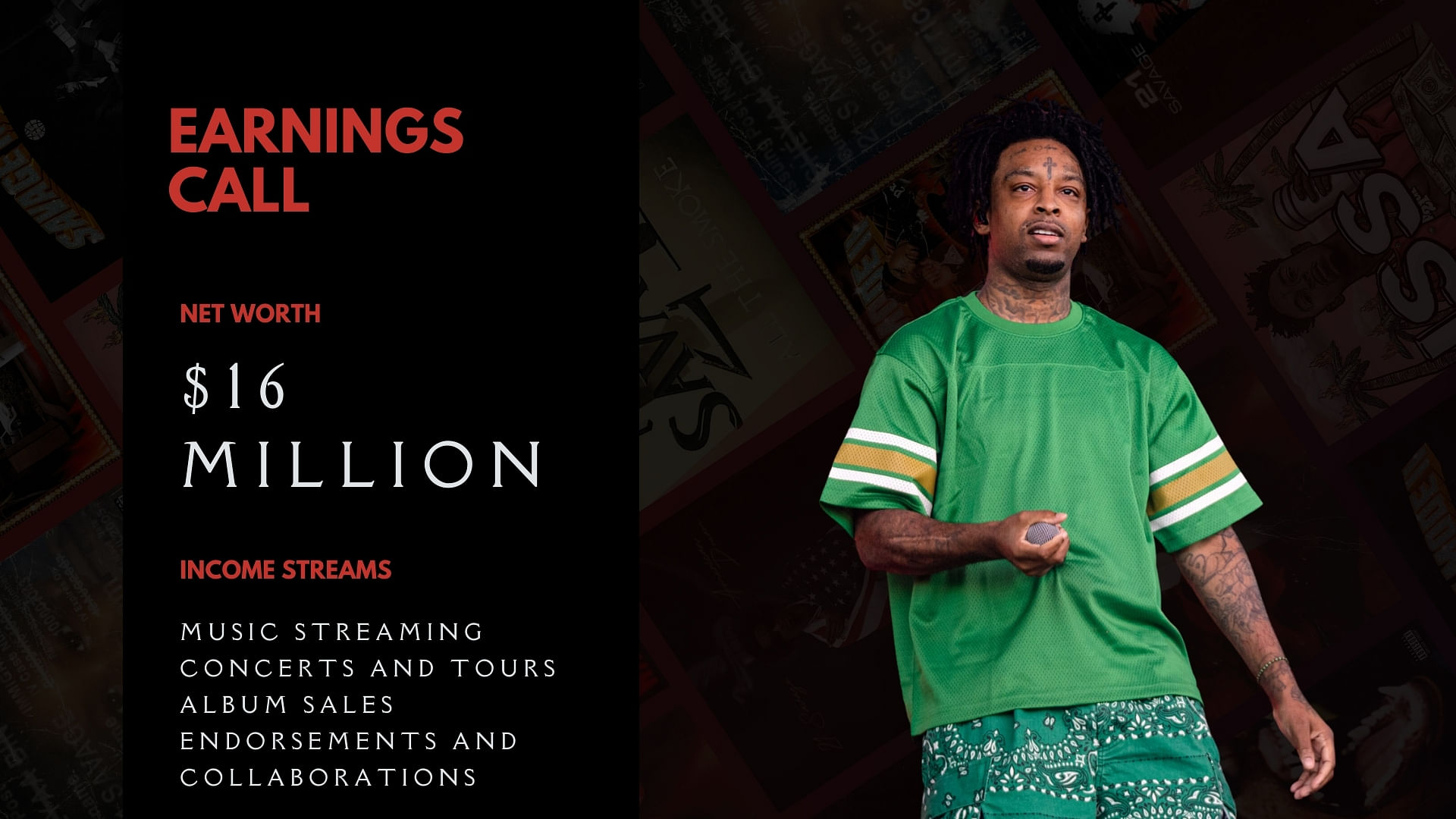
In 2015, 21 Savage’s net worth was estimated to be between $100,000 and $250,000. This modest figure represented his transition from a street-oriented lifestyle in Atlanta to a professional music career. His primary income sources included independent digital sales of his debut mixtapes and localized performance fees from club appearances.
The Financial Landscape of 21 Savage Before the Fame
To understand 21 Savage’s financial standing in 2015, one must look at the immediate context of his entry into the music industry. Born Shéyaa Bin Abraham-Joseph, the artist turned to rap seriously only after a series of life-altering events, including a 2013 shooting that claimed the life of his best friend. By early 2015, he was essentially starting from zero in a professional sense, though he possessed significant "street equity" and a burgeoning reputation in the Atlanta underground.
Unlike many contemporary "industry plants," 21 Savage’s early 2015 finances were characterized by the "independent hustle." He was not yet signed to a major label deal that would provide a massive six-figure advance. Instead, his net worth at the start of that year was largely tied to personal assets and small-scale investments in his own recording sessions. The shift from a "street economy" to a "music economy" is often a slow financial burn, and for 21 Savage, 2015 was the pivotal year where the latter finally began to outweigh the former.
The "breakdown" of his wealth at this time was less about liquid cash in a bank account and more about the valuation of his growing brand. In the music industry, an artist's net worth is often a projection of their future earnings potential based on their current momentum. By mid-2015, that momentum was skyrocketing, even if his actual bank balance hadn't yet caught up to his cultural impact.
Revenue Streams in 2015: Mixtapes and Local Bookings
The primary drivers of 21 Savage’s net worth in 2015 were his first two major projects: The Slaughter Tape and the Free Guwop EP. Released in May and July 2015, respectively, these projects did not have the massive streaming numbers associated with his later work, but they established a dedicated fanbase that could be monetized through other avenues.
Independent Digital Sales and Streaming
In 2015, the streaming revolution was well underway, but for independent rappers, the revenue per stream was—and remains—notoriously low. 21 Savage utilized platforms like SoundCloud and MyMixtapez to build buzz. While these platforms were free for listeners, they acted as a loss leader, driving traffic to paid platforms like iTunes and early iterations of Apple Music and Spotify. His revenue from these sources in 2015 likely totaled in the low five figures, reflecting his status as a rising regional star rather than a national powerhouse.
Performance Fees and the "Club Circuit"
The "real money" for a breakout Atlanta rapper in 2015 came from the club circuit. Atlanta’s nightlife is a multi-million dollar industry where rising rappers are paid to make appearances or perform short sets. At the beginning of 2015, 21 Savage might have been performing for $1,000 to $2,000 per night. By the end of the year, following the success of singles like "Picky," his booking fee likely rose to the $5,000–$10,000 range. When an artist performs several times a week, these fees become the primary engine for net worth growth.
Expenditure and Investment: The Cost of an Independent Launch
Calculating net worth requires subtracting liabilities and expenses from total assets. In 2015, 21 Savage was heavily "re-investing" in his own career. Launching a rap career in a competitive market like Atlanta is not cheap. The costs associated with his 2015 breakout included:
- Studio Time and Production: High-quality engineering and beats from producers like Metro Boomin and Sonny Digital are expensive. Even with "friend prices" or collaborative agreements, the cost of mixing and mastering two full projects is significant.
- Music Videos: Visuals are essential for digital growth. 21 Savage invested in gritty, high-impact music videos that helped define his aesthetic. These independent productions often cost between $2,000 and $7,000 each.
- Marketing and Street Teams: Promoting a mixtape in 2015 required both digital ads and "boots on the ground"—flyers, posters, and radio DJs.
- Security and Logistics: As his profile grew, the necessity for professional security and travel logistics increased, adding a consistent drain on his monthly revenue.
By the end of 2015, while he was generating more revenue than ever before, his net worth remained in the low hundreds of thousands because a vast majority of his earnings were funneled back into the "21 Savage" brand to ensure the 2016 breakthrough would be possible.
Comparing 21 Savage's 2015 Value to Later Career Milestones
Looking back from the vantage point of 2026, the growth of 21 Savage's financial empire is staggering. His 2015 valuation was a "seed stage" investment in himself. The following table illustrates the trajectory of his estimated net worth and key career markers over the years.
| Year | Estimated Net Worth | Primary Status | Key Financial Driver |
|---|---|---|---|
| 2015 | $150,000 | Independent/Regional | Club appearances, The Slaughter Tape |
| 2017 | $4,000,000 | National Star | Issa Album, "Bank Account" royalties |
| 2020 | $12,000,000 | Chart-Topping Mogul | Savage Mode II, Brand deals, Epic Records partnership |
| 2023 | $35,000,000 | Global Icon | "It's All A Blur" Tour with Drake, Catalog valuation |
| 2026 | $65,000,000+ | Industry Titan | Business ventures, streaming longevity, real estate |
The jump from $150,000 in 2015 to over $65 million by 2026 highlights the exponential nature of music industry success when an artist retains ownership of their brand and diversifies their income.
The Role of Social Media and Streaming in His Early Valuation
In 2015, the "valuation" of a rapper was increasingly tied to their social media engagement. 21 Savage was an early master of this. His Instagram presence and the "21" moniker became viral long before "viral" was a standardized metric for record labels. This digital footprint added "intangible asset value" to his net worth.
For instance, an artist with 100,000 dedicated followers on Instagram in 2015 was worth more to a record label than an artist with a hit song but no social following. 21 Savage’s ability to cultivate a specific, menacing, and authentic image gave him leverage. This leverage meant that when he eventually moved toward major label deals or larger distribution partnerships, he was doing so from a position of power, which significantly protected his long-term net worth.
SoundCloud, in particular, acted as a decentralized A&R tool. The "plays" on his 2015 tracks served as proof of concept. While these plays didn't put millions of dollars in his pocket immediately, they were the "proof of funds" that allowed him to command higher booking fees and better contract terms heading into 2016.
How 2015 Laid the Foundation for Future Wealth
The most important takeaway from 21 Savage’s 2015 net worth breakdown is that it wasn't about the money he had, but the foundation he built. By the end of 2015, he had accomplished three critical financial goals:
- Establishment of Intellectual Property: He owned the master recordings for his 2015 mixtapes (initially), which would later become valuable catalog assets.
- Proof of Marketability: He proved he could draw a crowd in the nation's most important hip-hop hub (Atlanta), making him a low-risk investment for partners.
- Strategic Partnerships: He solidified his relationship with Metro Boomin. In the music business, a partnership with a hit-making producer is a financial asset in itself, as it guarantees a certain quality of product that can be sold to the masses.
Without the disciplined reinvestment of his 2015 earnings back into his craft, the multi-million dollar "Bank Account" era would likely never have happened. He avoided the common pitfall of spending early "club money" on depreciating assets like jewelry and cars, choosing instead to fund the next stage of his career.
Key Factors Impacting His 2015 Valuation
- Independence: Not being signed to a major label meant he kept a higher percentage of a smaller "pie."
- Geographic Advantage: Being in Atlanta reduced his networking costs and placed him at the center of the rap economy.
- Authenticity: His "street" background provided a marketing angle that required $0 in traditional advertising spend to gain traction.
What to Learn from 21 Savage's Financial Origins
For those studying the business of music, 21 Savage's 2015 serves as a masterclass in "bootstrapping." His net worth was a reflection of raw labor and localized market penetration. He moved from a position of financial instability to a six-figure valuation in under 12 months by identifying a niche and consistently producing content (two projects in one year).
FAQ
What was 21 Savage's first big hit that increased his net worth?
While "Picky" and "Red Opps" were massive in the underground and on Vine/Instagram in late 2015, it was the 2016 release of "X" (featuring Future) from the Savage Mode EP that truly transformed his net worth from six figures to millions.
Did 21 Savage have any major brand deals in 2015?
No. In 2015, 21 Savage was considered too "raw" for mainstream corporate endorsements. His income was almost entirely "endemic" to the music industry—meaning it came from fans and club owners rather than corporate sponsors like Nike or Adidas, which came later in his career.
Who produced most of 21 Savage's music in 2015?
His early 2015 sound was heavily influenced by producers like Sonny Digital, Metro Boomin, and Zaytoven. These collaborations were essential for his financial growth, as their established names helped "validate" his music to listeners and DJs.
How much did 21 Savage charge for a feature in 2015?
In 2015, a 21 Savage feature could reportedly be secured for as little as $1,000 to $3,000, depending on the relationship. Today, his feature price is estimated to be in the six-figure range, showcasing the massive appreciation of his "brand equity" over the decade.
Was 21 Savage signed to a label in 2015?
He was operating under his own "Slaughter Gang" imprint. While he had distribution and management help, he had not yet entered the major label partnership with Epic Records that would later define his high-net-worth years.
Track Your Professional Growth
If you are an aspiring artist or entrepreneur, analyzing the 2015 "pivot point" of a mogul like 21 Savage provides a blueprint for growth. Focus on building a "minimum viable product" (the mixtapes), establishing a local stronghold (the Atlanta clubs), and reinvesting every dollar of profit back into production quality and visuals. Net worth is a lagging indicator of hard work; the work 21 Savage did in 2015 created the wealth he enjoys in 2026.