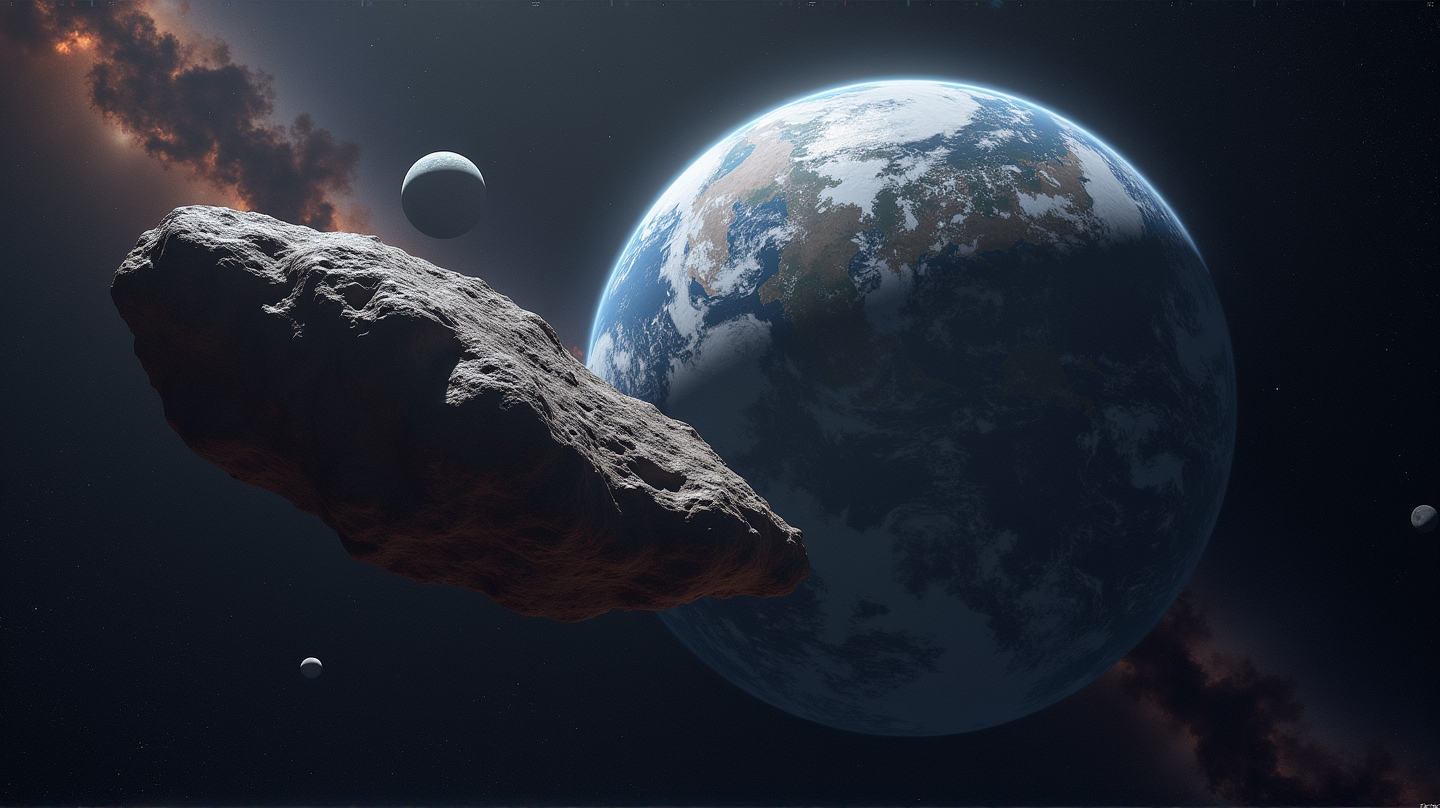
As of 2026, the 2036 encounter with asteroid 99942 Apophis is no longer considered a threat to Earth. While initial calculations in 2004 suggested a high impact probability, advanced radar observations in 2021 officially ruled out any collision risk for at least the next 100 years, including the highly anticipated 2036 flyby.
The History and Discovery of 99942 Apophis
The story of the "2036 asteroid the ultimate cosmic close encounter" began on June 19, 2004, when astronomers Roy Tucker, David Tholen, and Fabrizio Bernardi at the Kitt Peak National Observatory discovered a Near-Earth Object (NEO) that would soon send shockwaves through the scientific community. Named after the Egyptian god of chaos and darkness, 99942 Apophis quickly became the focus of intense scrutiny.
Initial orbital tracking suggested a terrifying possibility: a 2.7% chance that the asteroid would strike Earth during its first major encounter on April 13, 2029. This was an unprecedented level of risk, leading to the asteroid being ranked at a Level 4 on the Torino Scale, the highest rating any object has ever received in the history of planetary defense. While the 2029 impact was eventually ruled out through further observation, a new concern emerged—the "gravitational keyhole."
Scientists realized that if Apophis passed through a specific, narrow region of space during its 2029 flyby, Earth’s gravity would alter its orbit just enough to guarantee an impact seven years later, on April 13, 2036. This scenario solidified the asteroid’s reputation as a potential civilization-altering threat and sparked decades of global monitoring.
Understanding the Science of the Gravitational Keyhole
The primary reason the 2036 encounter remained a point of anxiety for over a decade was the concept of the gravitational keyhole. To understand why the 2036 asteroid was once considered the ultimate cosmic close encounter, one must understand the delicate celestial mechanics involved in orbital resonance.
A gravitational keyhole is a precise region in space where a planet's gravity can "nudge" a passing asteroid's orbit into a new trajectory that leads to a future collision. For Apophis, the keyhole for a 2036 impact was only about 600 to 800 meters wide. Given that the asteroid itself is roughly 340 to 370 meters in diameter, the margin for error was incredibly slim.
If Apophis had passed through that tiny window in 2029, the Earth's massive gravitational pull would have shortened its orbital period. This synchronization would have ensured that both the Earth and the asteroid arrived at the exact same point in space in 2036. Because our ability to measure an asteroid's position is subject to slight uncertainties—such as the Yarkovsky effect, where uneven heating from the sun causes a tiny but constant thrust—scientists could not immediately rule out the keyhole passage until more precise data was collected.
The 2021 Radar Breakthrough: Clearing the 2036 Threat
For years, the 2036 impact remained a statistical possibility, albeit a dwindling one. However, the definitive "all-clear" came in March 2021. During a distant flyby of Apophis, astronomers utilized the 70-meter (230-foot) radio antenna at the Deep Space Network’s Goldstone Observatory in California and the Green Bank Telescope in West Virginia to perform high-precision radar imaging.
The results were transformative. The radar data refined the knowledge of Apophis’s orbit with such extreme precision that the uncertainty of its future position was reduced from hundreds of kilometers to just a few kilometers.
- Risk Assessment: The 2021 observations officially removed Apophis from the Sentry Impact Risk Table maintained by NASA’s Center for Near-Earth Object Studies (CNEOS).
- Orbital Stability: The data confirmed that Apophis will safely pass Earth in 2029 and will not enter any gravitational keyholes that would lead to an impact in 2036 or even 2068, which was another year of minor concern.
- Scientific Consensus: Today, in 2026, the scientific community is certain that 99942 Apophis poses no danger for at least the next century.
Physical Characteristics of 99942 Apophis
Apophis is a significant object, which is why the prospect of an encounter was taken so seriously. It belongs to the "S-type" (stony) class of asteroids, primarily composed of silicate materials and nickel-iron.
| Feature | Specification | Impact Comparison |
|---|---|---|
| Diameter | ~340–370 meters (approx. 1,100 feet) | Larger than the Eiffel Tower |
| Mass | ~61 million metric tons | Roughly 1,000 times the mass of the Titanic |
| Velocity at Impact | ~12.6 km/s | Standard for Near-Earth Objects |
| Potential Energy | ~1,200 Megatons of TNT | 80,000 times the energy of the Hiroshima bomb |
| Composition | Silicate, Nickel, and Iron | Similar to ordinary chondrite meteorites |
If an object of this size were to strike Earth, it would not be a "planet-killer" like the asteroid that ended the Cretaceous period (which was roughly 10 kilometers wide). However, it would cause catastrophic regional destruction. An impact would likely create a crater 5 kilometers wide and generate blast waves capable of flattening forests and cities over thousands of square miles. If it hit the ocean, it could trigger devastating tsunamis across entire coastlines.
The 2029 Flyby: A Prelude to 2036
While the 2036 encounter is now known to be safe, it is preceded by the 2029 flyby, which remains one of the most significant astronomical events in recorded history. On April 13, 2029, Apophis will pass within 32,000 kilometers (20,000 miles) of Earth’s surface.
To put that distance in perspective:
- It is closer than the geostationary satellites that provide our weather and communication services.
- It will be visible to the naked eye for approximately 2 billion people across Europe, Africa, and parts of Asia.
- It will appear as a moving point of light, roughly as bright as the stars in the Little Dipper.
This 2029 event is a "once-per-millennium" opportunity for science. The proximity is so great that Earth's tidal forces are expected to physically alter the asteroid. Astronomers anticipate "asteroid quakes" on its surface, which could shift boulders or expose subsurface material. This event serves as the ultimate laboratory for planetary defense, allowing us to observe how a large celestial body reacts to a close planetary encounter.
Current Missions and Planetary Defense Strategy
As we stand in 2026, NASA and other space agencies are not merely watching from afar; they are actively engaging with Apophis. The most notable mission is OSIRIS-APEX (Origins, Spectral Interpretation, Resource Identification, Security-Apophis Explorer).
Originally known as OSIRIS-REx, the spacecraft successfully delivered samples from asteroid Bennu to Earth in 2023. Immediately following that success, NASA redirected the craft on a new mission to rendezvous with Apophis. OSIRIS-APEX is currently cruising toward its target and is scheduled to enter orbit around Apophis shortly after the asteroid’s 2029 flyby.
The mission goals for OSIRIS-APEX include:
- Mapping the asteroid's surface in unprecedented detail.
- Measuring the physical changes caused by Earth's gravity during the 2029 pass.
- Using its thrusters to "kick up" dust and small rocks to analyze the composition of the asteroid’s subsurface.
This data is vital for future planetary defense. If we ever discover an asteroid that is on a collision course with Earth, understanding the structural integrity and composition of objects like Apophis will help us determine whether to use a "kinetic impactor" (like the DART mission) or a "gravity tractor" to nudge it off course.
Common Misconceptions About the 2036 Encounter
Despite the scientific clarity provided by 2021 observations, several myths persist regarding the "2036 asteroid the ultimate cosmic close encounter."
- "The government is hiding the truth": Scientific data from the Goldstone and Green Bank observations are public and have been peer-reviewed by international teams. Near-Earth object tracking is a global effort involving the European Space Agency (ESA), as well as amateur astronomers worldwide.
- "The 2029 pass will definitely knock it into us in 2036": As discussed, the 2021 radar data confirmed that Apophis will miss the gravitational keyhole entirely. The 2036 pass will occur at a much greater distance—several million miles away—compared to the 2029 "close shave."
- "We have no way to stop it": Even if the 2036 risk were real, the success of the DART (Double Asteroid Redirection Test) mission in 2022 proved that humanity has the technology to change an asteroid's orbit.
FAQ: Frequently Asked Questions about 99942 Apophis
Will the asteroid hit Earth in 2036?
No, 99942 Apophis will not hit Earth in 2036. Based on the most recent radar measurements and orbital modeling, the asteroid is confirmed to pass at a safe distance. NASA has officially removed it from the list of potential hazards for the next century.
Can I see the 2036 asteroid with the naked eye?
The 2036 pass will not be visible to the naked eye because it will be much further away than the 2029 pass. However, during the April 13, 2029, encounter, the asteroid will be visible to the naked eye as a bright, star-like object moving across the sky for observers in the Eastern Hemisphere.
What is a "gravitational keyhole"?
A gravitational keyhole is a tiny region in space near a planet. If an asteroid passes through this exact spot, the planet's gravity will warp its orbit in a very specific way, causing the asteroid to return and collide with the planet on a subsequent orbit. Apophis was cleared of this risk in 2021.
How big is the 2036 asteroid?
99942 Apophis is approximately 340 to 370 meters (about 1,100 to 1,210 feet) across. To visualize its size, it is roughly as tall as the Empire State Building or the Eiffel Tower. While not large enough to cause a global extinction, it is large enough to cause significant regional destruction if it were to impact.
What would happen if Apophis hit the ocean?
If an asteroid the size of Apophis hit the ocean, it would create a massive crater in the seafloor and displace an enormous volume of water. This would result in "mega-tsunamis" that could devastate coastal regions thousands of miles away from the impact site. However, there is zero risk of this occurring in 2036.
Tracking the Future of Planetary Defense
While 99942 Apophis no longer poses a threat, it serves as a crucial reminder of the importance of planetary defense. The 2036 asteroid the ultimate cosmic close encounter transition from a "threat" to a "scientific opportunity" demonstrates the power of modern astronomy and international cooperation.
To stay informed about Apophis and other Near-Earth Objects, you should follow updates from the NASA Planetary Defense Coordination Office (PDCO). They provide real-time data on asteroid flybys and the progress of missions like OSIRIS-APEX. As we move closer to the 2029 and 2036 encounters, expect a wealth of new imagery and data that will deepen our understanding of these ancient remnants of our solar system. Supporting continued investment in early-warning telescopes, such as the Near-Earth Object Surveyor (NEO Surveyor) space telescope, is the best way to ensure that humanity remains safe from future cosmic threats.